
I have written a lot about agentics.
Quite a lot, actually.
It is the work I am doing every day: building agents, testing harnesses, thinking about governance, learning how digital teams might work, and trying to understand what happens when software stops waiting for us to click every button.
But I do not want to become somebody who only uses AI to write about AI.
That would be a rather impressive echo chamber.
Agentics is part of how I work. It should help me understand more of the world, not become the only part of the world I am allowed to examine.
The tool should not become the subject
When the web arrived, we did not spend the next thirty years writing only about browsers.
We used the web to understand businesses, people, medicine, engineering, law, energy, communities, politics, music, sport, and practically everything else.
I think the same should be true of agentic systems.
Yes, I want to write about how the tools work. I want to understand the models, the harnesses, the permissions, the memory, the cost, the security, and the operational resilience.
But at some point the technology has to leave the laboratory and help us think about something that is not itself.
Otherwise we are just building increasingly sophisticated ways to discuss the fact that we have built increasingly sophisticated ways to discuss things.
COVID was a good test of the method
My recent article, COVID: What Actually Held Up?, is an example of what I mean.
I did not write it because I suddenly fancied becoming an epidemiologist.
I wrote it because I wanted to ask a fairly ordinary question: of the important things we were told during COVID, what did later evidence support, what turned out to be false or materially overstated, and what remains mixed or unresolved?
That sounds simple. It was not.
Public statements had been compressed into slogans. Different statistics measured different things. A claim that was reasonable in one period could become wrong in another. A platform removing a claim did not prove it was false, and allowing it later did not prove it was true.
So the work became an audit of 26 exact propositions. Each one needed wording, dates, populations, outcomes, denominators, sources, boundaries, and a route for challenge.
That is not really a story about COVID.
It is a story about how we should use these new tools when the subject is consequential and the answer is not tidy.
I am not trying to win an old argument
The easiest way to write about a subject like COVID is to begin with a tribe and collect evidence for it.
I did not want to do that.
I am not interested in producing a scorecard that says one side was clever and the other side was stupid. My view is that many people were making decisions with incomplete information, under pressure, while the evidence and the virus were changing.
Nor am I offering medical advice. I am a curious citizen using public evidence to understand what held up and how the information was communicated.
The useful question is not: who can I embarrass with hindsight?
It is: what would help us communicate evidence more honestly next time?
The method matters more than the topic
The process I want to use is quite simple to describe, even when it is difficult to do:
- Start with a real question. Not the answer I want the research to produce.
- Recover the exact claim. What was said, when, about whom, and about which outcome?
- Open the evidence. A headline, abstract, search result, or confident AI summary is not enough.
- Name the boundary. Date, geography, population, denominator, uncertainty, and what the source does not establish.
- Invite challenge. Ask a fresh reviewer to find overstatement, missing evidence, or a conclusion that travels too far.
- Correct the whole pack. The article, image, social copy, metadata, and narration should all tell the same corrected story.
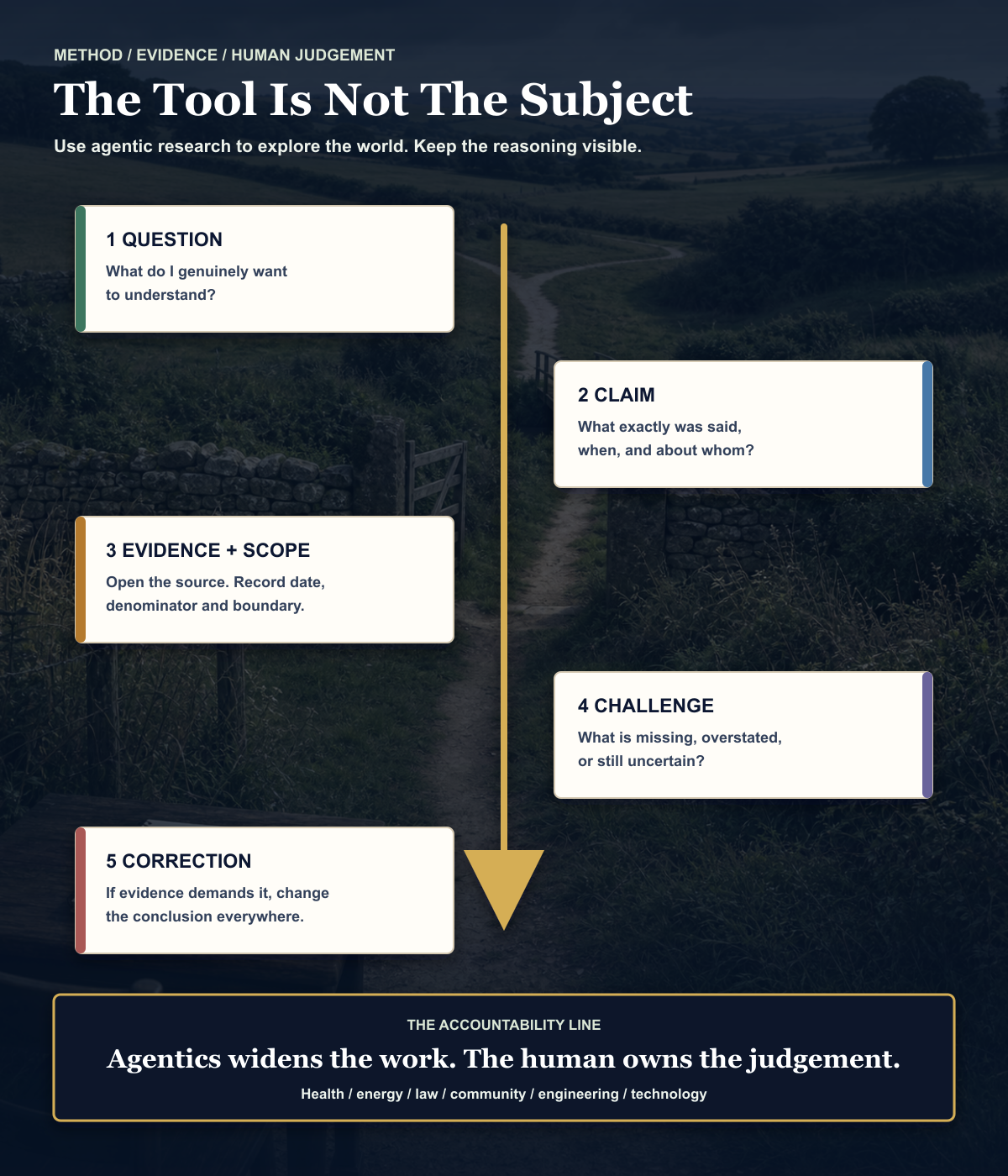
This is the same discipline whether I am looking at health evidence, the NHS, renewable energy, data-centre infrastructure, legal access, engineering, or the design of an agentic company.
The subject changes.
The obligation to show the work does not.
The research becomes working evidence
The point is not to create a pile of persuasive articles. It is to build a traceable body of public evidence: claims, sources, calculations, assumptions, limits, corrections and links between them.
That gives my agentic work something better to work with than a confident prompt or a passing headline. Agents can help retrieve, compare, challenge and update the material. They should not quietly turn an uncertain conclusion into a fact, or a fact into a decision without the source trail still visible.
The newer energy articles are part of that practice: What Does Electricity Really Cost In The UK? separates plant, system and support costs, while Why UK Energy Bills Are Still Higher Than Before The Crisis follows the household bill.
I am trying to get as close to the available evidence as I can, then make the distance still remaining visible. That is useful for a reader. It is also the only sensible foundation for agents that may help me reason across these subjects later.
Why this belongs on the same website
Tonywood.org began with a strong focus on agentics because that is where much of my work and curiosity sits.
But the deeper thread is not a particular technology.
It is how we make better decisions when systems are complicated, information is incomplete, incentives are messy, and confident answers arrive faster than judgement.
That thread runs through how the NHS learns from incidents. It runs through the materials behind renewable energy. It runs through water and power use in UK data centres.
These are not random departures from the theme.
They are the theme being tested against the real world.
The human is still accountable
Agentic tools can search more widely, organise sources, compare claims, generate charts, read drafts aloud, and help a reviewer look for contradictions.
That is extraordinary.
But the tools do not relieve me of responsibility for what appears under my name.
I still have to decide whether the question is fair. I have to decide which source is strong enough. I have to notice when a statistic has lost its denominator. I have to preserve uncertainty when a neat conclusion would be more satisfying. And I have to correct the work when somebody shows me that it is wrong.
The more capable the tools become, the more important that accountability becomes.
So yes, more subjects are coming
I will keep writing about agentics. There is far too much happening for me to stop now.
But I will also write about subjects that interest me, worry me, surprise me, or simply make me ask: is that actually true?
Some will be personal. Some will be practical. Some will be evidence audits. Some will probably begin as a small irritation and turn into several days of research. That appears to be how this works.
The common thread will be curiosity, visible evidence, explicit boundaries, and the willingness to change the conclusion.
Agentics is not the only subject.
It is one of the ways I can now explore many more of them.
Related reading
- COVID: What Actually Held Up?
- What Has The NHS Ever Done For Us?
- Renewable Energy Is Not Material-Free
- UK Data Centre Water And Power: The Facts
- What Does Electricity Really Cost In The UK?
- Why UK Energy Bills Are Still Higher Than Before The Crisis
Sources and notes
This is a personal explanation of the direction of my writing. The linked articles contain their own public sources and review notes; some also have private working claim ledgers. Nothing in this article is medical advice.