
I have been thinking about doing something that sounds straightforward but is not.
Take the things we were told during COVID and sort them into three piles:
- things that later evidence supported;
- things that later evidence disproved or showed were materially overstated; and
- things that remain unresolved, depend on context, or require a policy judgement.
I wanted the facts rather than the marketing. I also wanted to look at claims people were discouraged or prevented from making, because a platform removing a claim did not make it scientifically false.
The difficulty is that many public statements were compressed into slogans. "Masks work." "Vaccines stop transmission." "Stay two metres apart." "Natural immunity does not count." "It was just flu." Each sentence hides an outcome, a population, a date, a variant, a setting and a level of uncertainty.
This is not an audit of every sentence uttered during the pandemic. It is a UK-centred audit of 28 representative, consequential propositions, checked against primary evidence and major systematic reviews available by August 2026.
It is public information and commentary, not medical advice.
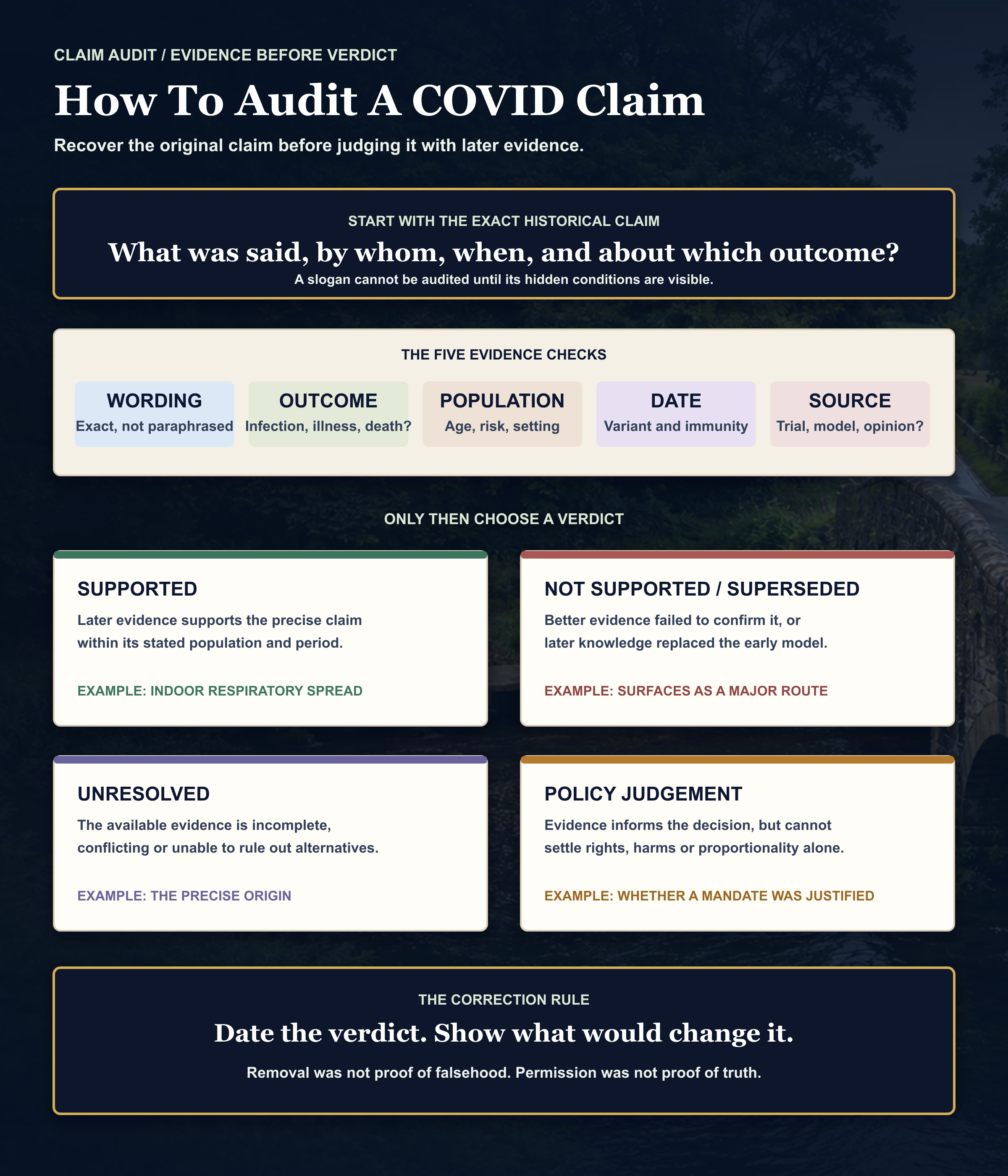
Scope and standard of proof
I have treated a proposition as supported or well established when good later evidence supports the claim within a clearly stated scope.
I have treated it as false, disproven or materially overstated when its ordinary public meaning is contradicted by better evidence, or when an important qualification changes the substance of the claim.
I have used mixed, unresolved or dependent on context when the evidence cannot sustain a single universal answer. Lockdown proportionality and school closure are explicitly labelled policy judgements because effectiveness is only one part of deciding whether a policy was justified.
The classifications are mine, not labels assigned by the sources. A reader may reasonably place a boundary differently. That is why the wording of each proposition matters more than the colour of its box.
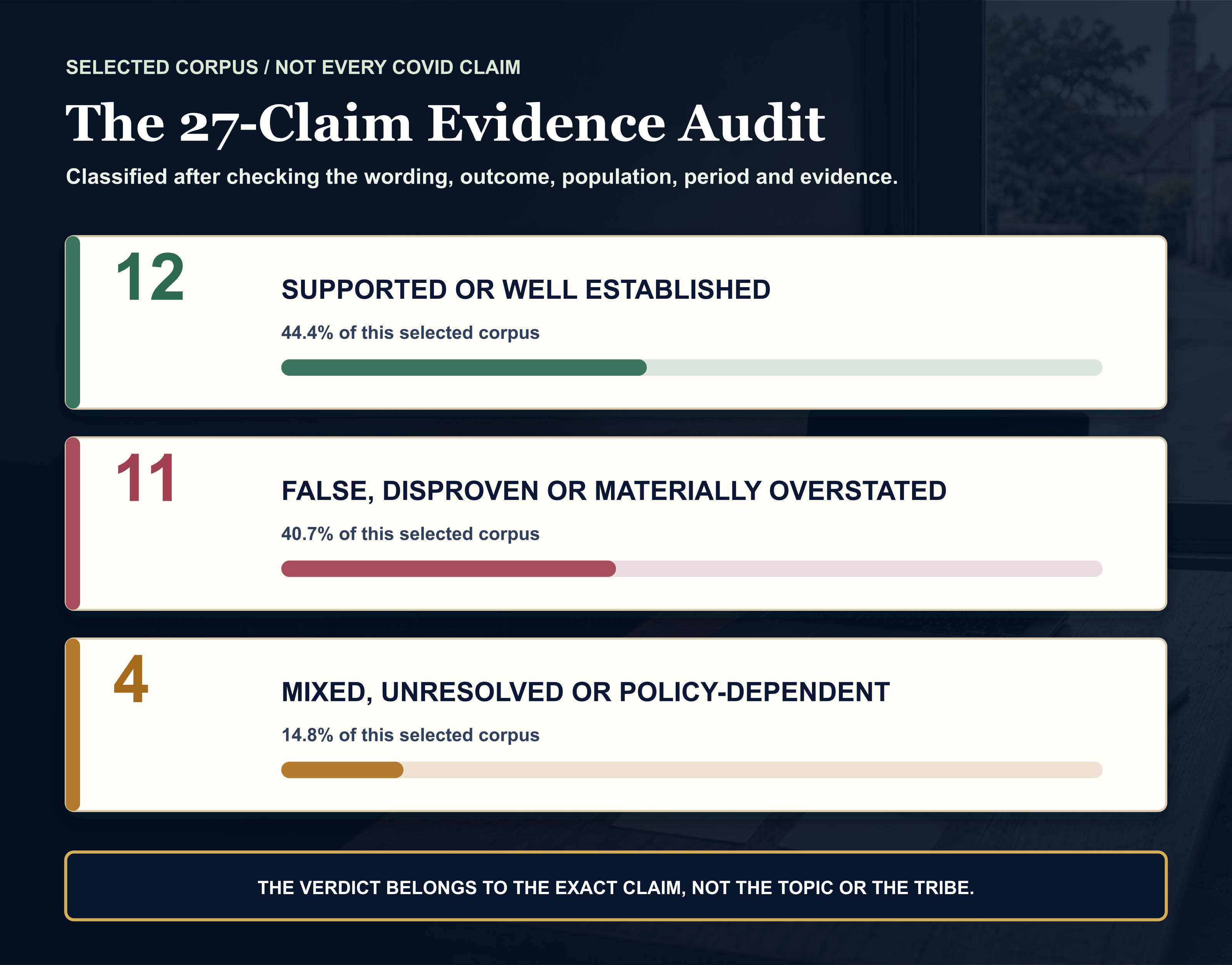
The 28-claim scorecard
Every row links directly to the evidence used for its verdict. Where the literature disagreed, I have included both the studies that supported the claim and the larger or more rigorous evidence that changed the weight of the conclusion.
| # | Proposition audited | Verdict | What the evidence supports | Boundary |
|---|---|---|---|---|
| 1 | SARS-CoV-2 was substantially transmitted through respiratory particles in the air. | Supported | Inhalation was central, especially indoors, during prolonged contact and with poor ventilation. Source: CDC scientific brief | This does not mean every transmission event was airborne or that close-range exposure did not matter. |
| 2 | People could transmit the virus before symptoms or without developing symptoms. | Supported | Presymptomatic and persistently asymptomatic transmission occurred. Source: living systematic review | Persistently asymptomatic people were generally less infectious than symptomatic people, and estimates varied. |
| 3 | Physical distance reduced transmission risk. | Supported | Risk generally fell as distance increased. Sources: Lancet systematic review; SAGE minutes | Time, ventilation, activity, orientation and other controls also mattered. |
| 4 | Surface transmission was possible but uncommon in ordinary settings. | Supported | Later reviews judged contaminated surfaces a possible route but not a substantial contributor in most situations. Source: CDC scientific brief | Low contribution is not impossible; ordinary hand hygiene remained useful. |
| 5 | COVID caused a large, genuine mortality burden. | Supported | ONS recorded 167,356 excess registered deaths in England and Wales from March 2020 to December 2022; removing deaths with COVID as the underlying cause reduced the excess to 17,288. Source: ONS excess-death analysis | The figures include non-residents, 2022 data were provisional, and ONS used year-specific five-year comparison baselines. |
| 6 | Risk was highly unequal by age and vulnerability. | Supported | OpenSAFELY found strong gradients by age, sex, deprivation and clinical condition; the adjusted hazard for people aged 80 or over was 20.60 times that for people aged 50 to 59. Source: OpenSAFELY study | This early-period estimate covered adults registered with English general practices and had a 95% confidence interval of 18.70 to 22.68. |
| 7 | The original Pfizer vaccine strongly reduced symptomatic ancestral COVID during the trial period. | Supported | The trial recorded 8 symptomatic cases after dose two in the vaccine group and 162 in placebo, giving 95% relative efficacy. Source: Pfizer-BioNTech randomised trial | Short blinded follow-up, original circulating variants and a symptomatic endpoint. |
| 8 | COVID vaccines reduced severe disease, hospitalisation and death. | Supported | Trials and later real-world studies found strong protection against severe outcomes, which generally persisted better than protection against infection. Sources: UKHSA systematic review; Israeli national study | Effectiveness varied by product, dose, age, variant, outcome and time since vaccination. |
| 9 | Previous infection produced meaningful immunity. | Supported | Regularly tested UK healthcare-worker data and later reviews found substantial protection after infection. Source: UK SIREN study | Protection was not uniform and waned; infection itself carried risk. |
| 10 | Hybrid immunity generally produced stronger protection than infection or vaccination alone. | Supported | A systematic review found hybrid immunity gave the highest magnitude and durability of protection against severe Omicron outcomes. Source: Lancet Infectious Diseases systematic review | The result is population-, variant-, dose- and time-specific, not a guarantee for every individual. |
| 11 | Rare serious vaccine adverse events occurred. | Supported | Signals included myocarditis after mRNA vaccination and thrombosis with thrombocytopenia after AstraZeneca. Sources: nationwide safety study; MHRA safety notice | Risk was strongly product-, age-, sex- and period-specific; infection also carried serious risks. |
| 12 | Dexamethasone saved lives in selected hospital patients with severe COVID. | Supported | RECOVERY found lower all-cause 28-day mortality among hospital patients receiving oxygen or invasive ventilation. Sources: RECOVERY trial; WHO guidance | Every death within 28 days counted in the trial endpoint, whatever its immediate cause. The randomised comparison used all-cause mortality rates, not raw death totals. No benefit was shown among patients receiving no respiratory support. |
| 13 | Two metres was a hard safety boundary. | False or overstated | Distance reduced risk, but UK SAGE described a continuous relationship and said two metres was not an absolute rule. Source: SAGE minutes, items 32-36 | It was a practical public rule, not a force field. |
| 14 | Vaccination completely or permanently prevented infection and transmission. | False or overstated | Protection against infection was initially meaningful but waned, and Omicron materially changed performance. Sources: duration review; UKHSA Omicron/Delta study | Failure to provide permanent sterilising immunity does not mean the vaccines did nothing. |
| 15 | "95% effective" meant that 95 out of every 100 vaccinated people would otherwise have caught COVID. | False interpretation | The 95% figure was a relative reduction in symptomatic cases between trial groups during the measured window. Source: Pfizer-BioNTech trial, Table 2 | The crude absolute difference in that population over that follow-up was about 0.88 percentage points. |
| 16 | Previous infection was biologically irrelevant. | False or overstated | Infection-acquired protection was measurable and substantial. Sources: UK SIREN; immunity systematic review | A biological fact does not by itself resolve vaccination policy, documentation, ethics or individual clinical advice. |
| 17 | Most deaths registered in England and Wales in 2021 whose certificates mentioned COVID did not record COVID as the underlying cause. | False | In 2021, 67,350 of 77,727 registered deaths involving COVID listed COVID as the underlying cause: 86.6%. Sources: ONS 2021 registrations; ONS methodology; UKHSA reporting review | This is a death-certificate comparison. The rapid 28-day dashboard could include a death from an unrelated accident or illness after a positive test, and could miss a COVID death after day 28. |
| 18 | Ivermectin was an established effective routine COVID treatment. | Not supported | Several early meta-analyses reported apparent mortality benefit, but described important uncertainty or relied heavily on small, high-risk studies. Later large randomised trials and the trustworthiness-screened Cochrane update did not find meaningful clinical benefit for the outpatient regimens studied. Sources reviewed: Evidence reporting benefit: Bryant et al.; Zein et al. Higher-quality later evidence: Cochrane update; TOGETHER; ACTIV-6 | This means an effective routine treatment was not established. It does not mean no positive study existed, and it remains limited to the regimens, outcomes and populations studied. |
| 19 | Hydroxychloroquine improved outcomes in hospitalised COVID patients. | Not supported | The UK RECOVERY randomised trial found no mortality or recovery benefit in hospitalised patients. Source: RECOVERY hydroxychloroquine trial | A laboratory effect or uncontrolled early study is not proof of clinical benefit. |
| 20 | Steroids should be given early to everyone with COVID. | False and potentially harmful | WHO recommended systemic corticosteroids for severe or critical COVID, not non-severe disease. Sources: RECOVERY trial; WHO guidance | Timing and disease severity matter; this is not individual prescribing advice. |
| 21 | Any cloth face covering was equivalent to a surgical mask or respirator. | Materially overstated | Filtration, fit and leakage differed substantially; well-fitting respirators provided the highest protection. Source: CDC/NIOSH mask hierarchy | A poorer mask may still filter some particles. "Not equivalent" does not mean "always useless". |
| 22 | Community mask mandates produced a large, predictable reduction everywhere. | Mixed and context-dependent | Masking can reduce risk, but policy effects depended on mask quality, adherence, setting and the wider intervention package. Sources: Bangladesh cluster RCT; Cochrane review; Royal Society review | Randomised policy evidence was limited and heterogeneous; the Bangladesh trial tested a complete promotion package. |
| 23 | Lockdown packages had an unambiguously favourable net effect. | Mixed: policy judgement | Reviews found that packages of non-pharmaceutical interventions reduced transmission. Sources: Royal Society NPI review; UK modelling report | Necessity and proportionality also require health, economic, social, civil-liberty and distributional harms to be counted. |
| 24 | School closures produced more benefit than harm. | Mixed: policy judgement | Attendance restrictions could reduce transmission as part of a wider package. Sources: UK education NPI report; Ofqual review; SPI-B/DfE evidence | English evidence also found learning loss, mental-health harm, lost services and greater effects on disadvantaged and vulnerable children. |
| 25 | Every previously infected person received the same meaningful benefit from vaccination or repeated boosting. | False or overstated | Vaccination after infection generally strengthened protection, especially against severe outcomes, but the incremental benefit was not uniform. Sources: UK SIREN; hybrid-immunity review; JCVI advice | Benefit varied with age, vulnerability, product, variant, time, prior doses and previous infection; policy changed as those conditions changed. |
| 26 | The origin of SARS-CoV-2 has been conclusively established. | Unresolved | WHO's 2025 SAGO assessment said the weight of available evidence favoured zoonotic spillover. Source: WHO SAGO assessment | Essential evidence remained unavailable, so all hypotheses, including a laboratory incident, remained on the table. |
| 27 | Early invasive ventilation was established as the generally superior first escalation for worsening COVID hypoxaemia. | False or materially overstated | March 2020 guidance suggested high-flow nasal oxygen after conventional oxygen failed, with close monitoring and intubation if the patient worsened. Later UK trial evidence found that an initial CPAP strategy reduced the combined outcome of intubation or death for selected hospital patients. Sources: March 2020 critical-care guidance; RECOVERY-RS trial; intubation-timing meta-analysis; WHO respiratory-support guidance | This does not mean ventilators caused the deaths of the sickest patients. Invasive ventilation remained necessary when urgent indications existed and should not be delayed. |
| 28 | Between 86% and 90% of Germany's individual positive COVID PCR results were false laboratory positives. | Not established; materially overstated | A 2025 paper fitted weekly aggregated PCR positivity to aggregated IgG positivity and reported a scaling factor of 0.14, with a 95% confidence interval from 0.135 to 0.146. The authors interpreted this as roughly 14% of PCR-positive people having been infected. The study did not link each person's PCR result to a later antibody result or independently determine whether each positive was correct. Source discussed: video commentary Underlying study: Günther, Rockenfeller and Walach Interpretive checks: large PCR-confirmed cohort; German CoNAN study; WHO PCR notice | The paper raises a legitimate question about using raw PCR-positive counts as a proxy for active infection. It does not measure a conventional individual false-positive rate. Weak or high-cycle results, prevalence, symptoms, timing and assay details still required contextual interpretation. |
Prevention and transmission
The clearest later evidence is that SARS-CoV-2 was substantially transmitted through shared air. In May 2021, the CDC's scientific brief described inhalation of infectious respiratory particles, including transmission beyond six feet in enclosed, poorly ventilated spaces. It judged contaminated surfaces a possible route, but not a substantial contributor in most situations.
That does not make early handwashing foolish. It changes the hierarchy. Fresh air, ventilation, filtration, time, crowding and effective respiratory protection deserved more attention than repeatedly disinfecting low-risk surfaces.
People could also transmit before symptoms, or without ever developing recognised symptoms. A living systematic review found both presymptomatic and asymptomatic transmission, while generally finding lower secondary-attack estimates from persistently asymptomatic cases than from symptomatic ones.
Distance mattered, but there was no invisible wall at two metres. In June 2020, SAGE said the relationship was continuous and non-linear. It advised two metres where possible, while warning that two metres should not be treated as an absolute rule.
The public rule was simple. The underlying evidence was conditional.
Masks were not one thing
A loose cloth covering, a surgical mask and a well-fitting respirator are not interchangeable. Later CDC and NIOSH guidance placed loosely woven cloth at the lower end of protection and approved, tight-fitting respirators at the higher end. Fit and leakage matter as well as the filter material.
The policy evidence is harder. In Bangladesh, a complete village-level package provided masks, promoted their use and monitored behaviour. Proper mask use rose from 13.3% to 42.3%, observed distancing also rose modestly, and symptomatic seroprevalence was about 9% lower. The 95% confidence interval ranged from roughly no reduction to 18%.
That is useful evidence. It is not evidence of a universal, predictable effect from every mandate.
Cochrane's 2023 review described the randomised evidence as generally low to moderate certainty. For its principal medical or surgical mask comparisons it used moderate certainty, while emphasising high or unclear risk of bias, heterogeneous settings and low adherence. Cochrane later said the review had been widely misinterpreted as proving masks do not work. The Royal Society, looking across evidence types, concluded that mask wearing and mandates generally, though not universally, reduced infection.
The fair conclusion is that filtration works, better masks and better fit work better, and the real-world effect of a policy depends on what people actually wear, where, how consistently and alongside which other measures.
Lockdowns and school closures are not one-number questions
Reviews found that packages of non-pharmaceutical interventions reduced transmission. That is an empirical result. It does not by itself prove that every restriction was necessary or proportionate.
Restrictions arrived in bundles. Behaviour changed before and after the legal rules. Variants, immunity, season and compliance changed. Harms were unevenly distributed. The narrower the question becomes, the harder it is to isolate one measure from the rest.
School closures show why the policy category matters. The UK's technical review found that attendance restrictions could reduce transmission as part of wider packages. The Department for Education and Ofqual evidence also found lost learning, impaired mental health, loss of support services and particularly severe consequences for disadvantaged and vulnerable children.
So "did it reduce transmission?" and "was it worth the harm?" are different questions. The second cannot be answered by an infection curve alone.
Vaccines, immunity and adverse events
The original vaccine results were genuinely impressive.
In the Pfizer-BioNTech randomised trial, the consistent analysis population contained 17,411 vaccine recipients and 17,511 placebo recipients at risk from seven days after dose two. There were 8 symptomatic cases in the vaccine group and 162 in placebo. That produced the famous 95% relative efficacy result against symptomatic disease during that trial period.
What the trial did not show was permanent sterilising immunity. SAGE had warned as early as June 2020 that true sterilising immunity from either vaccination or infection was unlikely.
Later evidence showed both parts of the story. Protection against infection and symptomatic disease waned, and Omicron changed performance materially. Protection against hospitalisation and death generally held up better. A 2022 systematic review and meta-regression found that protection against severe disease remained high at six months, although it had declined somewhat. An Israeli national surveillance study during the early 2021 vaccination campaign estimated 96.7% effectiveness against COVID-related death at least seven days after dose two, with a 95% confidence interval from 96.0% to 97.3%.
That means the statement "vaccines reduced severe disease" held up. The statement "vaccination permanently stops infection and transmission" did not.
Natural and hybrid immunity
Previous infection produced real protection. The UK SIREN study followed healthcare workers with regular testing and found infection-acquired protection that waned. In that pre-Omicron cohort, vaccination after infection produced strong additional protection.
A later systematic review focused on Omicron found that hybrid immunity generally gave the highest and most durable protection against hospital admission or severe disease. That does not make deliberate infection a sensible route to immunity. It means the immune system remembers both infection and vaccination.
If "natural immunity did not count" was meant as a biological claim, it was wrong. Sometimes, however, "did not count" described a documentation or policy rule. Biology alone does not resolve whether vaccination should have been compulsory for a particular previously infected person. That also involves age, risk, timing, product, ethics, documentation and the costs of the policy.
The same is true of repeated boosting. Later JCVI advice narrowed the UK programme towards people at higher risk of serious disease. That is evidence that the balance of incremental benefit changed with population immunity and risk. It is not evidence that every earlier dose was useless, or that every person benefited equally.
Safety required two truths at once
Rare serious vaccine side effects were real. MHRA identified an association between AstraZeneca vaccination and very rare thrombosis with thrombocytopenia. Myocarditis after mRNA vaccination was also real and concentrated in particular age and sex groups.
At the same time, two separate matched analyses in an Israeli population, each with 42-day follow-up, estimated an excess of 2.7 myocarditis events per 100,000 people after Pfizer vaccination and 11 per 100,000 after SARS-CoV-2 infection. Those population estimates do not settle every individual decision, but they show why "the vaccine had a risk" and "infection carried a larger set of risks" could both be true.
Treatments, mortality and statistics
Some treatments failed. One steroid worked in the right patients.
Ivermectin had laboratory plausibility, and it would be wrong to imply that no study ever reported a benefit. Several 2021 meta-analyses did. A review by Bryant and colleagues reported a mortality risk ratio of 0.38, while another by Zein and colleagues reported 0.39. The latter explicitly rated the evidence low certainty; other early reviews noted that many included trials had a high risk of bias.
The evidence changed as larger and more rigorous trials arrived. TOGETHER and ACTIV-6 did not find a meaningful clinical benefit for the outpatient regimens studied. Cochrane's updated review applied explicit trustworthiness criteria, excluded seven of the 14 trials in its earlier evidence set, included 11 trials with 3,409 participants, and concluded that the available evidence did not support using ivermectin to treat COVID. It found no eligible prevention trial.
That is why the audited proposition is carefully worded. The conclusion is not "ivermectin was proved useless in every possible dose and population." It is that ivermectin was not established as an effective routine COVID treatment by reliable clinical evidence.
Hydroxychloroquine followed a similar route. Early laboratory results and uncontrolled studies created excitement. The large UK RECOVERY randomised trial found no mortality or recovery benefit in hospitalised patients.
Dexamethasone was different. RECOVERY found lower 28-day mortality among hospital patients who were receiving oxygen or invasive mechanical ventilation, but not among those receiving no respiratory support. WHO therefore recommended systemic corticosteroids for severe or critical COVID, not for non-severe disease.
There is an important statistical detail here. RECOVERY's primary endpoint was all-cause mortality within 28 days of randomisation. Technically, if a participant died during that period after a fatal accident, from unrelated sepsis, or from another cause, that death still counted in the endpoint. The trial did not label every such death as caused by COVID.
That is deliberate. The patients had been admitted to hospital with clinically suspected or laboratory-confirmed COVID and were randomly allocated to dexamethasone or usual care. Randomisation is designed to make the risk of unrelated deaths comparable between groups in expectation. The trial then compared all-cause mortality rates, not raw death totals, without having to make a potentially subjective decision about the cause of each death. RECOVERY also recorded cause-specific mortality, but its main treatment comparison was all-cause mortality.
"Steroids work" was too vague. The evidence-supported statement was: dexamethasone helped selected hospital patients at the inflammatory, oxygen-requiring stage of disease.
The 86% PCR claim came from a model, not an individual accuracy study
A video saved to Recall under the description "PCR massively wrong" discusses a 2025 paper; it is not the research paper itself. The underlying study, by Michael Günther, Robert Rockenfeller and Harald Walach, compared two weekly German laboratory time series: the proportion of PCR tests that were positive and the proportion of IgG antibody tests that were positive.
The researchers accumulated the earlier PCR-positive fractions, delayed them by two weeks and scaled the result to fit the IgG curve. Their fitted scaling factor was 0.14, with a reported 95% confidence interval from 0.135 to 0.146. They interpreted that result as only about one in seven PCR-positive people having been genuinely infected. The video translated the paper into a stronger headline: that 86% to 90% of PCR positives were false.
But the 86% to 90% figure was not measured as a conventional false-positive rate. The researchers did not follow individual PCR-positive people and determine whether each result was correct. They fitted one aggregated, selected population's weekly results to another aggregated, differently selected population's results. The paper had no individual linkage, age or sex stratification. The selection criteria changed and were not known, laboratories used non-uniform cycle thresholds and antibody methods, and the original online ALM source had disappeared, so the authors relied partly on data they had previously extracted. The paper itself says that a key assumption about the relationship between the PCR-tested and IgG-tested groups was "almost certainly incorrect".
There is another problem with treating absent IgG as proof that an earlier PCR result was false: genuine infections do not produce identical, permanently detectable antibody responses. In one cohort of 2,547 people with previously confirmed SARS-CoV-2 infection, 160 people, or 6.3%, were IgG-negative. In the smaller German CoNAN community study, antibody detection was much lower: only about half of 38 previously PCR-confirmed participants were seropositive. Illness severity, assay and timing all changed what an antibody test could find.
My conclusion is that the 2025 paper is an interesting and provocative ecological model. It questions whether raw PCR-positive counts were a good proxy for active infections. It does not establish that 86% to 90% of Germany's individual PCR results were erroneous laboratory positives.
That boundary does not make PCR perfect. PCR detects viral genetic material, not necessarily infectious virus. WHO warned that weak positive results required careful interpretation, that lower prevalence increases the chance that a positive is false, and that results which conflict with the clinical picture should be retested. Cycle threshold, specimen, timing, symptoms, contacts and prevalence all mattered. That is a case for contextual interpretation, not a blanket dismissal of nearly nine in ten positive results.
The ventilator story was more complicated than the slogan
There was also advice about when people should be intubated and put on invasive mechanical ventilation. That advice is often remembered as, "COVID patients were put on ventilators too early." There is a real issue underneath that memory, but the simple version goes too far.
The March 2020 Surviving Sepsis Campaign guidance did not recommend invasive ventilation for everyone whose oxygen level fell. It suggested high-flow nasal oxygen when conventional oxygen failed, a trial of non-invasive support when high-flow oxygen was unavailable, close monitoring, and early controlled intubation if the patient worsened. Infection-control concerns and uncertainty about whether non-invasive support increased aerosol exposure also influenced early practice.
Later evidence widened the route before intubation. In the UK RECOVERY-RS randomised trial, the combined outcome of tracheal intubation or death within 30 days occurred in 36.3% of patients assigned to CPAP and 44.4% assigned to conventional oxygen. The difference was driven by fewer intubations; CPAP did not show a statistically significant mortality reduction, and it caused more adverse events. High-flow nasal oxygen did not significantly improve the primary outcome in that trial.
Studies comparing early and later intubation were observational, used inconsistent definitions and produced conflicting results. One 2022 meta-analysis of four cohorts found no statistically significant mortality difference. The responsible conclusion is not that ventilators killed people, nor that delaying intubation was always safer. It is that early invasive ventilation was not established as the universally superior first escalation. Selected patients could benefit from closely monitored non-invasive support, while people with urgent indications still needed prompt intubation.
Science changing its mind after a better trial is not proof that science failed. It is what the correction mechanism is meant to look like.
The mortality burden was real and unequal
ONS estimated 167,356 excess registered deaths in England and Wales from March 2020 to December 2022. The figures included non-residents and the 2022 data were provisional. ONS used 2015 to 2019 as the comparison for 2020 and 2021, and 2016 to 2019 plus 2021 for 2022. When deaths with COVID as the underlying cause were removed, the remaining excess fell to 17,288. When every death mentioning COVID was removed, deaths were 10,964 below the comparison baseline.
That does not mean every excess death was caused directly by infection. It does show that "the deaths were mostly invented by incidental positive tests" is not a credible description of the mortality record.
The burden was also radically unequal. OpenSAFELY analysed 17,278,392 adults registered with English general practices from 1 February to 6 May 2020 and found strong gradients by age, sex, deprivation and clinical condition. People aged 80 or over had an adjusted hazard of COVID-related death 20.60 times that of people aged 50 to 59, with a 95% confidence interval from 18.70 to 22.68.
A population-wide survival percentage hides that distribution. It can be numerically true and still be a poor description of the danger faced by an older or vulnerable person.
Deaths were counted in several different ways
The UK dashboard's "within 28 days of a positive test" count was designed for speed. It was not the same thing as a doctor certifying COVID as the underlying cause of death.
ONS distinguished deaths due to COVID, where it was the underlying cause, from deaths involving COVID, where it appeared anywhere on the certificate. In 2021, 77,727 registered deaths in England and Wales involved COVID, and 67,350 of those were due to it.
So, yes: the rapid dashboard measure could include somebody who died after a fatal accident, complications of a broken leg, unrelated sepsis, cancer, or another cause if they had tested positive in the previous 28 days. That did not mean the death certificate said COVID caused the death. Conversely, the dashboard could miss somebody whose COVID-related death occurred more than 28 days after their positive test.
This limitation was known. For England, UKHSA reported that during 2020 and 2021, between 80% and 90% of deaths in the 28-day measure also mentioned COVID on the death registration. The measures diverged as population immunity rose and incidental infections became more common; UKHSA stopped recommending the 28-day count as the leading measure in 2023. The right response is to name the measure, geography and period, not to pretend dashboard, certificate and excess-death statistics were interchangeable or fraudulent.
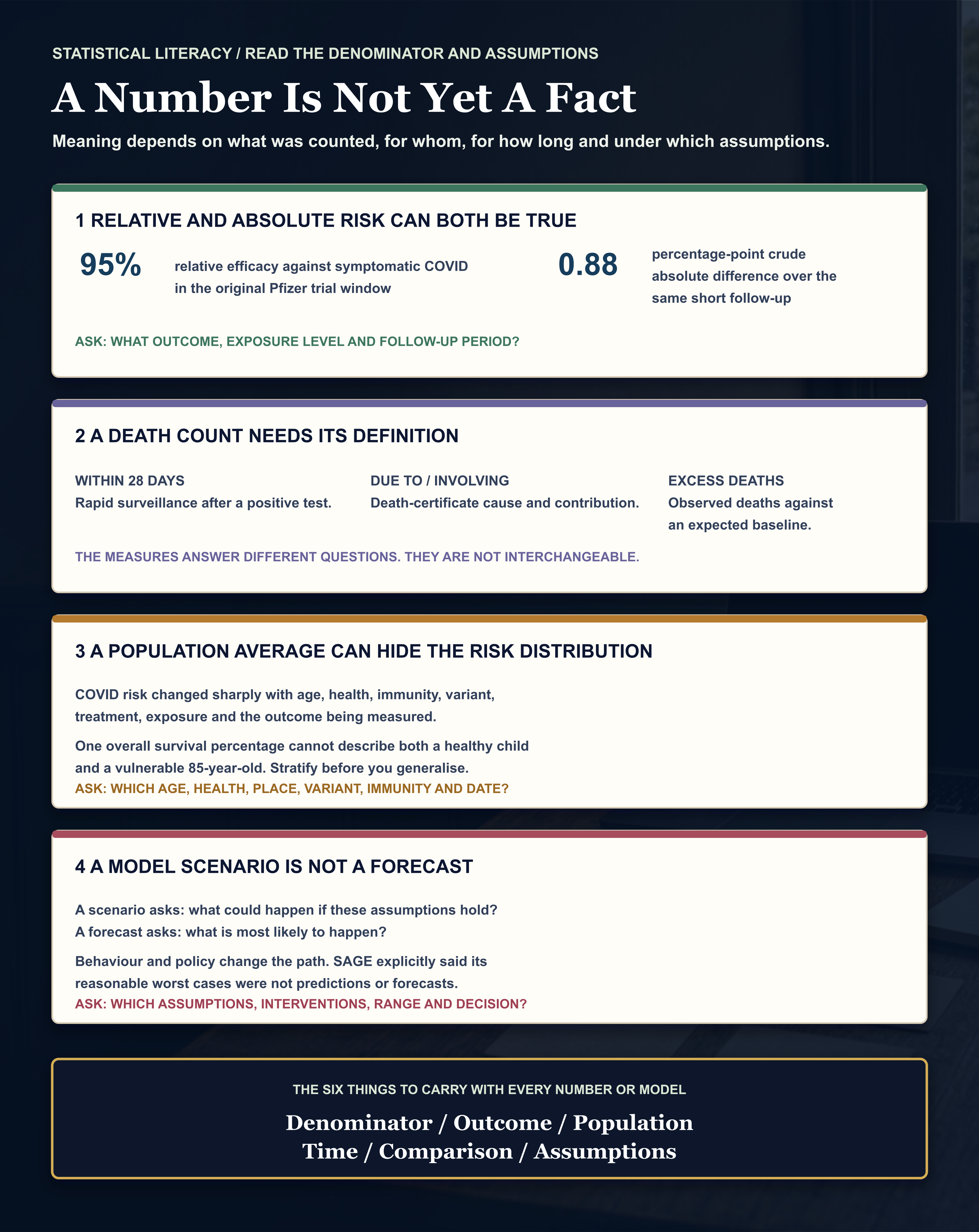
Relative and absolute risk can both be true
Pfizer's 95% result was a relative reduction in symptomatic cases. Using the same people-at-risk population from the published table, the crude risks over that follow-up window were approximately 0.046% in the vaccine group and 0.925% in placebo, an absolute difference of about 0.88 percentage points.
Put more simply, imagine 10,000 people in each trial group under the same short trial conditions. The published figures correspond to roughly 93 symptomatic cases per 10,000 people in the placebo group and about 5 per 10,000 in the vaccine group. The difference is about 88 fewer cases per 10,000 people. That is an absolute reduction of about 0.88 percentage points.
Now compare the two groups rather than the whole population: 5 is about 95% lower than 93. That is the relative reduction of about 95%. It did not mean 95 out of every 100 vaccinated people were saved from an infection they would otherwise certainly have had. Nor does the 0.88-point figure mean the vaccine was "only 0.88% effective". The two percentages answer different questions.
Both figures are true. Neither should travel alone. The relative figure describes the contrast between groups. The absolute figure depends on how much virus was circulating, who was enrolled, the follow-up period and which outcome was counted.
This article does not turn that short trial window into a number needed to vaccinate. Doing so without the endpoint, population, exposure period and changing background risk would manufacture more certainty than the calculation deserves.
A model scenario is not a forecast
COVID models were often reported as if they were predictions. SAGE explicitly said its reasonable worst-case scenarios were not predictions or forecasts. The later UK technical report explained that scenarios show possible futures under assumptions about behaviour, policy and biology.
A scenario can be useful precisely because it changes a decision and therefore does not come true. It can also be wrong because an assumption was wrong. The honest communication is: "If these conditions hold, this is one possible outcome." It is not: "This is what will happen."
Moderation, origins and unresolved questions
The origin of SARS-CoV-2 remains unresolved.
In 2025, the WHO's independent SAGO group said the weight of available evidence suggested zoonotic spillover, directly from bats or through an intermediate host. It also said critical evidence had not been provided and that all hypotheses, including a laboratory incident, had to remain on the table.
That is not a satisfying answer. It is the honest one.
Removal was not a scientific verdict
Meta's own policy record is instructive. In February 2021, it listed the claim that COVID-19 was "man-made or manufactured" among claims it would remove. In May 2021, while investigations continued, it stopped removing that claim.
"Man-made or manufactured" is not synonymous with an accidental laboratory incident involving a naturally occurring virus. The policy reversal showed that Meta changed its moderation boundary while the origin evidence remained incomplete.
It proved neither origin hypothesis.
A removal is evidence that a platform applied a policy at a particular time. It is not evidence that the claim was false. A later decision to permit the claim is not evidence that it became true.
Some removed claims were plainly dangerous. Others touched live scientific questions. A responsible platform has to manage immediate harm, but it should preserve the exact claim, the date, the evidence used and a route for challenge and correction.
Being censored does not make a claim true. Being permitted does not make it true either.
What should be communicated differently next time
The lesson is not that every official statement was a lie. It is not that every dissenter was right. It is that emergency communication repeatedly collapsed conditional evidence into certainty.
- Publish the exact claim. Say which outcome, population, period and variant it covers.
- Separate evidence from policy. "This reduces transmission" is different from "therefore it must be compulsory".
- Show relative and absolute numbers. Include the denominator and follow-up period.
- Name the measure. Dashboard, death certificate, excess mortality, detected case and estimated infection answer different questions.
- Label scenarios. Show assumptions and distinguish a possible future from a forecast.
- Date every conclusion. The virus, immunity, treatments and evidence change.
- Preserve disagreement. Record why a claim was rejected and what evidence would change the decision.
- Correct publicly. Update the claim rather than quietly deleting the old certainty.
I do not think trust is rebuilt by insisting that institutions were always right.
Trust is rebuilt by showing the evidence, the uncertainty, the corrections and the boundaries of what we know.
That is slower than a slogan.
It is also much closer to the truth.
Related reading
Sources and notes
- UK SAGE minutes, 4 June 2020. Distance-related risk was continuous, two metres was not an absolute boundary, and sterilising immunity should not be assumed.
- CDC archived scientific brief on SARS-CoV-2 transmission. Respiratory-particle transmission and the later assessment that surfaces did not contribute substantially in most circumstances.
- Living systematic review of asymptomatic and presymptomatic transmission. Transmission without recognised symptoms and differences in secondary-attack estimates.
- Lancet systematic review of distancing and protective equipment. Lower transmission risk with physical distancing, with important evidence limitations.
- CDC/NIOSH respirator and mask guidance. Filtration, fit and leakage differ across cloth coverings, surgical masks and respirators.
- Bangladesh cluster-randomised community masking trial. A complete promotion package increased use, modestly increased distancing and produced a modest, imprecisely estimated reduction in symptomatic seroprevalence.
- Cochrane physical-interventions review, Cochrane's statement on its interpretation, and the Royal Society NPI review. Used to distinguish filtration, individual use and real-world policy effects.
- UK technical report: NPIs in education settings, SPI-B and DfE evidence on remaining in education, and Ofqual's English learning review. Transmission effects and documented educational, health and inequality costs.
- Original Pfizer-BioNTech trial. Source for the consistent analysis population, 8 versus 162 symptomatic cases, 95% relative efficacy and the short blinded follow-up.
- Systematic review of vaccine protection over time and UKHSA Omicron and Delta hospitalisation study. Outcome-specific protection and the stronger durability of protection against severe disease.
- Lancet study of Israel's nationwide Pfizer vaccination campaign. Early 2021 adjusted effectiveness estimates for infection, hospitalisation, severe disease and COVID-related death, with outcome-specific denominators and confidence intervals.
- UK SIREN study and systematic review of previous infection and hybrid immunity. Infection-acquired and hybrid protection, with variant, time and population boundaries.
- JCVI advice for 2025 and spring 2026. Later UK policy narrowed as immunity, disease risk and programme objectives changed.
- Nationwide vaccine-safety study and MHRA AstraZeneca safety notice. Serious adverse events, their rarity and scope.
- Bryant et al. ivermectin meta-analysis and Zein et al. ivermectin meta-analysis. Early syntheses that reported apparent mortality benefit, included here so the positive literature is visible alongside its certainty and bias limitations.
- RECOVERY dexamethasone trial and WHO dexamethasone guidance. The trial used all-cause mortality within 28 days and found benefit in oxygen-requiring or ventilated hospital patients, not non-severe disease.
- March 2020 Surviving Sepsis Campaign guidance summary, the RECOVERY-RS randomised trial, a 2022 early-versus-late intubation meta-analysis, and WHO respiratory-support guidance. These distinguish non-invasive support, controlled intubation when deterioration occurs, and urgent intubation that should not be delayed.
- Cochrane ivermectin review, TOGETHER trial and ACTIV-6 trial. Higher-quality evidence for the studied outpatient regimens and populations.
- Final RECOVERY hydroxychloroquine trial report. Hospitalised patients and no meaningful mortality benefit.
- ONS excess deaths, March 2020 to December 2022. Excess mortality with and without deaths due to or involving COVID.
- OpenSAFELY risk-factor study. More than 17 million adults in England and strong gradients by age and other characteristics.
- ONS deaths due to COVID registered in 2021, ONS mortality methodology, UKHSA's 2020 explanation of the 28-day measure, UKHSA's 2023 reporting review, and Office for Statistics Regulation explainer. Distinguishes rapid surveillance, death-certificate and excess-mortality measures, including unrelated deaths after a positive test.
- ONS comparison of COVID with flu and pneumonia. Age distribution and underlying-cause comparisons.
- UK technical report on COVID modelling and SAGE minutes, 30 July 2020. Model scenarios, assumptions and the explicit statement that reasonable worst cases were not predictions or forecasts.
- WHO SAGO origin assessment, 2025. The weight of available evidence and the evidence that remained unavailable.
- Meta's COVID-19 misinformation-policy record. Evidence of the platform's February and May 2021 policy changes, not evidence for either origin hypothesis.
- The video commentary saved to Recall is separated from the underlying 2025 PCR-to-IgG modelling paper. The paper's population-level inference is checked against a large individual PCR-confirmed cohort, the German CoNAN study and WHO's notice on interpreting weak PCR positives.
Evidence checked 31 August 2026. This article audits a selected 28-claim corpus and does not provide individual medical advice.