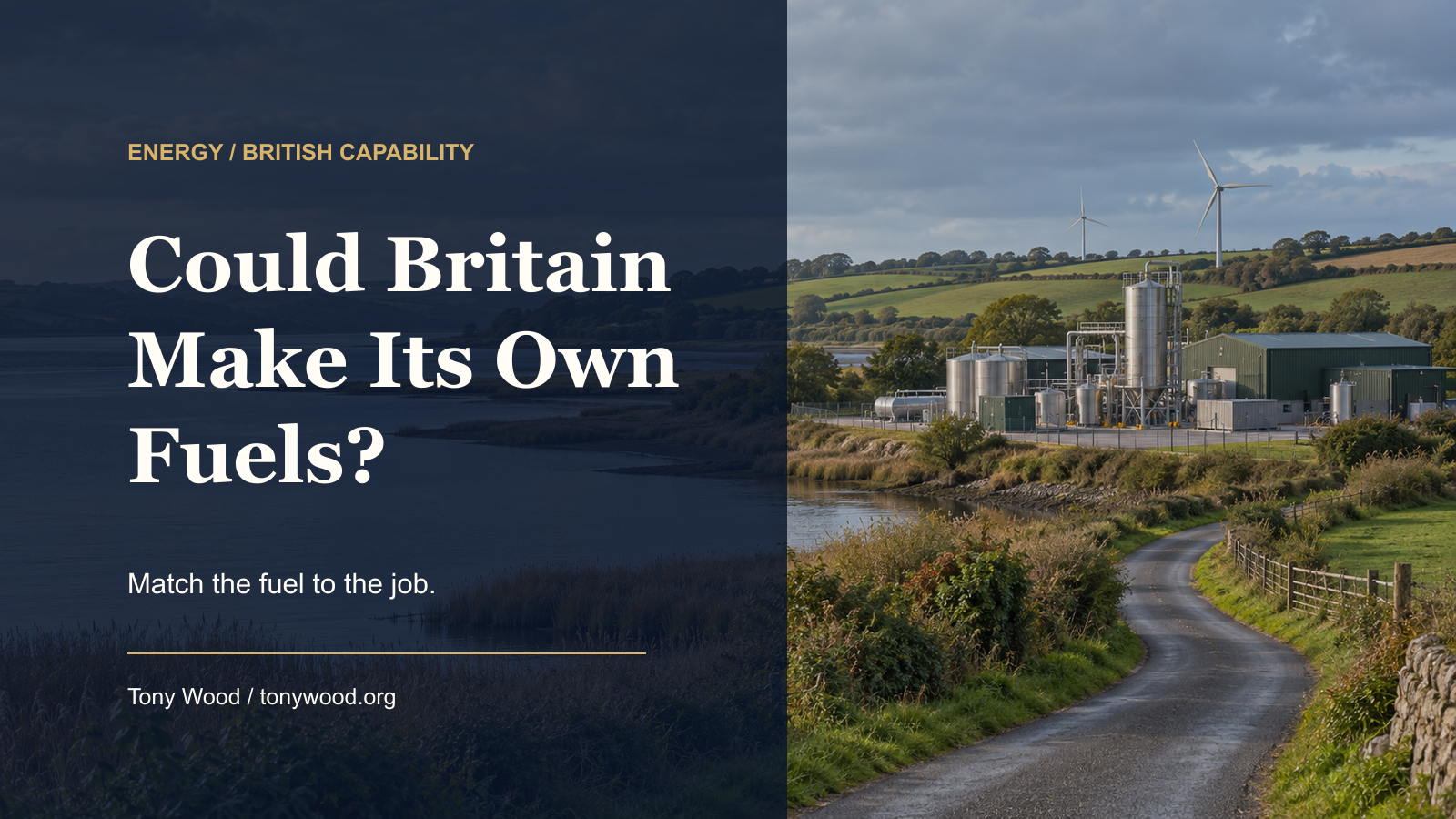
We have been talking about generating more electricity and getting it to the places that need it. But there is another question I wanted to explore.
Could Britain make more of its own fuel?
Not just extract oil and gas. Actually manufacture alternatives: hydrogen, synthetic petrol, fuels for aircraft and ships, and the equipment that makes them useful.
My answer, after working through the research, is yes. But the interesting question is not simply whether we can make them. It is where they make sense, what they cost us to produce, and what we would otherwise do with the same resources.
I think there is a real British industrial opportunity here. It is not a promise that we can replace every litre of petrol with a cheap homemade equivalent.
First, fuel is not the same thing as energy
Wind and sunshine can provide energy. Electricity lets us move and use it. Hydrogen can carry energy that we have put into making it. These are different parts of the system, not competing names for the same thing.
Hydrogen is generally manufactured from another substance. One route uses electricity in an electrolyser to split water into hydrogen and oxygen. That can connect renewable power to a fuel we can store and use later. It does not create extra energy for free. The US Department of Energy explains the distinction between hydrogen as an energy carrier and the electrolysis process.
Low-carbon electricity need not all be renewable: nuclear can also supply an electrolyser. Equally, the word hydrogen does not tell us how it was made. Hydrogen produced using fossil resources and hydrogen produced using low-carbon electricity have different supply chains.
So when someone says, "We should use hydrogen," my next question is: hydrogen made how, delivered where, to do what?
A fuel cell makes electricity, not hydrogen
This is worth separating out because the names can make the whole thing sound more complicated than it is.
An electrolyser uses electricity to make hydrogen. A hydrogen fuel cell uses hydrogen and oxygen to make electricity, with water and heat as its direct outputs. It is an electrochemical device, not simply a small combustion engine. The Department of Energy's fuel-cell explanation sets out that process.
That means a fuel-cell system and a hydrogen supply are two different things we need to organise. Manufacturing excellent equipment does not, on its own, give its customer affordable fuel.
And water at the point of use is not a full environmental assessment. We still need to account for making the hydrogen and getting it to the equipment.
Start with the job, not the favourite technology
If electricity can do the job directly, why turn it into a fuel first and then turn it back again?
Sometimes we need that extra step. Sometimes we do not. The Climate Change Committee's Seventh Carbon Budget explains that direct electrification avoids conversion losses. Its 2025 Balanced Pathway gives hydrogen a targeted role in industry and long-term energy storage, rather than a general role in household heating or everyday cars. That is an analytical pathway, not a prediction or a claim that every individual application has already been settled.
This is the distinction I would keep in mind:
| Option | The job worth examining | The important limitation |
|---|---|---|
| Direct electricity and batteries | Ordinary cars and vans, buildings and many industrial processes. | Need suitable equipment, connections and charging or supply arrangements. |
| Low-carbon hydrogen | Chemical feedstocks, selected difficult industrial processes and long-duration energy storage. | Needs a credible production, storage and delivery system; not a universal petrol substitute. |
| Hydrogen fuel cells | Turning supplied hydrogen into electricity, including specialist off-grid applications. | The equipment still needs fuel; its upstream emissions and delivered cost matter. |
| Synthetic hydrocarbon fuels | Applications needing liquid fuel, especially aviation and some residual uses. | Need energy and a carbon source; burning them releases carbon dioxide. |
| Methanol and ammonia | Dedicated marine and industrial applications worth developing. | Different fuels requiring suitable systems, infrastructure and safety arrangements. |
| Sustainable biofuels and biomethane | Using suitable biological feedstocks, wastes and residues. | Feedstocks are limited, must be traceable and have competing uses. |
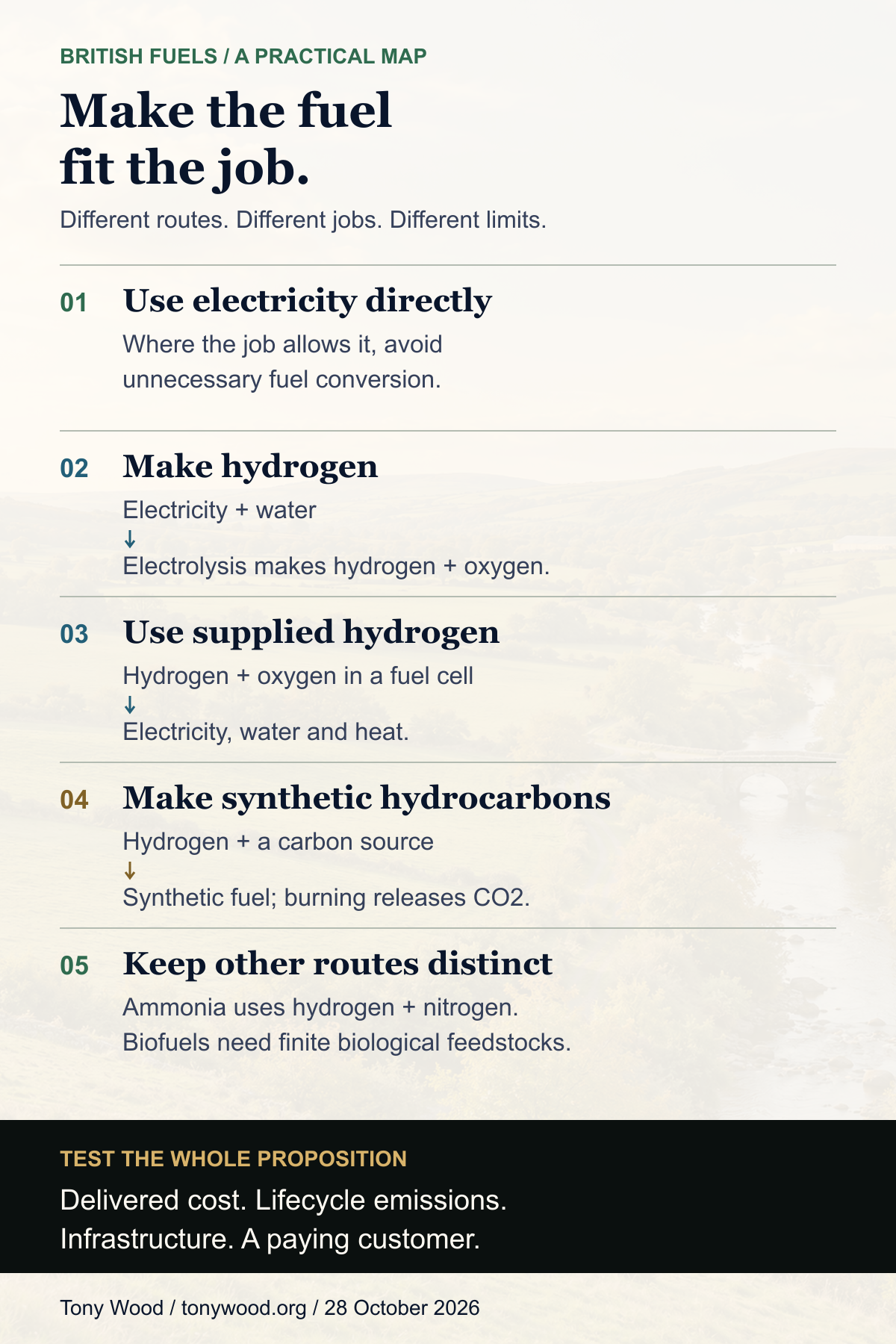
The table brings together the technical sources linked in this article. It is not a vehicle-conversion guide. My starting point would be to electrify the straightforward jobs and reserve manufactured fuels for the jobs where they earn their place.
Synthetic fuels: making molecules instead of extracting them
In an electricity-based fuel route, low-carbon hydrogen can be combined with a carbon source to make products such as e-methanol or synthetic hydrocarbons. With further processing and the right specification, hydrocarbons can become aviation fuel or petrol. Ammonia is different: it combines hydrogen and nitrogen, without carbon in the molecule.
The European Commission's CINEA agency explains hydrogen's role in making alternative fuels, including methanol and kerosene for difficult-to-electrify sectors. These are ways of making transportable fuel, not ways of avoiding the need to generate energy.
I can see the attraction. If a particular aircraft or other machine needs liquid fuel, an alternative that works within the appropriate approved specification could be extremely useful. We do not have to dismiss that just because a battery works well somewhere else.
But "synthetic" describes a manufacturing route. It is not an environmental certificate.
Where does the carbon come from?
When a carbon-containing synthetic fuel is burned, its carbon returns to the atmosphere. The IEA's discussion of carbon sources distinguishes carbon taken from the air or from biological material from carbon captured at a fossil-fuel industrial plant. Production electricity matters too.
Reusing fossil carbon in fuel is not permanent storage. Any transitional benefit has to be assessed across the whole process.
For me, the useful question is not, "Is this branded green?" It is, "What are its measured emissions from production through to use, compared with the thing it replaces?"
Biofuels are part of the answer, not an unlimited supply
Biological routes are different from electricity-based synthesis. Crops, residues and suitable wastes can provide fuel feedstocks. But calling something waste does not tell us how much is available, where it comes from, or what else needs it.
There is a revealing figure in the Department for Transport's final 2024 RTFO statistics, corrected in February 2026: 7% of the verified renewable fuel supplied to the UK was produced from UK-origin feedstocks.
That is not 7% of all British fuel, and it is not a measure of how much was manufactured here. It is a feedstock-origin statistic for the fuels verified under that scheme.
Still, it shows why I would ask two separate questions: are we processing the fuel here, and are the resources it depends on coming from here?
There are limits to expansion as well. In its June 2026 aviation-fuels call for evidence, the government highlighted constrained future supply and competition for the fats-and-oils feedstocks used in HEFA aviation fuel. A good use of waste is not automatically a resource we can expand indefinitely.
Can I put it in the car I already own?
This is where we need to be precise. A fuel designed and approved as a petrol substitute is not the same thing as a different fuel that happens to burn.
E10 petrol already contains up to 10% renewable ethanol. The government's E10 guidance explains compatibility and advises checking the vehicle or equipment manufacturer's information where necessary. That does not make much higher ethanol blends universally suitable.
HVO renewable diesel belongs in the diesel discussion, not the petrol tank. Renewable diesel is also chemically different from conventional biodiesel; the Alternative Fuels Data Center explains that distinction. Its US guidance is not a blanket UK approval for a particular vehicle.
Hydrogen, methanol and ammonia are not things we should casually substitute into existing petrol equipment. The fuel specification, engine, materials, storage and approvals all matter. "Drop-in" is a claim about compatibility with a particular specification, not permission to use any alternative in anything.
Ammonia illustrates the wider point. It has no carbon in its molecule, but that does not make it harmless. Lloyd's Register's marine technical guidance discusses toxicity, handling challenges and the need to manage potential nitrogen-oxide emissions. Specialist engineering is part of the proposition, not an optional extra.
Britain is not starting from nothing
There is a difference between hoping we might invent something and building on capabilities that already exist. These examples are encouraging, provided we are honest about what each one proves.
Equipment for making hydrogen
The Competition and Markets Authority's May 2026 ITM Power subsidy case identifies a UK electrolyser manufacturer headquartered in Sheffield. It describes proposed support for a new manufacturing facility. That is evidence of an existing manufacturing business and an expansion proposal, not proof that the proposed facility is complete.
Also, a factory's ability to manufacture electrolysers is not the same as hydrogen plants actually producing fuel. We need both equipment customers and operating projects.
Equipment for using hydrogen
Loughborough-based Intelligent Energy announced its IE-GRID 4 mobile fuel-cell generator on 6 October 2026. The company describes a system combining a fuel cell, battery, inverter and controls for temporary and off-grid power.
This is company-reported product evidence, not an independent finding that it is cheapest for every customer. It does, however, illustrate the sort of practical equipment British businesses can develop.
Processes for making alternative fuels
OXCCU says its OX1 demonstration plant at Oxford Airport has been collecting operational data since 2024 for its carbon-to-fuels technology. A demonstration is a useful stage beyond laboratory work. It is not the same as a commercial plant supplying a national fuel market.
Those are three different opportunities: make the production machinery, make the equipment that uses the fuel, and develop the processes that manufacture the fuel itself. We should not collapse them into one impressive-sounding capacity number.
The economics: electricity, operating hours and paying customers
I would be wary of anyone offering a single future price for "British hydrogen" or "synthetic petrol" without showing the assumptions.
NESO's hydrogen-cost modelling varies electricity prices, financing costs and electrolyser utilisation. NESO explicitly describes it as sensitivity analysis, not a forecast or a single expected price.
The practical implication is straightforward. A plant needs to pay for its equipment as well as its energy. Cheap electricity for a few hours and affordable production over a year are not the same proposition. Running less often means fewer units of output across which to recover fixed costs.
So "we will use surplus wind" is a starting idea, not a completed business case. I would want to see the available hours, location, connection arrangements, electricity contract, storage and production schedule. Then I would want a customer who needs the output at a price the project can sustain.
And I would compare the delivered fuel, not just the cost at the factory gate. Transport, storage and the customer's equipment belong in that decision too.
This connects directly to my article on what electricity really costs and the need for a usable grid connection. A fuel plant does not bypass those problems simply by being an interesting new industry.
A market for fuel is not proof that the fuel is ready
The UK's Sustainable Aviation Fuel Mandate began in January 2025. The government's June 2026 call for evidence described the main obligation and a separate power-to-liquid obligation scheduled from 2028, while asking about advanced supply availability and possible flexibility. The call has closed; it was not itself a change in the rules.
That is a useful reminder that sustainable aviation fuel is a category covering different production routes. It does not all mean electricity-based synthetic fuel. Policy can encourage a market without making the necessary plants, supplies and finance appear on schedule.
I would ask each proposed project the same simple questions. Is it announced, permitted, financed, being built, or producing? How much usable fuel has it actually delivered? Who has contracted to buy it?
Those are not negative questions. They help us distinguish the projects we should be celebrating for working from the projects we should be helping to get there.
What I would like Britain to build
I would not set the objective as recreating our existing petrol economy with different molecules. I would set it as making Britain better at providing reliable, lower-carbon energy and the engineering that goes with it.
For me, that would mean five priorities.
- Use electricity directly where it is practical. Do not create avoidable demand for more complicated fuels merely to preserve a familiar way of doing things.
- Build fuel projects around a specific need. An industrial customer, an aviation-fuel buyer or a defined specialist use is more useful than a promise to supply everyone eventually.
- Join up production, infrastructure and customers. I would look at industrial clusters and ports where those pieces could work together, rather than treating every plant as an isolated announcement.
- Back engineering and skills as well as litres of fuel. Electrolysers, fuel-cell systems, process design, installation and maintenance deserve attention. I would judge each investment by the capability and durable work it actually creates, not an unsupported national jobs total.
- Measure progress honestly. Track operating output, delivered cost, lifecycle emissions, resource origins and dependable supply. A grant, a factory capacity and fuel in a customer's tank are different achievements.
I would also avoid equating resilience with making absolutely everything at home. Domestic capability and diversified, dependable imports can be complementary. The decision should be which parts of the system we need to control, which we can trade for, and how we keep useful alternatives available.
That fits the wider energy discussion: generate more usable power, build the connections, and recognise that the machinery needs materials too.
Can Britain do this? Yes, I think we can. We already have examples of the engineering. The challenge is turning selected capabilities into dependable, competitive supply.
Electrify what makes sense. Manufacture the fuels that solve the difficult jobs. And be clear about what each one is actually doing for us.
Sources and notes
Researched on 28 October 2026. The links above provide the checked public evidence. This is research and industrial-policy opinion, not advice to convert a vehicle, handle a fuel or invest in a project.
- Technical principles: US Department of Energy explanations of energy carriers, electrolysis and fuel cells. These support the science, not current British market estimates.
- Technology choices: the CCC's 2025 Seventh Carbon Budget is a modelled UK pathway. CINEA explains hydrogen-based fuel routes. The IEA's 2023 e-fuels study, revised January 2024, supports carbon accounting; its historical pipeline is not used as a current forecast.
- Fuel compatibility and safety: DfT E10 guidance, DOE renewable-diesel guidance and Lloyd's Register on ammonia. Always use the appropriate equipment approvals and specialist advice.
- UK evidence: the 2024 final RTFO report concerns verified renewable fuel and feedstock origins, not all British fuel. The 2026 SAF call for evidence is a policy-review document, not evidence of new fuel output.
- Manufacturing and demonstration: the CMA's ITM case is official evidence about a proposed subsidy. The Intelligent Energy launch and OXCCU operational account are company sources, not independent commercial-performance audits.
- Costs: NESO sensitivity modelling. No guaranteed future fuel price or national employment forecast is claimed here.