Part one of Powering Britain's AI Future. This article looks at electricity supply. Part two asks how we get that electricity through the network to a working data centre.
I keep seeing the same uncomfortable combination. Britain wants the investment, the data centres, the AI capability and the productivity gains. Then a project gets held up because the electricity cannot arrive when it is needed.
We cannot build a more productive economy on a promise that the power might turn up later.
But I wanted to understand what we can actually do about it. Not just announce another power station. What could make a useful difference in the next twelve months?
The news is real. The diagnosis needs care.
On 19 October 2026, Reuters reported that Microsoft had ended its agreement to anchor Nscale's planned Loughton data centre after power-connection delays pushed expected supply into the 2030s. Microsoft said the decision concerned one site. Nscale said it remained committed to Loughton and was exploring alternative power sources.
That is a serious setback. It is not confirmation that the entire development has been cancelled, or that Microsoft has abandoned every UK project. Nor does it establish that Britain simply lacks enough generating machinery nationally.
In fact, NESO's published early view for winter 2026/27 forecasts a 5.5 GW de-rated margin, equivalent to 8.8% of forecast peak demand under its Average Cold Spell assumptions. That is a forecast with weather, plant and import risks, not a guarantee. It is also not a spare block of electricity that any developer can claim at any postcode.
There are at least three different questions here:
- Generation: can we produce enough electricity over the year and during difficult hours?
- Delivery: can the transmission network, local substations and final connection carry it to this site?
- Resilience: what happens when a plant, circuit or other important component is unavailable?
Price runs through all three. Electricity that exists but is too expensive for the business is another problem again.
Why I think this matters for productivity
I am optimistic about what AI could let British businesses do. Smaller teams could serve more customers, reduce administration, develop products and attempt work that was previously unaffordable. I think that could create new businesses, careers and opportunities, even as some existing jobs change or disappear.
That is my view of the opportunity, not a promise of net job creation.
The evidence is encouraging in particular settings. A published study of 5,172 customer-support agents found that access to an AI assistant increased issues resolved per hour by about 15% on average. It studied a staggered rollout at one company, not the British economy. It does not tell us that UK output or employment will rise by 15%.
Britain has experienced a long productivity slowdown, although ONS research published in September 2026 suggests the slowdown in output per hour was less severe than older estimates indicated. Those revised estimates were still research, not official statistics, when published.
So let us be ambitious without pretending the outcome is automatic. Computing capacity is an input. Businesses still need affordable access, useful applications, skills and the ability to change how they work. A warehouse full of processors is not a productivity strategy on its own.
First, understand what a megawatt tells you
A megawatt, or MW, measures power at a moment. A megawatt-hour, or MWh, measures energy over time.
For illustration, a facility drawing a constant 100 MW at its electricity meter would consume 876,000 MWh in a normal 8,760-hour year: 0.876 TWh. That is arithmetic, not a claim about the Loughton site's actual consumption. If someone instead quotes 100 MW of IT equipment, cooling and other supporting loads have to be accounted for separately.
The same distinction matters for batteries. An idealised 100 MW battery containing 200 MWh could discharge at full power for two hours before losses and operating reserves. It cannot supply 100 MW indefinitely. It also needs electricity to charge.
These are useful technologies doing different jobs. We get into trouble when we give them the same label and add the numbers together.
What I would do over the next year
I would start with projects whose difficult, slow prerequisites are already largely solved: the land, engineering, finance, equipment, permissions and a usable connection. Starting a new application is not the same as getting something switched on by October 2027.
1. Get more from the generation we already have
Ask which existing plants could safely deliver more reliably with the right maintenance, spare parts, repairs or investment. A restored machine already has much of the surrounding infrastructure. An unbuilt one does not.
That does not mean keeping unsafe equipment running or overriding nuclear regulation. It means treating dependable availability as something worth procuring, rather than discussing only new construction.
The government's Clean Power 2030 Action Plan explicitly recognises a continuing backup role for gas and says retaining existing gas assets where possible is likely to be the most cost-effective way to meet that role. Capacity kept available and fuel burned throughout the year are different things.
2. Build the solar projects that can actually connect
Warehouse roofs, commercial premises, schools and other suitable buildings are sensible places to look. The UK Solar Roadmap supports rooftops and multifunctional sites, alongside ground-mounted projects.
My priority would be sites where structural checks, installation capacity and network approvals make delivery within a year credible. Roof space on a map is not the same as a funded, buildable project.
Solar adds energy when the sun is available. It can reduce daytime imports and help charge storage. It does not, by itself, solve a dark winter evening. A few panels on a data-centre roof are not a substitute for its full electricity supply either.
3. Connect useful batteries, with their duration stated
This is not a technology Britain has to invent. The government's July 2026 flexibility update reports 2.3 GW of grid-scale battery power capacity energised during 2025.
That is evidence of a substantial historical build rate, not a guarantee we can repeat it in the next twelve months, and not 2.3 GW of new generation.
I would prioritise ready storage projects that improve the system where they connect. Record both MW and MWh, available charge, expected recharge opportunities and the conditions under which the battery can help. Short-duration storage can bridge a difficult period. It is not an energy source for a prolonged shortage.
4. Pay for useful flexibility and stop wasting power
Some consumption can move without stopping the service people actually need. Think of charging vehicles later, adjusting commercial equipment within safe operating limits, or scheduling a computing job differently where its deadline allows.
NESO's Demand Flexibility Service already provides a route for paying participating users to change demand. Its service page announces a constraint-management launch planned for 7 October 2026; I have not independently confirmed operational delivery of that new capability. My starting point would be the established service, checking which additional capabilities are actually available rather than assuming a planned date proves they are live.
My condition would be verified delivery, not a register of appliances someone hopes might respond. Protect medical needs, essential services and people who cannot move their consumption. Participation needs clear limits.
Alongside that, commission sensible efficiency work: controls, cooling, motors, lighting and buildings that consume more than they need. Check the savings in use. Do not count the same reduction once as efficiency and again as flexible demand.
5. Keep a limited reserve where the evidence requires it
There may be a case for modular gas equipment or temporary generation at particular prepared sites. But equipment availability, fuel, emissions, noise, permits and connections all still matter. A generator does not become a national solution because it fits in a container.
DESNZ's generation-cost research, published in January 2026, identifies turbine supply pressure and higher capital costs. Its generic cost estimates are not quotations for a project we can order today.
I would not base a twelve-month programme on a large new gas station, nuclear station or interconnector starting from scratch. Nor would I quietly make routine diesel generation the price of having an AI industry. The immediate programme should complement the longer-term build, not replace it.
A simple way to judge the options
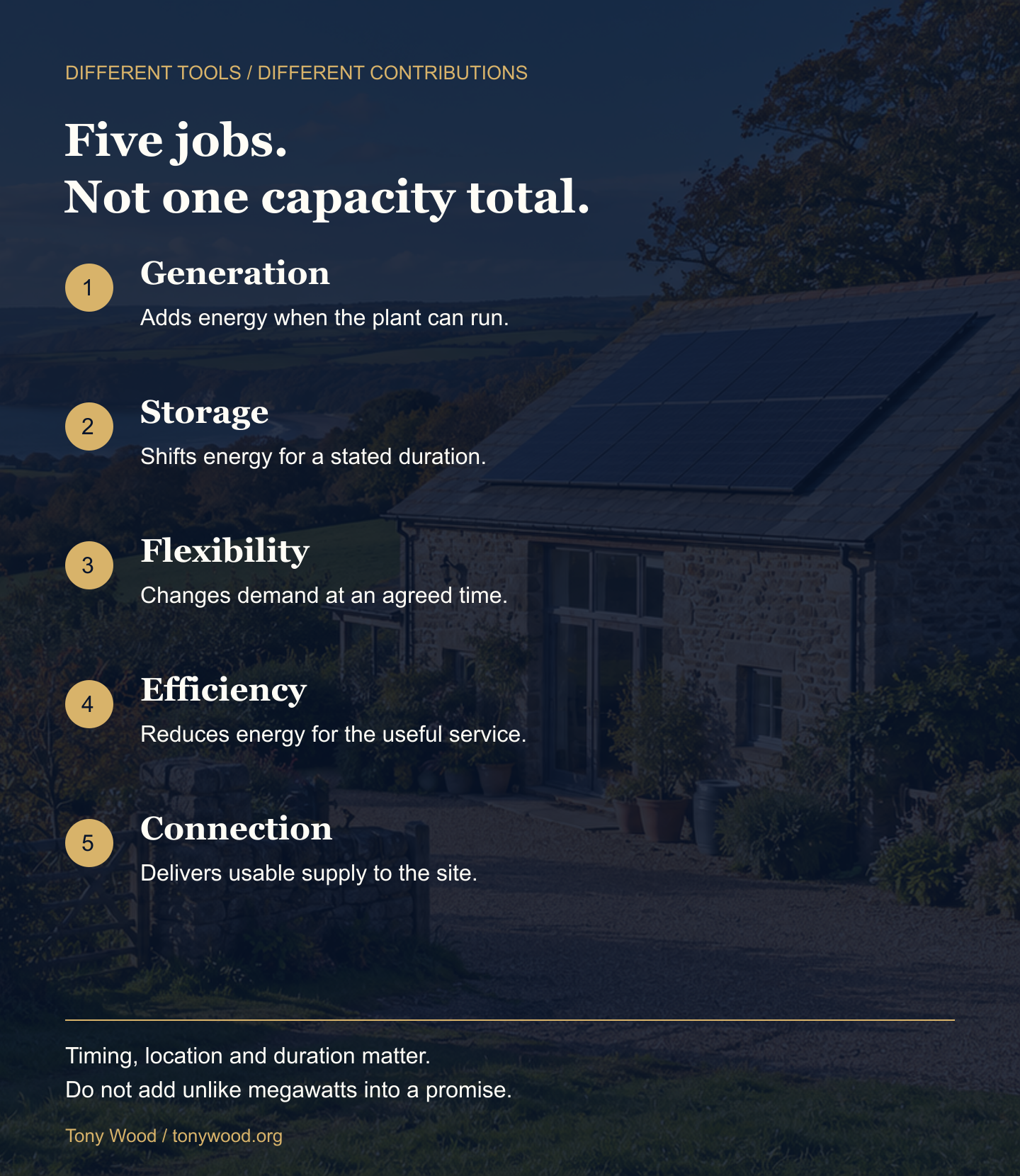
| Action | What it gives us | What it does not prove |
|---|---|---|
| More available generation | Electricity when the plant can run | That the local network can deliver it |
| Solar | Additional daylight energy | Supply through every winter evening |
| A battery | Stored energy delivered for a stated duration | New generation or unlimited endurance |
| Flexible demand | Load moved or reduced for an agreed period | A permanent reduction in annual consumption |
| Efficiency | Less energy needed for the same useful service | A saving until performance is measured |
That is why I am not adding the megawatts in those rows into one impressive national total. Their contributions depend on timing, location, duration and interactions. A delivery programme needs engineering and procurement evidence before it earns a firm capacity claim.
Give the programme a deadline and a useful scoreboard
Here is my proposed approach, not an announced government programme.
In the first month: identify the highest-value locations and the projects that can genuinely deliver within a year. Find the limiting item on each: equipment, finance, permission, commissioning or the connection.
Within three months: agree delivery plans for ready projects, contract measurable flexibility, commission justified reliability work and begin suitable public-estate solar and efficiency projects.
By October 2027: report what is actually energised and usable. Separate annual energy added, dependable power during stress, storage duration, peak reduction, cost and emissions. Show what failed to arrive as well.
None of this should take capacity away from homes, hospitals or other productive businesses without an honest public decision about priorities and who pays. The objective is a stronger system, not privileged access for whichever industry has the loudest announcement.
The opportunity is bigger than the data centre
I have already written about data-centre jobs and the skills Britain needs for the AI and energy build-out. The attraction is a sustained programme of useful technical work, not pretending every completed building employs thousands permanently.
Electricians, power engineers, controls specialists, installers and maintenance teams are part of making this possible. So are the people helping businesses turn available compute into useful outcomes.
I want Britain to capture that opportunity. But I want us to count completed capability, not announcements.
Make more electricity available. Waste less. Store some. Move demand where it makes sense. Then make sure the power has a route to the people who need it.
That last part is the subject of part two: More Power Is No Use Without a Grid Connection. It is not a footnote. It is the other half of the job.
Sources and notes
Evidence checked on 21 October 2026. Links beside the claims lead to the reporting, official publications and original research. The proposed timetable and priorities are my judgement, not a government commitment or a completed engineering study. The numerical examples are illustrative. I have not treated the supplied research's national capacity and cost scenarios as independently validated forecasts.
Most system-operation evidence here concerns England, Scotland and Wales: Great Britain. Northern Ireland participates in the all-island Single Electricity Market, so delivery there needs its own network and market assessment.
For the wider context, see Britain Needs Data Centres and AI Factories and What Does Electricity Really Cost In The UK?