Part two of Powering Britain's AI Future. Part one looks at electricity supply and what Britain could usefully do within a year. This is about the route from that supply to the place where the work happens.
There is a rather important catch in the argument that Britain should build more power generation for AI.
You can have electricity available somewhere in the country and still be unable to supply the building where you want to use it.
A data centre needs more than a generator on a national spreadsheet. It needs a properly engineered pathway, a connection it can actually use and a service that matches the work it is promising customers.
That is why generation and transmission deserve separate articles. They are connected problems, but they are not interchangeable ones.
It is not just a wire from the power station
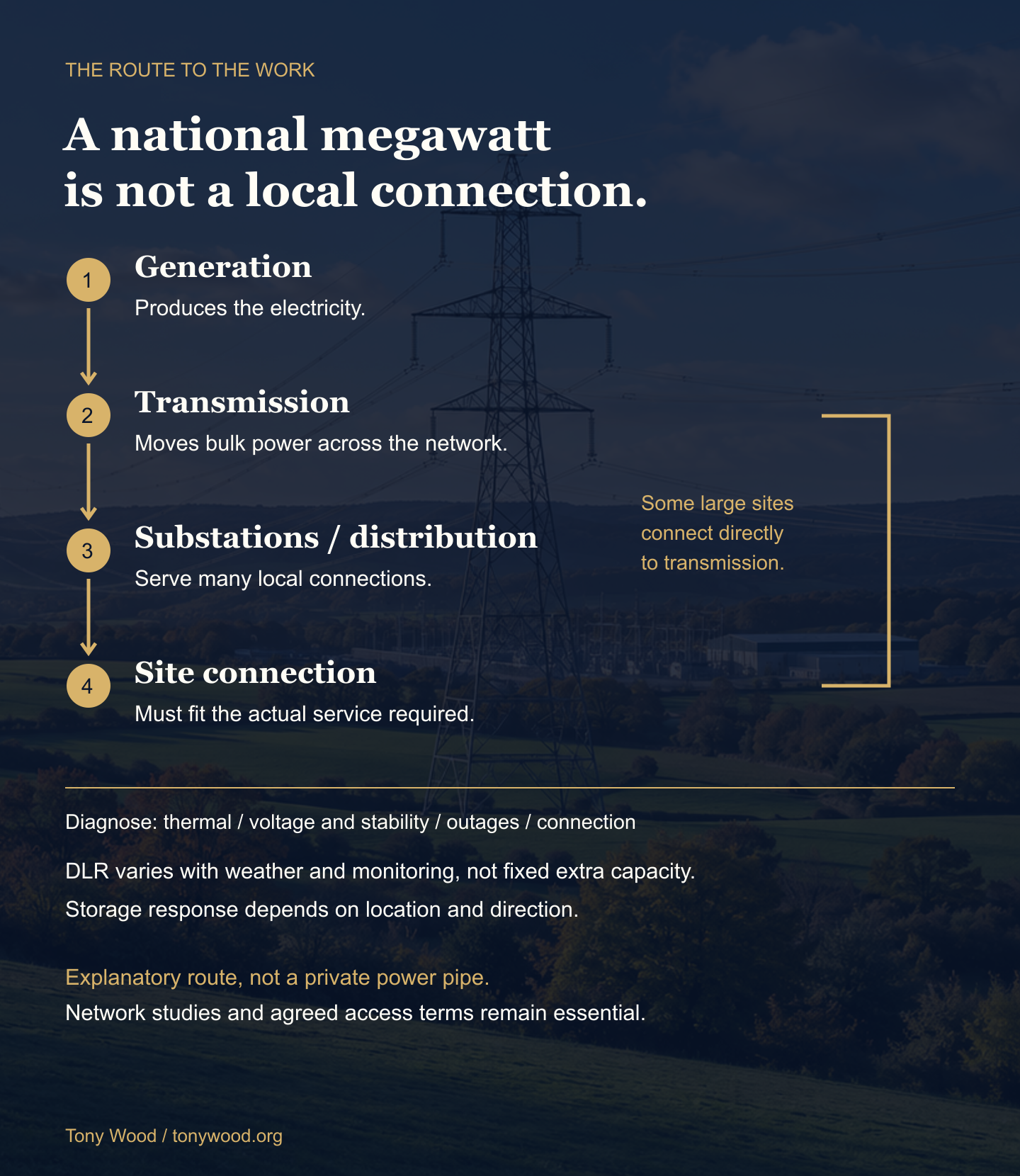
For a simple picture, think of generation feeding the high-voltage transmission network, then substations, distribution networks and the final site connection. Some large customers connect directly to transmission, so not every site follows every step.
NESO's explanation of the system sets out those layers. NESO operates Great Britain's transmission system; the transmission companies own and develop the physical assets. Distribution companies handle the networks serving many local connections.
And this is not a private pipe reserved between your chosen wind farm and your server rack. Electricity flows according to the physics of the connected network. Commercial contracts have to work with that network, not wish it away.
A power-purchase agreement can help arrange the commercial supply. It does not, by itself, remove a congested circuit, enlarge a transformer or commission the switchgear at your site.
The Loughton story discussed in part one is a connection-delay story. The public evidence does not identify every distribution or upstream transmission work behind that delay. We should not pretend a national diagram gives us the engineering diagnosis for one particular project.
Different bottlenecks need different answers
A line can only carry so much current without excessive heating and sag. But temperature is not the only limit. Voltage, stability, equipment ratings and what happens after a fault matter too.
The operator also has to allow for important equipment being unavailable. A route that works only when every component behaves perfectly is not a complete resilience plan.
Two examples from NESO's ETYS 2025 network assessment show why the diagnosis matters:
| Boundary | Published capability | Limiting issue in the assessment |
|---|---|---|
| B6, Scotland to England | 6.7 GW | A thermal constraint on the Harker-Moffat 400 kV circuit |
| EC5, East Anglia | 2.3 GW | A voltage constraint following a fault on the Pelham-Bramford-Braintree 400 kV circuits |
Those are capabilities under the report's studied conditions, not today's live headroom. They are not figures you can add together to calculate how many new data centres Britain can connect.
The practical point is simpler. Cooling a conductor may help a thermal limit. It will not automatically fix a voltage problem somewhere else.
What could we improve within twelve months?
The transmission research makes a useful distinction: improve the existing system while building the larger one we will still need.
I would organise that work around five questions.
1. Can we measure what the existing lines can safely carry?
Dynamic line rating, usually shortened to DLR, uses weather and monitoring information to assess a line's usable rating as conditions change.
Wind does two useful things here: it can drive turbines and cool overhead conductors. But conditions can also reduce a rating. This is not permission to assume every line has an extra 20% available all the time.
On 23 September 2026, SSEN Transmission announced that DLR was operational on more than 300 km between Beauly and Dounreay. It said installation had taken several months. That is an operating example, not just a promising presentation.
Ofgem's current electricity-transmission settlement also provides an incentive: owners deploying DLR at scale can earn 10% of the constraint costs each intervention saves.
My proposal is to prioritise other suitable thermal bottlenecks, with reliable sensors, communications, fallback ratings and operational approval. Check the rest of the circuit too. A better line rating does not upgrade a limiting transformer.
2. Are we replacing the right bit?
Reconductoring means replacing the conductors, potentially with a design that carries more current without unacceptable sag. Where the structures and clearances allow it, that can improve an existing route.
But the sensible next-year question is not, "Can we rebuild every important line?" It is, "Is there a short, already-engineered section setting the limit for a much larger route?"
I would also ask about fittings, protection, transformer limitations and clearances before assuming the entire conductor needs replacing. Surveys, engineering studies, equipment and outage windows still have to be available. This is work for the network engineers, not a generic instruction to turn the setting up.
3. Can we keep more of the network available during works?
The upgrades themselves can require taking circuits out of service. That creates an awkward transition: building tomorrow's capacity can temporarily remove some of today's.
I would require each major outage plan to consider whether different sequencing, temporary bypasses or another approved operating arrangement could retain more useful capability.
That is a proposal for investigation, not a claim every project can avoid an outage. The safety case comes first. And temporary capacity preserved during construction must not be reported as a permanent expansion.
4. Can controlled responses let us use the network better?
One existing approach is constraint-management intertrip. In simple terms, selected generators can be disconnected automatically after a defined fault. A properly designed scheme can therefore permit higher flows before that fault, instead of pre-emptively reducing as much generation.
That is not the same as gambling that the fault will not happen. It relies on dependable protection, communications and a studied response. It does not allow us to assume every proposed scheme is ready because a planned start date has passed.
Power-flow controls and voltage support also have roles where the studies identify them. The useful question remains: what is the actual limitation, and does this intervention change it?
5. Can we move demand to the useful side of the constraint?
This is where batteries and flexible consumption appear in both articles. They can help supply and help manage network congestion, but that is not a reason to count their benefit twice.
Suppose strong wind generation is trapped north of a congested boundary. Charging a suitably located battery or moving a flexible computing job into that area could absorb some electricity that would otherwise be curtailed. Discharging that battery into the same congestion at the wrong moment could make things worse.
On the importing side, a local battery discharging or a customer reducing demand can help reduce the flow that has to cross the boundary.
Those are simplified directional examples. The actual effect depends on the network and needs modelling. Not every megawatt of demand change produces a megawatt of relief on the boundary being studied.
NESO's DFS page announces a constraint-management launch planned for 7 October 2026; I have not independently confirmed operational delivery of that new capability. My suggestion is to procure the useful physical outcome through a verified available service: the location, direction, time, duration and dependable response. A vague national request to use less electricity is not the same product.
The final connection still has to work
Even a successful national transmission project does not automatically finish the local substation, install the site's switchgear or complete commissioning.
UK Power Networks describes several connection options for data centres, including ramped, flexible and profiled arrangements. A business may be able to start smaller or accept a defined pattern of access rather than wait for its full eventual requirement.
The terms matter. Its profiled-connection guidance says flexible demand can be curtailed to zero, whereas profiled arrangements protect the scheduled contractual minimum. Neither is a universal promise of unrestricted capacity or immunity from faults.
I would ask a developer to separate essential continuous workloads from work it can genuinely defer. Some batch jobs might tolerate that. A service promising immediate responses may not. Cooling, safety and customer obligations cannot simply be paused because an optimiser has found a cheaper hour.
The network operator and customer have to agree an arrangement that fits the real service. There is no public evidence that any particular alternative would have met Microsoft's requirements at Loughton.
Fix the queue, but do not confuse it with the build
In July 2026, Ofgem consulted on stronger progress milestones and a commitment fee for data-centre connections, seeking to prevent speculative projects holding capacity needed by viable ones.
That source is a consultation, not evidence that its proposed fee is now in force. An application is not an operational facility or a financed construction project.
Removing a speculative project can improve the queue. It cannot manufacture a transformer. We need both better allocation and physical delivery.
And this is not only about servers. National Grid reported in March 2024 that ramped arrangements had brought forward connection pathways for developments totalling 7,800 homes in West London. That was a reported pathway, not confirmation that every home had subsequently been built.
Housing, hospitals, factories and transport need functioning connections too. An AI strategy that ignores them is not a national infrastructure strategy.
What I would ask government and the industry to deliver
I would run a twelve-month grid-capacity programme alongside the generation work in part one. Not a promise to finish the whole network by October 2027.
- Diagnose: identify the limiting component and the conditions that make it a bottleneck.
- Prioritise: select improvements whose engineering, equipment, permissions and commissioning can genuinely fit the year.
- Coordinate: combine line ratings, protection, outages and flexibility rather than treating them as independent additions.
- Prove: test secure operation and agree the connection terms before counting a site as supplied.
- Keep building: use these measures as a bridge to major reinforcement, not an excuse to postpone it.
There is a financial reason to care. In its 6 August 2026 update, NESO forecast £3.2 billion of constraint costs over the following twelve months. That is a dated forecast, not a bill already paid or a guaranteed saving available to this programme.
My scoreboard would distinguish permanent secure transfer capability, weather-dependent capability, congestion relief during specified hours, energy no longer curtailed and capacity preserved during outages. Show consumer cost and verified site-connection milestones alongside them.
Do not add together three interventions that all relieve the same limiting circuit and announce three times the benefit.
Build where the whole service works
It may make sense to locate some computing near available generation and useful network capacity. But "put it all in Scotland" is no more a complete plan than "put it all beside London".
Different workloads have different requirements. Power needs to sit alongside fibre, latency, cooling, water where relevant, people, resilience, contracts and customer needs. A British location also does not automatically give British customers control over the models or services running there.
That connects to my earlier pieces on why the UK needs more data centres and water and power in context. The question is which facility, doing which work, in which place, with which resources.
I want more of that useful capability here. I want the engineering jobs, the businesses it can support and the opportunity to turn AI into better services.
But a national megawatt is not a local connection. We need to generate the electricity and build a dependable way of getting it to the work.
Read alongside part one: Britain Needs More Power. What Can We Do Within a Year? Neither half works without the other.
Sources and notes
Evidence checked on 21 October 2026. Technical values refer to the named NESO planning assessment, not live connection offers. Operator statements describe their own projects and services. The timetable and priorities are proposals, not a completed engineering design or a validated national gigawatt uplift.
This article concerns Great Britain's network. Northern Ireland operates within the all-island Single Electricity Market and requires a separate assessment. The transmission measures described here do not authorise anyone to alter electrical equipment, protection or operating limits.