
You do not have to become a software developer to have a place in the AI economy. Somebody still has to build the place, connect the power, install the cooling and keep the whole thing working.
I started looking at this after writing about how many jobs a data centre actually creates. The next question seemed fairly obvious.
All right. If there is work to do, how does somebody get into it?
Not somebody who already has twenty years of electrical experience and a van full of tools. Somebody who is sixteen and wondering what comes next. Somebody who is thirty-five, has bills to pay and wants a different career. Or somebody who is already a carpenter, plumber or refrigeration engineer and wants to understand where their skills might take them.
That is what this article is for.
My answer is straightforward: learn a recognised trade first, then add a specialism. Build a skill that is useful in several places, rather than betting your entire future on one fashionable project.
We can be excited about AI without pretending that every job is going to involve sitting in front of a chatbot. I would quite like the person installing the power to know rather more than how to write a good prompt.
Start Here: Which Situation Are You In?
This is a longer guide you can come back to. You do not need to read every funding scheme before doing anything useful.
- Leaving school? Start with the trades table, then look at apprenticeships and college routes in your part of Britain.
- Changing career? Read the training-pay section before committing to a course. The route has to work for your household as well as your ambitions.
- Already qualified? Look at the sector connections and employer list. You may need a specific additional skill, not another complete apprenticeship.
- Helping a child, colleague or community member? Use the questions for training providers near the end. A reassuring website is not the same thing as a clear route into work.
The practical details were checked on 10 September 2026. The main guide covers England, Scotland and Wales. Northern Ireland has its own short section because its training system is different. Funding and recruitment change, so check the linked scheme before relying on a place, a deadline or a particular amount of support.
The AI Economy Has a Physical Side
We talk about the cloud as though it floats above the practical business of the world.
It does not. A data centre is a building with power, cooling, machinery, monitoring and maintenance. Equinix's UK operations careers page describes facilities work involving electrical, mechanical, HVAC and plumbing systems, alongside building-management and control systems. That is a rather different picture from "everybody needs to learn coding". 1
Then widen the view. Nuclear construction, electricity networks, solar installations, heating systems and factories all need people with practical and technical skills. They are not identical jobs, and you cannot move between them without checking the requirements. But there are useful overlaps.
An engineering-maintenance background, for example, is about keeping machinery working. It is not tied to whether the machine sits in a factory whose marketing department has discovered the word AI. The National Careers Service describes maintenance technicians working on equipment, diagnosing problems and carrying out repairs. 2
There is demand worth investigating. CITB's 2026 UK construction outlook estimates a requirement for more than 41,000 new entrants a year across 2026-30. That includes the need to replace people leaving the industry. It is not a list of AI vacancies. 3
The government's October 2025 Clean Energy Jobs Plan projects direct and indirect employment rising from 437,000 in 2023 to 856,000 in 2030 under its assumptions. Its sector estimates mix UK and Great Britain coverage, and renewable estimates use upper-bound deployment scenarios. That is a conditional forecast, not a promise that all those jobs will appear or that they are net additions to the economy. 4 See the technical annex for the boundaries.
I think there is a positive story here. But we make it weaker if we turn every forecast into a guarantee.
Choose the Work, Not Just the Headline
Before asking which job will benefit most from AI, ask a more useful question: what work could I become good at, and would I actually want to do it?
Do you like finding out why something has stopped working? Making something accurately? Working outside? Reading drawings? Working with people in their homes? Would you cope with shifts, heights, travel or call-outs?
Those are not minor details. They are the job.
| Route to investigate | What you could be learning | Why it connects to the buildout |
|---|---|---|
| Electrician | Installation, testing, fault-finding and maintenance | Power in buildings and industry, with further requirements for specialist work. 5 |
| Refrigeration, air conditioning and heat pumps | Cooling systems, installation, servicing and diagnosis | Buildings, cold storage and the cooling required by infrastructure. 6 |
| Mechanical maintenance | Pumps, motors, machinery and systematic fault-finding | Keeping industrial equipment operating, not just building it once. 2 |
| Controls and instrumentation | Sensors, monitoring and the behaviour of physical systems | A route through electrical, engineering or building-services training into more specialist work. 7 8 |
| Welding, fabrication and pipefitting | Joining and assembling metal and pipework | Industrial and nuclear craft pathways, with task-specific competence requirements. 7 9 |
| Carpentry and joinery | Structures, roofs, interiors and accurate construction | Building, fitting out and refurbishing the places that infrastructure uses. 10 |
| Groundworks and civil construction | Foundations, drainage and service routes | Preparing and building the physical site. 11 |
| Technical design, planning and cost control | Drawings, digital engineering, scheduling or quantity surveying | Options for people who want to contribute without spending every day on installation work. 12 |
If I were starting from scratch and wanted broad technical options, I would investigate electrical work, refrigeration/cooling and mechanical or controls maintenance first. That is my judgement about the overlap between sectors, not an official ranking of the best careers.
And if I loved carpentry, I would not abandon it because somebody on the internet had declared another trade more "AI-proof". A good employer, a proper qualification and a skill you want to practise are a serious starting point.
HVAC Is Not One Magic Qualification
HVAC means heating, ventilation and air conditioning. You will also see RACHP: refrigeration, air conditioning and heat pumps.
A heating installer, ventilation specialist, refrigerant engineer and controls technician can work on the same building without having the same qualifications or being able to do one another's work.
So ask what a course actually qualifies you to do. "Green skills" sounds lovely. So does "future-ready". Neither tells me whether you can safely carry out the job I need.
Learn a Trade. Then Widen Your Options.
Here is the progression I would aim for.
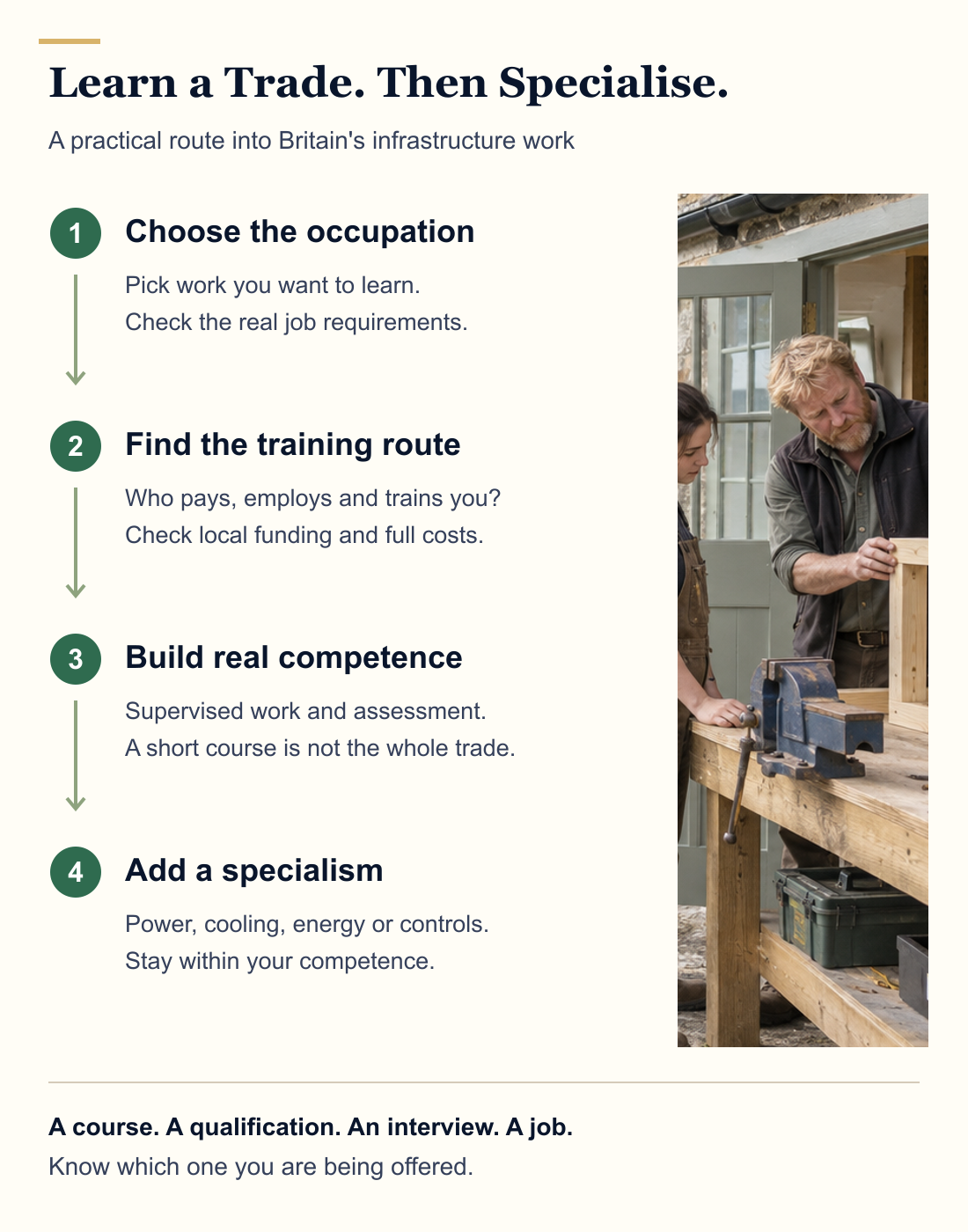
First, learn the foundations of the occupation. Then build the practical evidence that you can do the work. After that, investigate the additional training an employer needs for a particular system or sector.
The word "additional" matters. We are not talking about downloading an instruction manual and deciding that domestic electrical experience automatically authorises you to work on high-voltage infrastructure.
We are talking about a credible progression, with people who can supervise and assess you.
Nuclear Is More Than One Big Building Job
Sizewell C's early-careers page commits to 1,500 apprenticeships over construction, including opportunities through the project and its contractors. That is not 1,500 places open today. 13
Hinkley Point C has apprenticeship routes through EDF and its supply chain. Sellafield has craft pathways covering areas such as mechanical maintenance, electrical and instrumentation work, fabrication and pipefitting. These are different projects and different kinds of work. 7 14
The useful question is not simply "how do I get a nuclear job?" It is "which occupation would I learn, who would employ me, and what would I be qualified to do afterwards?"
Solar Is Not Just Making Panels
The government's Solar Roadmap estimates that solar could support up to 35,000 direct and indirect jobs in Great Britain by 2030. It also distinguishes opportunities in installation, supporting equipment and services from the much harder commercial proposition of competing in conventional panel manufacturing. 15
There is a difference between manufacturing a panel, mounting it on a roof, connecting it electrically and maintaining the installation. Look for the actual occupation and training route, not simply a course with "solar" in the title.
The Work Continues After the Opening Ceremony
Construction finishes. Maintenance does not finish on the same day.
That does not mean every building supports a huge permanent workforce. It means installation and ongoing operation are different employment opportunities, and a career plan should recognise both.
I would want a young person to see the whole picture: building something, learning how it works, finding faults and becoming trusted to keep it working. That is a much more substantial ambition than chasing the next announcement.
How Long Will It Take?
There is no honest single answer. Different occupations have different routes, and prior experience can matter.
| Published example | Time to plan around | What to check |
|---|---|---|
| JTL electrical apprenticeship in Wales | Usually four years | This is a particular Welsh route, not a universal UK timetable. 16 |
| England RACHP engineering technician, ST0322 v1.3 | 36 months practical training, typically six months assessment | Ask whether a quoted duration includes the assessment period. 17 |
| Sellafield engineering-maintenance craft programme | 48 months | The exact pathway and current recruitment availability. 7 |
| Octopus low-carbon heating apprenticeship | Around two and a half years overall | The employer page describes its timings in different ways; confirm the training and assessment timetable for the advertised intake. 18 |
| England groundworker, ST0513 v1.2 | 18 months, excluding assessment | A different occupation from a qualified electrician or refrigeration engineer. 11 |
Do not confuse a shorter route into one occupation with a shortcut into another.
I am not against short courses. They can be exactly what somebody needs when they already have the foundations, or when the course leads to a clearly defined entry role. I am against paying for the impression of being qualified while the practical route remains vague.
What Could You Earn?
These are the National Careers Service's illustrative annual ranges, from starter to experienced, checked in September 2026. They are not apprentice pay, not guaranteed offers and not self-employed business turnover.
| Occupation | Published annual salary range |
|---|---|
| Electrician | £26,000-£45,000. 5 |
| Refrigeration and air-conditioning installer | £25,000-£45,000. 6 |
| Engineering maintenance technician | £27,000-£48,000. 2 |
| Welder | £25,000-£45,000. 9 |
| Carpenter | £24,000-£40,000. 10 |
Now look beyond the headline. What are the hours? Is travel paid? Are there night shifts? What happens between projects? Who pays for tools, further training and accommodation? Is the quoted figure a salary or a contractor's revenue before costs?
I have a separate article for people who already have a trade about looking at the whole offer before moving. The same principle applies when you are beginning.
Training Has to Be Affordable Too
From April 2026, the minimum apprentice rate is £8 an hour for under-19s and people aged 19 or over in their first apprenticeship year. After that first year, apprentices aged 19 or over must receive at least the minimum for their age: £10.85 for ages 18-20, or £12.71 for age 21 and over. Employers can pay more. 19
At an illustrative 37.5 paid hours a week for 52 weeks, £8 an hour works out at £15,600 gross a year. That is arithmetic, not a promise of an employer's salary.
For a school leaver living at home, one offer might be workable. For a parent paying rent and childcare, it might not be. We do nobody a favour by ignoring that.
If government and employers want more adults to retrain, the question cannot stop at "did we fund the course?" It has to include "can somebody afford to complete it?"
Where to Start in England
A Paid Apprenticeship
An apprenticeship is a job with training. The basic English eligibility is generally age sixteen or over, living in England and not in full-time education. Employers and occupations have their own entry requirements. Start with the official apprenticeship search, employers and local colleges. 20
Ask who will employ you, how much you will earn and who provides the training. Those should be straightforward questions, not an awkward surprise at the end of a sales call.
There is an important current-rule detail. For English apprenticeship starts from 1 August 2025, off-the-job training has a minimum number of hours specified for each standard. The old blanket description of "20% of your working time" is not the correct general rule for new starters. Training should take place in normal paid working hours, with agreed compensation for exceptional arrangements outside them. 21
College and Preparation Routes
If you are not ready for a full apprenticeship, ask about suitable preparation or foundation options. Foundation apprenticeships are aimed at ages sixteen to twenty-one, with specified eligible groups aged twenty-two to twenty-four. They are a bridge, not the same thing as completing a full skilled occupation. 22
A T Level is another option after GCSEs: two years of study with an industry placement of around 45 days. It is not a paid apprenticeship, and tuition is free if you start before nineteen. The T Level course finder shows local provision. 23
The point is not that everybody should choose the same route. It is that you should understand where your chosen route goes next.
Adult Funding and Shorter Employer-Linked Training
For eligible adults, the Adult Skills Fund and Free Courses for Jobs can support approved qualifications. The 2026-27 rules for non-devolved English areas use annual gross earnings below £26,800 for the relevant fully funded offers, including people with no earnings. Age, residence, previous qualifications and the course still matter. London and other devolved areas set their own rules, so do not apply that figure automatically to your postcode. 24
Skills Bootcamps are free learner courses for adults aged nineteen or over, generally lasting up to sixteen weeks. Job-seeking routes include an employer interview; they do not guarantee employment, and not every Bootcamp awards a qualification. Ask exactly what the course delivers. 25 26
For eligible jobseekers, the Sector-based Work Academy Programme can provide up to six weeks of employer-linked preparation, work experience and interview or recruitment support. It operates in England and Scotland. Ask your Jobcentre work coach about local opportunities and your circumstances. 27
Your best funding question is this:
Which rules apply to my home postcode, this qualification and this start date? Can you confirm what is funded and what I would have to pay?
Get the answer before you sign up.
Scotland and Wales Have Their Own Routes
It would be much easier to write one simple "UK scheme" paragraph. It would also be wrong.
In Scotland, Modern Apprenticeships combine paid work with a recognised qualification. The national service describes programmes typically lasting one to four years, depending on the route. Start with Apprenticeships.scot and its vacancy finder. Ask about the Scottish framework rather than assuming an English qualification level means exactly the same thing. 28
In Wales, apprenticeships are available from sixteen with no general upper age limit, although specific role and funding conditions apply. Careers Wales is the starting point. 29
For eligible Welsh residents aged nineteen or over, Personal Learning Accounts offer flexible funded learning. The normal basic-earnings ceiling is £35,796, with no earnings cap for approved green and digital courses. Employment and other conditions apply; this is not the general route for unemployed learners. 30
ReAct+ is different: it supports eligible people aged twenty or over in specified redundancy or offender circumstances. It is not a grant for every unemployed adult. If you are unsure which route fits, ask Working Wales rather than guessing. 31
The broader lesson is simple: a scheme existing somewhere does not mean you personally qualify for it everywhere.
Employers and Colleges Worth Looking At
The following is a starting list, not a claim that all these organisations have an apprenticeship open today. Programme pages often remain online after an intake has closed.
| Organisation | What to investigate | Availability note, checked 10 September 2026 |
|---|---|---|
| SSE | Energy apprenticeships and trainee routes | Programme verified; check individual vacancies. 32 |
| ScottishPower / SP Energy Networks | Power-engineering pathways, including central and southern Scotland | The inspected 2026 higher-skills intake is closed. 33 |
| Sizewell C and contractors | Nuclear construction in Suffolk | Project-wide commitment is not a current vacancy count. 13 |
| EDF / Hinkley Point C | Somerset construction and supply-chain routes | Check the actual employer and start date. 14 |
| Sellafield | Mechanical, electrical/instrumentation and other craft pathways | Programme verified; not every pathway is recruiting. 7 |
| NG Bailey | Electrical, building services, commissioning and technical routes | Check individual intake requirements. 8 |
| Balfour Beatty | Construction, civil/mechanical engineering, plant and technical roles | UK-wide programmes; individual opportunities vary. 12 |
| Star Refrigeration | Industrial refrigeration engineering | The 2026 apprenticeship intake is closed. 34 |
| Octopus Energy | Low-carbon heating | The inspected page says applications are opening soon; check the current intake. 18 |
| Equinix | Data-centre facilities and operations | General apprenticeship route verified, not a specific open place. 1 |
| JTL | Electrical and building-services training linked to employers | A training provider, not a guaranteed job offer. 16 35 |
There are useful college starting points too. Five clean-energy Technical Excellence Colleges in England were selected in April 2026: Colchester Institute, South Bank Colleges, The City of Liverpool College, The Education Training Collective and University Centre Somerset College Group. 36
That does not make them the only good colleges. Nor does the designation mean every course is available or free for everybody.
A nearby college with good workshops, credible assessment and strong local employer relationships may be the right place for you. Ask it which employers actually take its apprentices.
And look beyond the name on the building. The apprentice may work for the electrical contractor, mechanical contractor or maintenance firm, not the data-centre operator or energy company. Your route does not have to begin with the biggest logo.
A Course Is Not a Qualification. An Interview Is Not a Job.
This is the part I would be most insistent about.
You can complete a course and still need workplace evidence. You can hold a qualification and still need specialist certification or employer authorisation. You can be promised an interview and still not receive a job offer.
Those are not reasons to give up. They are reasons to ask better questions.
The National Careers Service makes clear that classroom electrical learning is not, by itself, necessarily enough to become fully qualified. CSCS has qualification requirements for skilled cards; it is not a course provider or a universal licence to practise every trade. Specified work with F-gas equipment requires appropriate qualifications for the work involved. 5 37 38
Come on. If the promise is that a few weekends can turn a complete beginner into somebody qualified to do anything, I would want rather more than a glossy brochure.
Ask These Questions Before Paying
- What is the exact qualification? Get the title, awarding body and relevant level or framework.
- Is the course designed for a beginner? Some short specialist courses assume you already have a trade.
- Who supplies the supervised workplace experience? Do not leave that as "we will sort it out later".
- What assessment is required after the classroom work? Include the cost and time.
- Which employers recruited people from this exact course? Ask about recent outcomes, not a general marketing statistic.
- What will everything cost? Include tools, travel, assessments and resits, not just tuition.
- What happens if the employer or placement falls through? A recovery plan matters.
- What does the course not qualify me to do? A good provider should be able to explain the boundary.
These questions are useful whether you are spending your own money or taking a funded place. Your time matters too.
What If You Cannot Move Across the Country?
Not everybody can pack a bag and go to a major project. People have children, caring responsibilities, partners, homes and lives.
So start with the employers you can realistically reach. Look at local construction, refrigeration, building services and maintenance. Work out whether you can get to an early shift without assuming a bus route runs when it does not.
For someone able to travel, a large project might widen the options. For someone who needs to stay local, building a solid occupation through a smaller employer may make more sense.
Neither is a lesser ambition. The point is to find a route you can actually complete.
Your First 90 Days
First Fortnight: Pick Two Occupations
Not ten. Two.
Read the job descriptions, talk to people doing the work and ask what a normal difficult day looks like. Think about the physical demands, travel and the parts of the work you would enjoy learning.
Write down what you can afford during training. It is better to discover a gap now than halfway through a course.
By Day 30: Find the Route, Not Just the Course
Speak to two providers and several employers. Confirm entry requirements, funding, the workplace arrangement and the qualification endpoint.
Ask about maths and English support where you need it. Search actual apprentice vacancies. Make a note of the intake dates. A closed application round is disappointing; missing the next one because you never recorded it is avoidable.
By Day 60: Apply and Prepare
Tailor your application to the occupation. Explain why you want that work and what you have done that shows reliability, practical interest and follow-through.
Prepare for the employer's interview or assessment. Look for legitimate supervised experience where available. Do not invent experience, and do not buy a collection of certificates simply to feel that something is happening.
By Day 90: Make a Decision You Can Explain
Compare the employer, supervision, qualification, pay, travel, costs and progression.
If you have an offer, you should be able to explain why it is the right route. If you do not, agree a specific bridging step with a provider or prospective employer. Avoid drifting into an expensive course because it is the only thing that answered your enquiry quickly.
Use AI to Help You Learn, Not to Pretend You Know
Here is where AI can be useful right now.
Ask it to explain terminology. Practise the maths. Use it to organise your questions for a college. Give it a public job advert and ask it to separate essential requirements from desirable ones. Get help making your application clearer.
For example:
Compare these three apprenticeship adverts using only the information in them. Show the qualification, pay, location, travel, entry requirements, training time and closing date. Mark missing information as unknown. Give me five questions to ask each employer. Do not invent experience for my application.
That is a sensible use of an assistant.
Treating an AI answer as authorisation to work on a live electrical system, pressure equipment or refrigerants is not. Follow the qualified supervisor, relevant procedures and manufacturer documentation. Protect employer and customer information when using online tools.
The aim is to become a better tradesperson who can use AI. Not a person who can get an AI to sound like a tradesperson.
Northern Ireland: A Separate Route Worth Knowing About
Northern Ireland has its own apprenticeship and training system. Apprenticeships combine paid work and training from the relevant school-leaving age, generally sixteen, with specific employment and eligibility conditions. Start with nidirect. 39
A concrete example at the time of checking is the South West College Welding Academy in Cookstown. It advertises twelve places, six weeks of training and a £185 weekly allowance, with help towards travel and childcare. Applicants must be at least eighteen and eligible to work in the UK. The published deadline is noon on 2 October 2026, with training from 26 October to 4 December. Successful completion brings a guaranteed interview, not a guaranteed job; the roles are not eligible for skilled-worker sponsorship. Recheck the live notice before applying. 40
That is the kind of specific connection worth looking for: training, a defined entry point and named employer involvement. It does not mean six weeks qualifies you for every welding job.
What I Would Like Us to Do as a Country
I like the idea of Britain building things. I like the idea of people leaving education with skills they can use, improve and carry into different parts of their working lives.
But enthusiasm needs a route behind it.
If we want more people to work on our infrastructure, I would like us to judge training by more than the number of people who start a course. Can they finish? Can they afford to stay? Do they get supervised experience? Do employers recognise the qualification? Is there work at the end?
Those are the questions that turn a good announcement into somebody's career.
I am not claiming these jobs are immune to change. Robots, better tools and different construction methods can change physical work too. Nor is every energy or building project caused by AI. We need homes, functioning infrastructure and reliable energy regardless.
What I am saying is that you do not have to stand outside this change wondering whether it has a place for you.
Choose something useful. Learn it properly. Find people who will help you become good at it. Then use the new tools to widen what you can do.
There is a lot more to the future than writing the software. Someone has to make it work in the real world.
Sources and Notes
This is a practical, evidence-led guide, not an individual funding decision or a guarantee of employment. Government sources establish scheme rules but have an interest in their policy forecasts. Employer pages establish advertised programmes, not independent evidence of placement quality. Salary ranges are career-service illustrations. Qualifications, vacancies and funding should be checked again before enrolment.
The numbered links beside claims go directly to the source. Research checked 10 September 2026. Generated photographs are illustrative, not documentation of a real training provider or apprentice.