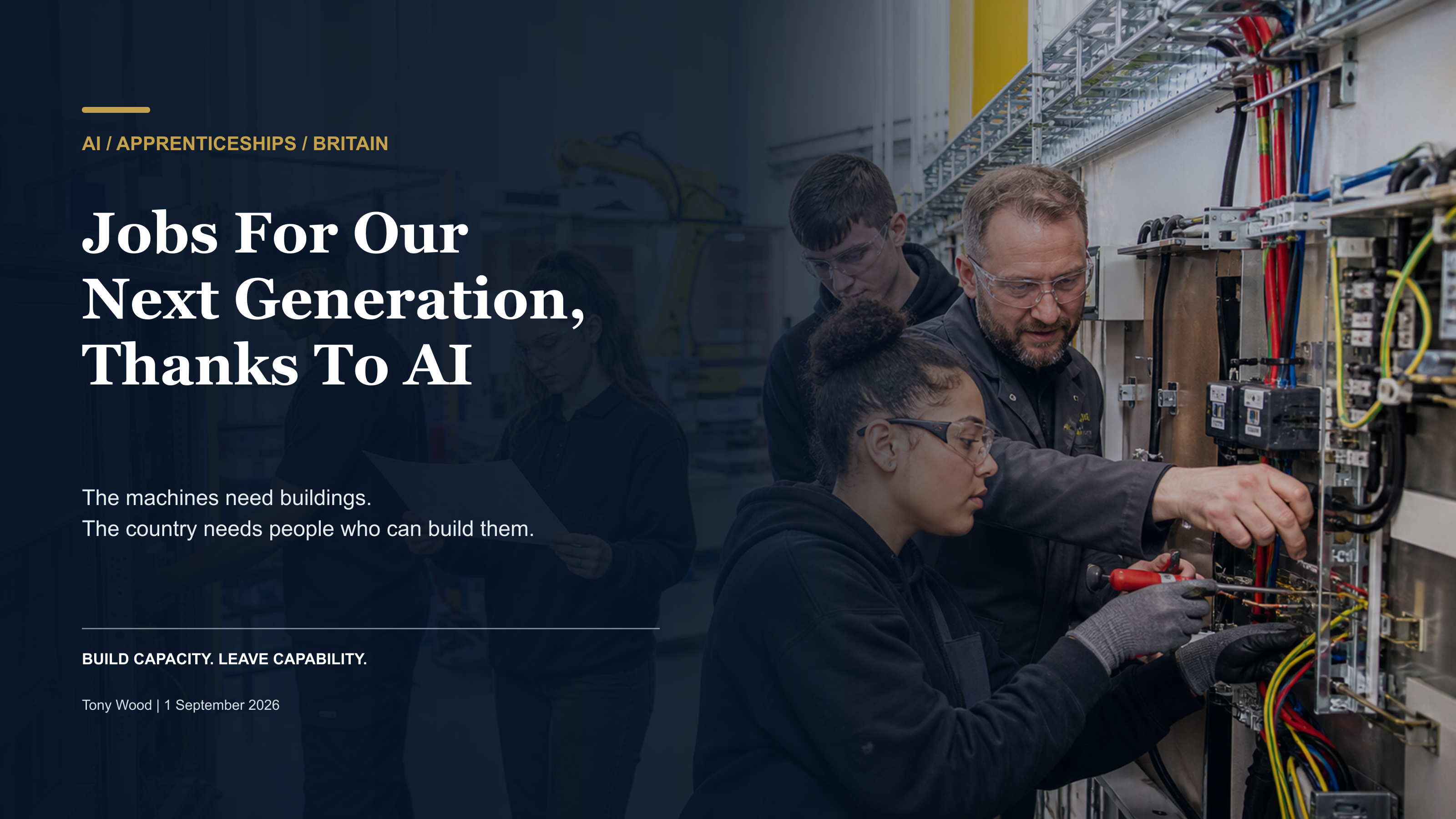
I had just finished asking how many jobs a data centre actually creates.
I expected a fairly dry answer about construction workers and permanent staff. What I found was much more hopeful.
The permanent workforce inside a data centre is not enormous. We should be honest about that. But building AI infrastructure needs electricians, cable installers, cooling engineers, mechanical technicians, controls specialists, commissioning engineers, fibre installers and people who understand how real systems behave when something goes wrong.
Those are not skills for one building. They are skills for the grid, batteries, factories, warehouses, robotics, rail, housing, nuclear, renewables and whatever we build next.
So perhaps the most valuable thing a British AI infrastructure programme could leave behind is not only compute.
It could leave behind a generation of people who know how to build, maintain and repair the physical economy.
AI has a physical economy
We talk about AI as if it lives in a browser. It does not.
Behind the chat box are substations, switchgear, transformers, uninterruptible power supplies, batteries, generators, cooling plant, pumps, control systems, fibre, racks, security and teams responsible for keeping all of it safe.
A model can write instructions. It cannot climb a cable ladder, isolate a live system, commission a cooling circuit or replace a failed pump in the middle of the night. Robotics will change some of that work, but robots also have to be designed, installed, programmed, maintained and repaired.
This is why I think the debate about AI and employment is often too narrow. We ask which office tasks AI may automate. We ask far less often who will build the physical systems on which AI depends.
The International Labour Organization's 2025 analysis found that clerical work has the highest exposure to generative AI. It also stressed that exposure is not the same as a job disappearing: because people remain necessary across many tasks, transformation is more likely than wholesale replacement for most occupations.
Physical technical work is not immune from automation. Nothing is. But a competent electrician, cooling technician or mechatronics engineer combines knowledge, judgement, dexterity, safety discipline and responsibility in a changing real-world environment. That is a strong foundation on which to build a career.
The jobs claim has to remain honest
I do not want to replace one bad headline with another.
My companion analysis found that one large UK planning case supports a narrow illustration of roughly five to seven direct construction full-time-equivalent roles per megawatt of IT capacity while actively building. That could mean around 500 to 700 direct construction FTE for a 100 MW project.
It does not mean 500 to 700 permanent jobs once the doors open. Operations teams are much smaller. Nor does it give us a defensible electrician headcount, because the published planning evidence does not contain a trade-by-trade workforce schedule.
The opportunity comes from a programme, not a single building: project after project creating enough continuity for people to finish their training and move into the next piece of infrastructure.
That is a better argument than pretending every data centre will employ thousands of local people forever.
Why domestic compute still matters
There is a resilience argument here as well.
Britain should work with American, European and other international technology companies. But we should not make ourselves entirely dependent on any one country, provider or commercial relationship for energy, communications or compute.
Model availability can change. Prices, terms, export controls, service routing and corporate priorities can change. Systems can fail. A government or provider does not need to maliciously "turn Britain off" for concentration risk to become painful.
The government's UK Compute Roadmap says the country will need at least 6 GW of AI-capable data-centre capacity by 2030, about three times the capacity available when the roadmap was prepared. It explicitly frames compute as part of sovereign capability and warns against over-reliance on foreign infrastructure.
But a building in Britain is not automatically sovereign AI. Real capability also requires secure energy, chips and replacement parts, networks, skilled operators, model access or ownership, data governance, cybersecurity and enough contractual or public control to keep critical workloads running.
Domestic infrastructure is one layer of resilience. The people who can build and operate it are another.
How long does it take to train?
Longer than an election announcement. Often longer than one standalone data-centre build.
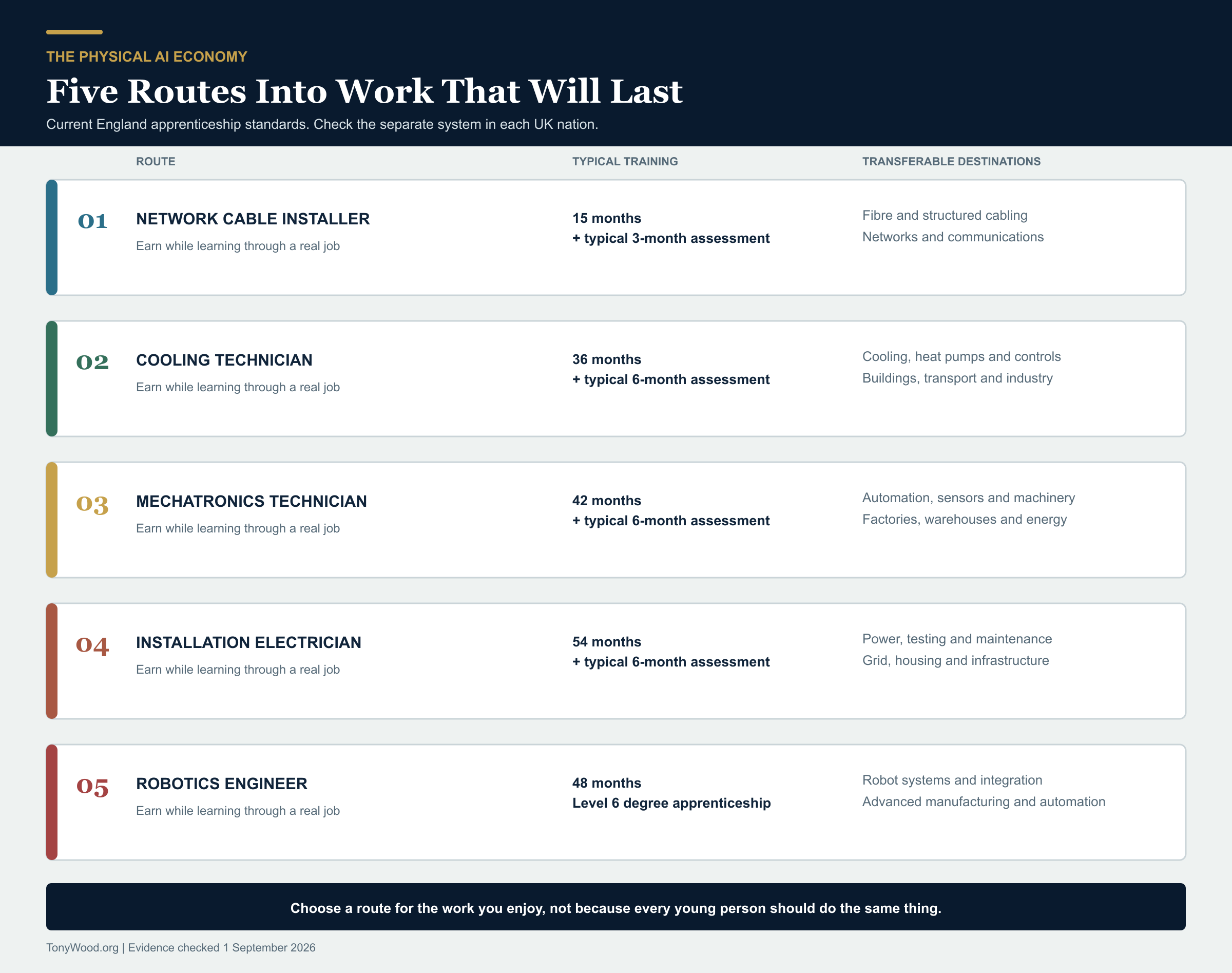
The current installation and maintenance electrician apprenticeship in England typically involves 54 months on-programme, followed by a typically six-month end-point assessment period. Other routes are shorter, but none turn an inexperienced teenager into a trusted critical-facilities engineer overnight.
| Route | Level | Typical duration shown by Skills England | Where it can lead |
|---|---|---|---|
| Network cable installer | 3 | 15 months plus a typical 3-month assessment period | Fibre, copper, structured cabling and network infrastructure |
| Refrigeration, air conditioning and heat pump engineering technician | 3 | 36 months plus a typical 6-month assessment period | Cooling plant, heat pumps, fault-finding and energy performance |
| Mechatronics maintenance technician | 3 | 42 months plus a typical 6-month assessment period | Automated machinery, controls, sensors, manufacturing and logistics |
| Installation and maintenance electrician | 3 | 54 months plus a typical 6-month assessment period | Electrical installation, testing, maintenance and progression into specialist systems |
| Robotics engineer degree apprenticeship | 6 | 48 months | Automation, robot systems, integration and advanced manufacturing |
These standards and durations apply to England. Apprenticeships are devolved, so Scotland, Wales and Northern Ireland operate their own systems and official vacancy services. The work is British; the training route must be checked in the nation where the learner lives and works.
We have more support, but starts are not enough
There are reasons to be encouraged.
Provisional figures for England recorded 308,770 apprenticeship starts between August 2025 and April 2026. Of those, 63,530 were by people under 19, and 23,900 were in the broad Construction, Planning and the Built Environment subject area.
From 1 August 2026, England's Growth and Skills Levy arrangements fully fund eligible apprenticeship starts for 16-to-24-year-olds. Government material also describes support of up to £8,000 for eligible small and medium-sized employers hiring young apprentices, alongside an ambition for 50,000 additional youth apprenticeships by the end of the Parliament.
That is movement in the right direction. But the completion numbers are the warning.
Official statistics put the overall apprenticeship achievement rate at 65.4% in 2024/25. For Construction, Planning and the Built Environment it was 58.3%.
An announced place is not a qualified person. If four in ten learners in a relevant subject area are not recorded as achieving, the answer is not simply to publish a larger number of starts. We have to understand why people leave, improve employer and provider quality, support learners through difficult periods and make sure a real job exists at the end.
The legal apprentice minimum from April 2026 is £8 an hour for apprentices under 19, and for those aged 19 or over during the first year. Older apprentices move to the minimum rate for their age after that first year. It is a floor, not an aspiration. Good technical employers should pay enough for a young person to travel, eat, obtain tools and remain on the programme.
These can become properly paid careers
The National Careers Service gives broad annual salary ranges of:
- Electrician: £26,000 to £45,000.
- Refrigeration and air-conditioning installer: £25,000 to £45,000.
- Mechanical engineering technician: £27,000 to £47,000.
- Robotics engineer: £31,000 to £60,000.
Those are national career guides, not promises and not a data-centre wage survey. Shift work, location, overtime, security clearance, responsibility and specialist qualifications can move actual pay in either direction.
The attraction is not only the salary. It is the portability.
An electrician trained on critical power can move into the grid, batteries, rail, a hospital, a factory, housing or another data centre. A cooling engineer can work across buildings, transport, food storage, heat pumps and industry. A mechatronics technician can move between robotics, automated warehouses, advanced manufacturing and energy systems.
That is what makes these lifelong skills rather than jobs tied to one fashionable technology.
What I would tell a 16-year-old
I would not tell every young person to become an electrician. That would be just as silly as telling everybody to learn to code.
I would say: if you like finding faults, making things work and understanding how the physical world fits together, take these careers seriously.
- Keep your maths, English and science moving. Entry requirements vary, but those subjects keep more technical routes open.
- Look beyond the job title. Search electrical, building services, cooling, network cabling, maintenance, controls, mechatronics and robotics.
- Apply through the official service for your nation. England, Scotland, Wales and Northern Ireland have separate systems.
- Interview the employer too. Ask how much time is supervised on the job, who the training provider is, what happens when the current project ends and how many previous apprentices completed.
- Check the pay and travel honestly. A technically good opportunity can still be impossible if the wage does not cover getting to a remote site.
- Build evidence. A college project, safe workshop practice, a wiring exercise, a robot, a repaired machine or a thoughtful portfolio can show far more than saying you are interested.
England also has 21 Institutes of Technology, created through partnerships between colleges, universities and employers to deliver higher technical education. They are one route, not the whole answer. Local further-education colleges and good apprenticeship providers remain essential.
I remember technical college
When I was young, I went to technical college. We did physical things. We worked with computers when that still felt like a slightly strange thing to choose.
There were only four people on my course. Two left. The course closed, and I moved on to a BTEC.
I remember that because the world later needed rather a lot of people who understood computers.
We are in danger of doing the same thing again if we wait until every data centre, grid connection, battery plant, automated factory and robot fleet is already being built before deciding that technical education matters.
Training capacity is infrastructure. You have to build it before the demand peak.
Britain knows how to make things
I do not want a misty-eyed list claiming Britain invented everything. Discovery and engineering have always crossed borders, and the best British successes often involved immigrants, international teams and ideas developed elsewhere.
But we should remember what can happen when this country gives practical people room to work:
| Contribution | What Britain actually did | The important nuance |
|---|---|---|
| Public railways | The Stockton and Darlington Railway opened in 1825 as the first steam-hauled passenger public railway, under George Stephenson's engineering leadership. | Railways emerged from many engineers, workers, investors and earlier technologies. |
| Jet propulsion | Frank Whittle designed and successfully tested the first British jet engine. | Hans von Ohain developed a jet engine independently in Germany; this was not a solitary British invention story. |
| Modern computing | Alan Turing's theory and wartime work helped establish foundations for computing and machine intelligence; Colossus operated at Bletchley Park. | Colossus was led by Max Newman and engineered by Tommy Flowers and his team, not built by Turing alone. |
| The World Wide Web | British computer scientist Tim Berners-Lee created the Web's core technologies. | He did it at CERN in Switzerland, inside an international research institution. |
| Efficient computing | Sophie Wilson and Steve Furber designed the first Arm processor at Acorn in Cambridge. | Arm's global reach came through a worldwide licensing and engineering ecosystem. |
The lesson is not that British people are magically cleverer than everybody else. It is that practical education, patient institutions, skilled teams and permission to tinker can turn small beginnings into infrastructure used around the world.
My proposal: an AI Infrastructure Skills Guarantee
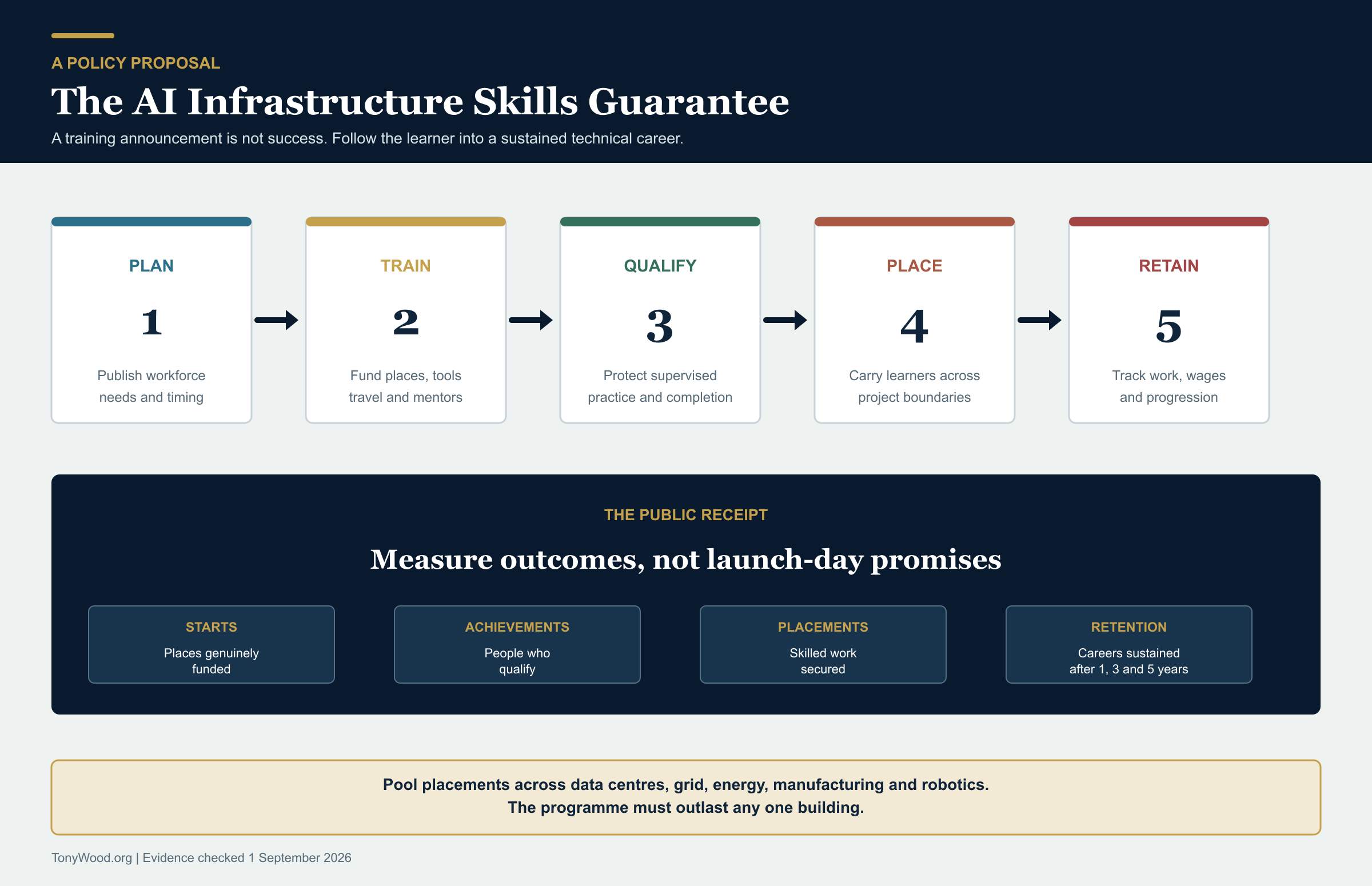
If Britain is going to provide land, power connections, planning support and public policy attention to major AI infrastructure, we should ask for a measurable skills bargain in return.
- Publish the workforce curve. Separate peak workers, average construction FTE, person-years, supply-chain work and permanent jobs.
- Fund places before construction peaks. Local colleges and providers need equipment, instructors and certainty years ahead.
- Pool placements across sectors. Data centres, utilities, grid contractors, energy projects and manufacturers should carry apprentices across project boundaries.
- Guarantee supervised experience. A course without enough real work does not create competence.
- Measure completions and progression. Publish starts, achievements, placements, wage progression and retention after one, three and five years.
- Make access practical. Include travel, tools, mentoring and support for learners who cannot rely on family money.
- Keep the benefit local without pretending every job is local. Set credible interview, placement and supplier commitments while acknowledging that specialist teams travel.
This should be designed with the four nations, employers, unions, colleges, training providers and young people. It should not become another glossy promise attached to a planning application.
Its success measure is simple: how many competent people entered sustained technical careers who would not otherwise have had the opportunity?
Believe in the next generation
I love this country. We are at our best when we stop apologising for making things and start giving people the tools to make them.
AI will undoubtedly disrupt jobs. We should prepare honestly for that. But it will also require Britain to build an enormous amount of physical infrastructure, and the same skills will be needed in energy, automation, manufacturing and robotics.
So do not only ask what AI will replace.
Ask what Britain must build. Ask who will build it. Ask whether a teenager in Sunderland, Slough, Newport, Belfast, Glasgow or Bicester can see a route into that work. Then make sure the training starts early enough for them to finish it.
Data centres may hold the machines. The more important national asset could be the people we train to build them.
Sources and notes
Evidence checked 1 September 2026. Apprenticeship policy, funding and statistics are labelled by nation because skills policy is devolved. Salary figures are National Careers Service guides rather than promises, and the construction-jobs illustration retains the boundaries explained in the companion data-centre analysis.
- Companion analysis: How Many Jobs Does A Data Centre Actually Create?
- UK Compute Roadmap
- Department for Education apprenticeship statistics 2025/26
- Apprenticeship funding from August 2026
- Department for Education update, 5 August 2026
- Growth and Skills Levy
- National Minimum Wage rates
- Skills England: installation and maintenance electrician
- Skills England: network cable installer
- Skills England: refrigeration, air conditioning and heat pump engineering technician
- Skills England: mechatronics maintenance technician
- Skills England: robotics engineer degree apprenticeship
- Skills England: maintenance and operations engineering technician
- Department for Education: Institutes of Technology
- National Careers Service: electrician
- National Careers Service: refrigeration and air-conditioning installer
- National Careers Service: mechanical engineering technician
- National Careers Service: robotics engineer
- International Labour Organization: Generative AI and jobs, 2025 update
- Official apprenticeship search for England and links to the devolved nations
- Apprenticeships Scotland
- Careers Wales apprenticeship search
- Northern Ireland apprenticeship opportunities
- Science Museum: Frank Whittle and the British jet engine
- Bletchley Park computing and AI timeline
- World Wide Web Foundation: History of the Web
- Arm: history of the Arm architecture
- National Railway Museum: Stockton and Darlington Railway