
I keep hearing a very simple argument about AI infrastructure.
Do not build data centres. They use electricity. They use water. They are bad for the environment.
The electricity and water questions are real. I have already looked at them in UK Data Centre Water And Power: The Facts. A large proposal should have to show what it will consume, when it will consume it, where the power and water will come from, and what happens when the local system is under stress.
But hospitals, leisure centres, factories, railways and housing also use resources. We do not decide whether to build them from one input alone. We ask what they provide, what they cost, where the burden falls and what Britain gets in return.
So I wanted to answer a narrower question:
How many jobs does a data centre actually create?
The answer is more interesting than either side's headline.
Data centres create a substantial amount of skilled work while they are being built, but a surprisingly small permanent workforce once they are running.
That does not make the jobs case weak. It changes the jobs case. The opportunity is not one building employing thousands of people forever. It is a sustained programme of electrical, engineering and construction work that could help Britain train people for data centres, the grid, housing, nuclear, renewables, rail and advanced manufacturing.
First, ask what the jobs number means
If somebody tells me a new data centre will create 2,500 jobs, my first question is: for how long?
Employment figures are often presented as if they were interchangeable. They are not.
- Peak workers means the largest workforce expected at the busiest point.
- Average construction FTE means the average number of full-time-equivalent positions supported while the project is active.
- Person-years means one person working for one year. Five hundred person-years could be 500 people for one year or 250 people for two years.
- Supply-chain jobs may be spread across Britain and may be estimated using economic multipliers.
- Permanent jobs are the people required once the centre is operating. Even then, shift coverage means not everyone is on site at once.
Unless those definitions are shown, the headline is not decision-useful.
A transparent 100 MW IT-capacity construction example
There is no official British rule saying a data centre creates a fixed number of jobs per megawatt. The denominator matters too: the calculation below uses IT capacity, not utility connection capacity. Design, power density, prefabrication, location, build sequence and campus scale all change the workforce.
One substantial UK planning case gives us a basis for a narrow illustration. Graven Hill's stated 290 MW of IT capacity and estimated 1,500 to 2,000 average gross direct construction FTE imply roughly five to seven direct construction FTE for each MW of IT capacity while actively building. This is one developer-commissioned campus study, not independent confirmation or a universal ratio.
| Measure | Indicative employment | Calculation | Evidence status |
|---|---|---|---|
| Average direct construction FTE while actively building | About 500-700 | 100 MW IT capacity multiplied by roughly 5-7 | TonyWood.org illustration derived from one prospective campus planning case |
| Electrician headcount | Not estimated | No published occupational schedule supports a per-MW ratio | Electrical work is important, but cost share cannot be converted directly into people |
| Permanent operating workforce | Not estimated generically | Use project-specific operating plans | The available projects use different scopes and boundaries, so no universal ratio is supported |
A smaller site can require more staff per megawatt because security, management and shift coverage create a minimum staffing floor. A very large campus can share people and systems across several buildings. The construction calculation is a planning lens, not a promise, and the operating workforce should stay project-specific.
What real UK projects say
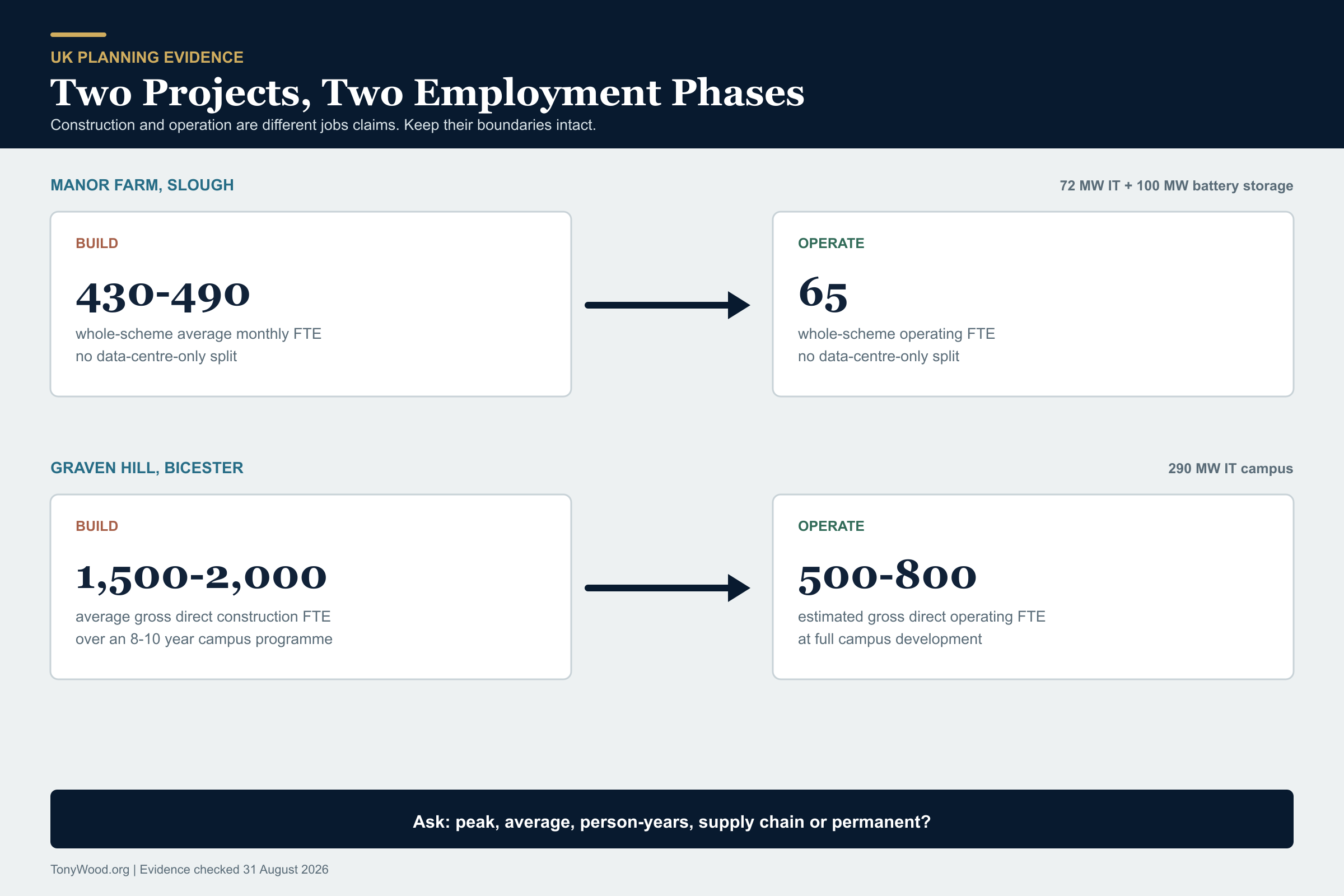
The proposed Manor Farm scheme in Slough combined a 72 MW IT-capacity data centre with a separate 100 MW battery-storage system. Its economic statement estimated 430 to 490 full-time-equivalent construction jobs in any given month during a 14 to 15-month build, equivalent to about 530 construction person-years, and about 65 permanent FTE once operating. The source does not split those jobs between the data centre and the battery system, so I treat them as whole-scheme estimates and do not use them in the jobs-per-MW calculation.
The proposed Graven Hill campus near Bicester is much larger: 290 MW of IT capacity in the planning material, developed over eight to ten years. Its economic statement estimated an average of 1,500 to 2,000 gross direct construction FTE, including on-site and off-site work, plus 1,800 to 2,400 indirect supply-chain FTE. At full operation it estimated 500 to 800 gross direct FTE, with about half expected to be on site at any given time.
These are developer-commissioned planning estimates, not counted outcomes. They are still valuable because they expose the methodology and the difference between construction and operation.
| Project | Capacity and build | Construction | Operation | Main caveat |
|---|---|---|---|---|
| Manor Farm, Slough | 72 MW IT data centre plus 100 MW battery storage; 14-15 months | 430-490 average monthly FTE; 530 person-years | About 65 FTE | Whole-scheme planning estimate; no data-centre-only split |
| Graven Hill, Bicester | 290 MW IT; 8-10-year campus programme | 1,500-2,000 direct FTE plus 1,800-2,400 indirect FTE on average | 500-800 gross direct FTE at full operation | Planning estimate; direct construction includes on-site and off-site work |
What are the jobs?
A data centre is not just a large shed containing computers. It is a power and cooling system wrapped around digital equipment.
During construction it needs high-voltage and low-voltage electricians, cable installers, commissioning engineers, mechanical and electrical project managers, controls engineers, heating and ventilation specialists, pipefitters, fibre installers, security-system engineers, groundworkers, steelworkers, fire-protection specialists and general construction trades.
Once open, the mix changes. The permanent team is smaller but technically important: critical-facilities engineers, electrical and mechanical technicians, network and hardware teams, security, operations, compliance and management. Specialist contractors continue to service UPS systems, switchgear, generators, batteries, cooling plant and high-voltage equipment.
The current National Careers Service ranges give a useful salary baseline:
| Occupation | Indicative annual range | Relevance |
|---|---|---|
| Electrician | £26,000-£45,000 | Power installation, testing and maintenance |
| Electrical engineering technician | £24,000-£48,000 | Equipment, controls, maintenance and fault-finding |
| Building services engineer | £28,000-£51,000 | Power, cooling, ventilation and building systems |
| Electrical engineer | £27,000-£58,000 | Design, power systems, assurance and commissioning |
Real data-centre pay can be above or below those broad ranges depending on location, shifts, overtime, security clearance, specialism and experience. They are national career guides, not a data-centre wage survey.
What does Britain get beyond the jobs?
The employment case is only one part of the public-value test. Data centres provide the physical computing behind cloud services, banking, communications, public services, research and AI. Domestic capacity can also improve resilience, reduce latency for some workloads and give organisations more choices about where sensitive data and critical services run.
I have made the wider capacity argument in Why The UK Needs More Data Centres. The important point here is that those benefits still have to be designed into the project. A new grid connection, fibre route, heat-reuse scheme or local training programme is not automatically a public benefit merely because it appears in a planning document. We should ask who receives it, who pays for it and whether it is delivered.
Jobs cannot rescue the wrong building in the wrong place. But neither should a serious piece of national digital infrastructure be described only by the water and electricity it consumes.
Where would the employment be?
It is tempting to say data centres will simply go to rural areas where jobs are needed. The geography is more complicated.
They follow available power, fibre, suitable land, planning consent, resilience requirements and proximity to customers. That is why the Thames Valley remains important. It is also why the government's AI Growth Zone programme is looking beyond the existing cluster to Oxfordshire, the North East, North and South Wales, and Scotland.
The construction workforce is partly local and partly mobile. Groundworks, building trades, transport, accommodation and services can benefit the surrounding area. Highly specialised electrical, commissioning and equipment teams may travel between national projects. Prefabricated equipment may be manufactured somewhere else entirely.
Local employment is therefore not automatic. A planning application can promise jobs while the most valuable work travels in and out with specialist contractors.
If a community is being asked to provide land, grid capacity and planning consent, it is reasonable to ask how many local people will start training, complete it, get placed on the project and remain in skilled employment afterwards.
Britain already has an electrical skills gap
JTL reported that England's electrical workforce stood at about 161,300 in 2025, around a quarter smaller than in 2018. It recorded about 7,200 electrical apprenticeship starts in 2024/25 and estimated that roughly 12,500 a year were needed.
Britain is not starting without a training system. Provisional official figures for England recorded 1,561,830 adults participating in further education and skills between August 2025 and April 2026. Over the same period there were 308,770 apprenticeship starts, including 23,900 in Construction, Planning and the Built Environment; 63,530 of all starts were by people under 19.
Those are not 1.56 million people waiting to become data-centre electricians. The further-education total includes adult apprenticeships and many unrelated subjects, while starts are not the same as completions. The figures show that a national training network already exists. The task is to fund the right places, improve completion and connect learners to real projects.
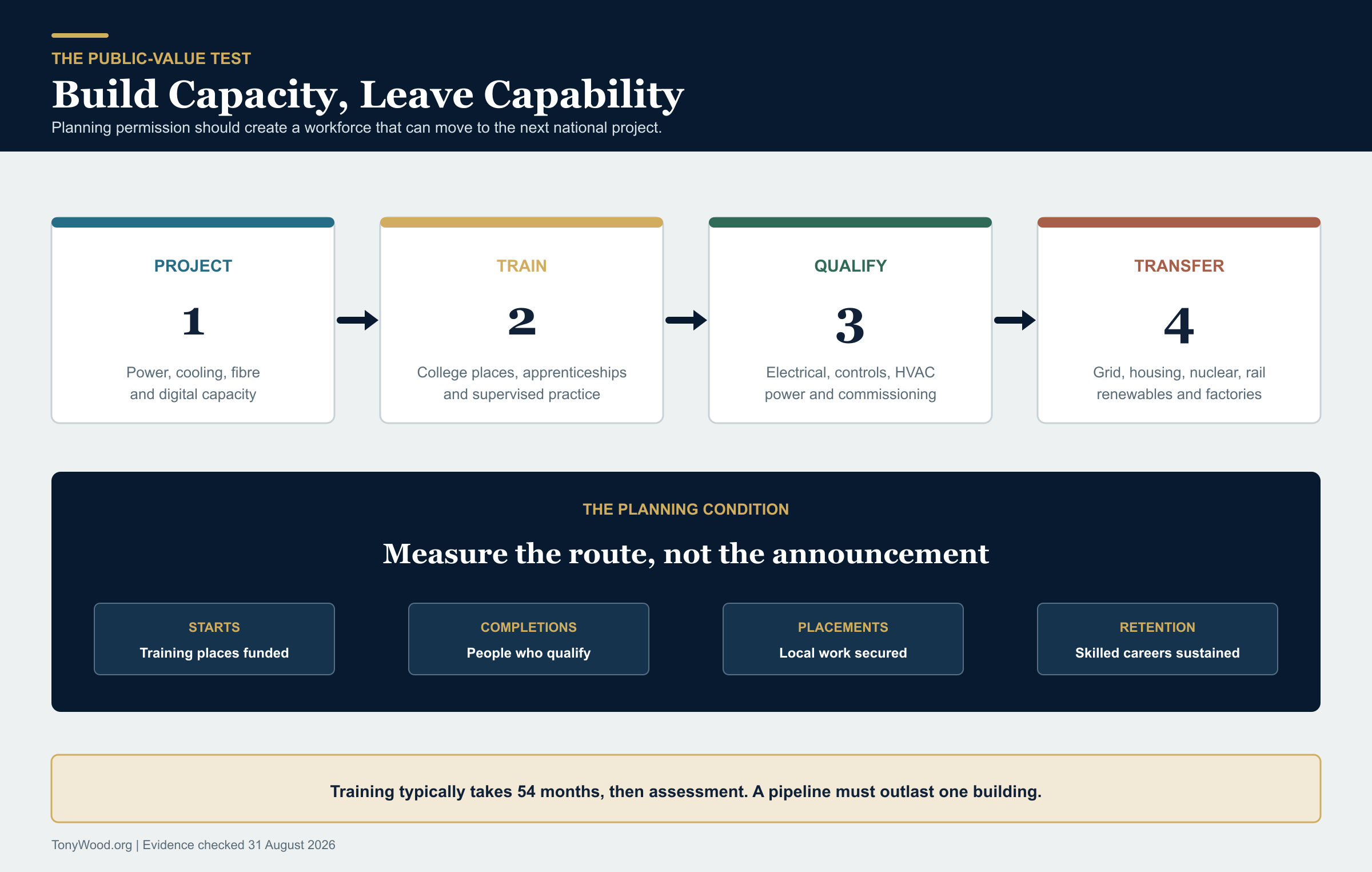
The current installation and maintenance electrician apprenticeship typically takes 54 months on-programme, followed by a typically six-month end-point assessment period. That is longer than many standalone data-centre builds.
This is important. One project cannot sensibly recruit hundreds of apprentices at the start and abandon them when the building opens. The training model needs a pipeline of projects and employers that can carry people through completion.
Turn planning permission into a skills bargain
England now has 21 Institutes of Technology linking colleges, universities and employers around higher technical education. Data-centre regions also have further-education colleges, apprenticeship providers and established electrical contractors.
I think every major campus should come with an employment and skills plan that is measurable rather than decorative:
- Publish the workforce curve. Show average, peak, person-year, supply-chain and permanent employment separately.
- Fund training before peak demand. Electricians take years to qualify. The college places must exist before the project needs them.
- Pool apprenticeships across projects. Developers, contractors, utilities and colleges should create continuity beyond one site.
- Set local interview and placement commitments. Do not pretend every specialist role can be local from day one, but create a route into them.
- Measure completions, not only starts. An apprenticeship announcement is not the same as a qualified worker.
- Publish retention and progression. Track whether people move into permanent facilities work or the next grid, housing, energy or industrial project.
As an illustrative policy, Britain could ask for 20 to 30 funded apprenticeship starts with retained placements per 100 MW of delivered IT capacity. That would mean 1,000 to 1,500 opportunities across 5 GW of IT capacity, or 4,000 to 6,000 across 20 GW.
That is my proposed benchmark, not a forecast or an existing national requirement. It should be refined with employers and training providers, then judged on completions and skilled employment rather than launch-day publicity.
How large could the programme be?
The UK Compute Roadmap says Britain needs at least 6 GW of AI-capable data-centre capacity by 2030, roughly three times the capacity available when the roadmap was prepared.
One automated commercial planning tracker displayed 280 data-centre-related applications across 83 local authorities on 31 August 2026. That does not mean 280 new data centres. The tracker warns that its aggregation requires source verification, and the total includes amendments, reserved matters and condition discharges. A separate analysis reported more than 60 applications for completely new centres in England and Wales during 2025.
Planning applications are not completed buildings, either. Some will be refused, revised, delayed or never financed.
The honest way to model the jobs is to ask how many equivalent builds are active at the same time.
| 100 MW IT-capacity equivalents actively building | Illustrative direct construction FTE | What this does not estimate |
|---|---|---|
| 5 | 2,500-3,500 | Separate electrician headcount, supply chain and permanent operation |
| 10 | 5,000-7,000 | Separate electrician headcount, supply chain and permanent operation |
| 20 | 10,000-14,000 | Separate electrician headcount, supply chain and permanent operation |
Suppose Britain delivered fifty 100 MW IT-capacity equivalents evenly over ten years, and assume each is actively building for about two years. The two-year duration is part of this TonyWood.org scenario, not a general industry fact. The scenario does not mean 25,000 to 35,000 construction jobs sustained for the whole decade. It means about ten equivalent builds active on average: roughly 5,000 to 7,000 direct construction FTE. The available evidence does not support splitting that total into a national electrician headcount.
That correction matters. It makes the argument smaller, but much more credible.
How does that compare with other development?
Different infrastructure produces different public value, so a jobs table cannot tell us what Britain should build. Housing provides homes. Nuclear provides firm low-carbon power. Rail provides transport capacity. A warehouse supports logistics. An office houses work that may already exist elsewhere.
| Development | Construction character | Long-term direct jobs | What not to confuse |
|---|---|---|---|
| 100 MW IT-capacity data centre | Electrical, power, cooling, controls and commissioning intensive | Use the project-specific operating plan; no universal ratio is supported here | Temporary build employment with permanent operation |
| Sizewell C | National, long-duration engineering programme; the project describes around 8,000 people on site at peak, while government describes 10,000 directly employed at peak | About 900 permanent roles | On-site and directly employed are different boundaries |
Sizewell C is a useful skills comparison. The project says it will create at least 1,500 apprenticeships. Its 2022 employment prospectus projected needs including 775 approved electricians and 170 cable installers for the then-scheduled 2026-2030 mechanical, electrical and heating phase. These are not measured current requirements. Sizewell is a much larger and longer project than a data centre, but the overlap in electrical, cooling, controls and commissioning skills is striking.
The jobs case, stated honestly
techUK's industry modelling says the existing UK data-centre sector supports about 43,500 direct, indirect and induced jobs and £4.7 billion of annual gross value added. Under a scenario in which annual capacity growth rises from 10% to 15%, it models around 40,200 additional directly employed operational roles by 2035 and 18,200 additional directly employed construction roles over 2025-2035.
Those are industry-modelled national estimates, not an official census. The 43,500 baseline includes the wider direct, indirect and induced footprint; the additional scenario figures are direct employment estimates with different time bases. None should be dropped into a local planning argument as if every proposed centre will produce the same result.
Nor should jobs be used to wave away water, grid, noise, land or environmental constraints. The ECA is right to warn that data-centre growth must not outpace grid capacity or the supply of skilled workers, and must not simply pull scarce electricians away from housing and clean-energy projects.
That is why the training commitment matters. If the sector only competes for the electricians Britain already has, it can make the national bottleneck worse. If it helps train more of them, carries apprentices through qualification and leaves a workforce able to move between critical projects, the value is much broader than the final operating headcount.
So I would not say:
“Data centres create more jobs than other development.”
The evidence does not support that.
I would say:
“A sustained data-centre building programme can support well-paid technical employment and help finance the electrical and engineering skills base Britain already needs for housing, energy, the grid and industrial growth.”
But only if we make that outcome part of the bargain.
Sources and notes
Evidence checked 31 August 2026. Project employment figures are planning estimates rather than measured completed-project outcomes. The 100 MW IT-capacity construction illustration, concurrent-build scenario and apprenticeship benchmark are transparent TonyWood.org calculations or proposals and are labelled as such. No generic electrician or permanent-jobs-per-MW ratio is claimed.
- techUK: Foundations for the Future
- Manor Farm economic statement
- Manor Farm recovered planning decision and inspector material
- Graven Hill economic benefits statement
- ECA: growth must not outpace grid capacity or skills supply
- JTL: England's electrical workforce and apprenticeship gap
- Skills England: installation and maintenance electrician apprenticeship
- Department for Education: further education and skills, 2025/26 provisional in-year statistics
- Department for Education: apprenticeships, 2025/26 provisional in-year statistics
- National Careers Service: electrician
- National Careers Service: electrical engineering technician
- National Careers Service: electrical engineer
- National Careers Service: building services engineer
- Department for Education: Institutes of Technology
- UK Compute Roadmap
- UK AI Growth Zones
- UK Data Centre Planning Tracker
- City AM analysis of applications for completely new data centres in 2025
- UK government: Sizewell C final investment decision
- Sizewell C workforce update
- Sizewell C employment and training prospectus