I think we are muddling two different conversations.
When people say Britain needs more data centres, some of us hear, "More buildings full of files." When I talk about AI factories, I am thinking about something else: the capacity to make intelligence available so people, agents and bots can get jobs done.
That is a different proposition. But it needs a little care, because a data centre does considerably more than store information. And an AI factory still depends on data-centre infrastructure.
Britain needs both. The interesting question is what we are putting inside them, who can use the capability, and what useful work comes out.
A data centre is not just a very large hard drive
A data centre provides the physical environment for computing: power, cooling, connections, security and the equipment running our digital systems. Those systems can include storage, databases, websites, business applications and backups.
Think about your company. Its accounts need to work. Its customer records need to be available. Its website needs to load. Its documents need to be somewhere you can retrieve them. There is processing going on, not just storage.
When the UK government designated data centres as critical national infrastructure in September 2024, it explicitly described information being both housed and processed. This is the infrastructure underneath services we already depend on. Source: UK government designation.
So I would not say, "A data centre stores things and an AI factory thinks." That is memorable, but it is too neat.
A better distinction is this: a general-purpose data centre keeps digital systems running; an AI factory specialises in developing and supplying AI capability. They can share a building, a campus or a provider.
Three different uses of the word factory
For this comparison, I mean an ordinary manufacturing factory when I say "factory": somewhere making physical products. I use "AI factory" to describe an organised AI-computing capability, not to imply a particular legal status or promise that the building contains AGI.
| Question | Manufacturing factory | General-purpose data centre | AI factory |
|---|---|---|---|
| What is its main job? | Make physical products. | Host and run digital systems. | Develop, adapt or serve AI models. |
| What goes in? | Materials, energy, designs and skilled work. | Data, software, computing equipment and electricity. | Models, authorised data, computing resources and engineering expertise. |
| What comes out? | Manufactured goods. | Available records, applications and digital services. | Trained or adapted models, or inference outputs such as predictions, generated content and proposed actions. |
| What is it organised around? | Machinery, production lines and physical quality control. | Reliable hosting, storage, networking and mixed computing workloads. | AI compute, data pipelines, model evaluation and serving, with specialist operating support. |
| What would I measure? | Usable products, quality, safety and cost. | Availability, security, recovery and service cost. | Useful model performance, response time, reliability and cost per satisfactory task. |
| How do they fit together? | Can use digital systems and AI to support its operations. | Provides the underlying physical hosting, including for AI. | Uses that foundation to supply capability other systems can call. |
This is a practical comparison, not three watertight categories. A manufacturer may have its own servers. A cloud campus may run conventional applications and AI workloads together. A specialised AI service may be spread across several locations.
What makes an AI factory different?
The phrase means more than putting some powerful chips in a room.
EuroHPC's AI Factories programme combines AI-optimised supercomputers with support, expertise and access to an ecosystem. That is a useful reminder: equipment alone does not make a usable service.
In a commercial setting, NVIDIA describes an enterprise AI factory as a combination of computing, networking, storage, software, models and data pipelines. NVIDIA sells this equipment, so I treat that as a vendor architecture, not an independent instruction that every company must buy its stack.
My practical definition is a compute facility, an AI software platform and the people operating it, organised to provide usable AI capability.
The operating part matters. Someone needs to decide which models are available, test them, manage access, keep the service working and understand the bill. A room full of accelerators without that support is not much use to a small business trying to get a job done.
Training makes a model. Inference puts it to use
These are different jobs, and they should not disappear into one enormous "AI" bucket.
- Training develops a model by changing its parameters using data.
- Fine-tuning adapts an existing model for a particular purpose. Hugging Face describes it as continuing training on task-specific data.
- Inference runs a trained model on new input to produce an output.
When you ask a model to summarise an enquiry, interpret an image or draft an explanation, you are using inference. That request does not, by itself, mean the model is being retrained.
Hugging Face's inference documentation shows the basic pattern: prepare an input, run the model and process the output. It also supports execution on CPUs and GPUs. Not every AI task needs a giant accelerator cluster.
For me, this is where the national conversation gets interesting. Building models matters. But making useful models available to people who need them matters as well.
A firm does not necessarily want to train a frontier model. It may want dependable inference for its customer enquiries, engineering information or internal support, at a price it can afford.
An agent needs more than a model
This is the bit I care about most.
The model supplies outputs. The agent's working environment supplies access to tools, records and the steps in a process. It also needs permission boundaries, a way to retain task state, checks and a record of what happened.
NVIDIA's agentic reference architecture places orchestration above the inference and data layers. That is one vendor's implementation, but it illustrates the distinction well. The model-serving system and the agent running your workflow are not the same component.
Your agent could run on a local machine and call a model hosted elsewhere. Or the provider could host both. Either way, a model suggesting an action is not proof that the action was completed correctly.
Inference can supply capability. Tools and permissions let an agent act. Verification tells us whether the work succeeded.
And a bot that follows fixed rules may not need an AI model at all. We do not need to turn every automation into an expensive thinking exercise.
What might this look like in an ordinary British business?
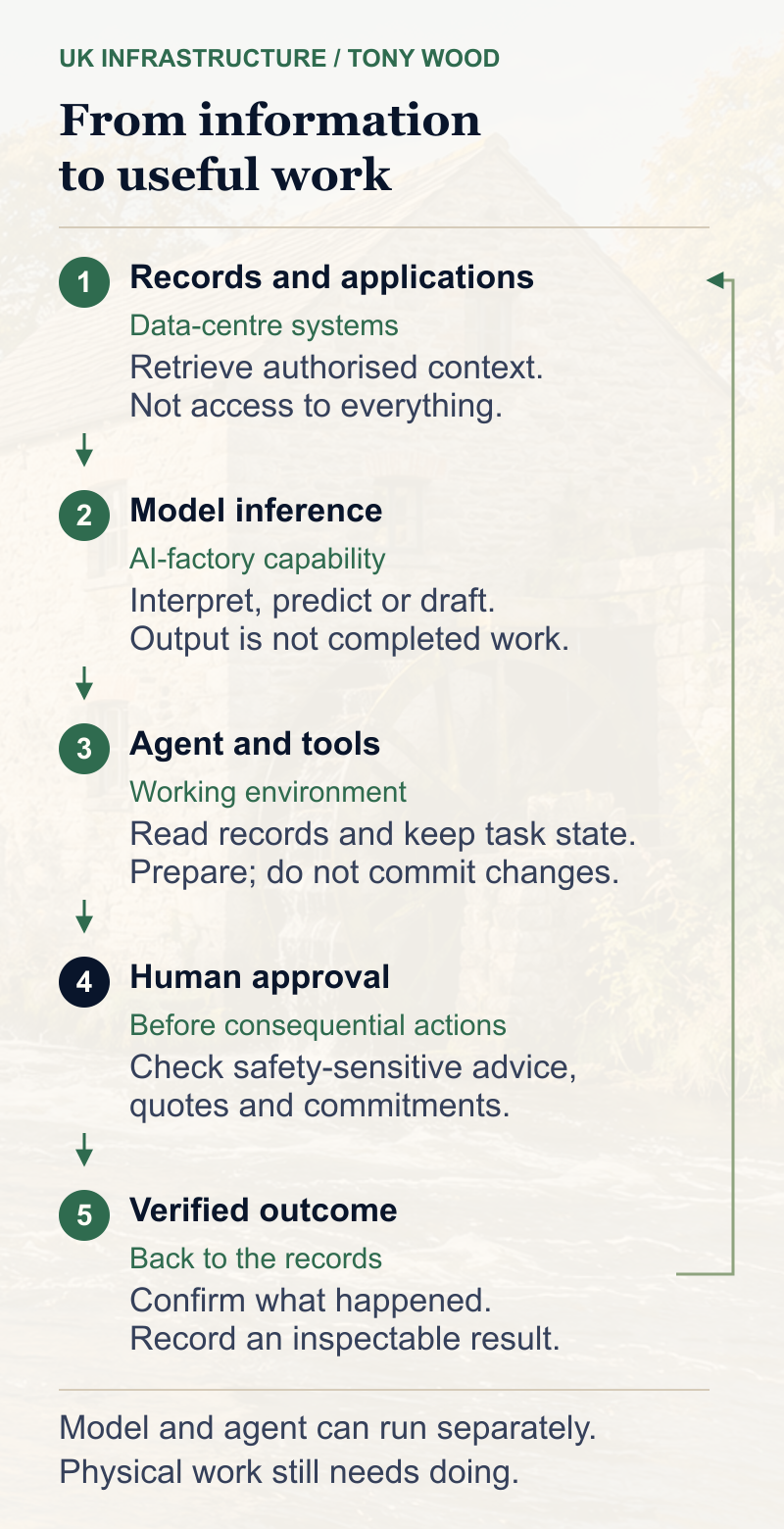
Imagine a maintenance company receiving a message about a broken ventilation system. This is a hypothetical example, not a measured case study.
- The records remain in the business systems. Customer details, equipment history and stock information stay in their authorised systems of record.
- The agent gathers the relevant context. It retrieves what it is allowed to read, rather than being given unrestricted access to everything.
- Inference helps interpret the enquiry. A model can help summarise the message, identify missing information and prepare a draft response.
- Tools do the system work. Authorised integrations check availability, parts and previous visits. The model does not magically know what is in the warehouse.
- A person checks the important decisions. A competent human approves safety-sensitive advice, the quotation and consequential commitments.
- The outcome goes back into the records. Approved actions and their results are recorded, so someone can inspect what actually happened.
The AI factory supplies the model capability. The data-centre systems supply the records and services. The agent joins the authorised steps together. An engineer still goes out and fixes the equipment.
That is why I see these as complementary, not competing, pieces of infrastructure.
The hardware and the operating priorities can change
Large training jobs may need many accelerators working closely together. A busy inference service may instead be organised around serving many requests quickly and economically. The right arrangement depends on the models and workloads.
That can change the requirements for chip memory, connections between machines, storage, electrical density and cooling. Some installations use direct liquid cooling. That does not mean every AI workload needs it, or that every existing data centre can accommodate every new cluster.
NVIDIA's enterprise design guidance discusses both air-cooled and liquid-cooled arrangements and different workload requirements. Again, these are design options, not a universal specification.
For buyers, I would care less about the grand name on the building and more about whether the service can do my work reliably. How long do I wait? What happens when it fails? What data does it see? What does a satisfactory result actually cost?
Britain already has a useful example
Isambard-AI makes the overlap tangible. The University of Bristol describes an AI supercomputer, launched in July 2025, with 5,448 NVIDIA GH200 Grace Hopper superchips, high-speed connections and direct liquid cooling. It is housed in a modular data centre.
It supports research workloads including training, inference and simulation, with access through research allocation processes. It is not a walk-up retail service for every company. The university's account is operator evidence about its own system. Source: Inside Isambard-AI, June 2026.
The data centre provides the physical foundation. The specialised system and support provide AI-computing capability. Calling one useful does not make the other obsolete.
The UK Compute Roadmap sets a target of expanding the computing capacity of the AI Research Resource, or AIRR, twentyfold from its 2025 baseline by 2030. That is a future computing-capacity target, not twenty times the completed work or capacity already delivered.
The June 2026 UK AI Hardware Plan also sets out a proposed £750 million heterogeneous AIRR supercomputer programme, including procurement for specialised inference chips. "Heterogeneous" means using different kinds of computing technology. A plan and a procurement opportunity are not the same as an operational service.
I think that distinction matters. We should be ambitious about the capability, while being honest about what is running, what is accessible and what is still promised.
UK-based is not automatically sovereign
I want Britain to have dependable access to AI capability. But a postcode is not enough to prove we control it.
The UK Hardware Plan itself frames resilience around domestic strengths and trusted international partnerships, not replicating every part of the supply chain.
My questions would be:
- Where is the data actually processed, and where do logs and support copies go?
- Who controls the service, its administration and the ability to suspend access?
- What rights do we have to run the models we depend on?
- Can we move our data and workflows to another provider?
- What is the fallback if a supplier, model or connection becomes unavailable?
Those are operating questions, not a claim that every UK-hosted service has solved them. Nor does every business need its own AI factory. Shared services, cloud access, smaller local models and a hybrid arrangement may be more sensible.
Intelligence energy is a metaphor, not free electricity
I like the phrase "intelligence energy" because it describes the capability people can draw on to help get work done.
But an AI factory does not generate energy. It consumes electricity to perform computation. Intelligence is not a physical fuel, and model output is not automatically correct, useful or authorised.
So I would not judge the whole investment by how many tokens it can produce. I would judge it by useful, checked outcomes, their cost and the resources they require.
Power, cooling, local water conditions and grid capacity still matter. An AI label does not remove the need to assess a site properly. Nor do proposed benefits give a developer a free pass. I have looked separately at data-centre water and power and construction and operational jobs; those are different questions from what the computing is used for.
The same goes for security. The NCSC's guidance covers secure design, development, deployment and operation. This is an ongoing service to operate carefully, not a machine we buy and then forget.
We need the infrastructure and the ability to use it
Britain needs the digital foundation: records, applications, connections and reliable services. It also needs access to the AI capability that can help people use those systems more effectively.
We will not get that just by counting buildings or chips. We need usable services, skills, affordable access, good integration and clear responsibility for the work.
The opportunity is not just to build somewhere to keep our information. It is to build the capability to do something useful with it.
That is what I mean by an AI factory. Not a replacement for the data centre. A different capability built on top of it, and one I think Britain needs to understand properly.
Sources and notes
Research checked on 4 October 2026. Definitions of "AI factory" differ between programmes and suppliers. The comparison and the business workflow are my explanatory synthesis, not a formal building classification or a productivity forecast. The generated visuals are illustrative, not photographs of Isambard-AI or another real facility.
- UK data-centre critical national infrastructure announcement, 12 September 2024. Official designation, not evidence that every site is equally secure.
- EuroHPC AI Factories FAQ. Institutional programme definition; no claim here about universal UK eligibility.
- NVIDIA: Building AI Factories for the Enterprise, updated September 2026, and Agentic AI in the Factory. Commercial technical reference architectures, not independent proof of returns.
- Hugging Face Transformers inference pipelines and fine-tuning documentation. Primary software documentation, not a cost or accuracy benchmark.
- University of Bristol: Inside Isambard-AI, 5 June 2026. Operator account of the research system.
- UK Compute Roadmap, July 2025, with its HTML updated 23 April 2026, and UK AI Hardware Plan, 8 June 2026. Government policy and future commitments, not proof of completion.
- NCSC: Guidelines for secure AI system development. Security guidance, not certification of a particular provider.