
I want Britain to get excited about what we can do with AI. Not just what it might do to us.
We have people who invent things, make things, run businesses and quietly sort out problems that nobody has written a manual for. I grew up with that get-on-with-it attitude. It seems to me a very useful starting point for this technology.
But an opportunity is not the same thing as an outcome. We have to learn how to use it.
Learn, learn, learn. That is the message. Not collect subscriptions. Not watch somebody else's demonstration and assume you understand it. Start doing something, find out what works, and become more capable yourself.
I did not start with the job I eventually built
When I was young, finding work was difficult. I sent applications to large companies and found that many were not taking people on. They were letting people go.
I was on an IT course that closed because there were not enough people who wanted to study it. In my corner of the world, computing still felt like a specialist interest. It was not the obvious career that everybody was trying to get into.
I eventually got into data-entry and secretarial work. Then I found computers, started using them and taught myself as I went along. I did not have the whole career mapped out. Learning what the machines could do helped me discover what I could do.
That is my experience, not a claim that everybody had the same opportunities. The difficult labour market was real, though: ONS's historical series records UK unemployment reaching 11.9% in 1984, among economically active people aged 16 and over. ONS historical unemployment commentary.
Nor was the whole country dismissing computers. The BBC Computer Literacy Project launched in January 1982. The Science Museum records that the BBC Micro had been adopted in about 80% of UK schools by 1985. Britain made a deliberate effort to help people understand and use an unfamiliar technology. Science Museum account.
That is the part of the history I would like us to repeat: make practical learning ordinary.
Britain has something to build on
I am not arguing that British people are naturally more inventive or harder-working than anybody else. Good people exist everywhere. National pride is not evidence of national superiority.
But we do have a substantial innovation base. WIPO's 2026 Global Innovation Index places the UK sixth overall, tenth for innovation inputs and fourth for outputs. Those are index rankings, not a guarantee of future success, but they are a useful corrective to the idea that Britain has nothing left to offer. WIPO's 2026 results.
My argument is that we should build on that capability by becoming exceptionally good at putting AI to work. There is room for frontier research, infrastructure, skilled trades and new software. There is also room for the person who understands a business process and can make it better.
You have not missed the whole thing
It can feel as though everybody else has already understood AI and you are somehow late.
Look at the evidence. ONS reported AI use by 30% of businesses across all size bands in its September 2026 survey results, or 38% among businesses with ten or more employees. These are self-reported estimates within BICS's industry coverage, not a census of every British organisation. ONS, released 8 October 2026.
Elsewhere, Eurostat reported AI use by 20% of EU enterprises with at least ten employees or self-employed persons in its covered sectors in 2025. The US Census Bureau found substantial differences by business size and sector in its December 2025 to May 2026 data. Eurostat; US Census Bureau.
The dates, questions, size thresholds and sector coverage differ. This is not a league table proving Britain is ahead. It is evidence that adoption remains uneven, including in countries with famous technology companies.
Silicon Valley is not the whole of America. London is not the whole of Britain. There is still useful work to do.
In the adoption article, I made the distinction between buying access to a tool and changing how an organisation works. That second part is where I think a great deal of the opportunity sits.
We have moved up a level before
Think about it. Programming has repeatedly become more accessible because another layer took care of some of the detail.
Machine code expresses instructions in the machine's own form. Assembly gives programmers symbolic instructions. High-level languages let them express more of the algorithm without spelling out every machine operation; a compiler translates that program into another form. Libraries and frameworks provide further building blocks.
Fortran, introduced by IBM in 1957, was an important part of that change. It helped people express calculations at a higher level rather than manually constructing all the underlying instructions. IBM's Fortran history.
In his 1987 essay No Silver Bullet, Fred Brooks described high-level languages as a major improvement and reported that observers credited their development with at least a fivefold productivity gain. That was a historical assessment of the shift to high-level languages, not a controlled estimate of every compiler's effect. Brooks's essay.
AI offers another way to cross some of those barriers. Somebody who could explain a problem but could not previously build a prototype may now be able to try. That does not remove the need for testing, security or somebody who understands whether the result is right.
It is also a different kind of tool. A compiler works on a formally specified program. An AI assistant can work with a much less precise request, but a plausible answer can still be wrong.
There is no honest universal multiplier to attach to that. A published study of 5,172 customer-support agents found a 15% average increase in issues resolved per hour after an AI assistant was introduced, with larger benefits for less-experienced and lower-skilled workers. That is one deployment, not a prediction for every British workplace. Generative AI at Work, 2025.
That percentage and Brooks's historical assessment measure different things. They do not tell us which technology wins a productivity contest. The useful question is what you can now do, and whether it actually works.
Initiative does not need a new job title
This is the bit I really want people to hear, especially people starting their careers.
Do not wait until somebody promotes you into an AI role before you start learning. Notice a problem. Ask whether you can investigate it. Be the person who says: "I think we could make this better. Are you happy for me to try?"
You do not need to demand a new title or an immediate pay rise before every small experiment. An agreed improvement project within your existing job can be valuable experience.
But that is not a request for juniors to provide endless unpaid overtime. Employers should provide authorised access, supervision and time to learn. UK overtime guidance makes clear that average pay across total hours worked must not fall below applicable minimum-wage requirements. GOV.UK overtime guidance.
If you have fewer financial commitments or some spare time, use that advantage deliberately. If you do not, that does not make you less ambitious. People in their twenties can have rent, children, debt or caring responsibilities too.
The point is to invest in a skill you can carry with you, not to prove how many evenings you can donate to an employer.
And this is not only for the young. If you have spent twenty years learning how an industry works, that knowledge is a starting asset. Add the tools to it. You do not have to pretend to be a beginner at everything.
Use the time you recover to become more capable
You can begin outside work. Ask an assistant to help plan a trip, organise non-sensitive information or build a simple checklist. Keep bookings, spending and consequential decisions under your control. Start with something small enough to understand.
Suppose an ordinary task takes you three hours and, after checking the result properly, you can do it in one. That is an illustration, not a promised saving. What do you do with the time?
Rest is a perfectly good answer. So are your family, your friends and a game you enjoy. I am not suggesting that every spare minute has to become another shift.
But give some of the recovered capacity to your own development. Learn why the automation worked. Understand the information it used. Try the next problem. Otherwise you may have acquired faster output without acquiring much capability.
Here is the learning loop I would suggest:
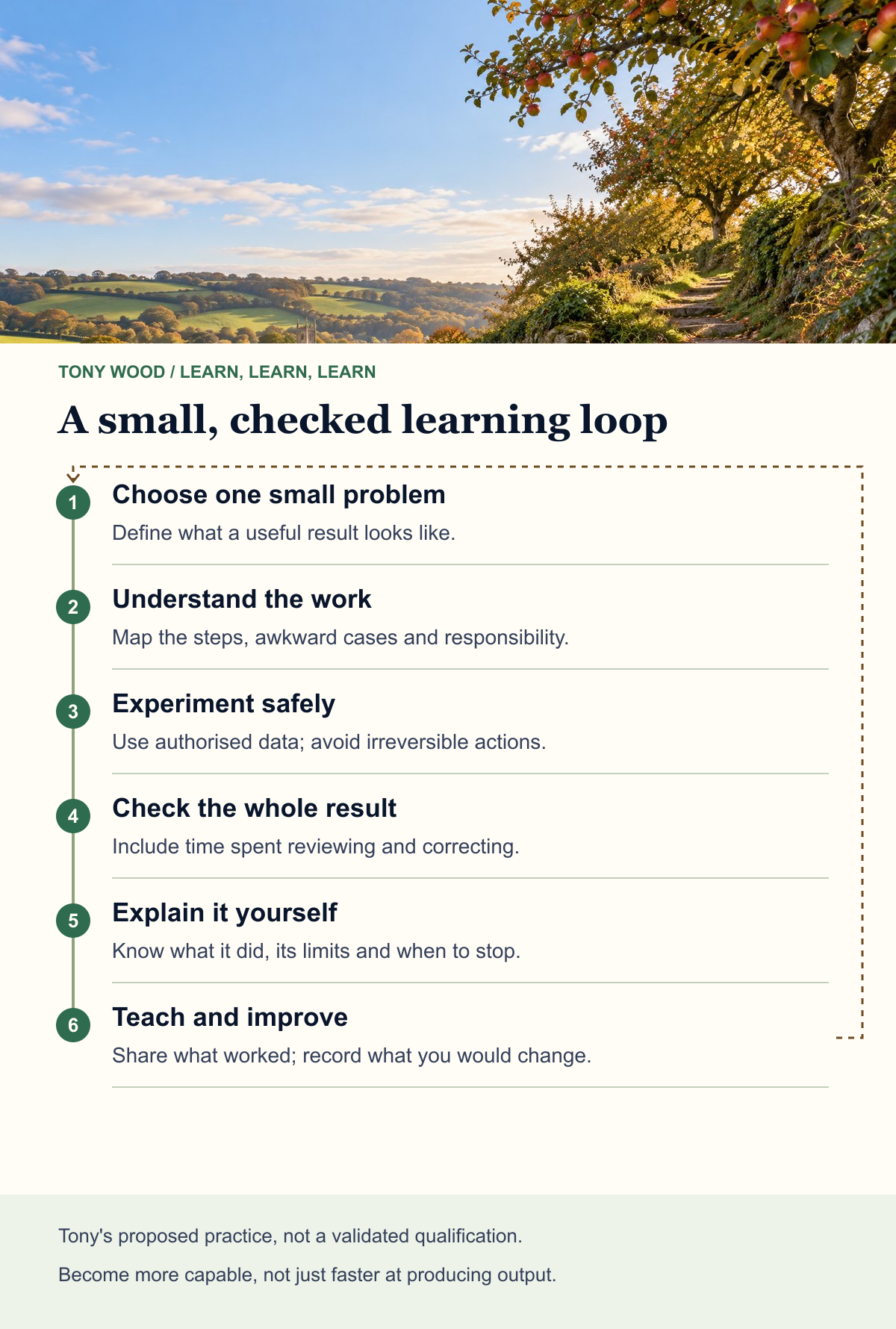
- Choose one small problem. Define what a useful result would look like.
- Understand the current work. Write down the steps, the awkward cases and who is responsible.
- Experiment safely. Use public, synthetic or properly authorised information. Keep the first version away from live customer records and irreversible actions.
- Check the whole result. Include the time spent reviewing and correcting, not just the time spent generating.
- Explain it without the assistant. What did it do? Why might it fail? When must a person take over?
- Teach someone and improve it. Keep a record of what changed, what failed and what you would try next.
This is my proposed practice, not a validated qualification. A small, checked improvement you can explain is a better learning record than a folder full of impressive-looking outputs.
Do not forget your natural intelligence
Dr Cornelia C. Walther's work on ProSocial AI, natural intelligence and hybrid intelligence is useful here. In When Human Bias Meets Machine-Scale Amplification, she describes natural intelligence, or NI, interacting with AI. In her work on cognitive autonomy, she argues for preserving human judgement and agency rather than allowing over-reliance to erode them. Walther, March 2026; Walther, August 2025.
I find that a much more useful ambition than making the human disappear. Bring your curiosity, experience, relationships and sense of responsibility. Use the machine to extend what you can investigate and attempt.
This is a conceptual framework, not a new intelligence score. My practical version is straightforward: ask for explanations, question assumptions, check the evidence and practise making your own decision.
Human judgement can be biased too. The aim is not to assume that either the person or the machine is always right. It is to make the combination more thoughtful.
There is a reason to be deliberate. A Microsoft-led study surveyed 319 knowledge workers and found that greater confidence in generative AI was associated with less reported critical thinking. It was a survey of experiences, not proof that AI causes people to lose intelligence. It does reinforce the value of asking how we are using the tools. CHI 2025 research.
Getting an answer is not the same as learning how to judge one. That is also the point of the critical-thinking training.
Your customer does not have to live down the road
Now look beyond the immediate job market.
We already sell services across borders. In its June 2026 digital-trade update, ONS reported that UK services exports supplied remotely through Mode 1 trade were worth £315 billion in 2023, or 68.3% of services exports. That is an older-year measure of remote supply, including telephone delivery, not the value of AI exports or a count of online jobs. ONS digital-trade statistics.
The international market is not something we would be inventing from scratch.
An operations specialist might help a small firm improve its handling of enquiries. An engineer might help organise maintenance information. A researcher might build a better evidence workflow. These are possible services, not promises of demand. AI could help a small team prepare and deliver them, provided it has the expertise to stand behind the work.
You might start in Enfield, Edinburgh, Cardiff or Belfast. Your first customers might be local. They do not all have to stay local.
Of course there are barriers: finding customers, earning trust, language, professional requirements, data rules, support and competition from people elsewhere using the same tools. AI does not hand you a global customer list with an order attached.
But I would like more people to look at the possibility. Not simply "Which jobs will somebody give us?" but "What useful work could we become good enough to sell?"
Make learning part of the deal
For employers, my request is to make this practical. Give people a bounded problem, an experienced person to learn from, permission to experiment and protected time. Share what works. Do not remove all the beginner's work and then complain that nobody has experience.
For government, colleges and professional bodies, help ordinary organisations participate, not just the businesses that already have an AI department. There is a government-backed free AI foundation-training offer for UK adults. That is a place to begin, not a substitute for supervised practice or a guarantee of a job.
The employment warning signs deserve attention. So do the different routes into useful AI-related work. Optimism should give us a reason to act, not an excuse to ignore people finding the transition difficult.
Britain could become a place people turn to when they want AI put to useful work. That is an ambition, not a forecast. It will take capable people, investment, reliable infrastructure and businesses willing to learn.
Please, please, please: start learning.
Do not just use AI to get through today's work. Use it to become more capable of doing tomorrow's.
Sources and notes
Evidence checked 24 October 2026. The personal account is Tony's recollection. The learning loop and proposed adoption-hub strategy are recommendations, not measured national outcomes. Historical compiler assessments, measured workplace effects and national adoption surveys are not comparable productivity benchmarks. Customer-support figures use the published 2025 study. Cross-country adoption measures retain their different dates and coverage. Remote-services trade is not necessarily digitally delivered trade. No forecast of net job creation, universal productivity gain or guaranteed earnings is made.