The first sign of an AI-driven change in employment may not be a redundancy announcement.
It may be a junior vacancy that never appears. A departing administrator who is not replaced. A team producing more with the same people, while deciding it no longer needs the graduate intake it once expected.
Those are possibilities worth watching. They are not reasons to attribute every recruitment slowdown to AI.
That is the useful idea behind a labour-market "canary": an early signal that tells us where to investigate, not a prediction that the whole economy will follow the same path.
This is part two of a series on Britain's AI economy, following the gap between AI adoption and useful implementation. The third article looks at how Britain can build careers around the change.
A demonstration is not a job-market statistic
A model completing a difficult task is a capability signal. It does not tell us how often the system fails, what supervision costs or whether a business can legally and safely put it into production.
An agent successfully handling a bounded workflow is a stronger signal. It still does not tell us whether the employer will expand the service, change roles, reduce recruitment or cut headcount.
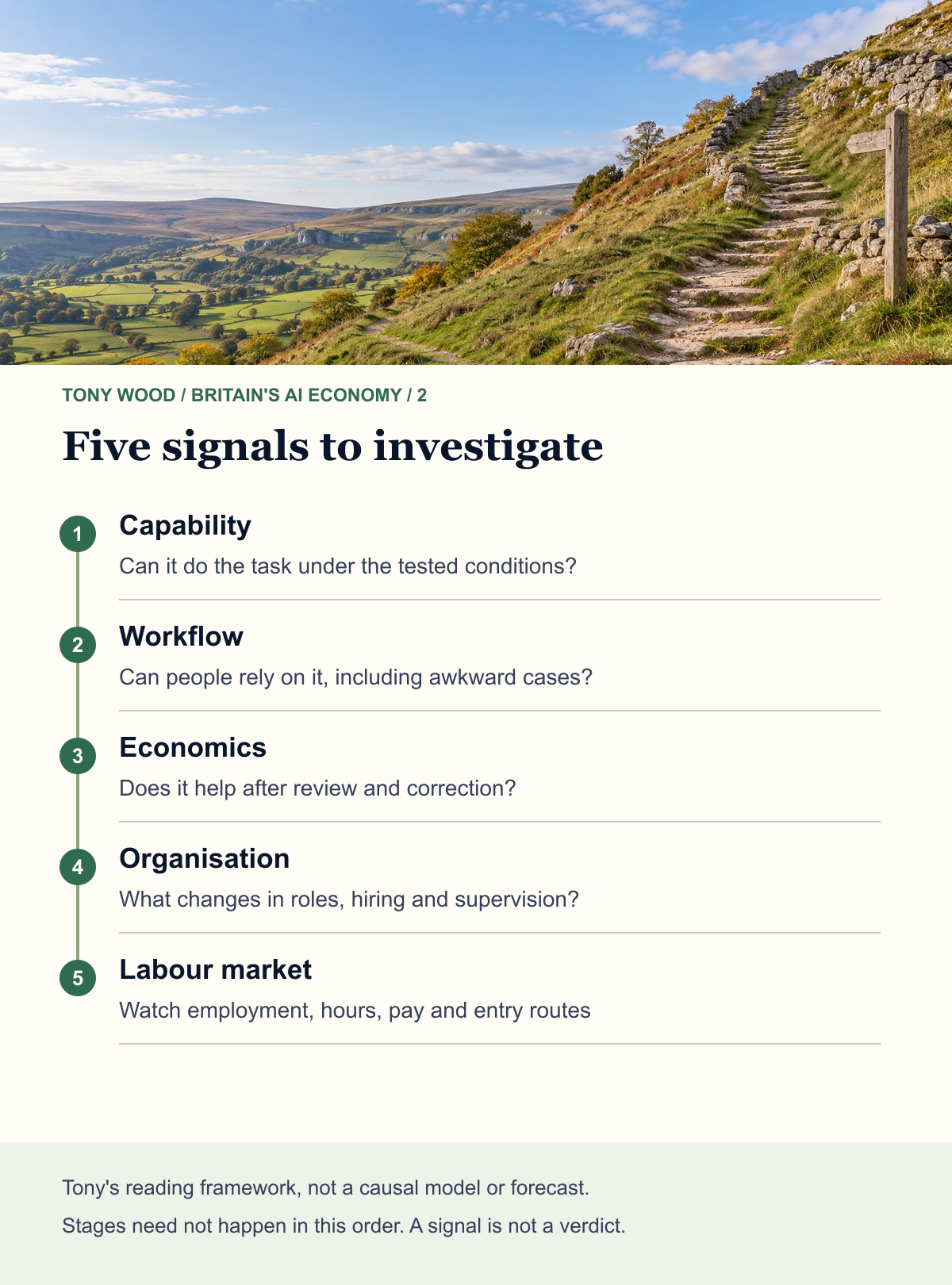
I would follow the evidence through five stages:
- Capability: can the system do the task under the conditions tested?
- Workflow: can people rely on it repeatedly, including the awkward cases?
- Economics: does it improve cost, time or quality after review and correction?
- Organisation: what changes in responsibilities, recruitment and supervision?
- Labour market: what happens to employment, hours, pay and entry routes?
That is my reading framework, not an established statistical classification. The steps need not happen in that order. A firm might change its hiring because of what it expects AI to do, before the promised productivity arrives.
The Stanford canary deserves attention, and a proper label
In the August 2026 revision of Canaries in the Coal Mine?, Erik Brynjolfsson, Bharat Chandar and Ruyu Chen analysed ADP payroll records covering millions of US workers through June 2026.
They found no evidence of widespread, economy-wide displacement in that analysis. But employment among 22-to-25-year-olds in AI-exposed occupations stood 19% below where it would have been if it had kept pace with less-exposed peers. Reduced hiring, rather than increased separations, was the main channel. Stanford Digital Economy Lab, revised 12 August 2026.
That is not "AI has removed 19% of British graduate jobs". It is not even a causal estimate of what AI removed in America.
The authors call the findings descriptive. They note differences from national survey benchmarks and some trends that predate widespread generative AI. The study is a serious warning signal, not a clean experiment with the entire labour market.
The UK lesson is to look at the front door of employment, not only the exit.
Britain should watch hiring as well as redundancies
The UK government's January 2026 labour-market assessment discusses sharper vacancy declines in some AI-exposed occupations. It also warns that interest rates, sector conditions and wider employment weakness complicate attribution. Those caveats are part of the finding, not an inconvenient footnote. DSIT and AI Security Institute assessment.
ONS provides a different measure. In its September 2026 tables, around 6% of businesses with ten or more employees using AI or unsure whether they did reported reduced overall headcount because of AI. Permanently ceased businesses are excluded. That is a proportion of businesses in the survey base, not a proportion of workers who lost jobs. ONS, 8 October 2026 and September data tables.
Neither result settles the long-term question. A modest reported headcount effect can coexist with fewer new opportunities in particular jobs. Equally, a falling vacancy count is not proof that technology caused the fall.
The productivity evidence does not all point one way
A study published in the Quarterly Journal of Economics examined the introduction of an AI assistant among 5,172 customer-support agents. It found a 15% average improvement in issues resolved per hour, with particularly useful gains for less experienced and lower-skilled workers. That is evidence from one deployment, not a universal return on AI. Generative AI at Work, 2025.
Now put that alongside METR's randomised study of 16 experienced open-source developers handling 246 real issues in repositories they knew. With the early-2025 tools tested, AI access made completion take 19% longer. METR, July 2025.
It would be a mistake to turn that into "AI makes programmers slower" for all time. METR's February 2026 follow-up said selection effects made its newer results unreliable as an estimate of the current productivity effect. METR's experiment-design update.
The sensible conclusion is not to choose whichever study suits our existing opinion. It is that task, worker, tool, context and review burden matter.
An impressive average from somebody else's workplace is a reason to test a use case. It is not a staffing plan for yours.
Do not remove the first rung without building another
The risk that concerns me most is learning.
If an organisation automates much of the work it previously gave to junior staff, how will those people acquire the experience needed for more responsible work?
This is a question to investigate, not proof that every routine task is good training. Some drudgery teaches very little. But simply deleting junior work and continuing to ask for experienced recruits is not a convincing long-term talent strategy.
The response I would want is deliberate replacement learning: supervised cases, simulations, customer exposure, investigation of failures and increasing responsibility. An assistant can help a beginner understand a problem as well as help a manager remove the beginner from the process. Which use we choose matters.
That connects with my earlier article on jobs for the next generation. A career route needs practice, support and progression, whether it starts in a workshop or an office.
A small dashboard beats a dramatic prediction
For employers, I would put these questions in the workforce review alongside the AI programme:
- Entry: are junior vacancies, apprentice starts and actual hires changing?
- Reasons: what evidence supports the explanation: AI, weak demand, cost pressure, restructuring or something else?
- Work: which tasks changed, and what happened to completed output and errors?
- People: who gained responsibility, who lost hours and who received useful training?
- Progression: are beginners becoming competent, or are we quietly narrowing the route in?
Compare across teams and over time. Speak to the people doing the work. Do not turn the dashboard into an individual surveillance system or treat a correlation as its own explanation.
At national level, I would want adoption, hiring, pay, hours and training evidence examined together, with clear regional and occupational differences. An overall employment total can conceal quite a lot.
A canary tells us to pay attention
I do not think the evidence justifies either "nothing is happening" or "all the jobs are going".
We have enough evidence to take changing entry routes seriously. We do not have a reliable percentage for the eventual number of British jobs AI will remove or create.
My preference is to act on what we can observe: measure real work, protect the route into competence, and help people move towards useful new responsibilities.
The warning may not be an empty office. It may be an office that has stopped letting beginners in.
Sources and notes
Evidence checked 24 October 2026. US payroll associations, UK business self-reports, an occupational exposure assessment, a customer-support field study and a developer randomised experiment answer different questions. They are not combined into one forecast. The proposed dashboard and learning response are recommendations. No claim is made that a particular model release establishes general autonomy or a timetable for unemployment.