When I wrote Jobs for Our Next Generation Thanks to AI, the focus was the physical economy: electricians, cooling engineers, controls, cabling and the people who build and maintain infrastructure.
I still think that is an important part of the opportunity. But it is not the whole picture.
Britain also needs people who can put AI to work in an ordinary business, connect it to useful information, test it, explain its limits and take responsibility for the result.
So this is an October follow-up, not a replacement for the earlier practical guide. AI work is bigger than building models, and bigger than adding "AI" to a job title.
It completes a three-part series on UK adoption and the employment warning signs we should watch.
First, count the right thing
The government's AI sector study estimated 86,139 AI-related full-time-equivalent jobs in 2024 across the dedicated and diversified businesses it identified. It estimated AI-related revenue at £23.9 billion. These are modelled sector measures, not a count of every British person using AI, and not the number of net new jobs AI created. DSIT, Artificial Intelligence Sector Study 2024.
Vacancy evidence tells another part of the story. PwC's 2026 AI Jobs Barometer counted approximately 180,000 specialist AI job postings in the UK during 2025, compared with 112,000 in 2024. Its UK analysis reported a 34.2% average AI wage premium. This compares advertised pay for AI-skill and non-AI roles within sectors; the method does not adjust for education, experience or location. PwC's UK findings and barometer methodology.
Those are consultancy estimates from job-advertisement analysis. An advert is not necessarily a hire. A wage premium does not mean taking a short course will give an individual a 34% pay rise.
And we must not add the two datasets together. A stock of people employed and a flow of adverts over a year are different things.
There are several ways into this economy
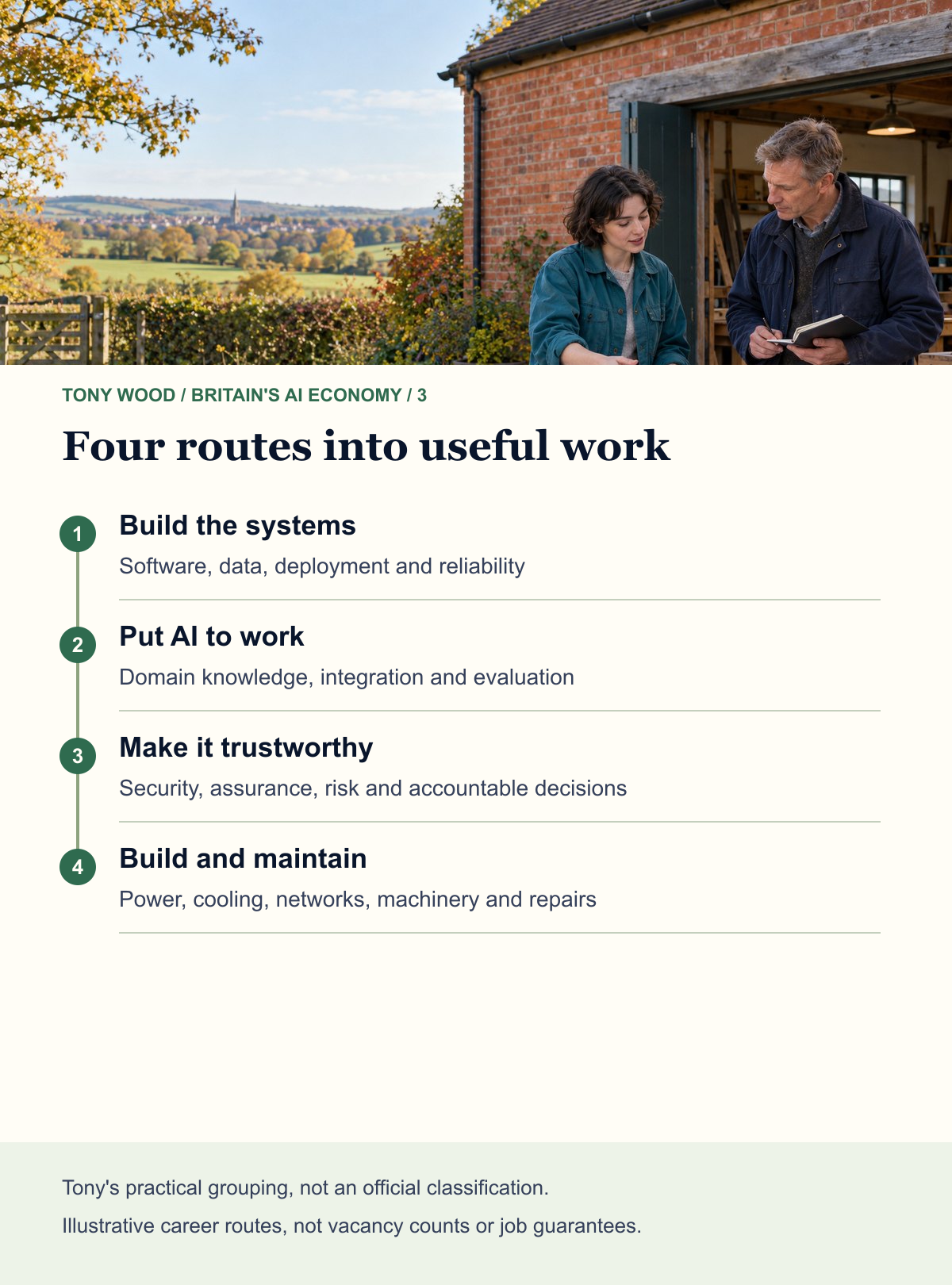
I find four groups useful when thinking about careers. These are my practical groupings, not an official occupational classification.
| Route | Useful work | A starting point |
|---|---|---|
| Build the systems | Software, data engineering, model deployment, infrastructure and reliability | Computing, maths, engineering, technical apprenticeships and a tested portfolio |
| Put AI to work | Understand a process, choose the right task, integrate tools and measure the result | Existing domain knowledge plus practical implementation and evaluation skills |
| Make it trustworthy | Security, assurance, access control, risk, testing and accountable decisions | Progression from engineering, audit, risk, compliance or operational work |
| Build and maintain the physical world | Power, cooling, networks, controls, machinery and repairs | Relevant trade, college, engineering or apprenticeship routes |
Some specialist research careers need advanced academic training. Other routes begin with an apprenticeship, a technical qualification or expertise somebody already has. There is no single entry ticket.
Research commissioned by DSIT distinguishes experts, specialists, implementers and general users. Its projections suggest much of the change will involve existing occupations acquiring AI responsibilities, rather than the creation of entirely new AI-specific posts. That is a modelled expectation, not a guarantee. AI Skills for Life and Work, January 2026.
The accountant who understands reconciliations, the engineer who recognises a dangerous instruction and the operations manager who knows why customers get stuck may have very useful starting knowledge. They still need to learn the tools and their failure modes. Domain experience is an asset, not an exemption from training.
If you already have a career, start there
I would not suggest that every experienced worker abandon their profession to compete for an entry-level machine-learning job.
I would ask: which part of your work involves information you can safely organise, repeated decisions you can explain, or a bottleneck you understand better than a software supplier?
Choose one low-risk example. Build a small demonstration using public, synthetic or properly authorised data. Show the original process, what changed, what failed, how you checked it and who remained accountable.
A portfolio explaining why the system must stop can be as useful as one showing what it can do.
For people who already work in a trade, the practical companion remains How to Bet on AI When You Already Have a Trade. Adding diagnostics, documentation or scheduling capability is a different proposition from pretending a chatbot qualifies somebody to work on a live installation.
If you are starting out, look for supervised practice
For a young person, I would look beyond the course title.
Who will supervise you? What real work will you do? How do you demonstrate competence? What happens after the current project ends? Can you afford the travel, tools and time needed to complete the route?
The same questions apply to a technical apprenticeship and to an office role using agents. Access to an impressive tool does not replace feedback from somebody who knows what good work looks like.
For the detailed infrastructure routes, use How to Get Skilled Up for the Coming AI Change. Apprenticeship arrangements are devolved: check the official services for England, Scotland, Wales or Northern Ireland, rather than assuming one nation's funding rules apply everywhere.
Government and industry have announced an ambition to give ten million UK workers AI-skills training by 2030, with free foundation courses available to UK adults. That is a useful invitation to begin. It is not ten million new jobs or a substitute for substantial occupational training. Government announcement, January 2026.
A data centre is a starting point, not an entire regional strategy
The sector study found around three quarters of registered AI-company office locations in London, the South East and the East of England in 2024. Registered offices are not a map of every worker's desk. Nevertheless, the concentration should make us ask how more of the country participates. DSIT regional analysis.
I want investment outside existing clusters to create a route into work for local people, not just a larger building near them.
That means connecting infrastructure projects to colleges, employers, smaller suppliers and organisations that will actually use the capacity. It means measuring completions and sustained careers, not only apprenticeships announced in a press release.
As my data-centre employment article explains, construction and permanent operations are different employment stories. A sequence of projects can support training and progression. One building is not an unlimited source of permanent jobs.
The bargain I would ask employers and government to make
If AI makes a business more productive, what are we going to do with that capacity?
My preference is a bargain that includes people: help smaller firms implement useful systems; give experienced workers time to learn; keep credible entry routes open; and connect major infrastructure investment with supervised technical training.
Then publish results people can understand. Did trainees finish? Did they find sustained work? Did staff acquire useful new responsibilities? Did the service improve? Did the business become more productive after the real implementation costs?
None of this means every existing role survives unchanged. The canary article sets out why junior hiring deserves particular attention. Creating specialist vacancies does not automatically compensate the person who loses a different job somewhere else.
But it does mean we have choices about how the transition works.
The opportunity is capability, not a fashionable title
I do not want Britain's AI ambition to be reduced to either "learn to code" or "become an electrician". Both can be good routes for the right person. Neither is a national workforce strategy by itself.
We need people who can build, connect, operate, question, explain and repair. We need people who understand customers and people who understand machines. Often the useful work will sit between those worlds.
The national opportunity is not to put AI in everybody's job title. It is to help more people become good at work Britain needs done.
Sources and notes
Evidence checked 24 October 2026. Employment estimates refer to 2024; the PwC barometer was published in 2026 and analyses 2025 adverts. Forecasts, training targets, vacancies and realised employment are not interchangeable. Current recruiter salary examples and numerical long-term job scenarios from the supplied reports have deliberately not been presented as national promises. Recommendations and the four-route grouping are editorial judgement.