Britain is using more AI. That is encouraging. But buying access to intelligence and putting it to work are not the same achievement.
The question is moving from "Have you tried AI?" to something more useful: what is your organisation now able to do better?
Can it serve more customers? Clear a backlog? Reduce mistakes? Give experienced people time to deal with the difficult cases? Or has it simply acquired another subscription?
This is the first of three linked articles about Britain's AI economy. The others examine the early warning signs in the labour market and how the country can turn AI capability into careers.
Use is rising. Depth is another matter.
In its September 2026 results, the Office for National Statistics reported AI use by 30% of businesses across all size bands in the Business Insights and Conditions Survey, compared with 9% in September 2023. Among businesses with ten or more employees, the September 2026 figure was 38%. These are weighted, self-reported estimates within the survey's coverage, not a census of every British organisation. ONS, released 8 October 2026.
The more revealing finding comes from the June data behind ONS's July analysis. Among businesses with ten or more employees using AI or unsure whether they did, around 10% described extensive use and around 15% reported daily AI use by at least half their employees. The tables exclude permanently ceased businesses. These were new questions, so ONS treats the results as early indications. ONS July analysis and June data tables.
That is the gap worth looking at. We can have widespread experimentation without widespread redesign of work.
A colleague drafting an email faster is useful. A team that can safely handle enquiries, retrieve the right records, prepare a response and escalate exceptions is a different level of capability. The second requires decisions about data, access, responsibility and what happens when the system is wrong.
My reading is that the next phase is as much a management problem as a model problem.
There is no single British adoption rate
The June ONS analysis put AI use at 58% in information and communication, compared with 13% in construction. Both figures concern businesses with ten or more employees. Different working environments create different opportunities and implementation costs. ONS industry comparison.
A construction firm might find its first useful applications in estimating, document handling or scheduling. That does not mean the physical work has become autonomous. Those are possible starting points, not measured outcomes for every builder.
Financial services has its own evidence. In the Bank of England and FCA's 2024 survey, 75% of respondent firms were already using AI. But only 2% of reported use cases involved fully autonomous decision-making. Bank of England and FCA, November 2024.
That is not a league table in which finance beats construction by a neat number of points. The populations, dates and questions differ. BICS's coverage notes also exclude finance and insurance, public administration and public provision of health and education. We need the sector evidence, but we should not stitch unlike surveys into one apparently precise national ranking.
Nor does a high adoption figure tell us that agents are running the entire business. "Uses AI" is a very broad description.
Time saved is a beginning, not the final result
The government's cross-government Microsoft 365 Copilot experiment offers an encouraging example. Its 2025 report described an average saving of 26 minutes per day. Crucially, these were user-reported estimates. The report also said it could not identify how the saved time was spent. Government Digital Service findings.
That distinction matters. A useful result does not become less useful because we describe it properly.
If I save time drafting a document but spend it checking invented references, my gain may disappear. If I produce the same work sooner and use the time to resolve a customer's problem, the benefit is different. If the organisation removes a bottleneck, an entire service might improve.
These are illustrative possibilities. The point is to measure which one actually happened.
In Could AI Make Britain Richer?, I separated productivity from the question of who receives its benefits. More output, lower prices, higher wages, shorter waits and greater profits are related possibilities. They are not interchangeable results, and none follows automatically from issuing licences.
The useful unit is a workflow
I would start with one recurring piece of work and follow it from beginning to end.
Take an enquiry arriving at a small business. Someone has to understand it, find the relevant information, check availability or eligibility, prepare an answer, get approval where needed and record what happened.
A chatbot might help with one step. A well-designed system might help with several. But it still needs an owner who can explain what it may do, what it must not do and how a human takes over.
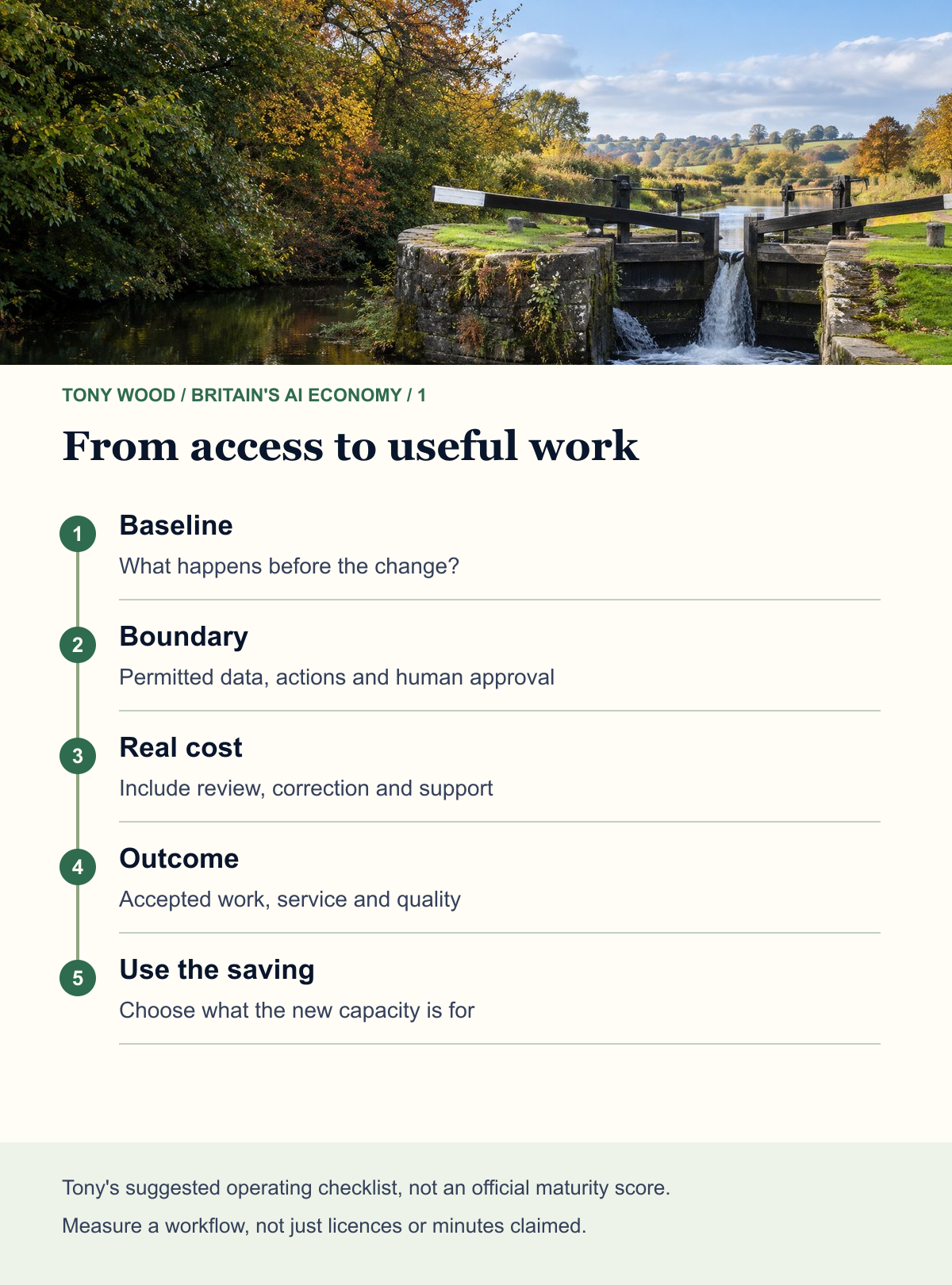
For a first rollout, I would record five things:
- The baseline: elapsed time, staff effort, mistakes and unfinished work before the change.
- The boundary: permitted data and actions, with consequential decisions kept behind explicit approval.
- The real cost: licences, usage, integration, review, correction and support.
- The outcome: accepted work completed, customer experience and whether quality improved or deteriorated.
- The use of the saving: more service, a smaller backlog, new work, staff development or a deliberate staffing decision.
This is my suggested operating checklist, not an official maturity score. Its purpose is to stop a successful demonstration being mistaken for a successful service.
Smaller firms need an achievable first step
The size differences in the ONS evidence should make us ask a practical question: what would make worthwhile adoption easier for an ordinary small business?
My answer would be help choosing a bounded problem, organising the relevant information, training the people doing the work and measuring the result. A grant for software alone does not supply those things.
There is also a risk of creating two versions of the economy: firms that learn how to use AI well, and firms that buy tools without the time or support to change how they operate. That is a risk to manage, not a claim that the split is already inevitable.
I would rather see a local business complete one modest, useful implementation than announce an ambitious transformation it cannot maintain.
The next national question
In Making the Cake Bigger, I asked how Britain builds productive capacity rather than only arguing about how to divide what already exists.
AI belongs in that conversation. But the productive asset is not just the model. It is the combination of tools, capable people, usable information, sound judgement and organisations willing to learn.
So I am positive about adoption. I want more people to get practical experience with this technology.
But the next question should not be how many organisations can tick an AI box.
It should be how many can show that something worth doing now gets done better.
Sources and notes
Evidence checked 24 October 2026. The September AI snapshot was published on 8 October; the newer 22 October BICS bulletin covers other topics. BICS results are official statistics in development, with sampling, coverage and self-report limitations. June depth measures and September adoption measures are labelled separately. Sector surveys are not directly comparable. Workflow examples and recommendations are illustrative judgement, not national forecasts.