We spend a lot of time asking which jobs AI might take. I want to ask another question.
What could Britain do with the time it gives back?
If we can deliver more healthcare, maintain things before they break, help a small company do work it could never previously afford and make government less of an obstacle course, that sounds rather good to me. We have not run out of useful things to do.
But there is a gap between an agent finishing a task faster and a family feeling better off. That gap is where the interesting economics lives.
In Why Do We Work?, I asked what we want work to provide. This is the companion question: if AI helps us produce more, how do we turn that capability into a better life?
My reading of the evidence is cautiously positive. Productivity can make us richer. It does not decide who receives the extra wealth, and it does not make the transition painless.
The economy is not a fixed to-do list
Imagine a business has enough work for ten people. A new system lets eight do it. Inside that company, two jobs may disappear. That matters enormously to the two people involved.
But it does not follow that the whole economy now has two fewer useful things for people to do. The company might lower prices and sell more. Its customers might spend their savings elsewhere. Someone might start a business that was previously too expensive to run.
Economist David Autor explains these countervailing effects in Why Are There Still So Many Jobs?: automation can replace labour in particular tasks while complementing people and increasing demand elsewhere. It changes the work available and what that work pays. It does not simply subtract from a fixed national stock of jobs.
There is historical evidence for that distinction. Autor and Anna Salomons studied 28 industries across 18 OECD countries from 1970 onwards. They found employment offsets beyond the industries experiencing productivity improvements, but a falling share of income going to labour. Their 2018 paper is a useful warning: more output and employment resilience do not guarantee that workers capture a fair share.
Neither paper proves the next generation of AI will repeat the past. And a national employment recovery is not much comfort if the new job is in another town, requires a qualification you do not have, or pays less.
So yes, freeing capable people can help an economy grow. But people need opportunities, customers, investment and a route into the new work. Unmet need is not the same thing as demand backed by money. An empty bank account cannot commission a new business.
What does growing the economy actually mean?
At its simplest, real economic growth means producing more goods and services, after allowing for price changes. It is not just charging more for the same dinner.
One useful identity is: real GDP = total hours worked multiplied by real output per hour. Productivity lets us increase the second part instead of relying entirely on more people or longer hours. The OECD's 2026 productivity compendium uses GDP per hour to measure economy-wide labour productivity.
However, these are different questions:
| Measure | What it tells us | What it misses |
|---|---|---|
| Real GDP | How much the domestic economy produces, adjusted for prices. | Who benefits, and whether population grew faster. |
| Real GDP per person | Average production relative to the population. | An average can rise while many households gain little. |
| Real household income | What people can afford after allowing for prices; taxes and transfers also matter. | Income alone does not capture waiting times, unpaid care or free time. |
| A better life | Health, reliable services, security, time and opportunity. | No single headline number measures all of it. |
A country could use a productivity gain to produce the same amount in fewer hours. GDP might barely change, while people gain an afternoon with their children. That is not an economic failure simply because the spreadsheet cannot applaud.
Equally, higher GDP does not establish that the median household is better off. We need to look at distribution and public services alongside the total.
First, the 40% maths
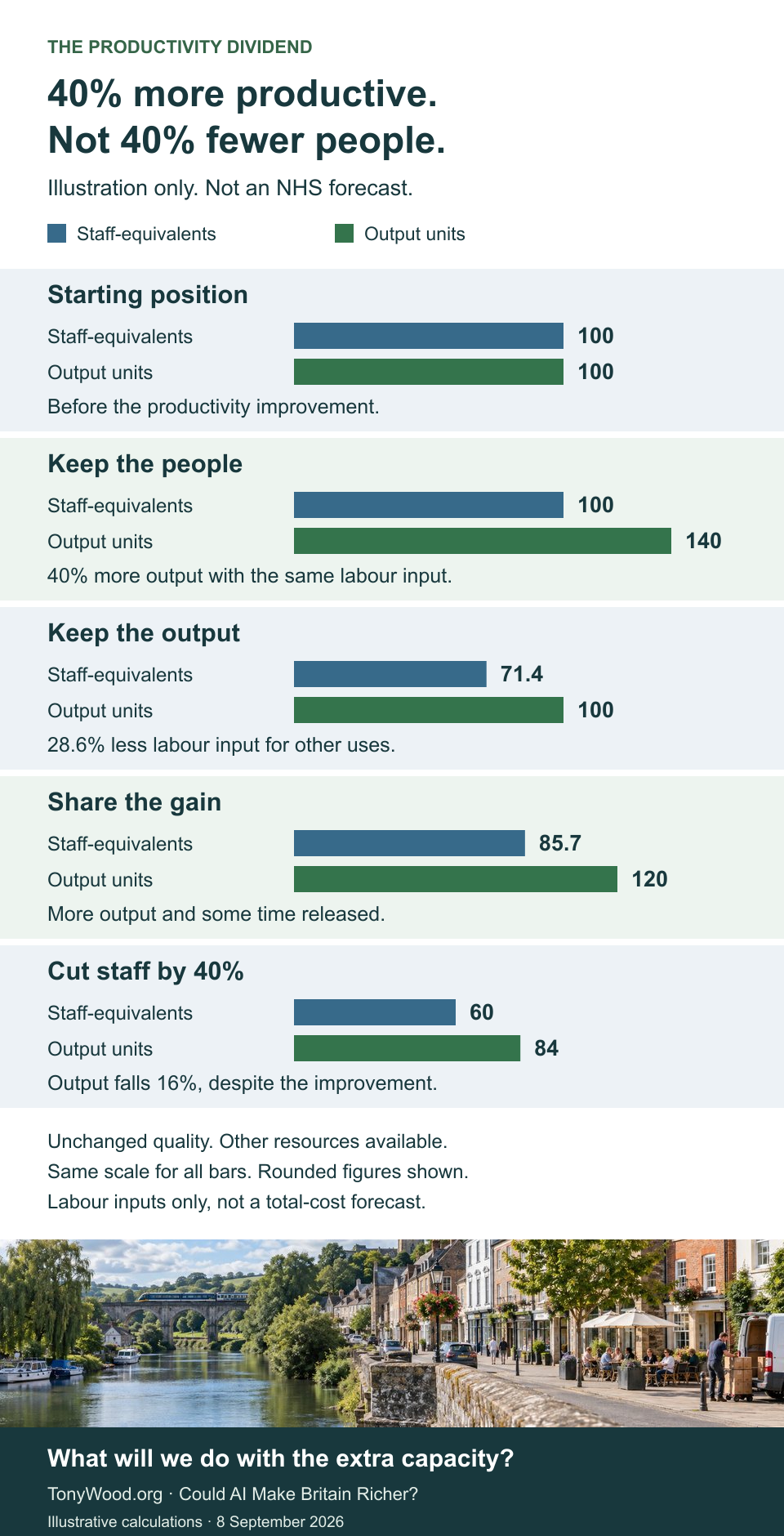
I started with this thought: what if the NHS became 40% more productive?
That is a hypothetical, not a measured NHS-wide AI result. And I need to correct the next part of my own question. Forty per cent more productivity does not mean you need 40% fewer people.
Suppose 100 staff-equivalents produce 100 units of useful output. If output per staff-equivalent rises by 40%, each now produces 1.4 units. To deliver the original 100 units, you need 100 divided by 1.4: about 71.4 staff-equivalents. That is 28.6% less labour input.
| Illustrative choice | Staff-equivalents | Output units | Meaning |
|---|---|---|---|
| Starting position | 100 | 100 | One unit per staff-equivalent. |
| Keep the people | 100 | 140 | 40% more output with the same labour input. |
| Keep the output | 71.4 | 100 | About 28.6% of labour input released for other uses. |
| Share the gain | 85.7 | 120 | 20% more output and about 14.3% less labour input. |
| Cut staff by 40% | 60 | 84 | Output falls 16%, even after the productivity gain. |
These are my calculations, rounded to one decimal where needed. They assume the improvement covers the whole process, quality is unchanged, inputs scale smoothly and other resources are available. Real clinical teams are not interchangeable fractions, and buildings, equipment, medicines and software still cost money. This is a labour-productivity illustration, not an NHS staffing recommendation or total-cost forecast.
The NHS already has somewhere to put extra capacity
In England, the June 2026 referral-to-treatment statistics recorded approximately 7.3 million incomplete treatment pathways involving about 6.2 million people. Only 65.8% were within 18 weeks, against the 92% standard. These are pathways, not 7.3 million different patients. The release includes estimates for two trusts that did not report. NHS England, published 13 August 2026.
So my first response to genuinely greater NHS capacity would not be, "Wonderful, who can we remove?" It would be, "Who can we help sooner?" That is my policy preference, not something a study can decide for us.
More capacity could mean shorter waits, longer appointments where needed, better follow-up or less exhausted staff. A clinician getting home on time is a benefit too, even when it does not appear as another appointment.
But the backlog does not disappear just because notes are quicker to write. Treatment needs the rest of the pathway: diagnostics, theatre time, beds, specialist teams and discharge support. New referrals keep arriving. A waiting list shrinks when exits exceed new entries; exits include treatment starts and other pathway closures. Extra treatment capacity still needs to match the patients waiting.
That is why I would measure completed, safe care rather than simply counting saved minutes.
What has actually been demonstrated?
There is encouraging evidence. There is also a lot of extrapolation. Keeping the two separate makes the positive case stronger.
| Evidence | What it found | What we cannot infer |
|---|---|---|
| NHS ambient voice evaluation, 2025 | In the per-protocol before-and-after comparison, pooled median total consultation time fell from 18.4 to 16.9 minutes, about 8.2%. | A multi-site observational evaluation, not a randomised estimate of whole-NHS productivity. Its emergency-department capacity modelling assumed 80% of saved time could be reused. Modelled benefits are not cash already saved. |
| MASAI mammography trial, Sweden, 2026 report | A randomised trial found AI-supported screening non-inferior on interval cancer rates, with higher sensitivity, the same specificity and reduced screen-reading workload. | A specific screening workflow, not proof that general-purpose chatbots can replace clinicians or improve every clinical task. |
| UK cross-government Copilot experiment, 2025 report | Survey-based estimates averaged 26 minutes saved daily. The deployment ran from September to December 2024. | Self-reported time savings, not a controlled estimate of additional public services. The report could not establish how the saved time was actually spent. |
| Health Foundation review, 2025 | Among 467 sampled studies of healthcare technologies, 144 found no time saving or a negative effect. | This covered varied digital and telephone technologies, not just AI. It was a rapid review, not a representative failure rate for AI products. |
The Nuffield Trust's February 2026 account of an NIHR-funded evaluation puts the central problem plainly: there is evidence of reduced documentation time, but much less about what that time subsequently delivers for patients, staff or system capacity.
For NHS accounting, there is another distinction. ONS public-service productivity considers multiple inputs and adjusts some outputs for quality. It is not simply output per employee, and ONS explicitly says it does not measure value for money or wider public-service performance. My 40% illustration must not be confused with that official series. ONS methodology, revised May 2026.
A faster task is not a faster organisation
Here is another small calculation that prevents a very large mistake.
Suppose one task takes 20% of the labour time in a process. AI makes that task 40% more productive. Its time falls from 20 units to 14.3. The other 80 units remain. Total time is now 94.3 rather than 100.
The overall labour-productivity improvement is about 6.1%, not 40%: 100 divided by 94.3, minus one. That assumes sequential tasks, unchanged quality and no new review work. Add integration, checking or rework, and the net gain is smaller. Remove other bottlenecks as well, and it could be larger.
This is not a reason to dismiss 6.1%. Across an important service, that could be very useful. It is a reason not to put a task-level result on the front of a national savings announcement.
Erik Brynjolfsson, Daniel Rock and Chad Syverson's Productivity J-Curve describes the importance of complementary investment, including less visible organisational changes. Buying the technology and realising its benefits are different stages.
My practical translation: budget for the new workflow, the training and the uncomfortable period when the old and new systems both need attention. Do not pretend the licence is the entire project.
Do economists think AI will make us richer?
Some expect substantial gains. Others see a much more modest near-term effect. We should understand the assumptions rather than choose whichever number best supports our mood.
| Research | Result or mechanism | Important boundary |
|---|---|---|
| OECD G7 study, June 2025, Table 2 | UK scenarios add 0.39, 0.97 or 1.27 percentage points to annual labour-productivity growth over a ten-year horizon. | Slow, medium and rapid adoption scenarios, with different capabilities. Modelled contributions, not observed gains or guaranteed forecasts. |
| Daron Acemoglu, The Simple Macroeconomics of AI | A US task-based calculation estimates no more than about 0.66% total-factor-productivity growth over ten years, reduced to about 0.53% allowing for harder tasks. | Total gain over a decade, not an annual rate. US assumptions and a different productivity concept; not a UK forecast or a ceiling on every future AI breakthrough. |
| Brynjolfsson, Rock and Syverson, 2021 | Benefits depend on complementary investment, with measurement and timing effects during adoption. | A framework for understanding the transition, not a number we can put in next year's UK budget. |
Do not compare the first two rows as if they were competing weather forecasts. Labour productivity is output per unit of labour; total factor productivity concerns efficiency beyond measured labour and capital inputs. Geography, time units, scope and assumptions differ.
There is even a source-checking wrinkle. A January 2026 UK government assessment summarises the OECD range as 0.4 to 1.2 percentage points. I have used the original OECD table's explicit UK values above.
The OECD's 2026 compendium describes some recent results as tentative signals consistent with AI helping productivity. That is not the same as isolating AI's causal effect across Britain.
My conclusion is not that we should wait until every economist agrees. It is that the opportunity is worth pursuing while measuring what actually happens.
Does the cost of dinner come down?
Potentially. But start with the cost of producing dinner, not the menu price.
Suppose a restaurant has a cost base of 100 units. A slice of that cost becomes 40% more productive, with unchanged input prices and quality. The affected slice costs 1 divided by 1.4 as much for the same output.
| Affected share of total cost | New total cost | Gross saving |
|---|---|---|
| 10% | 97.1 units | About 2.9% |
| 20% | 94.3 units | About 5.7% |
Illustrations only, not estimates of restaurant cost shares or actual AI performance. They exclude the cost of the AI, implementation and supervision. Rent, ingredients, energy and other unchanged costs do not fall simply because the booking system gets smarter.
Would the restaurant pass that saving on? It depends. A competitor may force its hand. It may use the money to pay staff more, repay debt, improve the food or restore a margin squeezed by other costs. It may keep the gain as profit. There is no automatic consumer refund attached to a productivity improvement.
The Bank of England's July 2026 business-contacts report offers a useful real-world check. Some firms described lower unit costs and pressure to reduce prices for routine tasks. Rising software, cloud and AI licence spending partly offset the savings. This is qualitative intelligence from business conversations, not a controlled estimate of national price reductions.
And lower costs than otherwise do not necessarily mean a falling price tag. If a meal would have risen from £20 to £22, but instead rises to £21, you benefit relative to that alternative while still paying more than before. Slower inflation means prices rise more slowly, not that they return to old levels. Bank of England inflation explainer.
What about water, trains and government?
This is where I get interested. I do not just want cheaper emails. I want a country that works better.
The following are opportunities to test, not measured savings forecasts. They combine AI with ordinary engineering and digital improvements. We should not rebadge every useful computer system as generative AI.
| Service | Possible benefit | What still stands between it and your bill |
|---|---|---|
| Water | Finding leaks, targeting maintenance and operating assets more efficiently. | Pipes still need replacing. Investment, financing, environmental obligations and regulation can outweigh operating savings. |
| Rail | Better maintenance planning, disruption management and use of existing capacity. | Train fitment, signalling, track, safety assurance and coordinated investment. Digital signalling is not itself proof of an AI saving. |
| Communications | Fault detection, network planning and fewer repetitive support tasks. | Physical networks, energy, resilience, competition and the contract you can actually buy. |
| Healthcare | Less documentation and avoidable repetition; more capacity where validated. | Whole-pathway constraints, clinical safety and the decision to spend savings on care rather than reduce spending. |
| Government | Quicker case preparation and information retrieval, with people checking decisions. | Lawful decisions, appeals, accuracy, access for people who cannot use digital channels, and measurable service outcomes. |
Network Rail's digital railway material makes the coordination problem tangible: train equipment and infrastructure have to move together. It explicitly labels the original 2019 deployment timetable historical. The enduring lesson is integration, not an old completion date.
For water, a useful historical example is the government's December 2024 statement on Ofwat's price review: it linked bill increases to investment in the system, including water supply and leakage reduction. Investment requirements help explain why operational efficiency and rising bills can coexist. This is not a quotation of today's tariffs or a claim that AI caused the investment. Ministerial statement on PR24, 19 December 2024.
For public services, we also need to separate three benefits: doing more within the same budget; avoiding future spending; and actually reducing today's cash expenditure. All can matter. They are not interchangeable savings, and we must not count the same saved hour twice.
Who receives the productivity dividend?
That is the political and commercial question hiding inside the technical one.
Customers can receive lower prices or better products. Workers can receive higher wages, better conditions or shorter hours. Owners can receive higher profits. Government can receive more taxable income or deliver better services. New businesses can enter markets that previously required a much larger team.
These outcomes can coexist. They can also compete. A business that cuts jobs may be more profitable while the people it dismisses are worse off. A service can improve without becoming cheaper. Higher profits are not inherently useless: they can finance investment. But we should ask where the money goes rather than assume it benefits everyone.
The historical labour-share finding earlier is why I would not treat distribution as a footnote. "The economy grew" and "ordinary people are better off" need separate evidence.
Britain also needs to think about value capture. Buying an imported AI service can still improve a British business. But supplier revenue, ownership income and UK domestic value added are different things. A larger bill paid to an overseas platform is not, by itself, a measure of British prosperity.
Freed people need a bridge, not a slogan
I like the idea of experienced people becoming available to build new things. I do not like pretending that losing your income is a cheerful invitation to reinvent yourself.
The Bank of England's July 2026 conversations included reports of reduced demand for some junior and graduate work, alongside demand for AI skills, oversight and judgement. That is not proof of an economy-wide employment effect, but it is a reason to protect routes into expertise.
Where do tomorrow's experienced people come from if nobody gets to do the early work?
My preference would be paid training, redesigned entry-level roles and redeployment before treating redundancy as the default measure of success. New firms need access to finance and customers. Someone moving into a different profession may need time, qualifications and support. Someone with caring responsibilities may not be able to move across the country.
We should also be honest about a tougher possibility. If displacement arrives faster than new demand and investment, employment and incomes can suffer during the transition. Reducing household spending can then weaken the businesses we hoped would expand. Historical adaptation is a reason for possibility, not a guarantee of speed or fairness.
What I would ask Britain to do
My positive case is not "buy AI and the rest sorts itself out". It is a more practical programme:
- Start with something people need. Shorter waits, more reliable services or a product smaller businesses cannot currently afford. Name the result before choosing the tool.
- Measure the whole process. Count quality, errors, rework, staff time, implementation and running costs. Use a credible comparison, not just a satisfied-user survey.
- Say where the gain will go. More capacity, lower costs, better pay, shorter hours or investment. Make that choice visible.
- Keep a route into skilled work. Training and new responsibilities should be designed alongside the automation, not after the redundancies.
- Make it possible for others to compete. Avoid locking public services and small firms into arrangements where every improvement becomes a supplier's price rise.
- Show households the result. Track real incomes, service access and reliability alongside GDP and company margins. If people cannot see the improvement, ask why.
Those are my recommendations. They are not predictions that every AI deployment will succeed.
Yes, I think AI could help make Britain richer. Not because unemployment is secretly good, or because every saved minute becomes money. Because we still have so much valuable work that is too slow, too expensive or simply not getting done.
That is the opportunity I want us to take seriously.
The point of becoming more productive is not just to need fewer people. It is to make more possible for the people we have.
Sources and notes
Research checked on 8 September 2026. This is an evidence-led economic argument, not investment advice, a staffing plan or a forecast of NHS savings. England-specific healthcare figures are labelled as such; international evidence is not presented as a measured UK effect.
The evidence combines academic economics, an international economic institution, official statistics, a randomised clinical study, service evaluations, independent health-policy research and business-contact intelligence. These are different kinds of evidence, not independent votes for the same claim. Government and operator reports have institutional interests; pilot findings and models need scrutiny even when the source is reputable.
The linked studies support the factual statements beside them. The productivity and dinner examples are my transparent calculations, not externally observed data. The policy preferences and wider service opportunities are explicitly my interpretation. The sources do not establish an end-to-end causal chain from present UK AI adoption to higher median household income.
Key methodological references: OECD G7 model, Table 2; Acemoglu's task-based model; the Productivity J-Curve; and ONS public-service productivity methods. Healthcare findings should be read with the Nuffield evaluation's distinction between time saved and outcomes achieved.