Why Do We Work? / Part 1 · Part 2: What If My Job Is Pointless?
Why do we work?
Before anybody gives me a beautifully framed answer about purpose, let's start with the rent. Or the mortgage. Food. Heating. Looking after the children, if we have them. Having enough left to see our friends, go somewhere or do something we enjoy.
For a lot of us, that is the first answer. We work because life costs money.
But that cannot be the whole answer. Some people keep working when they could comfortably stop. Some love making things, solving problems or building a business. Others would be delighted with a decent job, a predictable finish and more time with their family. Neither group needs fixing.
All the discussion about AI and jobs has made me want to separate two questions: what do we need an income for, and what would we still choose to do if that income were secure?
Those questions overlap. They are not the same question.
Research checked on 8 September 2026. This is a research-led reflection, not a prediction that AI will abolish work. The studies below concern different countries, populations and kinds of work. They do not produce one universal recipe for a good life.
First, a job is not the same as work
Looking after a parent is work. Bringing up a child is work. Repairing something for a neighbour is work. None necessarily comes with a salary.
Employment is a particular arrangement: you provide labour in exchange for pay. Useful activity is a much larger category. And a life can contain things worth doing which are not productive at all. You do not need to turn a walk with a friend into an economic contribution.
Philosophers of work make these distinctions because otherwise we quietly assume that paid employment is the measure of human usefulness. It isn't. The Stanford Encyclopedia of Philosophy's discussion of work and labour is a useful starting point.
My starting position is this: we need what good jobs can provide. We do not necessarily need every part of that package to come from a job.
The bundle inside a good job
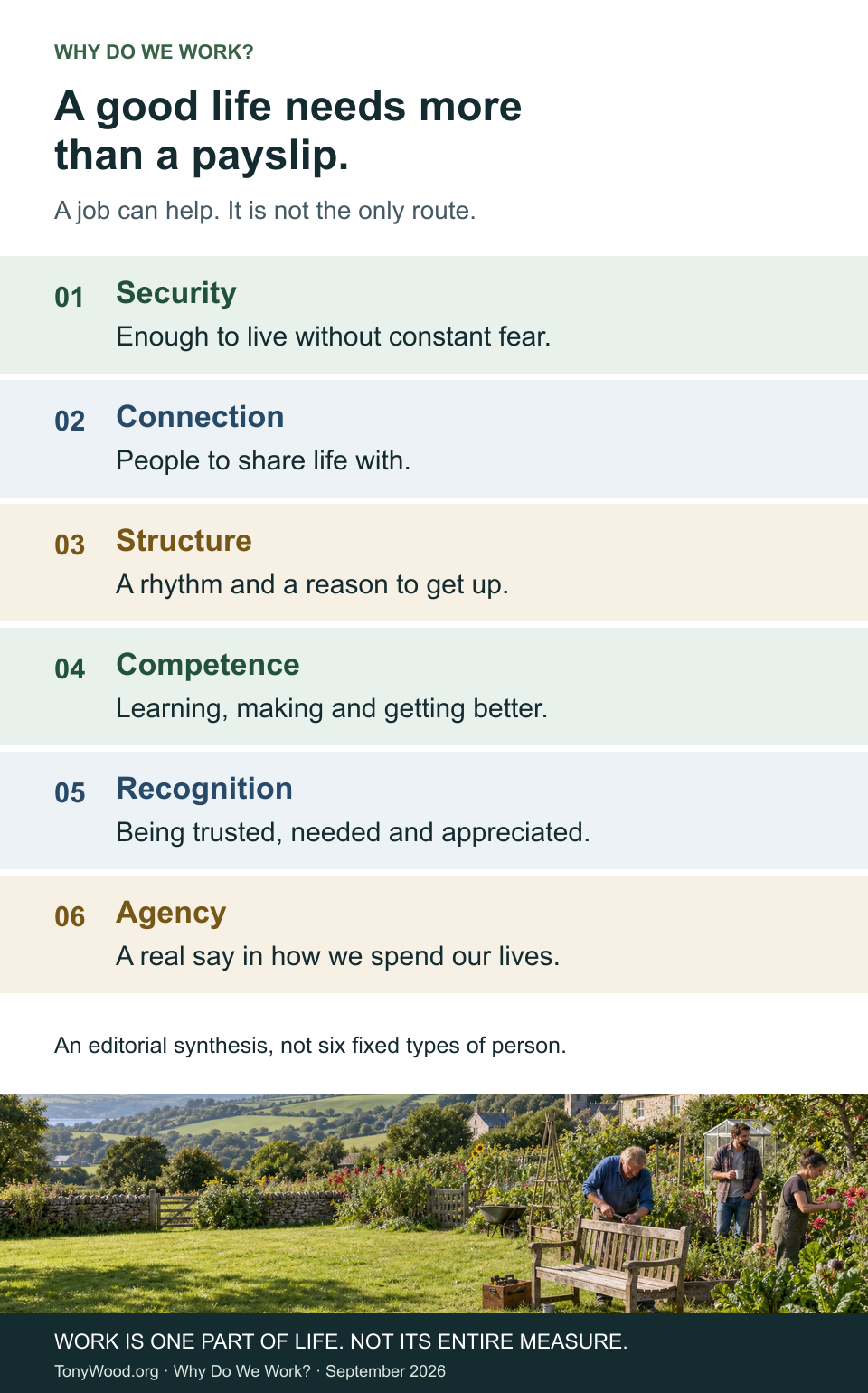
A job can provide much more than money. It can give a week a shape, put people around us and give us something to get better at.
A 2023 meta-analysis drawing on 106 studies examined income and five other functions associated with employment: time structure, social contact, collective purpose, status and activity. These were related to mental health. Most of the evidence came from Western settings, and association is not a promise that giving somebody any job will make them well. Paul and colleagues, 2023.
The following is my practical way of unpacking that bundle, rather than a psychological test.
| What we may need | What a good job can provide | Other possible routes |
|---|---|---|
| Material security | Income and some predictability. | Savings, shared provision, pensions or other income. |
| Connection | Colleagues and shared experience. | Family, friendships, clubs and community. |
| Structure | A reason to get up and a rhythm to the week. | Care, study, volunteering or a chosen routine. |
| Competence | Practice, feedback and visible progress. | Making, sport, learning and personal projects. |
| Recognition | Being trusted, needed and appreciated. | Relationships and contributions beyond a job title. |
| Agency | Resources and opportunities to shape a future. | Security, rights and real choices over our time. |
None of those alternatives is automatically available. An isolated person with very little money cannot simply be told to find a hobby. The point is to ask which need is missing, rather than treating employment as the only possible answer.
Losing a job and choosing to stop are different experiences
Having your income, routine and sense of being needed removed together can be an enormous loss. That is not a minor inconvenience to dismiss with a cheerful prediction about an automated future.
But neither should we turn the harms associated with unemployment into an argument that any employment is good employment.
A UK study following unemployed adults found that entering poor-quality work was associated with worse stress-related biomarkers than remaining unemployed. It was observational, so it cannot settle cause and effect, but it challenges the idea that a job is beneficial regardless of its conditions. Chandola and Zhang, published online in 2017.
Retirement gives us another useful comparison. A study exploiting the state-pension-age threshold in England found improvements in well-being and self-reported health associated with retirement, without evidence of changes in mortality or cognitive function. That result concerns people around pension age, not everybody who stops working. Rose, 2020.
Security and choice matter. Being told that you are no longer wanted is different from deciding that you have enough and would like your Tuesdays back.
Maslow is a useful question, not a fixed staircase
Maslow's hierarchy is an obvious place to start: physiological needs, safety, belonging, esteem and self-actualisation.
It makes intuitive sense that being hungry or frightened can make everything else harder. But the popular picture can become too tidy. People do not finish security, tick the box and then move on to relationships.
Maslow's original 1943 paper allowed exceptions to the ordering and described needs as partly satisfied at the same time. People can seek love, dignity or creative expression while materially insecure. Maslow, A Theory of Human Motivation.
I would use it to ask, "What is missing in this person's life?" Not to announce that everybody ought to want the same promotion once the bills are paid.
Another influential approach, self-determination theory, emphasises autonomy, competence and relatedness: having some choice, feeling capable and feeling connected. A review of workplace research found these needs associated with motivation and well-being. Again, it is a framework, not an exhaustive account of every person. Van den Broeck and colleagues, 2016.
Why does achieving something feel good?
I recognise the pleasure of wrestling with something difficult and finally getting it to work. With agentic systems, that can be a very familiar part of my day.
Is that about being better than somebody else? Sometimes comparison is part of it. But getting a system working can also mean that I understand something I did not understand yesterday. Or that somebody else can now do their job more easily.
Researchers describe an "effort paradox": effort can be something we avoid and something that gives an outcome value. That does not mean all struggle is rewarding, or that hardship is necessary for dignity. Inzlicht, Shenhav and Olivola, 2018.
There is a difference between choosing to climb a hill and being made to carry a heavy bag up it every day because somebody else controls the gate.
We should not confuse a satisfying challenge with drudgery. Nor should we assume that another person ought to enjoy the challenge we enjoy.
There is more than one respectable ambition
A much-cited study distinguished between seeing work as a job, a career or a calling. Its sample was only 196 people, so this is not a classification of humanity. It is a useful vocabulary for differences that can exist even among people doing similar work. Wrzesniewski and colleagues, 1997.
I would extend the conversation beyond employment. These are possible priorities, not fixed personality types or a ranking of better people.
| Someone might say | What fulfilment could look like |
|---|---|
| "I want a reliable living." | Fair pay, decent conditions and a predictable finish. |
| "I want to progress." | Responsibility, mastery, recognition or a growing business. |
| "This work matters to me." | A vocation or contribution, without making exploitation acceptable. |
| "I want to be there for my family." | Time and energy for care and relationships. |
| "I want to make and discover things." | A craft, a garden, a scientific problem or something nobody asked for. |
| "I want a life outside work." | Friendship, community, rest and interests that do not need monetising. |
One person can want several of these. Priorities can also change with health, children, caring responsibilities or simply experience.
Not wanting to build a company is not a lack of character. Wanting to build one is not automatically greed.
Philosophy has been asking a larger question
Psychology can investigate what people report and how their circumstances relate to well-being. Philosophy also asks what we ought to value. Those are different kinds of enquiry.
Here are five lenses I find useful. None settles the argument on its own.
| Lens | The question it adds |
|---|---|
| Aristotle: flourishing | Is this a good life as a whole, involving worthwhile activity and character, rather than just income or momentary pleasure? |
| Marx: alienation | Do people have a meaningful relationship to what they make and how they work, or feel separated from it? |
| Keynes: enough and relative wants | Could productivity buy leisure, while the desire to have more than others keeps moving the finish line? |
| Rawls: fair opportunity | Are opportunities genuinely fair, and do social and economic inequalities provide the greatest benefit to the least advantaged? |
| Sen and Nussbaum: capabilities | What are people actually able to do and be, given their circumstances, rather than merely what resources appear on paper? |
Keynes's 1930 essay imagined a much shorter working week as productivity rose. That was an argument about a possible future, not proof that abundance naturally distributes itself.
My concern is practical. If the only successful life we recognise is one with an impressive job title, we have made a surprisingly small box for everybody to live in.
We do not all start at the same line
You arrive with a life, but not necessarily a deposit, a safe home, good health, useful connections or somebody who can afford to support you while you take a risk.
Effort matters. So does the opportunity to turn effort into something.
Research using Britain's Wealth and Assets Survey finds substantial gifts and loans between friends and family are unevenly distributed, with more than half the value of gifts coming from the wealthiest fifth of people. This concerns transfers during life, not a measure of all inherited wealth. Institute for Fiscal Studies, 2023.
I understand why parents want to help their children. Saving and building something to pass on are understandable ambitions. We should not assume that every inheritance has a disreputable origin.
But a parent's freedom to help and a child's unequal starting position can both be real. Recognising one does not make the other disappear.
Housing is where that difference becomes particularly tangible.
| Area | Median home price | Median full-time annual earnings | Price-to-earnings ratio |
|---|---|---|---|
| England | £300,000 | £39,300 | 7.6 times |
| Wales | £213,000 | £35,800 | 6.0 times |
These are rounded national figures using individual, workplace-based earnings. They are not household-income ratios or mortgage offers. Deposits, interest rates and local prices matter too. Affordability improved as price-to-earnings ratios fell from their 2021 peak; the England ratio was its lowest since 2015. That improvement and the difficulty of buying without help can coexist. ONS, released 26 March 2026.
The question is not whether everybody should own the same house. It is whether ordinary effort offers a credible route to an ordinary secure life.
Why aren't the basics free?
They can be free to the person using them without being free to produce.
We already make that distinction. The NHS Constitution for England describes care free at the point of use, apart from limited exceptions authorised by Parliament. Staff, buildings and equipment still need paying for. And this is not a claim that all dentistry or every health-related service is free. NHS Constitution for England.
Apply that distinction to housing, food, transport or energy and the conversation becomes more useful. Instead of "Could we make it free?", ask what minimum provision we want, what resources it requires, who funds it and how people can obtain it reliably.
Cash gives people choice. Services can pool risks and supply something people cannot easily purchase individually. Neither removes the need for buildings, skilled people or electricity. A larger housing payment without more suitable homes could leave the shortage unresolved.
I am interested in a dependable floor beneath people, not a promise that everything anyone wants can be supplied without a bill somewhere.
Would people stop working if they had more security?
We can look at experiments. We cannot pretend they have already tested an entire post-work economy.
| Study | What happened | What it does not establish |
|---|---|---|
| Finland, 2017–2018 | 2,000 unemployed people received €560 a month unconditionally. There was no group-level employment effect in the first year. Survey respondents receiving the payment reported better well-being and financial security. | The second year's employment comparison was complicated by a new activation policy. The well-being survey had low and unequal response rates. This was not a permanent universal payment to everyone. |
| US OpenResearch study, 2020–2023 | 1,000 lower-income adults received $1,000 monthly for three years, compared with 2,000 receiving $50. The August 2026 accepted manuscript reports 1–2 fewer work hours weekly and 4.2 percentage points lower labour-market participation. Leisure was the largest measured increase in time use. | The study concerns selected adults aged 21–40 in Texas and Illinois. It does not measure the economy-wide taxes, prices or labour-market response to a national scheme. |
The uncomfortable answer for slogans on either side is that some people did work less, but these results do not show everybody abandoning work. The US study found increased spending on human capital, but no significant increase in degree attainment and no average improvement in job quality. More security does not automatically turn every spare hour into retraining.
Whether less paid work is a success, a cost or both depends on what it replaces and on how the provision is financed. That is a value judgement and a policy question, not something to hide in a headline.
There is also evidence that the relationship between hours and well-being is not simply "more is better". A UK longitudinal study found benefits associated with moving from no paid work into even 1–8 hours a week. It found no single optimal number of hours. This was observational, not a randomised four-day-week experiment, and it certainly does not mean eight hours will pay everybody's rent. Kamerāde and colleagues, 2019.
What could agentic AI actually change?
Here is the optimistic possibility I am interested in: if we can produce useful things with less human time and fewer resources per unit, perhaps people could spend less of their lives earning access to the essentials.
That is a possibility, not a forecast.
There is evidence of productivity gains in particular settings. A study of 5,172 customer-support agents found that access to a generative-AI assistant increased issues resolved per hour by about 15% on average, with larger gains for less experienced workers. It studied an assistant in one business, not an autonomous replacement for the economy. Brynjolfsson, Li and Raymond, 2025.
The ILO's 2025 assessment estimated that one in four workers worldwide was in an occupation with some exposure to generative AI. That is task exposure, not a forecast that one in four jobs will disappear. Its assessment favoured transformation over full replacement for most exposed jobs. ILO, 2025.
These findings give us reasons to investigate. They do not tell us who will receive the gains, whether prices will fall or how much paid work there will be.
A company could use a productivity gain to shorten the week, lower prices, improve service, pay people more, increase profit or employ fewer people. The technology does not vote on which one happens.
Cheaper intelligence is not automatically a cheaper house
We still need the physical world to cooperate.
| AI might help with | What still needs solving |
|---|---|
| Designing and organising a building | Land, planning, materials, finance, utilities and construction capacity. |
| Operating energy systems more efficiently | Generation, connections, networks, storage and who pays for them. |
| Reducing administration in care | Human attention, safe clinical decisions, premises and trained staff. |
| Making production more productive | Capital, materials, maintenance and sharing the financial gains. |
| Making expertise more accessible | Reliability, access, accountability and the ability to act on advice. |
Britain's Competition and Markets Authority identified problems including a complex, unpredictable planning system and the limitations of speculative housebuilding. A faster drawing does not by itself remove those constraints. CMA housebuilding market study, 2024.
Energy and materials are not unlimited either. The IEA's work on AI and on critical minerals describes electricity-system pressures and potential supply bottlenecks. Efficiency can help; it can also make a service attractive enough that we use much more of it. IEA, Energy and AI; Global Critical Minerals Outlook 2026.
I have explored the physical side in what electricity really costs and the technical jobs AI infrastructure could support. Less administrative work can coexist with a considerable need for electricians, engineers and care workers.
And who does the work nobody particularly wants?
This is the strongest practical objection to a comfortable vision of everybody choosing their own projects.
Bins still need emptying. Sewers need maintaining. Somebody has to work an inconvenient shift. Automation will not arrive everywhere at once, and some necessary tasks will remain difficult, unpleasant or dependent on people.
If people had more freedom to refuse those jobs, we would have to confront their terms: better pay, better conditions, better equipment, different hours or a different way of organising the service.
That could be a good thing for the people doing them. It could also make some services more expensive. It is not a free lunch.
A serious proposal needs to explain the workforce and the funding, not just the payment arriving in somebody's account. It also needs to protect the people who cannot work, without requiring them to perform usefulness to deserve a decent life.
Would achievement still matter if a machine could do it better?
I think so. That is my judgement, not a result established by these studies.
I do not have to be the world's best cook to enjoy making dinner for people I care about. A faster vehicle does not make a walk pointless. Someone else being able to make a better table does not remove the pleasure of learning to make one.
Sometimes I want the output. Please make the tedious administration disappear. Sometimes I want the experience of doing the thing.
Being able to tell those apart may become more important. Otherwise, we risk automating the part we enjoy and keeping the part we resent.
There is a further trap: replacing the demand for a successful career with a demand for a magnificent post-work life. Now everybody must become an artist, volunteer, athlete and entrepreneur to justify their freedom.
Perhaps somebody would just like to be less exhausted. That counts too.
What would I actually change?
I would not begin by promising that nobody will need to work. I would begin by asking whether productivity is making ordinary lives more secure.
For a business, that means looking beyond output per hour. Are people learning? Is the working day getting more manageable? Are the gains reaching customers and staff, or are we merely raising the target?
For government, I would want policies tested against dependable essentials, opportunities to learn, good conditions in necessary jobs and a credible way of paying for them. Cash, services, shorter hours and stronger bargaining power are options to examine, not interchangeable magic answers.
And for ourselves, there are a few questions worth sitting with:
- How much of my work is about paying for security?
- Which parts would I keep doing if the income were already there?
- Am I pursuing something I value, or a comparison I can never finish?
- Where else could I find connection, structure and contribution?
- Would the people closest to me choose the same life I am choosing for myself?
I love building things. I expect I would keep doing it. But that does not entitle me to prescribe building things as everybody else's meaning of life.
We work to pay for life. We can also work because something is worth doing. The opportunity is to make the second answer less dependent on the first.
So perhaps the most useful question is not, "What will everybody do without jobs?"
It is: if survival did not depend on your next payslip, what would you still choose to do, and what would make that a real choice for more people?
How to read the evidence
The research links sit beside the claims they support. They include original studies, official statistics, government trial results, scholarly philosophy and institutional reports. Observational associations, experiments, economic projections and moral arguments are identified separately.
Much of the well-being evidence is Western. The cash experiments are temporary and population-specific. The AI studies measure particular tasks and deployments, not a fully agentic society. None proves that a universal post-work settlement would succeed or fail.
My conclusion is a proposal about what we should value. It is not a scientific finding that one economic system has settled the meaning of life.
Continue to Part 2: What If My Job Is Pointless? Then Why Do We Work? We have looked at income, purpose and a good life. Next, I want to ask whether the pointless part of our week is the work itself or the way it is organised.