Apparently, the next generation is lazy. They do not want to work, they expect too much, and they have not got the attitude we had.
I keep coming back to a question. Were people saying that about us?
I grew up in the 1970s and 1980s and started work around 1986 or 1987. Before we congratulate ourselves on being the last generation with a work ethic, I thought it would be worth looking back.
It turns out that the argument was already there. So was another argument: perhaps young people needed opportunities, encouragement and a future they could see themselves in.
That is the bit I am interested in. Especially now, when we are asking another generation to find its place in a world of AI and agentic work.
We were young once, too
In July 1976, during a House of Lords debate on the state of the nation, Lord Soper challenged the temptation to judge young people through examples of bad behaviour. Lord Ritchie-Calder argued that young people had initiative but too few outlets for it. He called them adventurers without adventure
. Read the 1976 debate.
In May 1979, a Commons debate included warnings that measures aimed at the work-shy
could penalise young people who wanted to continue their education. Even then, the distinction between refusing an opportunity and trying to acquire the skills to take one was being argued over. Read the 1979 debate.
Then there is a particularly striking example from November 1987, right around the time I was entering work. In a debate on housing benefit, Ian McCartney protested about the way other MPs had discussed so-called workshy, lazy young people
. He was challenging the label, not endorsing it. Read the 1987 debate.
These are parliamentary arguments, not opinion polls. They do not tell us what every employer or parent believed. But they do show that blaming young people's attitude, and pushing back against that blame, is not something we have just invented.
The economic background matters as well. The ONS historical series records an annual UK unemployment rate of 11.3% in 1986 and 10.4% in 1987, for people aged 16 and over, seasonally adjusted. The rate measures unemployed people as a share of those working or unemployed, not the whole population. These are not youth unemployment figures. They are a reminder that entering work then did not mean walking into an economy with a job waiting for everybody. ONS unemployment series MGSX.
I do not want to turn this into a competition over who had it hardest. I want us to remember how little we knew about our own future before we criticise somebody for not knowing theirs.
What do we actually mean by lazy?
If we mean somebody could reasonably do something they have agreed to do, but repeatedly chooses not to make the effort, then let us discuss that behaviour. Commitments matter. Other people should not endlessly have to pick up the work.
But that is quite different from looking at somebody who is not getting much done and deciding we know why.
Are they unwilling? Do they not know how to start? Are they avoiding a task they find unpleasant? Are they exhausted? Do they believe the effort will lead anywhere? Have we even explained what good looks like?
Those questions describe different problems. Calling all of them laziness does not give us a particularly useful answer.
Take procrastination. Piers Steel's 2007 research review describes voluntarily putting off an intended action despite expecting the delay to leave you worse off. Its meta-analysis found associations with factors including how unpleasant the task felt, confidence in being able to do it, and impulsiveness. These are associations, not a diagnosis of a particular person or proof of what causes every delay. Steel's original paper.
Wanting to do something and struggling to begin is not the same thing as having no interest in doing it.
Nor should we casually turn a health problem into a character judgement. WHO identifies excessive workloads, low control, inadequate support and job insecurity among workplace risks to mental health. Its guidance asks employers to address working conditions, not just individuals' resilience. WHO: mental health at work.
None of that removes personal responsibility. It makes the conversation more precise. What is getting in the way, what can we reasonably change, and what will each of us do next?
A birth date is not a work ethic
There is another trap here. We compare somebody at the beginning of working life with somebody who has decades of experience, contacts and confidence, then call the difference generational.
A 2020 National Academies evidence review explains why these comparisons are difficult. Differences observed at one moment can reflect age. Differences between young people now and young people years ago can reflect the circumstances of the time. Neither automatically proves that a birth cohort has a distinctive character. The review concerns workforce research, principally in a US context; it is not a British laziness league table. Read the review's summary.
So I would rather ask about the person, the work and the circumstances than manage somebody through a label on their generation.
And there is another distinction worth making. Wanting to do a decent job and then go home to your family is not the same as being lazy. Neither is choosing rest over turning every spare hour into another project. Ambition is not a requirement to want the same life as your manager.
Hope needs a route, not just a speech
What does hope actually look like for somebody starting out?
Not a promise that everything will be fine. Not a lecture about how we managed. And certainly not telling them that AI will take their job, followed by surprise when they sound discouraged.
One useful psychological account comes from C. R. Snyder and colleagues' 1991 work on hope. It combines determination to pursue a goal with seeing possible routes towards it. This is a framework for understanding hope, not evidence that positive thinking creates vacancies or pays the rent. The original hope paper.
For me, the practical question is whether somebody can see a connection between the effort they make today and a life they might reasonably build.
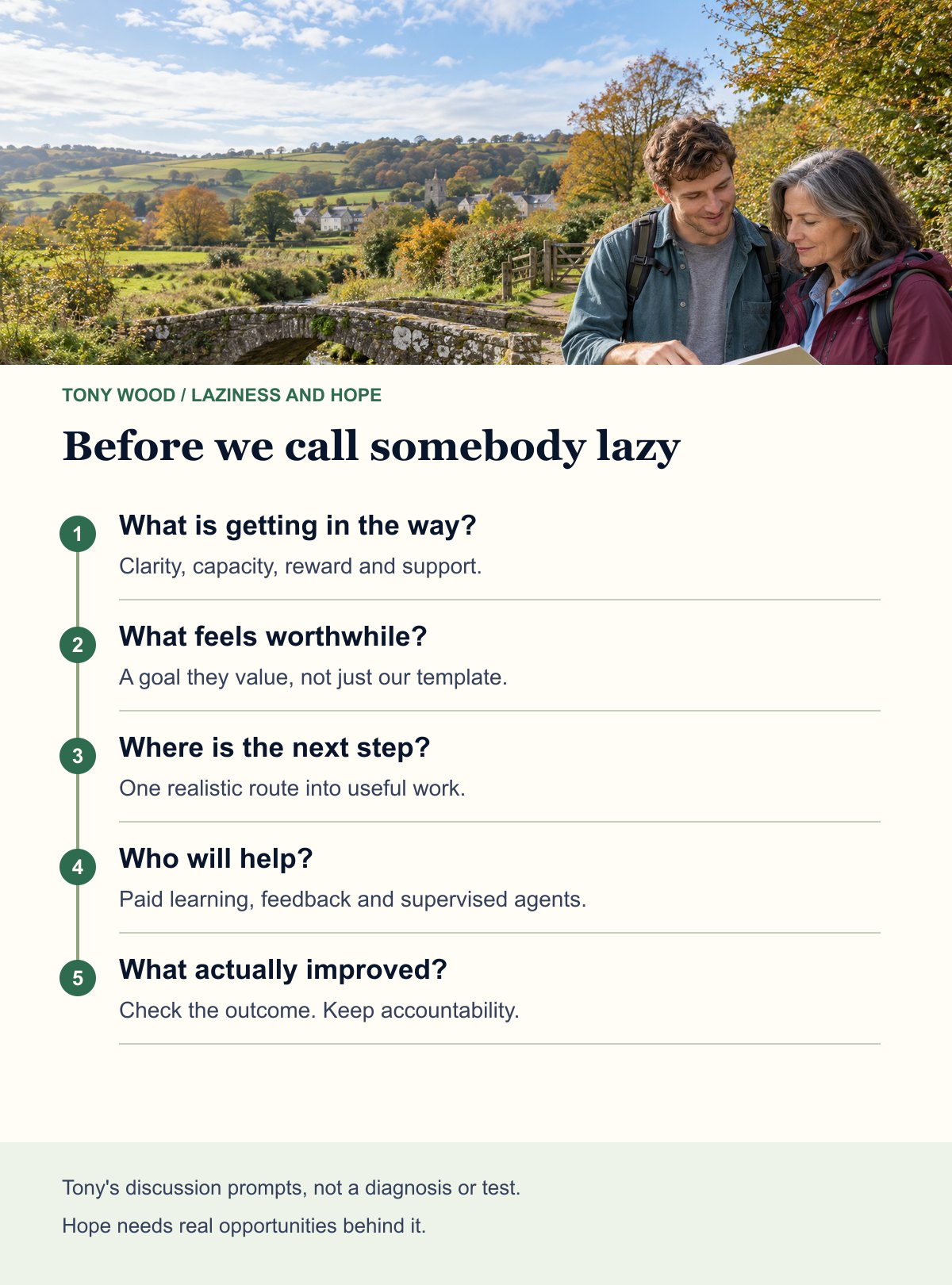
Can I learn something useful? Can I get a first opportunity? Will someone help me improve? Can this eventually support me? If the first route fails, is there another?
That is the sort of hope I think we should be offering. It needs opportunities behind it, not just encouraging words.
An agentic world could give us more ways in
I am optimistic about what agents could make possible. But that is an argument for building opportunities, not a prediction that the technology will automatically create enough good jobs.
Imagine a junior colleague working on a real business problem with an approved agent and somebody experienced alongside them. They have a clear task, suitable data and permission to experiment within sensible limits. They can ask questions, inspect the result, check it and explain what they have learnt.
That is a very different offer from handing them a login and saying, Off you go. Be productive.
I would like us to use these tools to let people attempt useful work sooner, while still teaching them the judgement to know whether the result is any good.
That might be improving an internal process, organising information, testing a small piece of software or helping a local business understand its enquiries. These are possible learning projects, not a list of jobs I can promise will exist.
The young person still has work to do. They need to ask, check, practise, accept feedback and follow through. An agent should help them learn the work, not become a way to send something on without understanding it.
But those of us running organisations have work to do as well.
Do not remove the first rung and blame people for not climbing
Here is the risk I want leaders to think about. If we automate the tasks through which people used to learn, where will their experience come from?
I am not arguing that we should preserve pointless administration to keep juniors occupied. I am arguing that we should deliberately replace the learning opportunity when we replace the task.
We could give people supervised projects, paid learning time, access to suitable tools and regular feedback. Let them review an agent's draft against the original evidence. Let them see a customer problem through to a checked outcome. Let them understand why a decision was made.
Do that inside proper working arrangements. A young person's willingness to learn should not become an excuse for expecting unlimited unpaid labour. Nor should opportunity depend on having parents who can fund the experiment.
A useful offer might be quite small: a paid, bounded project; an experienced person who will answer questions; and a chance to show what improved at the end.
That would give someone more to work with than another speech about how hungry they ought to be.
And we must be honest about the limits. AI access does not by itself provide income, customers, affordable housing or a fair share of productivity gains. Those still require business decisions, public choices and real investment.
We have a responsibility here, too
To somebody starting out, my suggestion is to look for one useful thing you can learn or improve. Ask for help. Try a manageable task. Build something you can explain, not just something an agent has produced for you.
To the rest of us, I would ask: what are we actually offering them?
We were young people once, too, trying to build a future before we knew how it would turn out.
I do not think our job now is to declare that the next generation is worse. It is to keep standards, take people seriously and help create worthwhile ways forward.
Before we ask why they have not got up and gone, perhaps we should ask whether we have helped give them somewhere to go.
Related reading
This is an unnumbered companion to Why Do We Work? and What Gives Us Our Get-Up-and-Go? The first asks what work is for; the second explores what helps us start and keep going. This piece asks what we miss when we call somebody lazy.
Sources and notes
Sources checked on 27 October 2026. The historical examples are a small selection from the UK parliamentary record, not a systematic count of press coverage or a measure of public opinion. The proposals for an agentic future are my interpretation, not findings from the historical debates or psychology studies.
- Hansard, 14 July 1976: The State of the Nation. Lord Soper's challenge to negative generalisation and Lord Ritchie-Calder's argument about initiative and opportunity.
- Hansard, 16 May 1979: Health, Education and Social Services. Debate about work incentives, benefits and access to further education.
- Hansard, 19 November 1987: Housing Benefit. Ian McCartney's objection to the language used about young people.
- ONS, series MGSX. Annual UK unemployment rates, aged 16 and over, seasonally adjusted; release dated 20 October 2026.
- Steel, 2007: The Nature of Procrastination. Original research review and correlational meta-analysis; procrastination is not a measure of a generation's work ethic.
- WHO: Mental health at work. Workplace risk factors and organisational prevention; not an assessment of any individual's health.
- National Academies, 2020: Are Generational Categories Meaningful Distinctions for Workforce Management? Evidence review explaining the difficulty of separating age, period and cohort.
- Snyder and colleagues, 1991: The Will and the Ways. Original development and validation of a model and measure of hope; not a test of an employment policy or AI intervention.