This follows the thought experiment: What If AI Takes All the Jobs? We Still Need to Eat.
Well, what is the other option?
If AI changes the way we earn a living, perhaps we should not only ask how everybody gets another job. Perhaps we should ask what would happen if the essentials were provided.
Food. Somewhere decent to live. Warmth. Access to care. Enough stability to get on with your life.
Imagine more of that being organised locally. A council helps make sure people have what they need. People contribute to the community, but perhaps not through the familiar arrangement of doing a job and receiving a wage.
Then comes the obvious question: is that socialism?
Some versions would move in that direction. Others could be public services within a mixed economy. The answer depends on who owns things, who makes decisions and whether participation is voluntary.
I think we should be able to examine an arrangement without being required to adopt a complete political identity first. But we should also be honest about what we are proposing.
The label does not settle the design
Socialism is not one perfectly agreed thing. The Stanford Encyclopedia of Philosophy's account describes a varied tradition, with social or worker control of productive resources central to the contrast with capitalism. It also distinguishes socialism from simply concentrating power in the state.
That matters. A cooperative, a state-owned enterprise and a privately owned company providing a publicly funded service are different arrangements.
A government paying for an essential service does not, by itself, tell us who owns the rest of the economy. Equally, if I proposed comprehensive social ownership of productive assets, it would be misleading to insist that had nothing to do with socialism.
I am not using the word as praise or an insult. I want to understand the arrangement before deciding what I think of it.
We can ask whether a policy helps without pretending its political history does not exist. We can also reject parts of a political programme without refusing to examine every idea associated with it.
We already separate some essentials from the bill at the door
The NHS Constitution for England says access is based on clinical need rather than ability to pay, with services generally free apart from limited exceptions.
That is an England-specific principle, not a claim that every health service is free, that access is unlimited or that funding has ceased to matter.
But it illustrates the distinction. We can decide to finance access collectively without deciding that every shop, farm or business must have the same owner.
The interesting question is how far we want to extend that principle, to what, and under which safeguards.
It is not enough to say, "The government provides." We still need to know who produces it, how it is paid for and what happens when the service is poor.
There is a name for part of this: universal basic services
The UCL Institute for Global Prosperity's universal basic services work explores public services available free at the point of need and use. Its Social Prosperity Network published a UK proposal in 2017, concerned with access to essentials and the connections between different forms of insecurity.
This is a policy proposal and research programme, not evidence that an entire post-job economy has been tested. Its historical cost estimates are not a current costing for the much broader idea I am exploring.
In plain English, a basic income gives people money to spend. Basic services arrange access to specified things. A society could use both.
Neither automatically means that everything is free, every desire is guaranteed or nobody needs to contribute towards the cost.
A useful description for the version I would like to examine is a guaranteed floor of essentials, organised as locally as practical. That is a description of the question, not a new political doctrine.
What might a local version look like?
Imagine a neighbourhood with a community kitchen, dependable access to groceries, help keeping homes safe and warm, and places where people can learn or get support. This is an illustration, not a description of an existing council scheme.
The council might coordinate access and commission services. Local businesses might supply food. A cooperative might run part of the service. Charities and residents might contribute in clearly defined roles.
The council would not necessarily own every field, cook every meal or employ everybody involved.
There is an important difference between guaranteeing a service and insisting that one organisation must produce every part of it. I would want to examine both quality and choice, not assume either public or private provision always wins.
In England, council responsibilities already vary by type and area. Housing, planning, social care, transport and waste are among the services described in the government's guide. They are not all the responsibility of every council. Scotland, Wales and Northern Ireland have their own arrangements.
A new guarantee on the scale imagined here would need decisions about powers, funding and responsibilities. It would not follow automatically from what councils already do.
Local delivery cannot mean every town is on its own
I can see the appeal of bringing decisions closer to the people affected. It gives us a place to ask questions and a service we can actually look at.
But "local" does not automatically mean competent, fair or well funded.
The House of Commons Library's May 2026 briefing on local government finances describes English councils receiving funding through a mixture that includes central grants, council tax and retained business rates. It also notes that needs, deprivation and available funding vary between areas.
That is why I would not want a basic guarantee to depend only on the wealth of the area you happen to live in.
A possible arrangement would combine wider funding and minimum standards with local decisions about delivery. The detail would have to reflect the different governments and institutions across the UK.
Nor would local provision mean local self-sufficiency. Food, energy, medicines, equipment and specialist services would still need reliable supply networks. Drawing a council boundary does not create those resources.
The difficult bit is "we all work, but do not get paid"
It's interesting, isn't it? At first that sounds like a community looking after itself. But it could describe several very different relationships.
One is that everybody has secure access to essentials and people choose to help. Someone grows vegetables. Someone helps organise deliveries. Someone repairs a shared space. Contribution can be encouraged and valued without becoming a condition of eating.
Another is an exchange: you must complete specified work to receive food, housing or other support. Economically, we have not made the exchange disappear. We have changed what people receive and the rules under which they receive it.
A third is compulsory allocation: somebody decides your duties and imposes penalties if you do not comply. That raises a different set of questions about power and freedom.
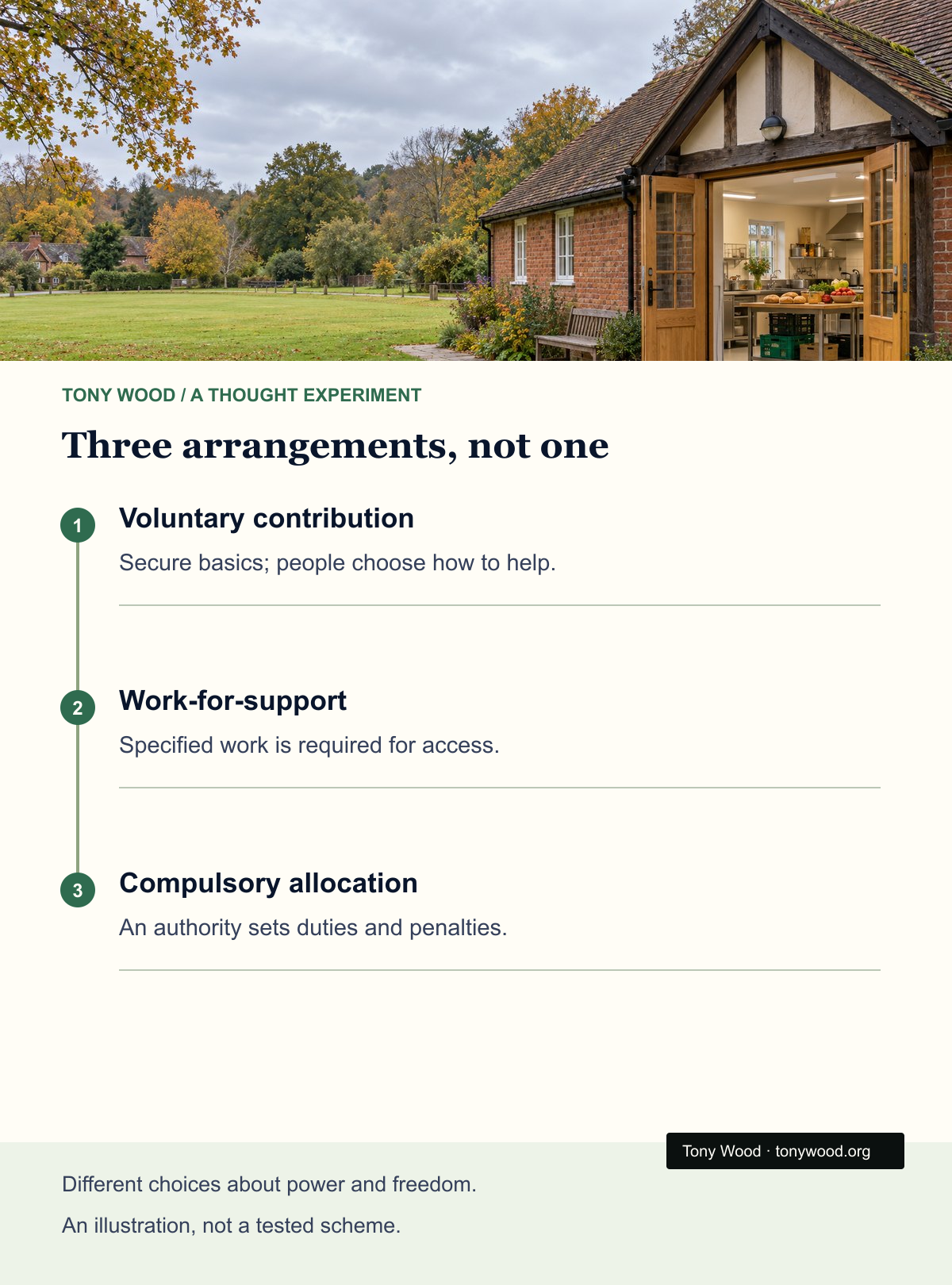
I would not slide between those arrangements as though they were the same idea.
Current UK minimum-wage guidance is also clear that the real relationship matters, not just calling someone a volunteer. It distinguishes genuine volunteers from workers and contains specific exemptions, including rules for certain voluntary workers. This article is not legal advice, and a food-for-work scheme cannot simply be assumed to sit outside employment law.
Before any real scheme, the relevant legal, pay and safeguarding questions would need proper advice. Changing the description is not a substitute for that work.
Who decides what counts as a contribution?
Suppose someone is caring for a parent. Someone else has a fluctuating health condition. Another person is studying. A fourth wants to start a business which may eventually help the area, but has not earned anything yet.
What counts? Who decides? What happens when the record is wrong?
It is reasonable to ask how a community sustains shared provision. I would also want to know who does the difficult or unpleasant work, how skills are developed and how free-riding is addressed.
But an identical work quota for every person would not answer those questions fairly. Nor would treating the absence of a visible council task as proof that somebody contributes nothing.
For the version I would want to investigate, I would start by separating the essentials guarantee from a compulsory contribution test. Then examine how useful participation could be supported and how genuinely necessary jobs should be rewarded.
If we still need skilled people to maintain buildings, provide care or keep equipment safe, I would not assume they will do it indefinitely without adequate reward because their groceries are covered.
Perhaps some activities could be shared. Others might need pay, training, better conditions or redesign. That would be a system with a different mix of paid and unpaid activity, not the disappearance of every job.
A floor should not become a ceiling
One test I would apply is whether people remain free to build something beyond the basics.
Could you start a company? Earn more? Choose another supplier? Move to another area? Disagree with the people running the service?
What if the meals do not meet your needs? What if the housing is unsuitable? Can you challenge the decision without risking the support you depend on?
I would want transparent standards, routes to complain, independent review and credible ways to fix a failing provider. An election matters, but it would not be enough for someone who needs a problem resolved this week.
There would also be trade-offs. More individual choice can complicate procurement. Standardisation can reduce flexibility. Local discretion can produce variation. A guarantee would need to say what is actually guaranteed, rather than promising everything to everyone.
These are design questions, not reasons to abandon the conversation.
There is more than one way to organise ownership
We do not have to choose only between a distant state organisation and a conventional investor-owned business.
The International Cooperative Alliance's principles describe voluntary membership and democratic member control of jointly owned enterprises. That offers another model to consider, not a guarantee that any particular cooperative will succeed.
For an imagined local food service, I could examine a council-run service, a contract with an independent business, a resident or worker cooperative, or a partnership. Each would need clear responsibilities, access to capital, competent management and ways of dealing with failure.
Putting a service into a cooperative would not, by itself, settle how the rest of the country should be organised. Nor would a public guarantee remove the need to inspect how a private contractor behaves.
The ownership label is useful information. It is not the whole quality-control system.
What does AI change?
AI could help with forecasting demand, organising deliveries, administration or maintenance planning. Those are possible applications to test, not savings I have measured for this model.
If automation made essentials easier and cheaper to produce, the options available to a community might widen. But we would still need food, buildings, power, equipment, maintenance and capable people where human work remained necessary.
We would also need a credible funding arrangement. Taxes, charges elsewhere in the system, public investment returns or shared ownership might play a part. None is a blank cheque, and none is costed in this article.
I would be particularly careful about the records and decisions which affect people's access. An AI tool might help an administrator. It should not become an unchallengeable answer to why someone cannot get food or suitable support.
Technology could help deliver an arrangement. It would not decide for us what the arrangement should be.
Can we ask the question without choosing a team?
That is what I find useful about this thought experiment.
I am not proposing that the state owns everything, or that everyone should be assigned an unpaid council job. I am asking whether we could organise a dependable floor beneath people's lives as the way we work changes.
Some answers would be socialist. Some would be extensions of public provision within a mixed economy. Others might rely more heavily on cooperatives, cash support or independent providers. Those differences matter and deserve an honest description.
My questions would be practical: does it meet needs? Can it be funded? Does it preserve choice? Does it recognise different circumstances? Who has power, and how can they be challenged?
We can investigate how to make sure everybody has enough without treating a political label as either a complete answer or a reason not to think.
What would you want guaranteed locally? And what freedoms would you insist on keeping alongside it?
Sources and notes
Checked on 29 October 2026. This is an exploratory companion to the question of what happens if AI changes paid employment, not a declaration of political allegiance, a costed programme or a proposal to introduce compulsory unpaid work. The imagined local service and safeguards are my suggestions, not a tested model or a claim about any existing council.
- Stanford Encyclopedia of Philosophy, Socialism, substantive revision 25 May 2024. Philosophical reference on a diverse tradition, social control and institutional models; not a test of anyone's political identity.
- UCL Institute for Global Prosperity, Universal Basic Services. A research and policy-proposal programme with a 2017 report, not enacted national policy, a current costing or a full post-job trial.
- GOV.UK, Understand how your council works. England-specific guide; responsibilities differ by council type. No current council count or reorganisation timetable is used.
- House of Commons Library, Local government finances, 29 May 2026. English funding arrangements and variation; not a funding plan for the proposed guarantee.
- GOV.UK, Eligibility for the minimum wage, updated 23 October 2026. Worker status, genuine volunteers and specific exemptions depend on the actual arrangement. This essay is not legal advice on a scheme.
- International Cooperative Alliance, Cooperative identity, values and principles. The cooperative movement's own standard, not independent evidence of better outcomes.
- NHS Constitution for England, updated 17 August 2023. Clinical-need access and generally free services with limited exceptions; not unlimited provision or a UK-wide charging statement.
Related reading: Why Do We Work? and Could AI Give Us More Time for Our Communities?