The companion thought piece asks: what if the government provided the basics?
People keep asking a version of the same question: what happens if AI takes all the jobs?
My first thought is rather basic. We are still going to need to eat. We will need somewhere to live, warmth, clean water and somebody to help when we are ill.
The jobs might change. Our need for those things does not.
So perhaps we all become farmers. Or builders. Perhaps we spend more time looking after each other while machines take care of much of the rest.
But follow that thought a little further and another question appears. If machines can produce what we need, why would losing a salary mean losing access to it? And if machines cannot produce it, who is going to do the work?
A society with no jobs is not necessarily a society with nothing to do. It is a society that needs an answer to how people obtain what they need.
This is a thought experiment, not a date in the diary
I am not predicting that every British job will disappear, or putting a year on it.
The ILO's 2025 research on generative AI and occupations describes job transformation as the more likely outcome because many tasks still require human input. Exposure to a technology is not the same thing as redundancy. That research does not establish that AI will eliminate all employment.
Nor does it settle what future AI combined with robotics might eventually do. For this article, I want to explore the extreme assumption and see what it reveals about how we organise society.
Not just: what would happen to my job title? What would happen to breakfast, the roof and the hospital?
We need to separate jobs, work and production
A job is an arrangement under which someone pays you to do something. Work is broader: raising a child, repairing a gate or helping a neighbour can be useful without producing a payslip.
Production is the supply of goods and services. It is what puts food on the shelf, electricity into the socket and treatment within reach.
These are working distinctions for this discussion, not an attempt to rewrite employment law or national accounting.
Imagine two futures.
In the first, everyone loses their job and the systems stop. Crops are not harvested. Water is not treated. The electricity network is not maintained. That is a failure of essential production. We would urgently need to organise people, machines or both to get it working again.
In the second, people lose their jobs but automated systems keep supplying the goods and services. The country has not necessarily lost its ability to provide a good life. It has lost a major way of distributing the income used to buy that life.
The ONS describes GDP as a measure of production, not a measure of how many people have jobs. My inference is that, under the second assumption, output need not disappear just because payrolls do. That does not tell us whether ordinary households would be better off.
Same phrase, "no jobs". Very different problems.
So, do we all become farmers?
Perhaps more of us would grow food, repair things and do practical work locally. I can see the appeal of that. There is something very direct about doing something useful and seeing the result.
But growing a few vegetables and running a food system are different propositions.
A farm needs suitable land, water, knowledge and equipment. Its produce needs storing, processing and moving. Some of its inputs may come from overseas. Defra's 2024 Food Security Report examines precisely these interdependencies, including agricultural inputs, energy, transport, labour and skills.
Its discussion of food sources also treats domestic production and international trade as parts of the same system. Producing more at home would not automatically remove dependence on imported inputs.
And not everybody has land, equipment or the health to farm. I would not want access to dinner to depend on being able to grow it yourself.
There is also a useful logical test here. If people are still needed to farm, build houses, repair machinery or provide care, essential human work has not disappeared. The question is how we organise and reward it.
If machines really can do all of that reliably, we do not have to send everyone back to the fields to justify feeding them.
The difficult question is who gets the output
Imagine an automated food business. This is an illustration, not a claim about a particular company.
Its machines grow, pack and deliver food. There are few employees, but plenty of produce. If most households have lost their wages, who buys it? And who receives the income from selling it?
Owning a productive machine and needing what it produces are not the same thing.
That is where I think the conversation needs to go. The economic benefit of automation does not automatically arrive in everybody's bank account. Lower costs might help, but the outcome would also depend on prices, competition, ownership and public policy.
The IMF's 2024 discussion of generative AI and fiscal policy considers the risk that gains accrue to capital owners while labour income and the tax base come under pressure. It argues for preparing social protection and taxation for different scenarios, not assuming that productivity will distribute its own benefits.
A country could, in principle, produce more while many people became less secure. That is the outcome I would want us to prevent.
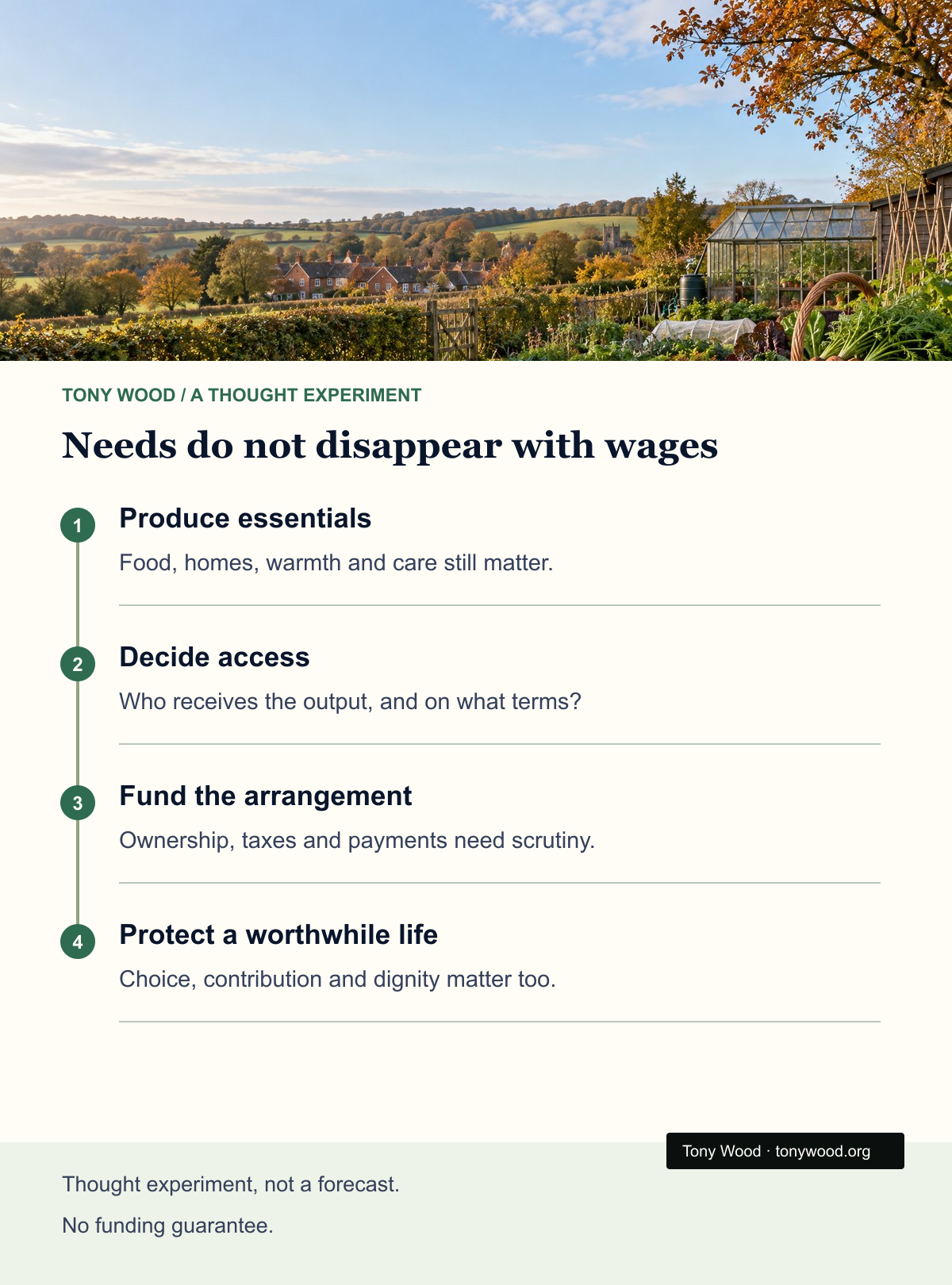
The state is one answer. It is not the only arrangement.
One response would be a universal basic income: a regular payment that does not depend on having a job.
Another would be a stronger guarantee of essential services, so households need less cash to obtain a decent life. Another would be shared ownership, through cooperatives, broadly held investments or a public fund, giving people a share of productive returns.
I would explore a mixture rather than assume one mechanism solves everything.
Cash gives people choices, but has to buy things that are actually available. Public services can protect access, but someone still has to organise capacity and quality. Ownership can provide income, but somebody has to acquire and govern the assets, and returns are not guaranteed.
These are possibilities to examine, not a costed programme or a forecast of what Britain will choose.
One deliberately round example shows the scale: paying £10,000 a year to 50 million people is £500 billion a year in gross payments. That is arithmetic using assumed numbers, not an estimate of the eligible UK population or the net cost of a policy.
A real proposal would have to account for tax recovered, existing benefits, children, housing, disability, care needs and the resources the economy could supply. My example does not tell us that £10,000 would be adequate.
The OECD's 2017 basic-income modelling is a useful warning about design: replacing targeted support with a flat payment can leave some disadvantaged households worse off. It is historical modelling, not a costing for an automated Britain.
And who pays the state?
We cannot simply say, "The government will pay," and stop there. We need to ask what it can draw on and how it will fund the commitment.
For a sense of the present system, HMRC reports that Income Tax, Capital Gains Tax and National Insurance together supplied 59% of its annual receipts in 2025/26. That is not a claim that 59% comes from wages, or that all of it would vanish if employment fell. Capital Gains Tax is not a wage tax, and Income Tax also applies to some non-employment income.
But if wage income shrank drastically, continuing to rely on payroll-related revenue while expanding income support would be a difficult combination. We would need to examine taxes on other income and assets, returns from public ownership, spending choices and the wider economy.
There is a further UK question: where are the productive assets and their owners? Being able to use an overseas AI service is not the same thing as owning its profits or being able to tax all of them. The IMF paper also discusses international profit shifting and tax competition.
I would want that considered before assuming a British dividend will neatly arrive from a global technology boom.
Money does not build the house by itself
Suppose everybody receives an income, but there are still too few suitable homes where people need to live. We have improved their ability to bid for housing. We have not necessarily improved its supply.
The same reasoning applies to electricity, food and treatment. Where supply cannot respond, more purchasing power can put upward pressure on prices. The result would depend on the actual constraints; it is not a claim that every income payment inevitably causes inflation.
So I would ask two questions together: how will people pay, and how will we make sure the things they need are there?
Nor does automation mean Britain must stop trading. In this hypothetical world, machines could still produce exports. But food inputs, medicines, equipment and energy supply chains would still need reliable arrangements. "No wages" is not the same as "no international economy".
A simpler life might be a choice. I would not want it to be a polite description of having much less because the essential systems were not maintained.
What happens to healthcare, builders and callings?
I keep coming back to the practical things. Somebody needs a home made safe. Somebody needs treatment. Somebody needs help getting through the day.
If humans are still necessary to provide those things, we should train, support and reward them. That is a future with a different balance of jobs, not literally no jobs.
Some people may choose a role because it is a calling. I would be careful about turning that into an excuse to underpay them. Meaningful work and a decent life should not be alternatives.
If machines could perform much more of the necessary work, we would still have to decide what care we want and who answers when it goes wrong. Technical capability alone would not answer those questions for us.
We already have an example of separating access from the patient's ability to buy a service. The NHS Constitution for England bases access on clinical need rather than ability to pay, with services generally free apart from limited exceptions. That is an England-specific principle, not a claim that every UK health service is free or that resources are unlimited.
For me, the future question is how we sustain access and accountability as the technology changes. It is not simply whether a robot can perform a task.
Having enough to live on is not the whole of a life
This is where the question joins my earlier pieces on why we work and what gives us our get-up-and-go.
What would you want to do if the basics were secure? Learn something? Make something? Look after your family? Build a community project? Rest for a while?
I would expect different answers. I do not think we need to prescribe one acceptable way to have a worthwhile life.
We should take the loss of work seriously, though. A 2025 systematic review of 38 longitudinal studies found poorer mental-health outcomes associated with unemployment and improvements after re-employment. The authors rated the certainty of the evidence as low. These were studies of unemployment in existing societies, not experiments in a secure, universally post-job world.
I would not turn that into a prediction that nobody can be happy without employment. I would take it as a reason to think about income, relationships, routine, identity and opportunities to contribute together.
Finland's 2017-18 basic-income experiment offers a limited piece of evidence, not an answer to the whole future. It involved a selected group of unemployed people, not everybody. Its evaluation reported better wellbeing on several survey measures, alongside employment analysis and varied personal experiences. It did not test a society where jobs had disappeared, and the survey findings should not be treated as a clean causal verdict on every outcome.
Money matters. So does having somewhere to belong. Neither finding means we should invent pointless duties to keep everyone occupied.
The transition might be the hardest part
The more immediate worry, for me, is an uneven change. Some people lose incomes while others are still urgently needed. Some businesses do well while the people who used to buy from them struggle. The new arrangements arrive after the old ones have started to fail.
That is a scenario to prepare for, not evidence that it is inevitable.
I would want Britain to look at essential supply, household security and opportunities to learn together. Are homes being maintained? Can people afford the basics? Are we capturing productive gains? Who has time and money to retrain? What happens to someone whose health or caring responsibilities limit their choices?
Shorter working weeks and a mixture of wages, services and other income are possible arrangements to explore before imagining an overnight switch to no employment. Their effects would depend on pay, productivity, staffing and what people actually want.
There could also be more room for community activity. But volunteering should remain a choice, not become the price of being allowed to eat.
Perhaps the question is what we want the work to achieve
I do not know whether AI will ever remove the economic need for human labour across an entire country. The evidence here does not establish that it will.
But the thought experiment is useful because it brings us back to what we actually need: food, shelter, warmth, health, connection and room to make something of our lives.
Maybe more of us will grow food. Maybe some will build, repair, teach or care because they want to. Maybe others will do work we have not thought of yet. None of that should require pretending that everyone has the same abilities or ambitions.
If machines can take away more of the drudgery, I would like us to use that opportunity to improve people's lives. We will still have to decide how the benefits are shared.
The question is not just, "What happens if there are no jobs?" It is, "Can we make sure people have a decent life when a job is no longer the way they earn one?"
What would you want to do if the basics were secure? And what would we need to put in place before that became a genuine choice?
Sources and notes
Evidence checked on 29 October 2026. This is a thought experiment informed by the supplied research and the primary sources below, not a prediction, a costed policy or a claim that current AI can replace every worker. Scenarios, imagined examples and suggested responses are my interpretation. Financial arithmetic is explicitly illustrative.
- ILO and NASK, Generative AI and Jobs: A Refined Global Index of Occupational Exposure, 20 May 2025. Task exposure and potential transformation, not a forecast of total UK job elimination.
- ONS, Gross and net measures of the UK economy, 24 October 2023. Production is distinct from welfare and distribution.
- Defra, UK Food Security Report 2024, Theme 2 and Theme 3, 11 December 2024. Domestic supply, trade and interconnected inputs; not a simulation of a post-job UK.
- IMF staff, Broadening the Gains from Generative AI: The Role of Fiscal Policies, June 2024. Scenario-based policy analysis, not an endorsed forecast or a recommendation for the particular ownership mix discussed here.
- OECD, Basic income as a policy option: Can it add up?, May 2017. Historical model assumptions; not current UK benefit rates or a costing for full automation.
- HMRC annual tax-receipts bulletin, updated 21 October 2026. The 59% figure covers Income Tax, CGT and NICs within HMRC cash receipts for 2025/26, not all government revenue or just employment taxes.
- NHS Constitution for England, updated 17 August 2023. Stated access and charging principles; not a UK-wide guarantee of unlimited services.
- Sterud and colleagues, Mental health effects of unemployment and re-employment, 2025. Review of 38 longitudinal studies; low-certainty evidence, not a post-work experiment.
- Kela and research partners, Evaluation of the Finnish Basic Income Experiment, 6 May 2020. Targeted 2017-18 experiment; survey, register and qualitative findings have different evidential limits.
Related reading: What If My Job Is Pointless? Then Why Do We Work?, alongside the work, motivation and community pieces linked above.