What if one of the best things AI gave us was a Wednesday afternoon?
Not another meeting. Not another report. Some time to help at a local charity, share a skill, organise a community lunch or spend an hour with somebody who would appreciate the company.
I've been thinking about this alongside the question of why we work. If AI helps us do more of our paid work in less time, what do we want to do with the difference?
We could keep increasing output. There are good reasons to do that. But perhaps some of the benefit could be time for one another. An AI-enabled community revival, led by charities and the people who already understand their local area.
I think that is worth exploring. Not because it will happen automatically, but because it is something we could choose to build.
A shorter week is a possibility, not a promise
My starting thought is a four-day week. Perhaps, further ahead, a three-day week in some kinds of work. If technology changes how much human time a task needs, why should every benefit have to appear as more work?
There is useful evidence on shorter hours. The UK four-day-week pilot ran from June to December 2022, involving 61 organisations and around 2,900 workers. The pilot tested reduced working time without loss of pay, although some employees' hours did not change. The original report describes improvements in employee wellbeing.
These were organisations choosing to try a shorter week, not a representative experiment across every UK workplace. It was not an AI trial, and it does not establish the case for a three-day week.
There is another useful detail. In its interviews, the report describes two employers disappointed by low uptake of voluntary work during the pilot. An extra day did not necessarily become a day of volunteering.
That matters. We should not build this argument on the assumption that AI creates spare time, which immediately turns into community action. Employers might use productivity gains to expand services or profits instead. People might need the time to recover, care for family or earn more.
The social benefit depends on decisions about how the gains are shared.
You cannot pay the rent with spare time
There is a huge difference between working fewer hours with enough income to live on and losing work you still need.
If somebody has a free Friday because their hours have been cut and they cannot pay the bills, that is not a wonderful volunteering opportunity. Their priority is finding an income. Quite reasonably.
That is why I think the conversation has to include income security. It might mean shorter hours without a pay cut. It might involve a basic income or another way of sharing the economic benefit. Those are possibilities to debate and test, not outcomes I am claiming AI will deliver.
The Welsh basic-income pilot for care leavers is a real example of testing an income floor for a particular group. Its payments ended in 2025, with evaluation continuing into 2027. It was not a universal scheme, and it does not prove that a nationwide basic income would produce more volunteering.
For me, the principle is simpler than choosing the entire policy now: people need some security before we can reasonably invite them to give more time.
And any proposal for sharing AI's gains has to answer who pays, who benefits and what happens to people whose work cannot be shortened so easily.
People need a way in
Community work is not an empty space waiting for AI to invent it. The 2025/26 Community and Engagement Survey reports that 18% of people aged 16 and over in England formally volunteered at least monthly in the preceding year.
Among respondents asked why they had not volunteered more frequently, or at all, work commitments were the most commonly reported barrier, cited by 51%. That is a figure for that question's respondents in England, not for every worker across the UK.
Time matters, then. But so does the shape of the invitation. NCVO's Time Well Spent 2023 research highlights flexibility, reluctance to make an ongoing commitment and concern about being out of pocket.
Think about what that means in practice. An invitation to help for two hours on a Saturday is different from an open-ended commitment to turn up every week. A clear role, a named person to ask and covered expenses could make the first step easier.
We should make room for small contributions, occasional contributions and people who need to change their availability. Not everyone can promise the same afternoon for the next year.
AI could help on both sides
This is where I think the idea becomes interesting. There are two opportunities, not one.
AI might help people reclaim some time from paid work. It could also help a charity use the time people offer without drowning its staff in administration.
The Charity Digital Skills Report 2026 found 38% of respondents describing their AI use as active or strategic. Its survey received 807 responses from charities and other social-sector organisations. It is a picture of those respondents, not a census of every UK charity. Reported uses include drafting emails, summarising notes and preparing documents.
Those are sensible places to start. I would look at drafting role descriptions, suggesting rotas from availability people have chosen to share, preparing induction material from approved guidance and helping a coordinator find information.
The aim would be to give that coordinator more time with people. Not to assume that because an AI can draft a rota, we no longer need somebody to notice when a volunteer is struggling or a person needs help.
A useful assistant would suggest. An authorised person would check, decide and take responsibility.
Start with a local need, not a new platform
Imagine a local charity working with its Volunteer Centre, a council for voluntary service or another local support organisation, and the council where appropriate. This is a proposed example, not a programme I am reporting as already running.
They start with a question: what help do people here actually want?
Perhaps it is a community lunch. Perhaps it is companionship, help with digital confidence or a skills-sharing session. Perhaps an existing community garden needs volunteers for an agreed, suitable task.
They offer a few clear roles. People can see the commitment, location, accessibility, expenses and support before signing up. There is a way to join by phone or in person, not only through an app.
An AI assistant could help the coordinator prepare reminders and suggest matches between those roles and volunteers' stated interests. People would choose whether to accept. Nobody would be allocated a stranger's personal problem by a bot and told to get on with it.
Where a role needs training, safeguarding checks, permission or specialist supervision, those requirements stay. The technology does not get to waive them.
I would rather see one modest, well-supported local experiment than a grand platform looking for a community to use it.
Fund the person who makes it work
Here is the part I would not want us to miss: offering unpaid time does not mean organising it should cost nothing.
My proposal would include funding for coordination, training, accessible opportunities, suitable checks and expenses. Otherwise we risk asking a small charity to absorb more work in the name of helping it.
Where useful, several organisations could share technical support instead of each buying and maintaining a separate system. But the local people doing the work should help decide what they need. A tool that creates more checking than it saves is not much of a gift.
The Charity Commission's discussion of AI, for England and Wales, emphasises human oversight and trustees' continuing responsibility for decisions. It also highlights risks around sensitive beneficiary information.
So keep confidential information out of casually chosen AI tools. Agree what the assistant can access, what it can do and what must go to a responsible person. Helpful administration is one thing; handing over safeguarding judgements is another.
And volunteers should add to a properly supported service, not become an excuse to remove paid expertise or leave public responsibilities unfunded.
Keep it voluntary
I would love more people to have the chance to contribute. But I do not want us to replace one test of a person's worth with another.
We've been discussing what we mean when we call people lazy. It would be a strange outcome if we gained some freedom through technology and immediately began policing everybody's new day off.
Rest is a reasonable choice. So are family, learning and doing something simply because you enjoy it. Caring for somebody already matters, whether or not it appears in a formal volunteering figure.
The version of this idea I support is an invitation, not a condition attached to an income floor. No compulsory volunteering, no ranking people by how much time they give and no assumption that everybody has the same health, money or capacity.
Make it easier to take part. Let people decide.
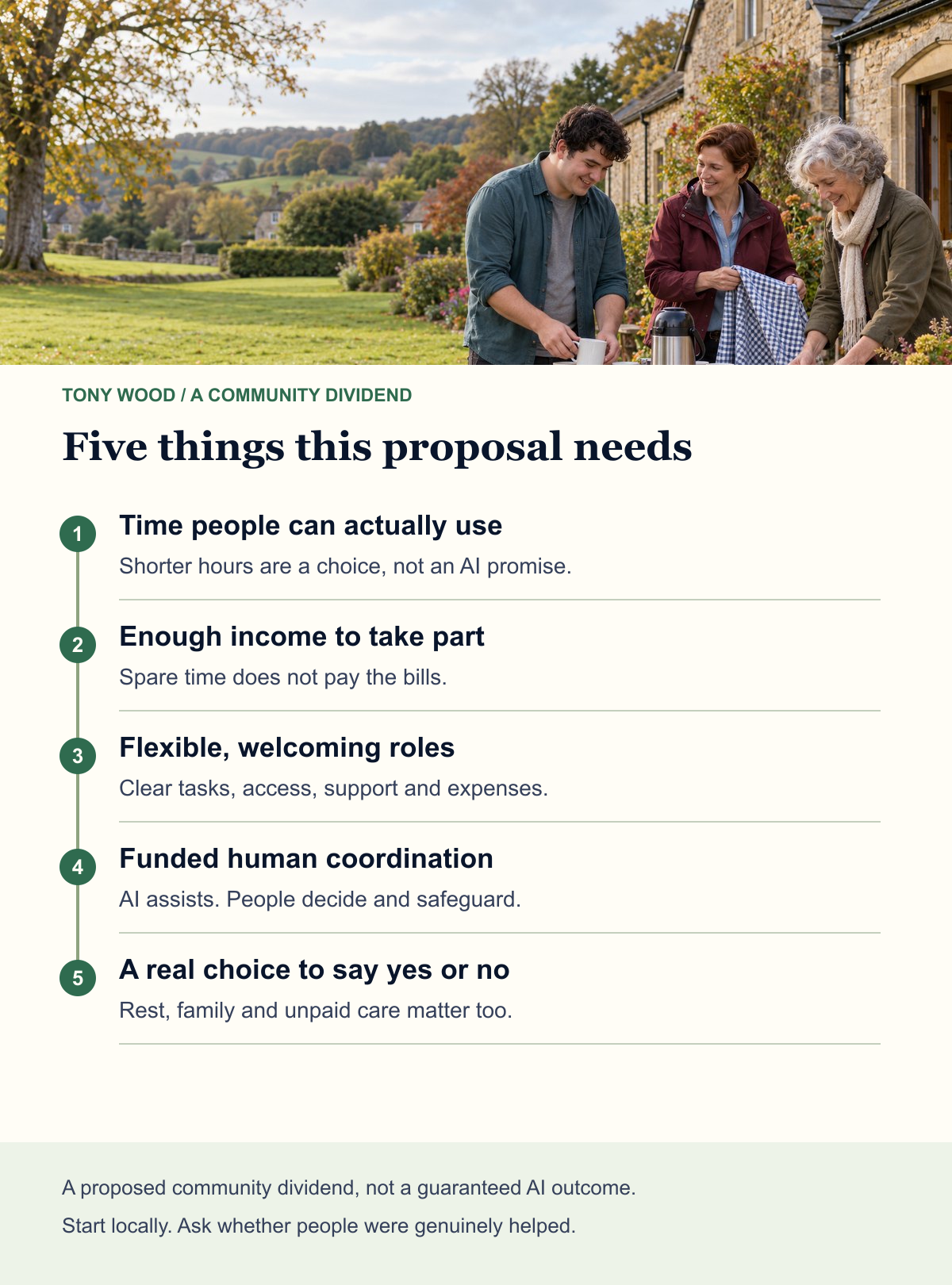
A community dividend worth testing
For an employer, this could begin with a properly evaluated shorter-hours trial or supported volunteering time, without pretending either is cost-free. For a council or funder, it could mean backing existing local organisations to offer flexible roles and paying for the coordination around them.
Then ask whether it helped. Were people better supported? Could more people take part without being out of pocket? Did volunteers enjoy it? Did charity staff gain time or inherit another system to manage? Were the roles safe and genuinely wanted?
Count those things, not just how many messages the AI sent.
I do not know whether we will move towards a three-day working week, a basic income or something we have not yet worked out. But we can decide now that the benefits we look for should be wider than commercial output alone.
What if we used some of that new capability to make it easier to look after the places we live and the people around us?
More time for one another. That would be a rather good use of AI.
Sources and notes
Evidence checked on 27 October 2026. This is a thought piece: the proposed community model, future working patterns and income arrangements are possibilities, not established consequences of AI.
- The UK's four-day-week pilot, February 2023: original report, particularly the trial design and discussion of time off on printed page 63. A campaign-linked pilot, not a representative AI experiment.
- Community and Engagement Survey 2025/26: official volunteering statistics for England, updated 16 September 2026. Formal volunteering means unpaid help through groups, clubs or organisations.
- NCVO, Time Well Spent 2023: reported volunteering experiences, barriers and enablers, not a causal study of shorter weeks.
- Charity Digital Skills Report 2026 methodology and AI findings: a voluntary-response sector survey. Its wider 79% headline includes organisations exploring AI, not just active users.
- Welsh Government, basic-income pilot evaluation update, February 2026: a targeted pilot, with final impact and economic evaluation expected in 2027.
- Charity Commission, Charities and Artificial Intelligence, April 2024: opportunities, oversight and risks. Its regulatory remit is England and Wales.