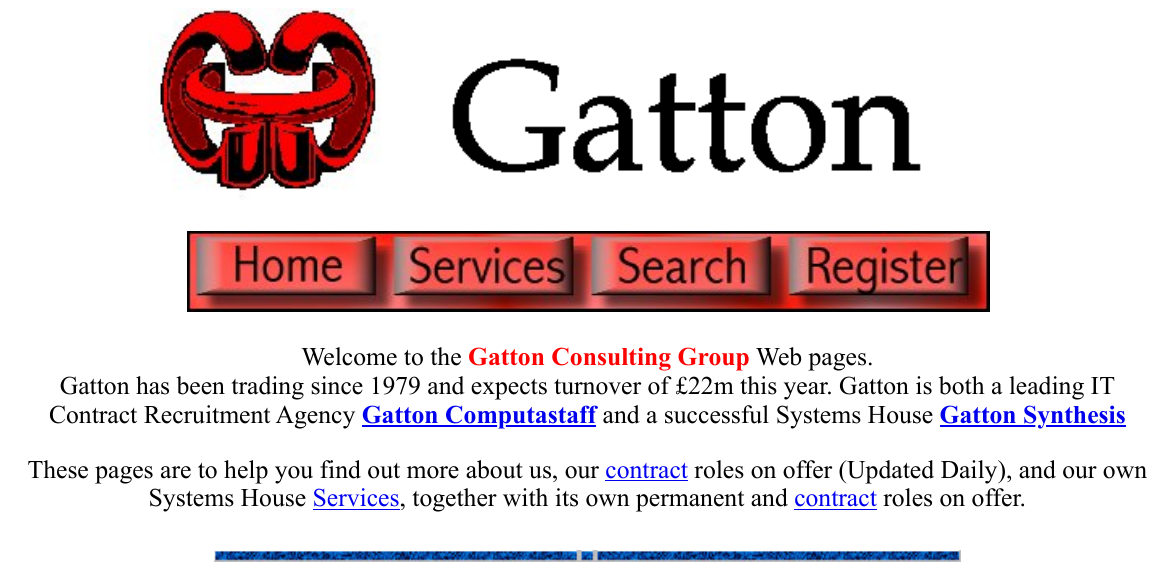
I have been looking at the first proper business website I built. Red buttons. A logo I designed myself. A search page that, at the time, felt rather impressive.
And yes, I was terribly proud of those buttons.
About thirty years later, I can record five or ten minutes of thoughts, work through them with an agentic team, check the research and turn them into an article. I am dyslexic. Getting ideas out of my head and into a form other people can use has not always been straightforward. This has made an enormous difference to me.
That is why I want Britain to take this opportunity seriously. Not because every AI demonstration is useful. Not because the risks have disappeared. Because better tools can let more people contribute, and we need to learn how to use them.
When putting a search box on a website was exciting
My recollection is that I started experimenting with a website through CompuServe around 1993 or 1994. In 1995, we started the Gatton website, and in 1996 we added our recruitment search.
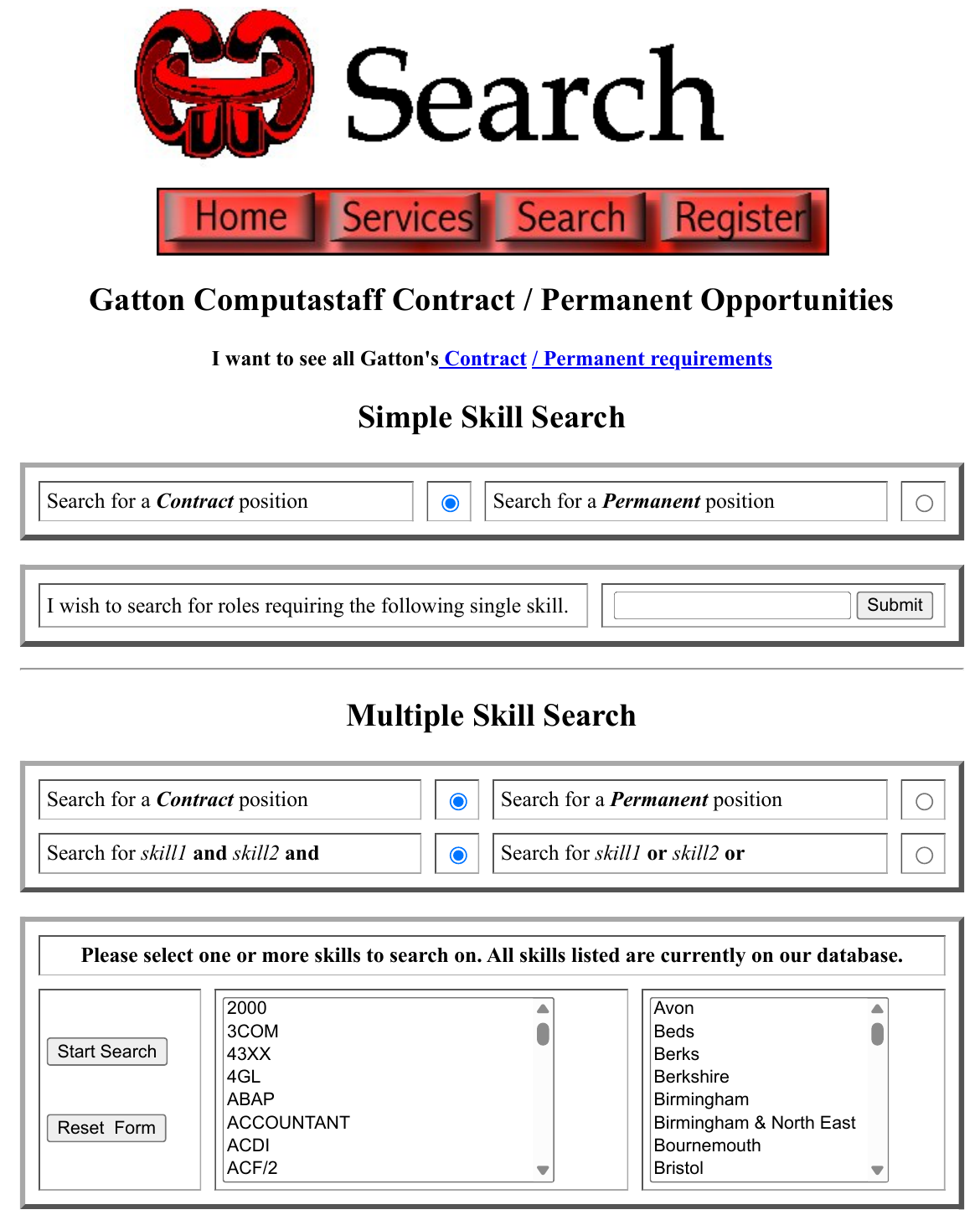
The surviving material includes a Gatton homepage archived in December 1996 and a search page archived in January 1997. Looking at them now takes me straight back.
Behind that page was a Texas Instruments 990 minicomputer in the office, which I maintained. As I remember it, we took a nightly export from the recruitment system, sent it to the web server, and used Perl to search CSV files: rows of information in a relatively simple text format.
A visitor could choose contract or permanent work, search for a skill, or combine skills and locations. That sounds ordinary now. It did not feel ordinary then.
We felt we were doing something unusually early for a UK recruitment business. What mattered was not a claim to have invented search. It was that somebody could find a suitable role without waiting for us to find it for them.
The technology changed how the work could happen.
Now the tool can help with the work itself
Forty years in IT. About thirty years working with the web. Twenty years on LinkedIn. That is quite a lot of changing tools, and I am still learning.
I am thinking a lot about the future of work for a book I am writing. This feels like another important change, but not simply another website.
My old website helped people find information. Today's agentic tools can also help me organise it, question it, draft something from it and inspect how a task might be done.
In my writing workflow, I speak the initial idea. We shape it, find sources, challenge claims and revise. I review the result before it goes out. That has helped me build hundreds of articles, including pieces where the point of writing was to work out what I actually thought.
It has not removed my responsibility for the words. It has reduced one of the barriers between having an idea and doing something useful with it.
For someone else, the barrier might be a blank spreadsheet, a pile of administration, unfamiliar software or the difficulty of making sense of a long report. Those are worth investigating too.
"I'm not technical" should be a starting point
I do not think everybody needs to become a programmer. We have made the word technical much too narrow.
You can be a capable user of a car without designing its engine. You still need to know which controls matter, when something is wrong and when to stop.
Working with an agent needs a similar sort of practical understanding. What information are you giving it? Where is that information stored? What is it allowed to change? How will you know whether it did the right thing?
A file is a saved item of information. A process is a running program or task. Data is the information being used. A permission determines what an account or tool can access or do. You do not need a computer-science degree to begin asking sensible questions about them.
And if nobody has explained those things to you, that is not a character flaw. We should explain them.
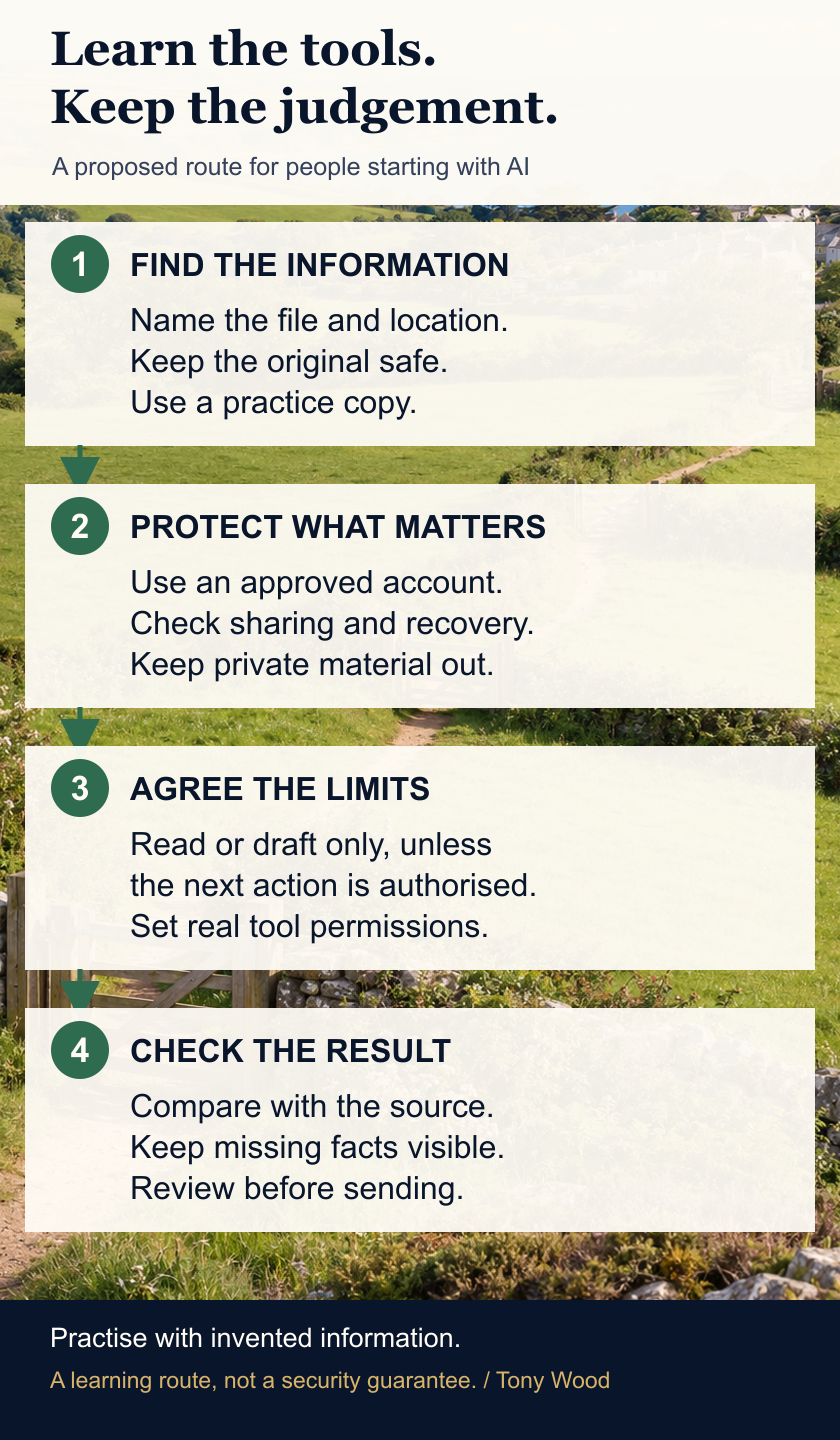
I have put together three short starting points. Each uses harmless examples, not your employer's records:
- What is a file, and where does it live? Find an item, understand its location and keep the original safe.
- Security without the jargon. Protect accounts and information without pretending you need to become a security specialist.
- What is authorisation? Separate being signed in, having access and having permission to act.
"I am not technical yet. Can you show me?" is a much more useful conversation than "That is for somebody else."
Employers have a part to play here: time to learn, accessible tools, patient help and a clear account of what people may safely try. Encouragement is useful. Making people feel stupid is not.
Britain needs more useful output, not more theatre
Productivity is not a judgement about how hard British people work. It is about how much useful output we get from the resources we use.
The ONS's September 2026 explanation of its new measurement approach says the UK's post-financial-crisis productivity slowdown remains, although revised estimates make the slowdown in output per hour smaller than previously thought. It is not a licence to declare Britain the world's least productive country. Read the ONS explanation.
The OECD's July 2026 UK assessment also identifies weak productivity growth, regional differences, energy costs and fiscal pressures as challenges. This is a bigger problem than buying everyone an AI subscription. Read the OECD assessment.
I have explored that wider question in Making the Cake Bigger and Could AI Make Britain Richer?
My argument is that we should test whether these tools can help us do more of the work we need, then keep the improvements that stand up to scrutiny.
A polished presentation about transformation is not the same thing as a resident getting an answer.
What could a council do with the time?
Think about the work around a public service: finding the right document, bringing together correspondence, preparing a first draft, checking whether an application contains the required information.
Could an approved tool help with some of that, so staff have more time for people?
There is evidence worth taking seriously, with limits. A cross-government Microsoft 365 Copilot experiment ran from September to December 2024 across 12 organisations, with 20,000 staff given access. The findings report, published in June 2025, estimated average savings of 26 minutes a day from users' reported time-saving bands. It did not establish how the saved time was subsequently used. Read the findings and methodology.
That is not proof that every council employee can recover two or three days a week, or that a saving automatically becomes better service. But it gives us a reason to try a bounded workflow and measure the result.
Start with something like preparing a draft from approved public documents. Check accuracy, staff time, rework and accessibility. Ask whether the person using the service actually benefits. If the pilot creates more checking than it saves, change it or stop it.
I would like planning teams to spend less time chasing missing paperwork and more time evaluating applications properly. I would like infrastructure teams to compare information more easily, not skip environmental evidence or safety checks. Those are proposed uses, not claims that an agent can approve a development or deliver HS2.
The aim is better work, not merely faster paperwork.
The opportunity needs somewhere to run
AI is not an invisible resource arriving from nowhere. The computers behind it need electricity, cooling and connections. The IEA's Energy and AI report examines that physical relationship.
If we want more capability here, we need to take that infrastructure seriously, including its costs and environmental effects. Building a data centre without a workable electricity connection is not a productivity strategy.
That is why I have written separately about data centres and AI factories, what Britain can do about power and why the grid connection matters.
The people learning to use the tools and the people building the power, networks and equipment are part of the same opportunity.
Use good tools now. Keep a route out.
I am not arguing that we should refuse useful global tools while waiting for a perfect British alternative. Use what fits the task, the information and your organisation's rules.
But know what happens if a service disappears, a contract changes or access is restricted. Keep your source material, document the workflow and test a fallback on representative work. A different provider's logo is not evidence that the replacement can do your job.
There are European and UK developments worth evaluating. Mistral's model documentation lists open-weight models, although each model's licence and deployment requirements need checking. Cosine describes Lumen Sovereign as a planned UK sovereign model; as checked on 21 October 2026, its published roadmap places commercial launch in Q1 2027. That is a roadmap, not a generally available replacement today.
Neither a local server nor a European company, by itself, proves that every part of a system is sovereign, secure or independent. We need to inspect the actual dependencies.
I set out more of that business-continuity argument in What If the US Switched Off Britain's AI?
Safety is a design requirement, not a slogan
"It is not safe" can describe a genuine reason to stop. Personal records, commercial secrets and decisions affecting people's lives deserve proper care.
What I want us to challenge is the idea that this necessarily means doing nothing at all.
Can we use invented information? Public documents? A read-only copy? An approved account with limited access? A draft that a qualified person checks before anything is sent or changed?
The UK Government's AI Playbook puts security, lawful use, human control and appropriate assurance alongside the opportunity. These are part of doing the work, not an optional appendix.
Sometimes the answer will still be no. The useful next question is: what would have to change for a small, safe trial to become possible?
Prosperity is not something we inherit forever
I love this country. I want us to have good services, rewarding work and the confidence to build things. That is why I do not think we can rely on what Britain used to be.
There are warnings in other countries' experiences, but they need telling honestly. The World Bank's growth memorandum for Argentina describes a long relative economic decline and points to instability, trade and human capital. It is not a story about a country refusing one new technology.
Italy offers a different lesson: the OECD's 2026 survey describes productivity growth lagging the euro-area average since the mid-1990s, with barriers involving investment, business growth, innovation and skills. That does not make Italy a failed country. It shows that maintaining a strong economy takes continued work.
Neither example proves that AI will rescue Britain, or that caution will make us poor. They do challenge the comforting idea that past prosperity looks after itself.
We do not need everyone to understand every model, write every line of code or become an enthusiast overnight. We need more people to have the chance to learn, try something useful and judge the result.
Thirty years ago, I was proud of making a search box work.
Today, I am proud that I can speak an idea and work with a team of agents to turn it into something other people can use.
The tools have changed. The habit is much the same: be curious, learn enough to begin, check what you have built and keep improving it.
They were good buttons. But I would not try to build Britain's future with them.
Sources and notes
This is a personal reflection, researched on 21 October 2026. The early dates, technical implementation and personal workflow are my recollections. The supplied archive prints support the surviving page designs and capture dates, not a claim to have launched the UK's first recruitment search. They were printed in 2026; they are not original 1990s PDFs.
The linked ONS, OECD, government and World Bank material supplies the wider economic and public-service context. Potential council uses and the suggested learning approach are proposals, not forecasts or measured outcomes. Provider documentation describes provider offerings and plans, not independent proof of their suitability.