This is part six of Agentic Operating System For Your Business, the story of building the Chief Agentic Officer Briefing into an agentic business. I wanted the briefing to run on Orchistra. Research, tasks, the work behind the publication: Orchistra was going to hold it together. Then I wanted it to run everything else as well.
That version did not work. I have put a stop to it.
In The Deployment That Didn't Happen, I wrote about the gap between proving pieces of a system and getting the whole thing into production. This is the next part of that story: deciding how much of the ambition to put down, and what Orchistra should actually become.
The briefing was the reason for building it
It is worth coming back to that, because the platform can become so absorbing that you lose sight of the thing it was meant to support.
The Chief Agentic Officer Briefing started with a newsletter and a subscriber flow. Then came the larger question: could I build a company that agentic workers could help run, with me as the Shepherd Of Agentic Sheep?
The early recorded baseline was zero useful briefing corpus growing into 15 issues, 76 tracked signals, 76 linked sources and 64 topic threads. Those are the figures recorded earlier in this series, not a fresh count. They matter because they describe something useful accumulating: research, sources and memory.
Orchistra was supposed to help that work happen. I became caught up in building the operating system that could run the briefing, then every other business I wanted to put through it.
I still like the ambition. I have had to change the size of the thing I am building.
Nearly four weeks going round the loop
By my reckoning, I spent almost four weeks trying to get it deployed.
I could run it locally. Turning that into an application I could deploy and operate reliably was where I got stuck.
I had my local development environment, a separate test environment and the intended live environment. I kept cycling between the three. Work locally, try the next stage, find another problem, go back round.
The whole effort became too complicated and too intense. It was trying to hold too much at once, and I was trying to make all of it work properly before I could get on with using it.
I wanted it to run everything, work really well and put the whole operation together. Each of those ambitions sounds reasonable on its own. Together, they had become more than I could get through in the time I had.
Eventually, the deployment effort was taking up the attention the briefing was supposed to benefit from.
I am a bit pissed off, frankly
I burned through so many attempts trying to get the thing working.
It is exasperating to keep putting time and effort into something, see it working in one place, and still be unable to turn it into the usable application you intended.
I do not know whether I want to call the whole thing a failure. It feels like one.
There is a temptation, when writing about this in public, to hurry past that feeling and produce a neat lesson. I do not quite have the neat ending yet. I stopped this version because I could no longer justify the complexity and the time it was taking.
The previous chapter's lesson still stands: stopping an unearned production release was the right thing to do. But I also needed to stop asking this particular design to become the whole operating system.
Giving Orchistra a smaller job
Orchistra is going back towards the idea it started with: something like Slack for agentics, with human tasks integrated into it.
That is my shorthand for the direction. I want a place where the conversation and the work sit together.
I tried some open-source task-management software for the human side. It felt too clunky for what I needed. I could have contributed changes, of course, but that would have become another sizeable piece of work. I was already trying to get out of one of those.
What I want is fairly simple:
- Messaging where humans and agentic workers can keep the conversation together.
- Tasks attached to that conversation, so the next piece of work has somewhere to live.
- Work packets when a job needs more context, a defined outcome or clear boundaries.
A message should be able to become a task. A task should retain the discussion that explains it. When the job needs a more structured handover, there should be room for a work packet.
That is enough of a product to build and test. I want to keep it super simple.
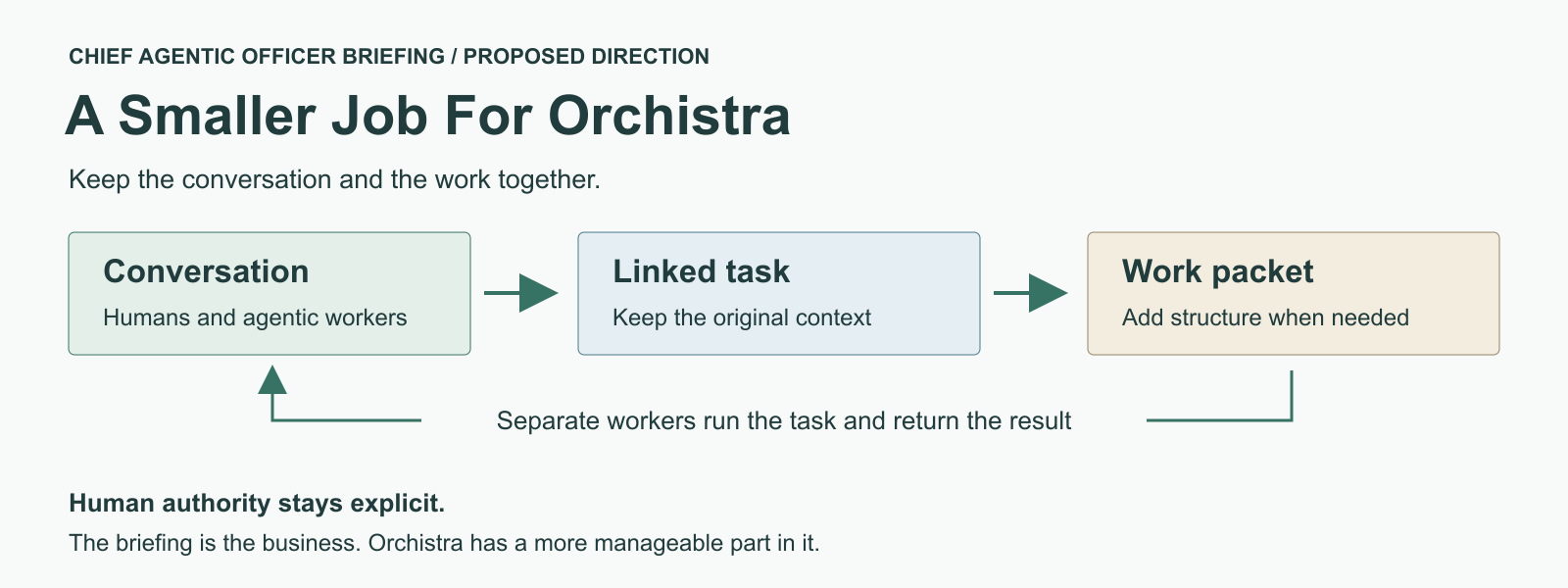
For the Chief Agentic Officer Briefing, that gives Orchistra a clear purpose again: keeping the people, agentic work, conversations and tasks connected. The briefing remains the business I am trying to run. Orchistra gets a more manageable part in making that possible.
A different direction for the workers
Alongside this, I am moving towards OpenClaw and Codex on Linux boxes for my agentic work.
I have been looking at Linux machines in place of Mac minis. For the setup I am putting together, they look cheaper and, so far, seem a better fit. That is an early impression from my own work, not a finished comparison.
I will write properly about that once I have the machines and workflows fully up and running. I do not want to announce the replacement as a success before I have used it enough to know.
The direction is to give the workers somewhere suitable to run, while letting Orchistra concentrate on messaging, tasks and work packets. Any authority to publish or take other external actions still needs to be explicit.
The next episode has to be smaller
In the last article I described the smaller rebuild as Orchistra Zero. This update takes that reduction further: I am changing the job I expect Orchistra itself to do.
There is still a place for the work behind Agentic First, SNAXK's judgement model and Agent Moves. That thinking can inform how the work is described and managed without every part of it having to become infrastructure inside one application.
My next test is whether the simpler Orchistra helps me run the briefing: can I keep a useful conversation, turn it into a task and carry enough context into the work? Can I use it without spending all my time trying to get it deployed?
I wanted to aim for the stars. Perhaps I will land on a moon. We will see.
For now, I have stopped the version that was consuming the effort, kept the parts I still believe are useful, and given Orchistra a smaller job.
I would quite like to get back to running the briefing.