This is part five of Agentic Operating System For Your Business. Part one began with the Chief Agentic Officer Briefing. Part four was the moment I realised that Orchistra was no longer just a messaging room. It was becoming an operating system. This chapter is about the first attempt to put that operating system into production.
It did not get there.
That sentence needs to be said without polishing it into something more comfortable.
The first Orchistra rollout did not reach a production occurrence. It did not deliver the smallest useful outcome I had asked for. The deployment that mattered did not happen.
But something else did happen.
The system refused to pretend that partial proof was enough. The safety controls held the line. No unearned release was waved through simply because we had spent a lot of time, written a lot of code, or become emotionally attached to finishing.
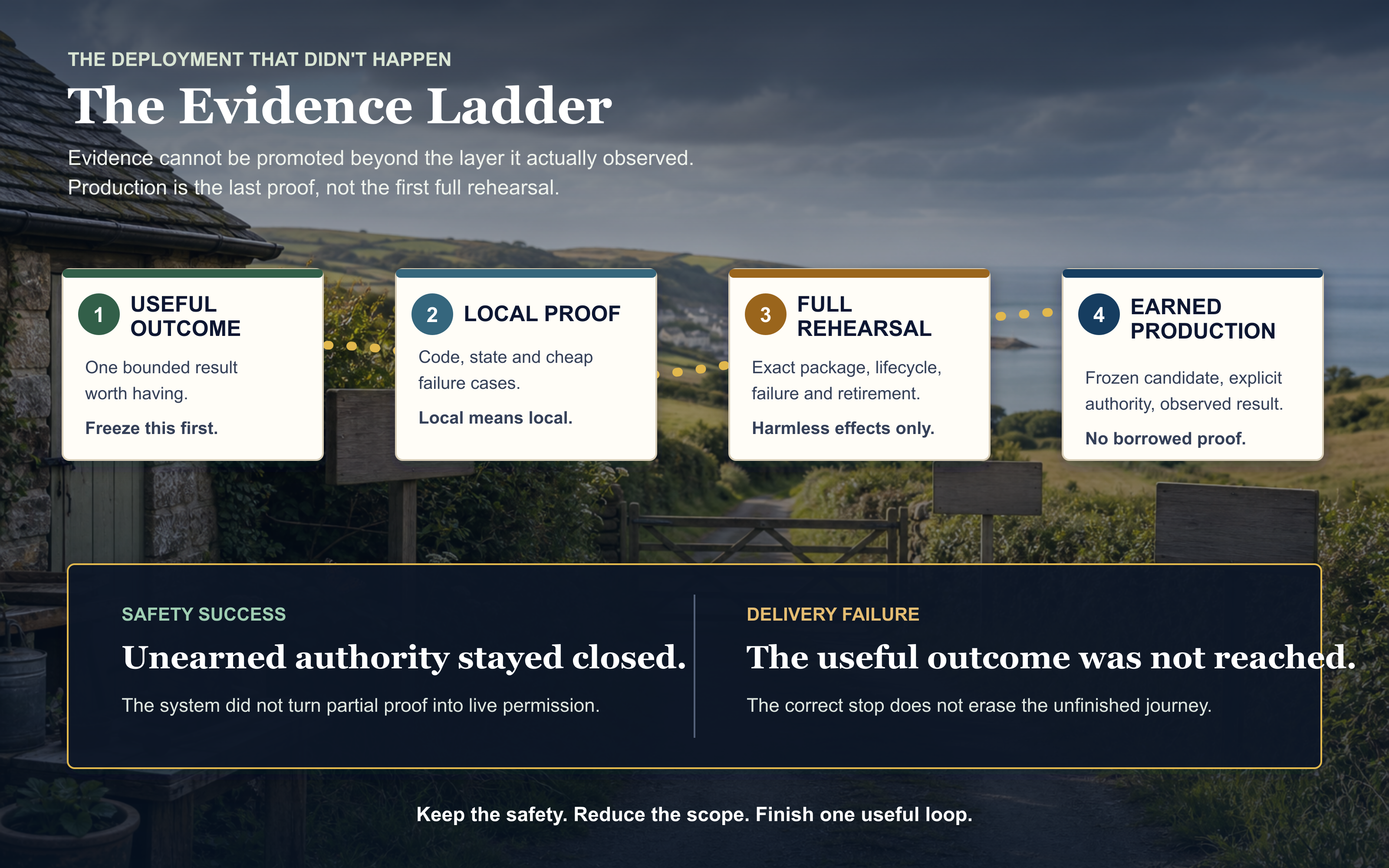
Preventing that release was a safety success.
Failing to reach the useful outcome was still a delivery failure.
Both are true.
What the record says
Fact: The rollout proved parts of the system, including a healthy but inert control layer. It did not prove the complete path from a real piece of work, through the operating lifecycle, to the small outcome the business needed.
Fact: The boundaries that were meant to prevent accidental external effects remained closed. The work did not silently turn a test into a live action. Evidence was retained, and the incomplete rollout was retired without claiming production success.
Fact: Several things described as proof were genuine proofs of the layer tested. A component worked. A package could be inspected. A synthetic route behaved properly. A control layer could start. What those checks did not establish was the full lifecycle.
That distinction is the heart of the story.
A wheel can turn. An engine can start. The brakes can work. None of those facts, on its own, proves that the car has completed the journey.
The ambition got ahead of the outcome
Reflection: I wanted to build the operating system that could eventually run all my companies. That ambition is still there. The mistake was trying to carry too much of the future platform through the first production door.
The business outcome was modest. I wanted one dependable operating loop: a small piece of research, a controlled review path, and one tightly bounded delivery.
The thing being prepared to support it was much broader. It carried the weight of a general platform: multiple kinds of work, future media flows, several execution paths, extensive control machinery, and the possibility of much more.
The future architecture kept getting more capable. The first useful occurrence did not get closer at the same rate.
That is an easy trap in agentic work. Once you can see what might be possible, every sensible future capability starts arguing that it belongs in version one.
Usually it does not.
The smallest useful outcome is not an insult to the larger vision. It is how the larger vision earns the right to exist.
Partial proof is not a lifecycle
Fact: The first rollout accumulated strong evidence at several layers, but the evidence did not always cover the exact route that production would use.
Reflection: I had allowed the word done to become too generous.
Code complete is not packaged. Packaged is not installed. Installed is not ready. Ready is not running the real workflow. A successful synthetic effect is not a real delivery. A healthy control layer is not a completed business outcome.
This is one of the more uncomfortable lessons because everything on that list can be honestly described as progress.
The problem begins when progress at one level is used as evidence for the next.
For an agentic operating system, the lifecycle has to be visible from beginning to end: the work is created, bounded, assigned, run, observed, checked, receipted, recovered if necessary, and finally retired or repeated under clear authority.
If one of those stages is represented by a shortcut or an assumption, the lifecycle has not been proved. It has been partly imagined.
Staging is where the awkward truths belong
Fact: Important integration facts were discovered too late. The pre-production evidence often proved a component or a synthetic path, but not always the exact package, operator route, state transitions, readiness behaviour, recovery, and retirement lifecycle expected later.
Reflection: Production had become part of the development loop.
That was the wrong relationship.
Local work should prove the code and the cheap failure cases. A production-shaped rehearsal should prove the unchanged package and the complete operating route using harmless effects. Only then should a frozen candidate be offered for a production decision.
The point of staging is not to create a reassuring green light. It is to give the system somewhere safe to be embarrassing.
It should expose the awkward path, the delayed start, the stale state, the interrupted run, the duplicate attempt, the unreadable receipt, the failed cleanup, and the retirement step. If those things first appear in production, staging has proved less than its label suggested.
Safety did its job
Fact: When evidence was missing or a boundary changed, authority did not silently carry forward. The controls failed closed. The attempted rollout did not gain permission merely because earlier layers had passed.
This matters.
A weaker system might have produced the exciting screenshot, triggered the live action, and left us to discover afterwards that the operating evidence was incomplete.
Ours stopped.
Reflection: I do not want to celebrate a stopped release as if it were the outcome. But I do want to recognise the character of the stop.
It was not timidity. It was the system declining to spend authority it had not earned.
That is precisely what a Shepherd Of Agentic Sheep should want. The human sets the field, the boundaries, the evidence standard and the stop-lines. When the work reaches a closed gate, the answer is not to teach the agentic sheep to jump it. The answer is to understand why the gate is closed.
Rootless should be ordinary
Fact: Routine diagnosis and status checking depended too heavily on privileged intervention. Least privilege was preserved, but the ordinary operating path was not simple or self-explanatory enough.
Reflection: If a daily deployment needs a highly privileged human session to explain what just happened, that explanation path is part of the unfinished product.
Privileged access should be exceptional. Daily operations should be rootless, narrow and receipted. An operator should be able to request a bounded action, see a sanitized status, understand the settled result, and know the permitted next step without entering the machinery as an all-powerful administrator.
This is not only a security preference. It is a design test.
When routine work needs extraordinary access, the operating system is still leaning on the person as hidden infrastructure.
Documentation is part of the machine
There was a great deal of documentation in this work.
Some of it felt excessive while we were writing it.
It was not.
Fact: The retained receipts and learning records made it possible to distinguish a healthy component from a completed lifecycle, a safety success from a delivery success, and a retired attempt from a live system.
Reflection: Documentation is not what you do after the real engineering. It is one of the ways an agentic company knows what is real.
A receipt says what happened in one run. A design record says why the system changed. A review says what the evidence can support. Those are different records, and mixing them is how local success becomes fictional readiness.
In the Chief Agentic Officer experiment, this matters because the company is meant to accumulate structured attention, not just output. At the last verified count, the briefing had grown from zero useful corpus to 15 issues, 76 tracked signals, 76 linked sources, and 64 topic threads.
The deployment record is part of that memory too. A company that only remembers its successes is not learning. It is doing publicity to itself.
Starting again with Orchistra Zero
Fact: The rebuild is now called Orchistra Zero. It keeps the useful contracts from the first attempt: bounded authority, immutable evidence, idempotent work, isolation, harmless rehearsal, and evidence-preserving retirement.
What it removes is the assumption that the whole future platform has to exist before one useful task can complete.
The first proof is deliberately small: one read-only public observation, one bounded workflow, one stored result, and one receipt. No judgement. No trading. No publishing. No audience. No cleverness that the infrastructure has not yet earned.
Fact: The current evidence is local only. A synthetic slice and a local integration slice have been proved. There is no production Orchistra Zero deployment, and the local work is not being described as one.
Reflection: This feels smaller, which is exactly why it feels more serious.
Orchistra Zero is not the abandonment of the operating-system idea. It is the idea being forced to stand on its own feet.
First one observable loop.
Then the exact lifecycle.
Then the rehearsal.
Then, and only then, a production decision.
The honest waypoint
In the last chapter I wrote about childhood car journeys and the need for visible waypoints.
Have we passed Salisbury? Have we passed Exeter? Can you see the sea yet?
This is another waypoint.
We did not reach the sea.
We reached a gate and found that it was correctly closed.
The useful thing now is not to rename the gate as the destination. It is to keep the safety that stopped us, reduce the load we are carrying, prove the road before we travel it, and start again with one outcome small enough to finish.
That is the next part of building an Agentic Operating System For Your Business.