This started with a newsletter.
Which is exactly how these things get you.
About a month ago, I was putting together the Chief Agentic Officer Briefing for a talk. I wanted a simple subscriber flow so people could sign up, receive the briefing, and see something real rather than another slide about the future of work.
I used MailerLite. I did not know every corner of MailerLite. I did not sit down and become a MailerLite expert for the noble glory of yet another settings page.
I used agentic work to configure it.
The useful bit was not that a form existed. The useful bit was that I could work from the outcome. Create the group. Understand the fields. Wire the signup. Check the behaviour. Draft the briefing. Send the test. Leave a receipt.
That was the moment the shape changed.
It was not really a newsletter any more.
It was the first small loop of an operating system.
The briefing that started it
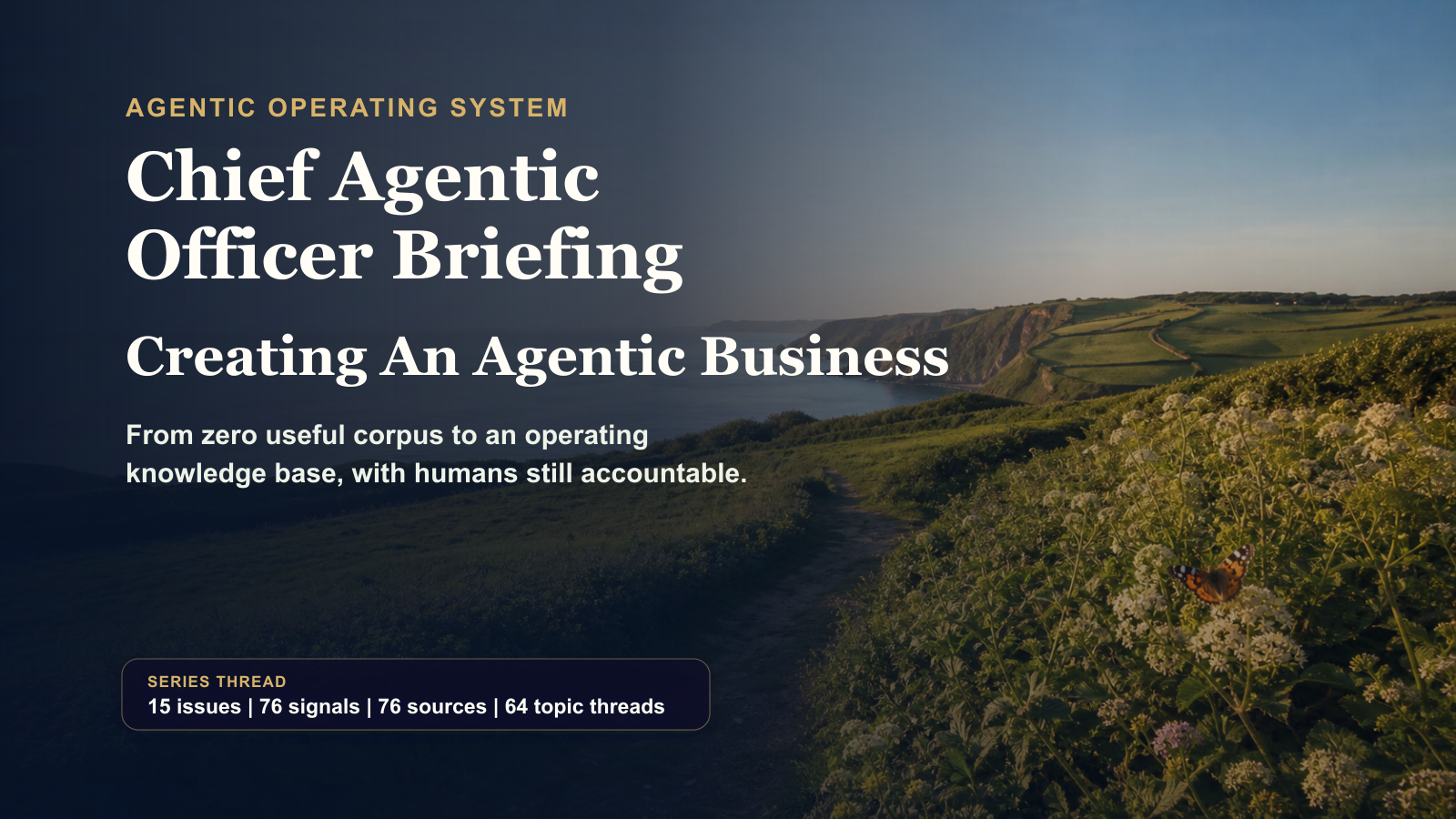
The Chief Agentic Officer Briefing began with almost nothing useful as an operating base.
No briefing corpus. No issue map. No tracked signals. No linked source register. No topic threads.
Just an idea: leaders are going to need a clearer way to see what agentic work is doing to their business.
Then the system started to gather shape.
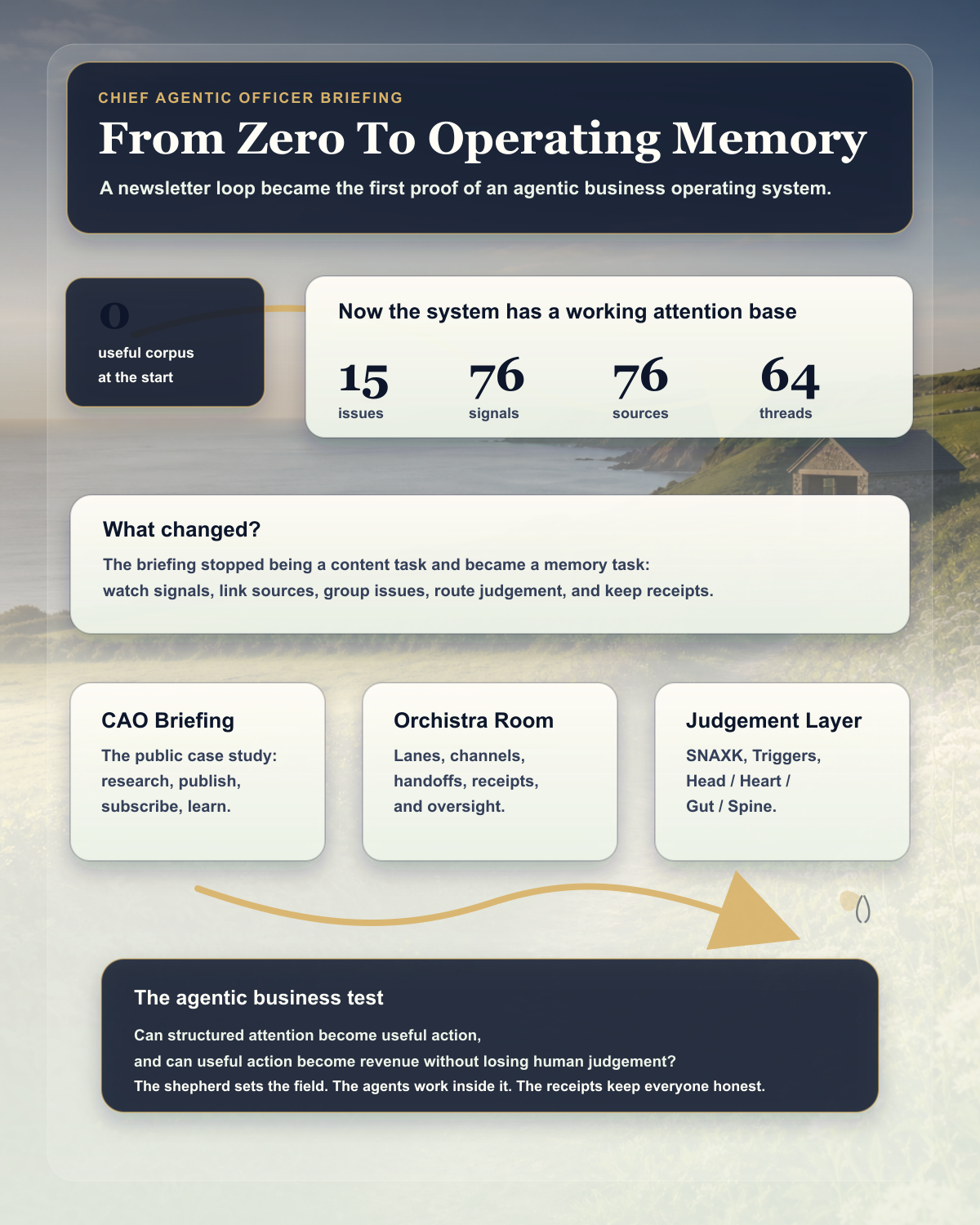
It now has 15 issues, 76 tracked signals, 76 linked sources, and 64 topic threads.
That line matters.
It is going to be one of the threads running through this series, because it shows the difference between content and operating memory.
A newsletter can send words.
An operating system has to accumulate structured attention.
It has to know what it is watching, what has changed, which sources support the claim, where the issue belongs, and what a human might need to decide.
The moment the shape changed
When the MailerLite path worked, I had a slightly dangerous thought.
If agentic work can configure a subscriber flow, research a briefing, draft the copy, check the source trail, prepare the send, and leave a receipt, then this is not only a publishing workflow.
It is a business workflow.
And if it is a business workflow, then the next question is obvious enough to be inconvenient.
Can I build a company this way?
Not a fake company.
Not a demo where the agent writes a motivational memo to a pretend sales team and everyone politely claps.
A real small business. One that has to attract attention, create value, manage operations, watch costs, handle risk, build trust, and eventually make money.
That is the experiment.
A company is an operating system
I like operations. This is not a secret.
And the more I work with agentic systems, the more I think a company is best understood as an operating system.
It has finance, procurement, supply, sales, marketing, research, delivery, operations, admin, governance, risk, and customer attention.
Those are not just departments. They are functions the business has to perform.
In a larger company, you hire people into those functions. In a tiny company, the work still exists. It just lands on the founder, usually at 11.47pm with a faint smell of panic.
The agentic question is not "can I pretend an agent is a finance director?"
That would be silly, and quite possibly expensive.
The better question is: which operating functions can be held by agentic workers, with clear boundaries, receipts, and human judgement?
That is where the idea becomes useful.
The Chief Agentic Officer Briefing is the case study. The bigger pattern is an Agentic Operating System For Your Business.
Shepherd of agentic sheep
This is where the phrase Shepherd Of Agentic Sheep keeps coming back to me.
I am not trying to build a company with no human responsibility.
I am not trying to convince myself that agents are people, employees, colleagues, or magical interns with perfect judgement.
They are not.
But they can hold work.
They can watch a signal. They can draft a briefing. They can compare sources. They can propose a next action. They can check a repeatable routine. They can keep a receipt. They can say, in effect, "this looks ready for your judgement" or "this has crossed a line and needs a human."
That makes the human role different.
The shepherd sets the field.
What is the goal? What is in scope? Which tools are allowed? What evidence is needed? What should be watched? What must pause? What is the budget? What does good look like? What gets escalated? What is never automatic?
The agentic workers can move inside that field.
The accountability stays with the human.
Orchistra as the operating room
If this is going to work, the agents need somewhere to work.
Not a hidden swarm. Not a pile of private chat threads. Not a maze of brittle automations quietly doing who-knows-what in the background.
They need a visible operating room.
That is how I think about Orchistra.
Orchistra is the backbone I am using for this experiment: the place where work can be routed, discussed, traced, reviewed, and handed back. The public-safe version of the idea is simple: agentic work needs lanes, channels, receipts, handoffs, escalation, and human oversight.
This is also why the language work matters.
Agent Moves help make the kind of act visible: inform, request, propose, handoff, escalate, decide, refuse, correct.
Meaning Blocks help preserve canonical meaning only when the mapping is deterministic and reviewable.
The Agent Communication Packet carries the practical work: claim, evidence, uncertainty, risk, owner, route, next action, success condition, and action status.
The Agent Esperanto Register asks whether agents need a more regular, inspectable register for working with each other and with humans.
This is not decoration.
It is the operating language of the business.
The SNAXK and judgement layer
The operating system is not only tools, channels, and automations.
It needs judgement.
That is where the SNAXK line of work comes in. Publicly, the strongest way to describe it here is through Head / Heart / Gut / Spine and Triggers.
Head asks what the evidence supports.
Heart asks who is affected and what happens to trust.
Gut asks what feels off, pressured, too neat, or anomalous.
Spine asks what is allowed, what is bounded, and what must stop.
Triggers give the system a signal language for attention, routing, memory, review, and constraint.
That matters because an agentic business does not become safer just because the agents are busy.
Activity is not control.
The point is to make the work legible enough that the right things can continue, the risky things can pause, and the human can spend attention where judgement actually matters.
This is all my work coming together
That is the part I find exciting.
The Chief Agentic Officer idea is not separate from Agentic First, Orchistra, SNAXK, Agent Moves, Meaning Blocks, Triggers, Head / Heart / Gut / Spine, Agent Canon, and MCP.
It is a place where those ideas have to prove whether they are useful.
Can they create a working business operating system?
Can they help me do the work without hiding the work?
Can they let agents help without pretending agents are accountable?
Can they turn zero information into structured attention, then structured attention into useful action, then useful action into revenue?
That is the documentary.
The public experiment
So this series is not me announcing that I have solved it.
Come on. That would be unbearable.
This is me documenting the attempt.
I am building the Chief Agentic Officer Briefing as an agentic business case study.
I am using Orchistra as the operating room.
I am using the Tonywood protocols as the public language and judgement layer.
I am treating myself as the shepherd of agentic sheep.
And I am going to keep returning to the evidence line: from zero useful corpus to 15 issues, 76 tracked signals, 76 linked sources, and 64 topic threads.
The question now is simple.
Can this become a business?
Can it make money?
Can it do that without becoming a new kind of operational fog?
That is what I am going to find out.
Continue to part two
The next field note follows one of the first roles inside that experiment: turning the written briefing into a short audio companion and getting it into a real publishing platform.
The audio was straightforward. The difficult bit was identity, delegated authority, permission, approval, and the final human upload gate.