The meeting finishes. Everyone knows what they need to do. Then customers, travel, another meeting and the rest of the week happen.
Somewhere in there, the useful idea loses its owner. The promised reply never arrives. The document everyone agreed to update is still the old one.
That is the work I would look at first with OpenAI Dots.
The attraction is an assistant that can carry a responsibility between conversations. I could talk something through, leave it with a clear job, and return to see what has moved and what still needs me.
This is how I would approach it. These are proposed uses, based on the documentation and early accounts, rather than workflows I am claiming to have tested myself.
What a Dot actually does
OpenAI introduced Dots on 29 September 2026. At launch, you start with one primary Dot. Teams of Dots and specialist organisational Dots are at different stages of development and enterprise pilots.
Your Dot uses GPT-6 Astra and has its own cloud computer and browser. It can keep working while your laptop is off. OpenAI's overview describes research, document preparation, data analysis and software work.
The practical change is continuity. I could ask it to keep a launch plan current, then return tomorrow with a changed deadline without having to explain the whole project again.
I would still give it a proper brief. A capable assistant with a vague job can produce a remarkable amount of work that nobody needed.
As an entrepreneur: keep close to the customer
My first job would be keeping track of customer feedback.
I would choose one product, one feedback source and one place to keep the findings. Then I would ask for the recurring problems, the evidence behind them and the decisions they raise.
For example: several customers say they cannot complete a purchase. Are they describing the same fault? Has something changed since last week? Is there enough evidence to investigate, or do we need to ask a better question?
I would want links to the original messages, not a confident paragraph about what customers supposedly think.
Once the reading was reliable, a small software fix could become a separate Codex task, with a proposed change and test results for review. OpenAI documents that delegation, including using a Codex cloud environment you have already set up.
I would keep the customer reply and the decision to release a change with the people responsible. Finding a pattern, fixing a problem and deciding what to promise are three different jobs.
The measure would be simple: did this help us notice something useful and respond better? I would count the time spent correcting the assistant as well as the time it saved.
As a leader: keep the moving parts connected
A launch is a good candidate because the same decision often changes several things.
Move a feature out of the first release and the sales deck, website copy, demonstration and customer promise may all need attention. I would ask a Dot to identify those connections and prepare the changes for their owners to review.
I would give it the approved plan and ask for a short list: what changed, what that affects, who owns the next step and which decision needs me.
I would also tell it what deserves an interruption. A missed decision that threatens launch day matters. Another cheerful update saying everything is proceeding splendidly probably does not.
The source documents would stay in a place the team can inspect. The assistant could help keep them current, but people would need to know which version had actually been approved.
That is the useful connection to Making Agentic Work Visible. Work needs an owner and evidence of its result, especially when several people and agents are involved.
As a board member: prepare better questions
I would start with material the company has authorised me to use in this service.
An assistant could compare the current pack with the previous one, identify changed assumptions and prepare questions against the source pages. It could help me track an agreed action between meetings: what was promised, when it was due and whether there is evidence it happened.
I would ask it to separate a reported fact, an inference and an unanswered question. If the figures disagree, show both sources. If a document is missing, say so.
This is preparation for judgement. I would still check the underlying papers and make my own call.
I would be particularly careful about context from different companies. I would use the company's approved workspace and access arrangements, and check what information the assistant could carry forward. Giving jobs different names would not, by itself, establish confidentiality between them.
For sensitive board material, the data arrangements may decide whether this is a suitable tool at all.
How I would build the agentic family
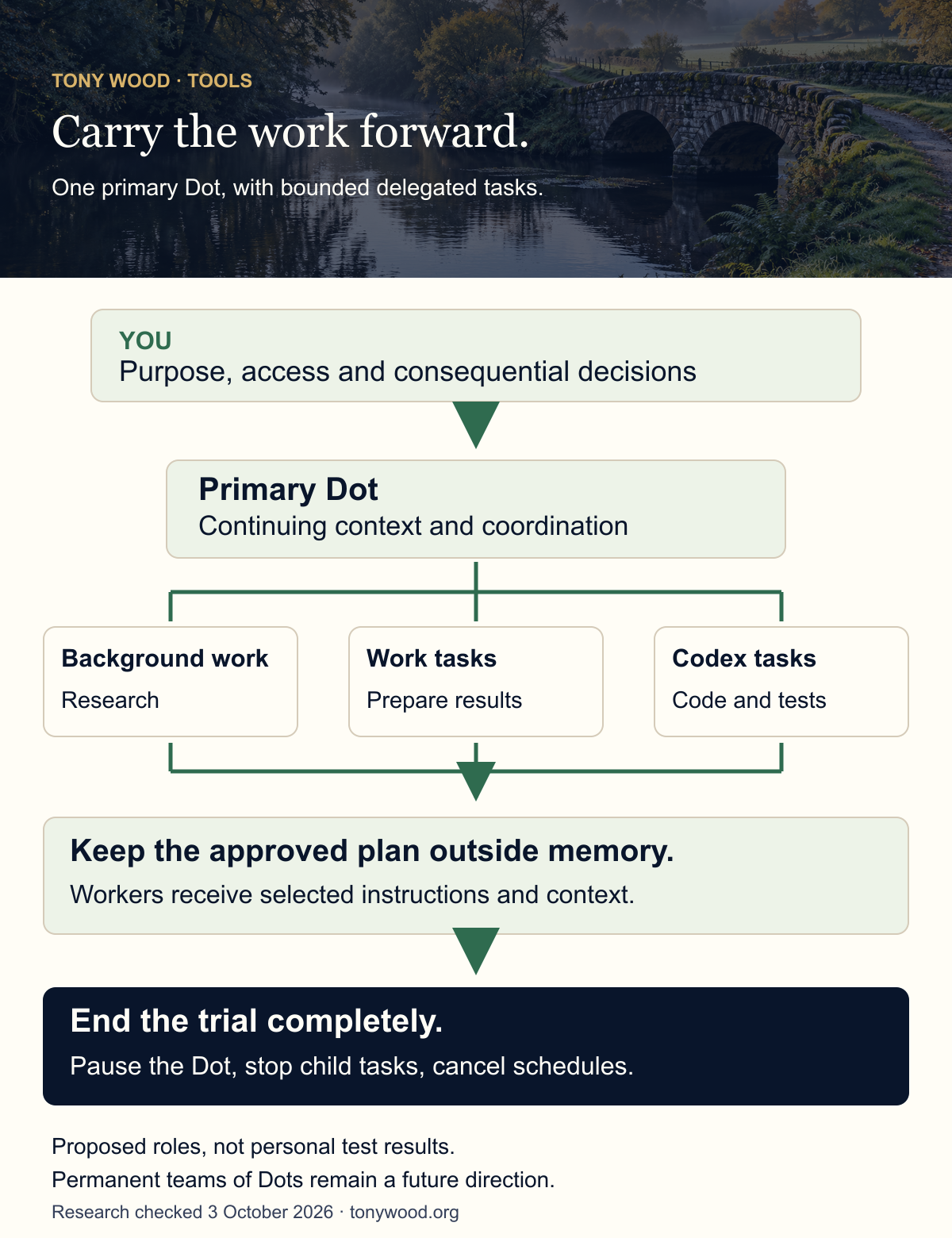
I would start with one Dot coordinating a small amount of work.
It could gather the sources, hand a defined task to a background worker, ask Codex to investigate a software problem and bring the results back together. Those are jobs in a proposed working family, rather than a claim that several permanent Dots are available to everyone today.
OpenAI's tasks guidance says delegated tasks receive the instructions and context the Dot passes to them. They do not automatically receive its entire conversation history.
I would therefore make each handover explicit: the question, the approved sources, the output required and the point at which the worker should stop. The coordinator would check what came back before presenting one coherent result to me.
For connections, I would first look at supported apps and plugins. If an internal system needed a custom connection, a developer could expose a limited set of tools through MCP, a way for an agent to use another system's information and functions.
For example, I would prefer a tool that reads the launch's open actions over broad access to the whole company database. Another tool might prepare a proposed update. Sending it would be a separately controlled operation.
I would keep the current plan outside the assistant's memory as well. As I explored in Your Context Is the Next Lock-In, the knowledge that accumulates around an assistant becomes something we need to manage.
A first brief I would try
Here is a small experiment for a launch I already understand:
For the next two weeks, help me keep this launch ready. Use only the approved plan and the connected project channel I have named. Begin by listing the decisions, owners, deadlines and unanswered questions, with links to the evidence.
At 9am each weekday, Europe/London time, check for changes. Keep routine findings in the checklist. Message me in ChatGPT only when a deadline is at risk, sources conflict or you need a decision. Confirm the saved schedule and its end date.
Prepare suggested changes for review. Do not send messages to other people, publish, spend money or change our live systems. Tell me when a source is unavailable. Finish each report with what you checked and what remains uncertain.
I would read the first result before scheduling it. After a few runs, I would ask whether it was finding useful exceptions or merely keeping itself busy.
OpenAI's controls guide makes a useful distinction: pausing the main Dot, stopping a delegated task and cancelling a schedule are separate actions. I would check all three when ending the experiment.
Where the information goes
The Dot's cloud computer is separate from your laptop. Connecting your own computer is optional; only one personal computer can be connected at a time, and local work needs it online with ChatGPT open. The connection guide explains the difference.
The privacy FAQ says a Dot can retain context from conversations and connected apps. Disconnecting an app stops new access but does not erase what it learned. Individual Dot memories cannot currently be inspected or edited directly; clearing its context requires deleting the Dot. Files and separate tasks can remain elsewhere.
For geographic storage and processing, OpenAI's enterprise guidance says Dots does not support data or inference residency during the Enterprise beta. Local computer access still involves cloud coordination. I would check the actual company's requirements before connecting confidential information.
OpenAI describes encryption, secure sign-in and action checks. These reduce risk; the company also says Dots can make mistakes. I would connect only what the first job needs and keep important decisions visible.
What others have found
In her hands-on review, Allison Johnson used a Dot to revise her website and assemble a video for social media. Those tasks worked better for her than errands involving websites that blocked its cloud browser.
Cedric Chee's brief early trial was less enthusiastic about response speed and the interface. These are individual experiences, not a reliable forecast of what a particular business will gain.
Flavio Copes' guide is useful further reading, but he explicitly says he had not yet had access. His suggested workflows are ideas to try, not completed case studies.
That is a sensible place to be with a product launched only days ago: interested, specific and willing to check the result.
Check access before planning around it
As checked on 3 October 2026, Pro access excludes the UK, the European Economic Area and Switzerland. Business Premium is available across supported ChatGPT regions. Enterprise, including Edu and Healthcare, is an admin-enabled beta. The current access guide has the details; rollout is gradual.
The first Dot is included in eligible Pro or Business Premium plans with an allowance for deeper work. Tasks it starts in Work or Codex use those products' allowances. Check the usage terms before making it responsible for a busy recurring job.
My first test would be one responsibility, a small set of sources and drafts I can check. I would widen the job when the results gave me a reason to.
You can follow the wider thinking at Shepherd of Agentic Sheep. The field looks at how these tools carry context, follow through and leave people in charge. Its documented capabilities and editorial assessments are kept distinct from hands-on qualification.
For another approach to continuing work, read the Grok Bot Tools article.
Sources and notes
Research checked on 3 October 2026. The examples describe how I would use Dots. They do not claim personal test results or company adoption. Availability, allowances and controls may change.
Start with OpenAI's Dots documentation, privacy FAQ and workspace controls. For the deeper safety evidence and its limitations, see the Dots appendix to the Astra system card.
For the surrounding choices, see Agentic Architecture Is Layers All The Way Down and How Long Will Agentic Work Take?.