The part of Grok Bot that interests me is the work around a decision. Finding the background. Preparing the meeting. Remembering what we promised. Getting a useful first draft in front of the person who needs to act.
As an entrepreneur, a leader or a board member, I would start there. There is plenty of value in arriving better prepared and leaving fewer loose ends behind.
This is how I would approach it, drawing on the current documentation and published accounts from people using it. These are suggestions to test in your own work.
What Grok Bot actually does
Grok Bot gives you named AI assistants with ongoing roles and memory. You can give one a job, return to it later and build on the instructions you have already agreed. The product overview describes bots that can keep working after you close your laptop.
They use a cloud computer with a browser, files and a terminal, which lets them run software. They can also connect to applications through plugins. That gives them ways to find information and produce work inside the tools you already use. You can inspect their computer and take over when needed. The computer guide explains the setup.
For example, you might ask a bot to prepare for tomorrow's customer meeting using an approved set of notes, the latest email thread and the company's public website. The useful result would be a short brief with sources and the questions you still need to ask.
You can talk to bots by text or voice, and they can pass work to one another. That is where an agentic family becomes interesting: several assistants with clear jobs, helping each other finish something useful.
As an entrepreneur, I would use it to investigate
Suppose I were considering a new service. I would give a research bot a narrow question: which customers appear to have this problem, what are they doing about it now, and what evidence would make the opportunity less attractive?
I would want links to actual material, a clear distinction between facts and guesses, and a short list of things to ask potential customers. A polished market report would be much less useful if it quietly filled the gaps with optimism.
The next job might be preparing for five conversations. Find the background, pull together any previous contact and draft a few relevant questions. After the calls, help me compare what people actually said with what I had hoped they would say.
There is also less glamorous work worth considering. The vendor's procurement account describes using a bot to examine software spending, usage and renewals, and prepare negotiations. I would try a smaller version: one approaching renewal, the contract, the invoice and the usage figures. Show me the options before anyone contacts the supplier.
For me, the test would be whether the work improves a real commercial decision. Producing another document is easy enough. Finding something I would otherwise have missed is more interesting.
As a leader, I would use it to keep context together
Before an important meeting, I would ask for the background that matters: what was agreed last time, what has changed, what is waiting on me and where two accounts of the situation differ.
Afterwards, I would use it to draft follow-ups from the notes I provide. Who agreed to do what? Was a date actually agreed? Which question remains open? A bot should leave an unknown visible rather than invent a deadline because the table looks tidier with every cell filled in.
The vendor's post-sales guide offers a useful example. It describes a chief of staff coordinating specialist bots, preparing calls and collecting outstanding promises. The author still reviews and sends the messages. It is a vendor account, but the working pattern is worth examining.
I would also try a short weekly exception brief. Tell me about commitments slipping, a customer issue that needs attention or a change affecting a decision we have already made. Explain why each item matters and link to the source.
If nothing important has changed, I would be quite happy to hear nothing. A new assistant should not become another person demanding a status meeting.
As a board member, I would use it to prepare better questions
With the company's permission and an approved setup, I would ask it to compare the current board pack with the previous one. What changed? Which earlier action has disappeared? Has a measure changed definition? Where does the commentary need more explanation?
I would ask for references to the pages or passages behind each observation. If it says two figures disagree, show both figures and their periods before suggesting a problem.
That could help me prepare questions for management and keep track of follow-through between meetings. I would still read the papers and form my own view. An assistant can miss something, misunderstand a number or attach too much importance to a passing remark.
I would keep each company's information within an arrangement approved for that company. Calling one bot “Board A” and another “Board B” would not give me the separation I need. The security FAQ says a user's bots share a computer, including its files and logged-in accounts.
The family I would build
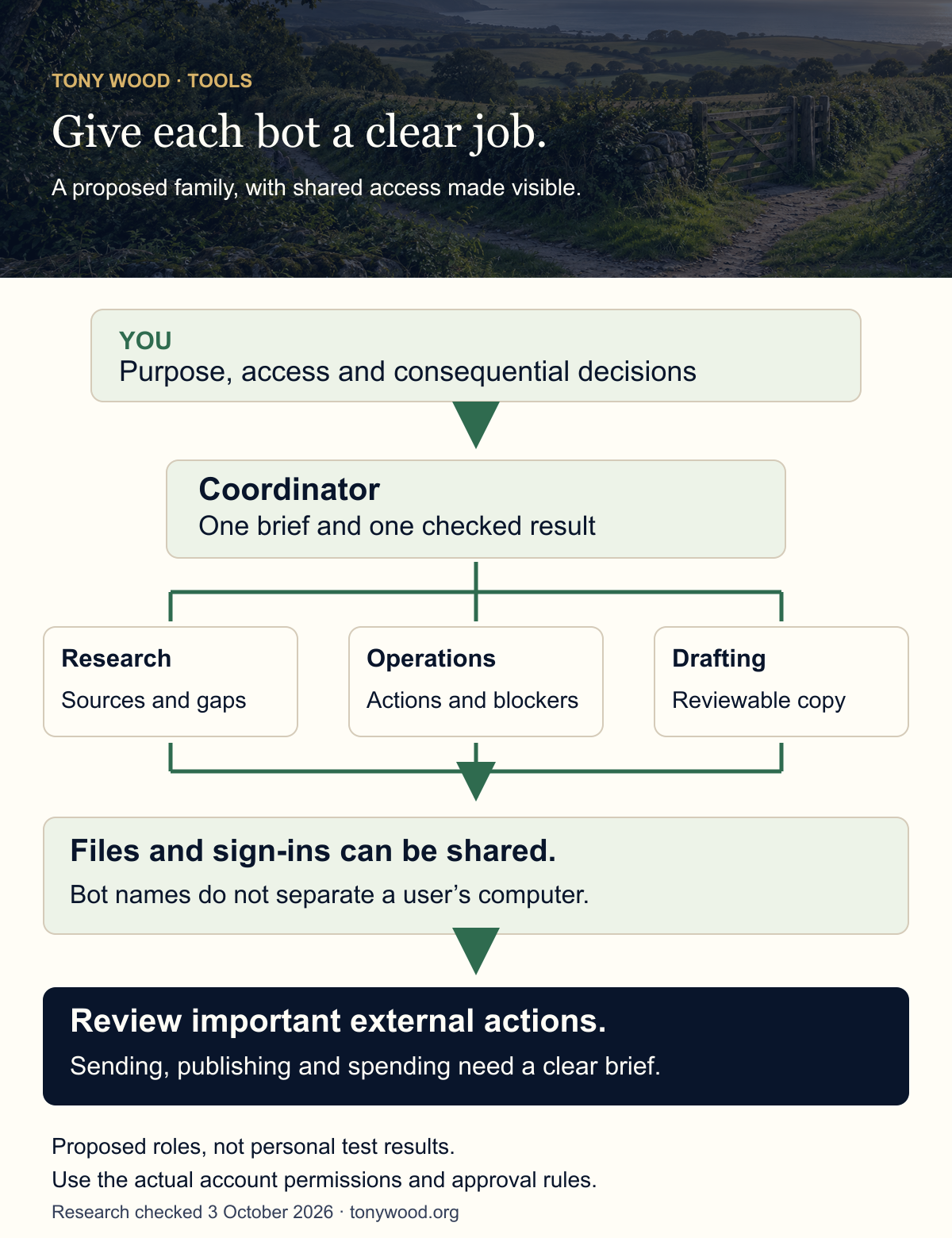
I would begin with one bot doing one useful job. Once that works, I could see a small family developing:
- A chief of staff keeps the brief, assigns work and brings me one coherent result.
- A researcher checks the background, follows sources and identifies gaps.
- An operations assistant prepares action lists, checks progress and proposes updates to our records.
- A communications assistant turns approved material into drafts in my voice.
Those are jobs I would assign. They are not protected compartments inside the product.
Imagine an upcoming partnership meeting. I would brief the chief of staff. It could ask the researcher for the background and the operations assistant for previous commitments, then bring the findings together for me. Once I have checked them, the communications assistant could draft an agenda.
After the meeting, I would supply the notes. The family could propose the follow-up, with one named bot responsible for keeping the work together. I would approve the message and any changes to shared records.
For an engineer, the family can extend into coding work. The engineering guide describes Grok Bots delegating tasks to Cursor Cloud Agents and checking their outputs. That is a useful route to investigate if building software is part of your business.
When connecting applications, look for a supported plugin first. MCP is one way software gives an agent access to its tools and information. Browser access can help where a suitable connection is missing, though a login or a changed screen may need your attention.
The family needs somewhere to leave its work. I would keep the source documents and a simple task list in a place the people involved can inspect. That connects to Making Agentic Work Visible: give the work an owner, a clear finish and evidence of what happened.
I would also keep the important context in documents I control. As I explored in Your Context Is the Next Lock-In, the background an assistant accumulates deserves attention of its own. I would ask bots to check current records whenever a fact may have changed.
Give it a job it can finish
Here is the sort of instruction I would start with:
Prepare a one-page brief for my meeting with [company] on [date]. Use the attached notes and the public sources I have listed. Read only: do not send messages or change anything in our systems.
Explain what has changed, what we previously agreed and the questions I should consider. Link to the evidence for each important point. Separate confirmed facts from your interpretation. If you cannot access a source, say so. Do not fill the gap from memory.
Finish with what you checked, what you could not check and anything you need from me. Wait for my review before proposing further work.
I would run that on a meeting where I already know the background. It is much easier to judge the answer when I can spot what is missing.
Then I would correct the result. Too long? Tell it what to cut. Wrong emphasis? Show it the useful version. Awkward writing? Give it a few approved examples of my own writing, rather than access to my entire sent folder.
Grok Bot's skills and routines let you reuse instructions and run work on a schedule or supported event. I would turn a task into a routine only after checking it on several different examples. I would also decide what happens when a source is unavailable or the task is only partly finished.
Scheduling a bad brief makes it arrive more reliably. It does not improve the brief.
Where the information goes
Grok Bot's computers are hosted by Cursor. The current security FAQ says they run in the United States. This is a cloud service, and its hosting location should be checked before adding company or board information.
The privacy and approvals guidance explains how Cursor's privacy settings apply. Training choices, storage and access are different questions. Deleting a bot does not clear its computer's files or browser logins.
I would connect only the accounts needed for the job and start with reading and drafting. Sending messages, spending money and changing important records would stay with a person. I would check the actual permissions too: writing “ask me first” is not a substitute for restricting what an account can do.
If you use Team Bots in shared Slack conversations, check their approval settings carefully. When nobody can answer an approval card, the bot can run without an automated action check called Auto Review, unless the team requires it. Check the permissions before assuming it will stop and wait for you.
What people are using it for
There are useful accounts beyond the vendor's own examples.
Claire Vo's published episode summary describes a chief of staff across inboxes and Slack, alongside engineering and personal bots. Ryan Robinson's walkthrough describes a team preparing material for a YouTube channel, with human editing still part of the process. Marc Abraham's review describes using a Trello planner and voice on his phone.
These are individual accounts from different contexts; some appear in sponsored or commercial publications. They suggest things to try. They do not tell us what results our own organisations will get.
I would also watch the usage bill. The current plans guide describes eligible subscriptions, a weekly allowance and paid usage beyond it when enabled. More bots and more frequent routines mean more work to pay for and inspect.
My first experiment would be one meeting brief, built from a small set of approved information. I would compare the time it saved with the time I spent checking and correcting it, and ask whether it helped me notice anything useful.
If that worked, I would add the follow-up. The family can grow as the work earns it.
You can follow the wider thinking at Shepherd of Agentic Sheep. The field looks at how these tools carry context, follow through and leave people in charge. Its documented capabilities and editorial assessments are kept distinct from hands-on qualification.
For another approach to continuing work, read the OpenAI Dots Tools article.
Sources and notes
Researched on 3 October 2026. The examples above describe how I would use Grok Bot; they are not a claim that I have run these workflows myself. Features, plans and controls may change.
For the broader picture, start with the product documentation, the Grok Bot guides and the relevant announcements in xAI news. The persistent-agent design article explains the product's building blocks. The customer-support account describes a gradual rollout beginning with preparation and review. Vendor success stories remain vendor evidence.
For more on the surrounding decisions, see Agentic Architecture Is Layers All The Way Down and How Long Will Agentic Work Take?.