If you run a business, a surprising amount of the job is keeping the pieces together. The customer waiting for a reply. The order that needs checking. The campaign nobody has quite explained. The promise you made in a meeting last week.
That is where Meta Muse interests me. As an entrepreneur, a leader or a board member, I would use it to help me prepare, notice things and follow through.
The value would be in getting useful work done around a decision. Fewer loose ends would be a perfectly respectable start.
These are uses I would test, based on the current documentation and published accounts. I have not run these workflows myself.
What Muse actually does
Meta describes Muse as a personal AI agent powered by its Muse Spark model. The model does the reasoning; the wider product supplies a computer, memory and ways to work with other applications.
Muse can continue working in the background. You can return to a conversation, inspect progress and steer the work. Meta's product design account describes goals, side conversations and editable memory, as well as tools for browsing, files and running software.
The small-business announcement makes this more relevant to everyday business. It lists connections to services including Shopify, QuickBooks, Slack, Notion, Stripe and Canva, alongside Facebook and Instagram business accounts.
I can see why that might appeal to an owner who already works across those services. The question is which small piece of that work Muse could make easier.
As an entrepreneur, I would start with one commercial question
Suppose I ran a small business selling through Shopify and attracting customers through Instagram. I would ask Muse to help examine one recent campaign, using a limited set of approved sales figures, campaign results and customer questions.
Which products attracted interest? What did people ask before buying? Where did attention appear to lead nowhere? What would we need to check before spending more?
I would want the figures, their dates and their sources. Sales, profit and a popular post are different things. If the information does not establish a connection, the answer should say so.
Then I would ask for three modest experiments, with the reasoning behind each. Perhaps a clearer product description, a different answer to a recurring question or a draft campaign aimed at an overlooked customer group.
At this stage, the work would be preparation. I would decide what to try, approve the copy and control the spending.
Meta's announcement includes Tom Mulholland of Mulholland Grocery in Iowa, who describes help with the jobs around running his shop. It is a vendor-selected account, with no measured return established by that testimony. The useful idea is helping an owner with the work beyond their main craft.
As a leader, I would use it to bring the right things back
Before a meeting, I would ask for a short brief: what we agreed last time, what has changed, what is waiting on me and which sources disagree.
Afterwards, I would give it the notes and ask for the commitments. Who owns the action? Was a date actually agreed? What still needs a decision? An unknown should remain an unknown. A tidy action table is no help if it invents the promises.
Once that worked, I would try a weekly exception brief from a small set of approved records. Bring me the slipping commitment, the unresolved customer problem or the dependency threatening a launch. Explain why it needs attention and link to the evidence.
If nothing important has changed, keep it quiet. I have enough things competing for my attention already.
I would use Muse's goals and activity view to inspect what it had done, then compare the result with the actual records. An assistant's confidence is a reason to check the source, not a reason to skip it.
As a board member, I would use it to prepare questions
I would begin with public reports or a sanitised sample approved by the company. Ask it to compare two reporting periods, identify changes in the definitions of measures and prepare questions about the explanation.
If two numbers appear to disagree, show both numbers, their periods and the relevant passages. Do not turn a possible difference in definition into an accusation.
For confidential papers, I would first need the company's permission and a setup approved for that information. A useful consumer agent does not, by itself, establish suitable terms or controls for a board pack.
I would also keep each company's information within its own approved arrangement. Giving tasks different company names does not create a security boundary. Meta's architecture account describes background work and delegated agents sharing a user's computer.
The result I would want is better preparation and clearer follow-through. I would still read the papers and form my own judgement.
The agentic family I would build
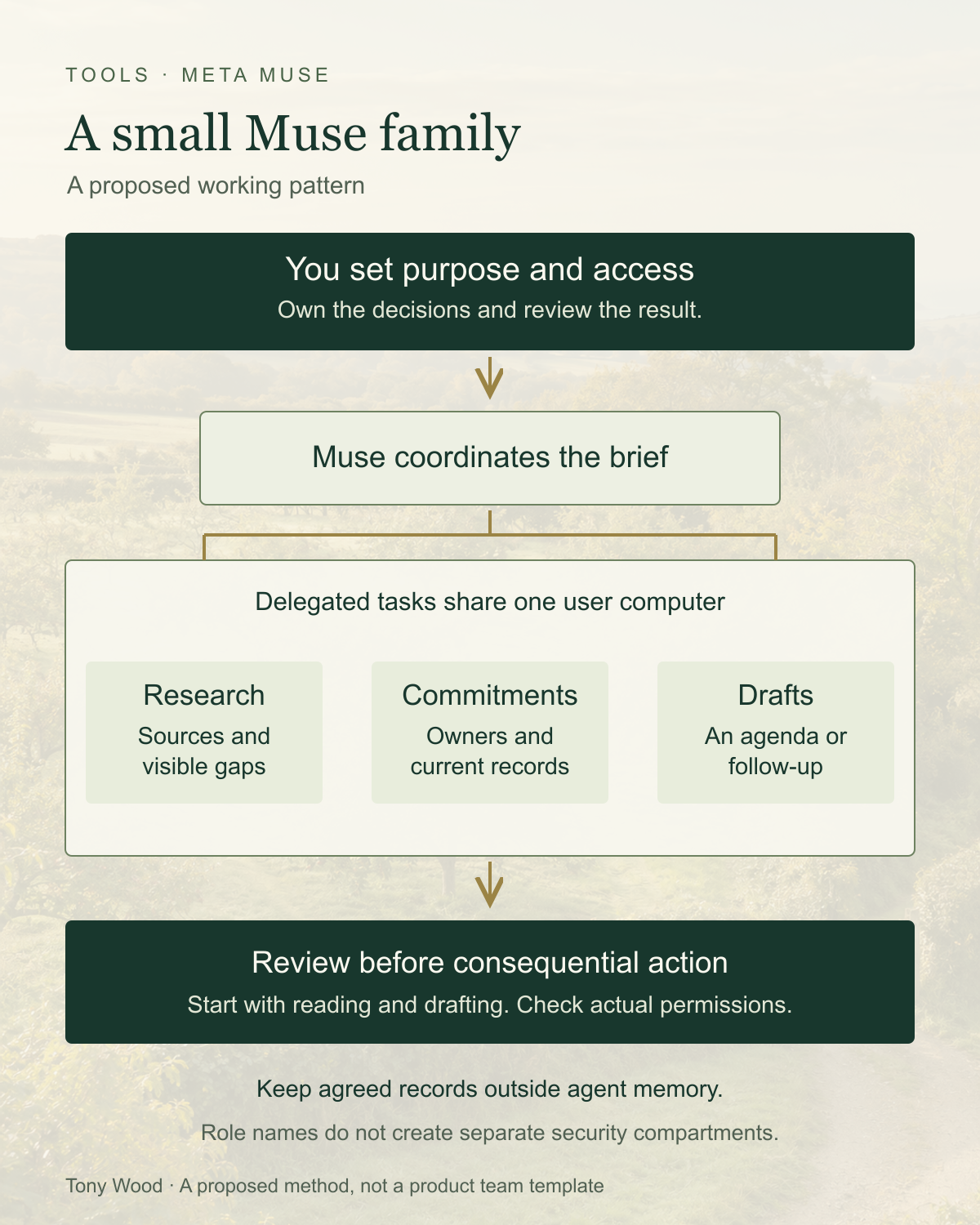
I would begin with Muse coordinating one piece of work. Meta documents delegation to other agents within Muse. The following are roles I would give those tasks:
- A coordinator keeps the agreed brief and brings me one coherent result.
- A researcher checks sources and makes gaps visible.
- An operations assistant compares commitments with current records.
- A drafting assistant turns checked findings into an agenda or follow-up.
For a partnership meeting, the researcher could prepare the public background while the operations task checks earlier commitments. Muse could combine them into a brief. After I review it, the drafting task could prepare the agenda.
Those job titles are my proposed working pattern. They do not establish separate accounts, protected memories or a ready-made team inside the product.
I would keep the agreed plan and important source documents somewhere the people involved can inspect. The assistant's memory can help, but the approved record should remain accessible outside it.
When connecting things, I would start with a supported connector and inspect the access it requests. Muse can also help create custom connections through an application's API. Meta's connector guidance says Meta does not review those custom connections or how they use information. I would have someone competent check one before using it with business data.
If I used Muse alongside Dots or Grok Bot, I would begin by passing an approved brief or document between them. The sources checked here do not establish an automatic bridge between the three. A shared task needs one owner and a clear place to leave the result.
Where the information goes
Meta says each Muse user has a dedicated Linux cloud computer storing the agent's files and state. Some information also goes to model processing and telemetry. It is a cloud service, even when you use it from your phone.
Meta can currently access the system for support, security and operation. Its security account describes confidential computers intended to exclude that access, planned for later in 2026. Check availability before relying on them.
The pages reviewed do not establish a hosting country or a precise deletion timetable for my proposed business use. I would ask those questions before adding sensitive material.
Meta provides a training opt-out. It also says conversations and computer data are not shared directly with its advertising systems, while some activity on connected services can affect advertising indirectly. The launch explanation and security account set out those distinctions.
Check existing connections too. Meta says Facebook, Instagram and Threads may be connected automatically through the same Accounts Centre. Disconnecting a service stops new exchanges; information already received may remain in conversations or memory.
Connected services also have their own terms. The connector guide is worth reading before linking an account.
Set the permissions as carefully as the brief
A separate component, Sentinel, checks actions against permissions. Meta documents grants for one action, a task or longer; an existing grant can allow work without a fresh prompt.
I would therefore start with reading and drafting, and keep sending messages, publishing, spending and changing important records subject to my review. I would check the actual settings and account access. Writing “ask me first” in a prompt is only part of the arrangement.
Meta acknowledges mistakes and malicious instructions in material agents read. I would supervise the work and check important results.
What people are using it for
Lance Ulanoff's account describes Muse finding overlooked emails and deadlines in his personal inbox. He also had to correct outdated context about a trip. That combination is instructive: useful connections, with a person still checking what they mean.
In Eric Hal Schwartz's trial, Muse spotted an appointment email and prepared a reply for approval. He found the convenience useful and the breadth of personal access uncomfortable.
These are individual trials, mainly of personal tasks. They suggest things worth testing; they do not establish business results or tell us how well Muse will work in our own organisations.
Availability, cost and a sensible first experiment
Meta's 29 September announcement names the US and Canada. The pages checked for this article do not confirm UK availability for a particular account.
The subscription help page lists a free allowance, Power at $20 a month and Maximum at $100 a month. Eligibility and offers vary. Check what your account actually offers rather than treating those figures as a UK price.
My first experiment would be one meeting brief using two or three approved sources, where I already know the background. Something like this:
Prepare a one-page brief for my meeting with [company] on [date]. Use only the attached notes and listed public sources. Read only: do not send messages, publish, purchase or change records.
Show what has changed, earlier commitments and the questions I should ask. Link each important point to its source. Separate facts from interpretation. Say what you could not check, and leave unknowns visible. Stop when the draft is ready for my review.
I would check the permissions before running it, then compare the brief with the sources. How much useful time did it save after checking and correcting? Did it help me notice something I would otherwise have missed?
If that worked, I would add a follow-up task. The family can grow as the work earns it.
This connects with Shepherd of Agentic Sheep: choose the context that matters, bound the work and keep the important decisions visible. The site separates documented capabilities from editorial assessment and hands-on qualification.
For the other tools in this series, read OpenAI Dots: Keeping the Work Moving Between Conversations and Grok Bot: How I Would Use It as a Leader.
Sources and notes
Checked on 5 October 2026. The business examples are proposed uses, not a claim that I have tested Muse or achieved these results. Vendor descriptions and individual accounts are attributed above. Features, availability, plans and controls may change.
Start with Meta's launch announcement, small-business guide, product design account and security explanation. Read the current connector and subscription help pages before setting up your own trial.