I have a hopeful theory about AI and jobs.
The standard argument says that if AI makes each worker dramatically more productive, companies will need fewer workers. Look at one company in isolation and the arithmetic seems obvious.
But companies do not operate in isolation.
If Company A can use AI to make a better product, reduce its price or launch more versions, Companies B and C cannot simply carry on as before. They have to respond. They may improve their own products, lower their prices, enter new markets or create things that were previously too expensive to attempt.
That competition could turn a productivity gain into more output and more demand, rather than only fewer jobs.
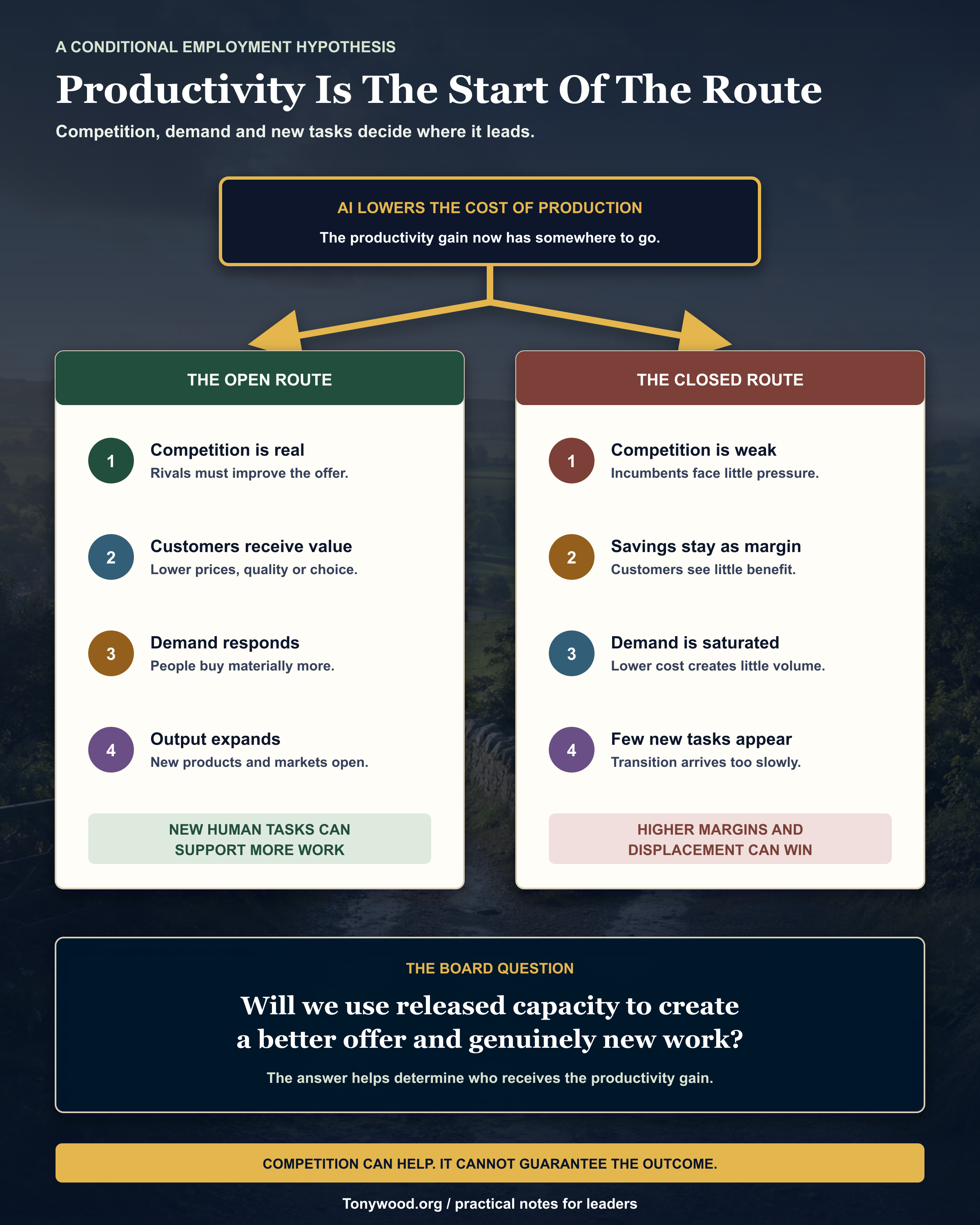
Competition may save us from some AI job losses, but only if the productivity reaches customers and creates new work.
That final condition is doing a lot of work.
A cost saving has two obvious destinations
Suppose AI lowers the cost of producing a service.
The company can keep the saving as a higher margin. Or competitive pressure can force some of it into lower prices, better quality, faster service and a wider range of products.
The UK's Competition and Markets Authority describes this basic mechanism directly: well-functioning competition pushes firms to keep prices low, improve quality, innovate and operate more efficiently.
If there is little competition, the company has less reason to pass the benefit on. AI can improve the margin while the customer sees very little.
That is why I do not think the effect of AI on jobs can be separated from market structure.
Demand decides what happens next
Even when prices fall, employment does not automatically rise.
The crucial question is how customers respond.
In a simple hypothetical, if a 20% price reduction causes people to buy far more of the product, the company may need to produce, sell, install and support much more. If nearly everybody who wants the product already has one, the same price reduction may barely change demand.
Economists call this demand elasticity. The plain-English version is: when it becomes cheaper, how much more do people want?
James Bessen's historical working paper AI and Jobs: The Role of Demand uses textiles, steel and cars to explain why this matters. Those industries experienced long periods in which technology improved and employment grew. Later, as markets matured and demand became less responsive, further productivity gains were associated with falling employment.
Technology did not produce one permanent result. The state of demand changed the result.
Take air conditioning as a thought experiment
Imagine that AI helps a manufacturer produce a good air-conditioning system much more cheaply.
In a competitive market, rivals have to respond. Prices may fall. Better systems may appear. Installation, servicing, energy management and building design may expand around them. People who could not justify the old price may decide the new price is worth paying.
This is a thought experiment, not a forecast that cheaper air conditioning will preserve a particular number of jobs.
It is plausible because cooling demand is not obviously saturated. A July 2025 International Energy Agency analysis describes rising cooling demand driven by temperature, population and income, while electricity access also limits adoption. Its income-quintile chart uses 2020 median values for Europe and Central Asia, East Asia and Pacific, and Sub-Saharan Africa. Affordability is one important factor.
But the example also shows the boundary of the argument. More cooling creates pressure on electricity systems and emissions unless efficiency and clean supply improve too. More demand is not automatically an unqualified social good.
Companies can redeploy people into the work they could not afford before
If I ran a company with 50,000 people and AI released a large amount of capacity, I would not begin by assuming all that capacity was surplus.
I would ask:
- Which customers are underserved?
- Which products are too expensive to build today?
- Which quality problems have we tolerated because fixing them took too long?
- Which markets could we enter?
- Which human service would make the product meaningfully better?
- Which risks and maintenance backlogs are we carrying?
There is no shortage of useful work. There is a shortage of work that the current cost structure allows a company to fund.
This is close to what I have called human debt: all the repairs, care, service, teaching, improvement and resilience we know we need but keep postponing.
Productivity can create room to pay some of that debt down. Competition can make it dangerous for a company not to.
New tasks matter as much as automated tasks
There is another piece to the employment question.
Automation removes tasks from people. Innovation can also create tasks in which people have an advantage.
Daron Acemoglu and Pascual Restrepo describe these as a displacement effect and a reinstatement effect. Their published task-based framework does not say that new jobs will magically appear. It says the balance between automated tasks and genuinely new human tasks is central to labour demand.
That makes product ambition important.
If a company uses AI only to remove labour from an unchanged product, displacement pressure is stronger. If it also creates new products, services and roles, the calculation changes.
There are at least five ways my hopeful theory fails
I would not turn this into a promise. The route can break in several places.
- Demand is already saturated. People do not want enough extra output, even at a lower price.
- Competition is weak. Firms keep the saving as margin rather than improving the offer.
- New output is also highly automated. Sales rise without creating much additional human work.
- New tasks arrive too slowly. Displacement can happen before retraining, investment and new industries have had time to create alternatives.
- The gains and losses land in different places. Society can become richer overall while particular workers, age groups, regions and entry routes carry the damage.
The last point matters. A displaced administrator cannot pay the mortgage with a chart showing higher national productivity.
The joint ILO-NASK 2025 exposure index estimates that one in four workers globally is in an occupation potentially exposed to generative AI. It concludes that transformation is more likely than full replacement because most exposed jobs still contain tasks that require human input.
That is a statement about task exposure, not a forecast that everybody keeps their job or income.
Market position may matter more than the cost-saving target
When boards discuss AI, the conversation often starts with efficiency.
I would add market position.
If your competitors can offer more for less, cutting cost while leaving the product unchanged may be the least ambitious use of the technology. You may need the released capacity to defend the business.
The questions I would put on the board agenda are:
- Which AI savings will reach the customer?
- Where would a lower price materially increase demand?
- Which products or services become viable at the new cost?
- What new human tasks appear around those products?
- Which roles are exposed before the new work exists?
- What will we retrain and redeploy before we recruit elsewhere?
- Which market barriers could stop a better competitor reaching our customers?
That is a different plan from asking each department to reduce headcount by 10%.
Government has a role in whether the gains spread
If competition is part of the protection, governments cannot be passive.
They need to keep markets open enough for new firms to challenge incumbents. They need to scrutinise lock-in, control of essential data and infrastructure, anti-competitive acquisitions and rules that accidentally protect the old cost base. They also need transition support, portable skills, functioning safety nets and routes into work when traditional entry routes are disrupted.
None of that requires pretending every market should be a free-for-all. Competition has to operate alongside safety, labour standards, privacy, security and environmental limits.
The aim is practical: make sure productivity does not disappear into a small number of balance sheets.
I am hopeful, conditionally
I do not see inevitable mass unemployment when I look at AI.
I see the possibility of companies doing much more: making products better, serving more people, entering markets that were uneconomic and tackling work we have postponed for years.
But productivity will not save us by itself.
Competition has to move some of the gain to customers. Customers have to want more when the offer improves. Companies have to create new work rather than only remove old tasks. People need a route from the work that disappears to the work that grows.
If those conditions hold, AI can support a period of extraordinary improvement in products and services.
If they do not, we may get higher margins, greater concentration and job losses while being told that the technology worked perfectly.
So can competition save us from AI job losses?
From some of them, perhaps. But only if we protect the competition and deliberately build the new work.
Related reading
- AI Has A Middle-Management Problem
- Where Is The Productivity We Were Promised?
- Before There Is No Work Left, We Have Human Debt To Pay Down
- The AI Harness Is Becoming The Operating System
Sources and notes
- Bessen: AI and Jobs - The Role of Demand
- Acemoglu and Restrepo: Automation and New Tasks
- Competition and Markets Authority: The State of UK Competition Report 2024
- ILO and NASK: Generative AI and jobs - a refined global index of occupational exposure
- International Energy Agency: Staying cool without overheating the energy system
- International Energy Agency: Air-conditioner penetration by income quintile
This is a hypothesis about possible labour-market mechanisms, not a forecast of employment or investment advice. Outcomes will vary by product, market, country, time period, regulation and the pace at which companies create new tasks.