I am less interested in whether we have reached AGI than in what AI is already doing to work.
Nobody seems to agree on what AGI means anyway. The argument can wait. Companies have a much more immediate question:
What happens when technology built to cross tasks and systems meets an organisation built to pass work between people?
I am seeing two very different experiences.
On one side are individuals and small teams who feel invigorated. They can take on projects they would never have attempted before. I have a couple running now. Without agentic help, I simply would not have started them.
On the other side are large organisations with years of systems, roles, controls, meetings and reporting lines. They are extremely good at helping thousands of people work together. That is an achievement. It is also the reason change is harder.
The problem is not that corporations are ignoring AI. In 2025, Eurostat reported that 55% of large EU businesses used AI, compared with 19% of small and medium-sized businesses. The survey covered enterprises with at least ten workers; SMEs had 10 to 249 workers and large enterprises had 250 or more. My observation is about the depth and speed of change inside particular teams, not the prevalence of adoption.
A small company can change how it works this afternoon. A large company has to change how people work together.
We built companies to coordinate humans
Think about what a corporation contains.
Managers. Managers of managers. Country managers. One-to-ones. Status meetings. All-hands meetings. Board papers. Budgets. Approvals. Policies. Reports. Support desks. Security controls. Service notifications. Escalation routes.
Much of that machinery exists because a person in one part of the company cannot see, understand or safely act on everything happening somewhere else.
So information is summarised, handed over, discussed, approved and reported back. Management sits in the middle of that process. A good manager adds judgement, context and care. They also spend a great deal of time collecting information and keeping work aligned.
Then an agent arrives that can work across a document, a spreadsheet, a mailbox, a CRM and a codebase in the same run.
It does not see the department boundaries in the way the organisation chart does.
That is where the interesting problem begins.
The economics are difficult to ignore
The cost comparison is crude, but it explains the pressure.
From April 2026, the UK National Living Wage for somebody aged 21 or over is £12.71 an hour. At 37.5 hours a week for 52 weeks, that is £24,784.50 in annual gross pay. For an eligible worker aged 22 or over who is automatically enrolled, using the standard 15% employer National Insurance rate above the £5,000 secondary threshold and the minimum 3% workplace pension contribution on qualifying earnings gives an illustrative direct employer cost of about £28,309.
At the September 2026 official consular rate of $1.41 to £1, the $200-a-month higher-usage ChatGPT Pro tier is about £1,702 a year before VAT. Depending on VAT recovery and whether the employer can use Employment Allowance, the illustrative direct statutory cost of that one eligible minimum-wage job is roughly equal to 12 to 17 annual subscriptions.
That excludes recruitment, equipment, payroll, training and management. It also excludes most of what makes a person valuable.
A subscription is not an employee. It does not bring loyalty, lived experience, moral judgement, accountability or care. It is not guaranteed output, and a consumer plan is not an enterprise operating model. This is not a case for replacing one person with sixteen logins.
It is a warning about the scale of the economic incentive.
AI changes individual work before it changes collective work
A useful randomised field experiment used Office telemetry from 7,137 knowledge workers across 66 large firms during an early Microsoft 365 Copilot rollout. People who actively used the tool spent about two fewer hours a week in Outlook email; across everybody assigned access, the difference was 1.4 hours.
Average document-writing and meeting time did not significantly change. The study measured work patterns, not productivity or performance.
The researchers' explanation is important. People could change email and document work on their own. Changing meetings required colleagues, calendars, expectations and processes to change too.
That is the corporate problem in miniature.
Giving everybody an AI tool can improve isolated tasks. It does not automatically redesign the organisation.
Do not blame the middle manager
It is easy to say that middle management is the problem. I think that misses the point.
Organisations created these roles because coordination was necessary. They measured managers on plans, updates, approvals, delivery and control. They rewarded people for becoming the reliable human bridge between one group and another.
Now we are asking the same people to introduce systems that may automate part of the work by which the company recognises their value.
The problem is not middle managers. It is that we are asking them to automate the coordination work by which the company currently measures their value.
Why would that move quickly without a frank conversation about roles, status, reward and what happens next?
A 2022 McKinsey global online survey included 706 qualifying non-C-suite respondents who managed at least one manager. They reported spending nearly half their time on non-managerial work, including almost a day a week on administration, while less than a third went to talent and people management. That is consultancy survey evidence, not a universal time sheet. It still describes a recognisable design problem.
If AI removes some of that administration, the answer should not be to pretend the manager has disappeared.
The answer is to decide what better management now looks like.
The manager's job should move up the value chain
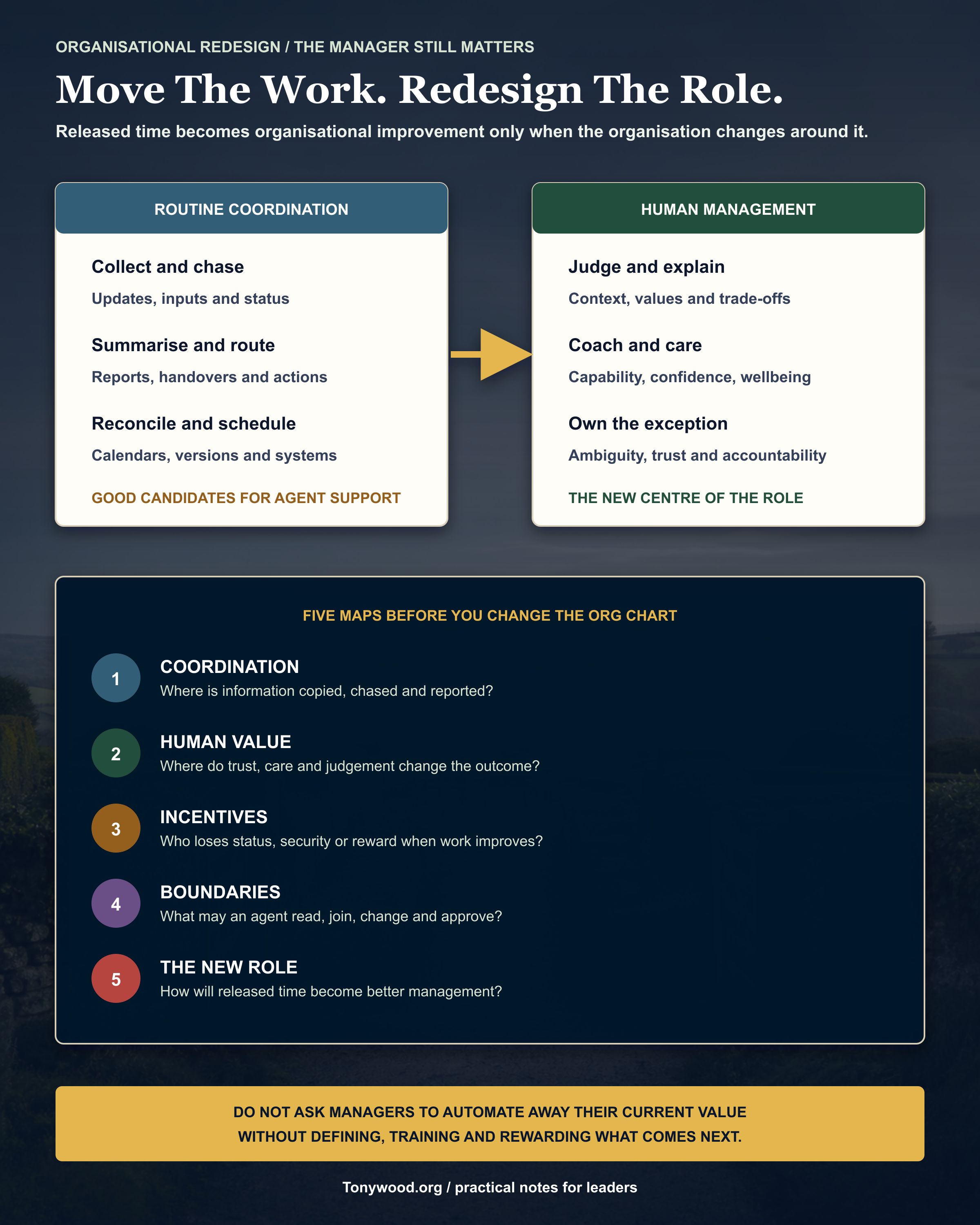
I expect the role to move away from carrying information and towards work that requires human responsibility:
- Judgement: deciding what matters when the evidence is incomplete or the values conflict.
- Coaching: helping people become more capable rather than merely checking progress.
- Wellbeing: noticing when somebody is struggling, overloaded or losing confidence.
- Sensemaking: explaining why the work matters and what has changed.
- Exception handling: dealing with the unusual cases that do not fit the automated route.
- Accountability: owning the decision when an agent cannot.
- Organisational memory: making tacit knowledge explicit without stripping away its context.
The skills evidence points in this direction, although it is still developing. A 2024 OECD working paper analysed online vacancies from ten countries over different country-specific periods. In occupations exposed to AI that did not require specialised AI skills, management, business-process and social skills remained heavily demanded. It also found some early evidence of small falls in demand for certain skills at establishments more exposed to AI. Vacancy data is a proxy for employer demand, not a complete picture of work.
The technology is still junior
None of this means the systems are ready to run the company.
If you have worked closely with current agents, you know the feeling. They can be astonishing and strangely naive in the same hour. They miss nuance. They become confident at exactly the wrong moment. They need context, boundaries, checking and somebody experienced enough to notice what is missing.
The productivity evidence is mixed for the same reason.
A study of 5,172 customer-support agents within one company found a 15% average productivity gain, with much larger gains among novice and lower-skilled workers and little benefit for the most experienced. In a different setting, METR's 2025 randomised study found that 16 experienced open-source developers took 19% longer with the AI tools available at the time, even though they believed the tools had made them faster.
Different jobs, different tools, different results.
Feeling invigorated matters. It can unlock ambition and experimentation. It is not the same as measured productivity.
What I would do inside a large company
I would not begin with a target for reducing managers.
I would begin with five maps:
- Map the coordination work. Where is information copied, summarised, chased, reconciled and reported?
- Map the human value. Where do judgement, trust, coaching, negotiation and responsibility change the outcome?
- Map the incentives. Who loses status, budget, headcount or security if the process improves?
- Map the boundaries. Which systems and data may an agent read, change or join together?
- Map the new role. What will managers be expected, trained and rewarded to do with the time released?
Then I would test one complete workflow across the existing organisational boundaries. I would measure the whole journey, including review, correction, exceptions and failures. I would involve the managers whose jobs currently hold it together.
If the company only automates their administrative work and leaves their role undefined, resistance is rational.
If it gives them better tools and a more valuable job, they can become the people who make the transition work.
This is an organisational redesign
Small teams can feel the freedom first because they have fewer boundaries to renegotiate.
Large organisations can still gain far more in absolute terms. They have more knowledge, customers, capital, data and repeated work. But they will not get there by dropping an AI assistant into every old job description and waiting.
We built today's company to help people coordinate with other people.
Now we have systems that can carry part of that coordination across tasks and departments.
The management question is no longer simply, "How do we make everybody use AI?"
It is, "What do we want our managers to become when carrying information is no longer the centre of the job?"
Related reading
- How Do We Get Our Teams To Use AI?
- Management Is The Missing Literacy
- Where Is The Productivity We Were Promised?
- Can Competition Save Us From AI Job Losses?
Sources and notes
- Eurostat: Digitalisation in Europe 2026
- Dillon, Jaffe, Immorlica and Stanton: Shifting Work Patterns with Generative AI
- Brynjolfsson, Li and Raymond: Generative AI at Work
- METR: Measuring the Impact of Early-2025 AI on Experienced Open-Source Developer Productivity
- OECD: Artificial intelligence and the changing demand for skills in the labour market
- McKinsey: Middle management - a precious but wasted resource
- GOV.UK: Rates and thresholds for employers 2026 to 2027
- GOV.UK: Workplace pension contributions
- GOV.UK: Consular exchange rates for September 2026
- OpenAI: What is ChatGPT Pro?
The subscription comparison uses a 37.5-hour week, the 2026/27 UK adult National Living Wage, standard employer National Insurance and minimum automatic-enrolment pension rates for an eligible worker. It is an illustrative direct-cost comparison, not a workforce plan. Employment Allowance, pension eligibility, VAT recovery, age, location, benefits, equipment, training, paid absence and the appropriate business plan can materially change it.