This is the thought that arrived after writing about why children need to learn how to manage agentic workers.
Maybe the deeper issue is not AI literacy.
Maybe the deeper issue is management literacy.
We teach people how to work. We teach them how to follow instructions, pass exams, comply with rules, write essays, solve equations, use software, submit assignments, and avoid danger.
But we do not consistently teach them how to manage.
Not management as in a corner office, a hierarchy, or a corporate title.
Management as a human skill.
Managing yourself. Managing attention. Managing time. Managing other people. Managing tools. Managing uncertainty. Managing evidence. Managing risk. Managing what good looks like. Managing the gap between an intention and an outcome.
That suddenly feels like one of the most important literacies we could teach.
There are management degrees
Let me correct myself before I get carried away.
There are, of course, degrees in management.
You can study management at university. The London School of Economics has a BSc Management. The University of Manchester has management degrees. The QAA subject benchmark statement for business and management describes business and management as a recognised higher-education subject area. The Chartered Manager Degree Apprenticeship exists. MBAs exist. Business schools exist.
So the point is not that nobody teaches management anywhere.
The point is that we treat management as a specialist route.
Something you learn if you choose business, join a management programme, take an apprenticeship, become a team leader, or end up in charge of people later.
But the AI era is making management a general literacy.
Because when students, workers, founders, teachers, parents, and public servants use AI, they are no longer only doing work. They are directing work.
That changes the skill.
AI turns doing into directing
If a student writes an essay entirely by hand, the task is mostly execution.
If a student uses AI, the task changes.
Now the student has to set the outcome, describe what good looks like, give context, judge sources, shape the draft, reject generic work, add their own thinking, and explain why the final answer is theirs.
That is management.
If a junior analyst builds a report manually, the work is slow execution.
If an agentic tool builds the report, the analyst has to brief it, monitor it, check evidence, understand assumptions, identify risk, decide what to use, and own the recommendation.
That is management.
If a founder has five agentic workstreams running at once, they are not simply using software.
They are managing a small, strange, tireless team.
And that is why I think the education conversation needs to move.
Not away from safety.
Safety matters.
But beyond safety.
We are very good at saying no
When I looked around the current AI education material, I found useful work.
TeachAI gives schools a practical toolkit for AI guidance. The UK's Department for Education has materials on understanding AI in education and generative AI product safety expectations. UNESCO's AI competency framework for students tries to move beyond tool use into a broader set of competencies. The OECD is preparing a PISA 2029 Media and Artificial Intelligence Literacy assessment. In Europe, AI literacy is also becoming an organisational responsibility, not only a classroom topic.
There are practical learning routes too. Experience AI, Common Sense Education's AI materials, AI4K12, and Elements of AI all help people find a way into the subject.
That is all good.
But a lot of the visible conversation still feels like this:
- Do not cheat.
- Do not trust everything.
- Do not share private data.
- Do not submit generic AI output.
- Do not use tools you are not allowed to use.
- Do not forget the risks.
Those are necessary boundaries.
They are not enough.
The more useful question is:
Here is how I want you to use it well.
That is the bit I think we are missing.
Not just what not to do.
What to do.
How to do it effectively.
How to know when the work is good.
What happened in the classroom
I felt this recently when teaching university students.
I told them, very plainly, that I expected them to use AI.
The world they are entering will expect them to use AI.
But I also told them that if they handed me something generic, I would mark them down.
Not because they used AI.
Because they were not in the work.
If all you do is click the button and accept what comes back, you are not human in the loop. You are not human on the loop. You are outside the loop, watching the loop happen.
There is no judgement there.
There is no taste.
There is no creativity.
There is no responsibility.
The work has to contain you.
That does not mean every sentence has to be typed manually. That is an old way of measuring effort.
It means the thinking has to be visible.
The return of thinking
This is the part I am strangely optimistic about.
There is a lot of worry that AI will make people stop thinking.
It can.
If we teach it badly.
But it might also force us to teach thinking properly.
The Education Endowment Foundation's work on metacognition and self-regulated learning is relevant here. So is Harvard Project Zero's Visible Thinking work. So is the OECD's language around student agency and the Learning Compass 2030.
These are not AI ideas.
They are older, deeper education ideas.
AI has simply made them urgent.
Because now the output can arrive instantly.
So the question becomes: what did the student actually think?
What did they ask for?
What did they reject?
What did they improve?
What evidence did they check?
What did they learn?
What did they decide?
That is a better education conversation than pretending the tool does not exist.
Management is not control
I think some people hear "management" and imagine control.
That is not what I mean.
Bad management is control.
Good management is clarity.
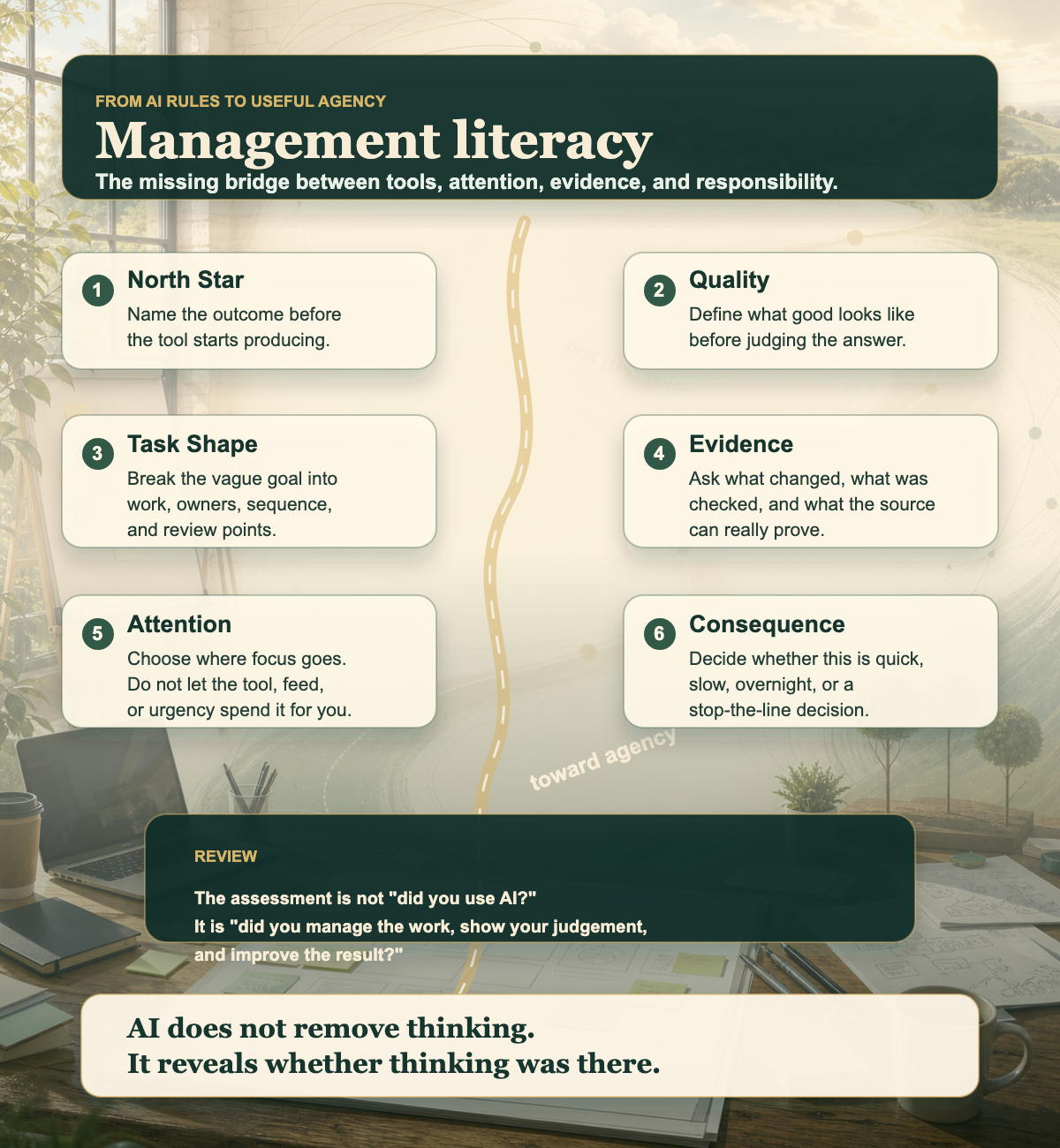
It gives people, and now tools, a north star. It says what good looks like. It makes the task understandable. It names the risks. It explains the boundary. It protects attention. It asks whether the right people are involved. It checks whether the evidence is strong enough for the consequence.
That is not bureaucracy.
That is care.
And children can learn it.
They already manage more than we admit: friendships, homework, sport, group work, revision, family expectations, online identities, social pressure, and attention.
The question is whether we help them make that management skill explicit.
What schools already teach
The building blocks are already there.
| Existing building block | Where it shows up | The missing AI-era extension |
|---|---|---|
| AI literacy | Experience AI, MIT Day of AI, UNESCO, TeachAI, and OECD work. | Move from "what is AI?" to "how do I responsibly direct work done with AI?" |
| Critical thinking | Metacognition, visible thinking, argument, source evaluation, project reflection. | Require students to show what they accepted, rejected, questioned, improved, and why. |
| Project work | Project-based learning, group assignments, maker tasks, enterprise days. | Teach role clarity, task decomposition, review points, risk, and decision records. |
| Essential skills | The Skills Builder Universal Framework covers listening, speaking, problem solving, creativity, staying positive, aiming high, leadership, and teamwork. | Add the explicit skill of managing semi-autonomous tools and workstreams. |
| Digital citizenship | Online safety, media literacy, data protection, acceptable-use policies. | Teach attention as something students own, not something platforms harvest. |
So I am not arguing for a completely new empire of curriculum.
I am arguing for a new join.
Join AI literacy to critical thinking.
Join critical thinking to project work.
Join project work to responsibility.
Join responsibility to attention.
That join is management literacy.
Attention is part of the curriculum now
There is another reason this matters.
Attention is becoming one of the most important resources a young person has.
If you are not paying for something, you may still be paying with your attention, your behavioural data, your future preferences, and your sense of what matters.
That is not a moral panic.
It is an operating reality.
So when we teach AI, we should not only teach students how to get an answer.
We should teach them how to decide where their attention goes.
They should be able to ask, clearly and regularly: where do I put my attention?
That matters because attention is not an abstract virtue. Research on digital multitasking keeps pointing back to the same practical problem: switching between streams of work can raise cognitive load, weaken concentration, and make decision-making worse. The digital multitasking paper I was sent is useful here because it frames the issue as brain health and cognitive performance, not just manners in a classroom.
I have also been thinking about the warning that heavy AI use can create a kind of agency decay. A recent Psychology Today piece on thinking fast, slow, and no longer puts language around a fear many teachers and leaders already feel: if the machine does the first move, the human can stop making one.
Which inputs deserve time?
Which recommendations deserve trust?
Which signals are useful?
Which influences are trying to use them as the product?
Which work is worth doing because it makes them more capable?
That is not just media literacy.
It is self-management.
The lesson I would build
If I were designing a practical lesson, I would not start with "write a better prompt."
I would start with a messy outcome.
Something like:
Your team has to propose a community event, a small business, a local transport improvement, a charity campaign, or a school policy change. You may use AI, but you must show your management trail.
Then I would ask students to produce:
- a north star, in one sentence;
- three signs of what good looks like;
- a task breakdown;
- a responsibility map;
- the prompts or instructions they gave the tool;
- the outputs they rejected and why;
- the sources they checked;
- the risks they noticed;
- one decision they made slowly;
- one thing they changed because their own judgement improved the work.
That would be a useful assessment.
Not "did you use AI?"
"Did you manage the work?"
What good looks like
At the end of this kind of education, I would want a student to be able to say:
- I know what I am trying to achieve.
- I can define quality before I see the answer.
- I can break a vague goal into useful work.
- I can use AI without disappearing from the process.
- I can tell the difference between a quick decision and a consequential decision.
- I can explain what evidence changed my mind.
- I can protect my attention from systems that want to spend it for me.
- I can show where my judgement improved the final result.
That is the skill.
And I think it is good news.
For years, a lot of education and work has rewarded compliance, output, and speed.
AI can produce output and speed.
So the human value has to move upward.
Judgement. Taste. Care. Evidence. Creativity. Direction. Responsibility. Attention.
That is not the death of thinking.
That is an invitation to teach thinking properly.
The future is bright if we help people become managers of their own minds, their own tools, and the work they choose to bring into the world.