I keep wondering where the productivity has gone.
We can now build things faster. A lot faster.
Once you understand how to work with agents, once you stop treating AI as a novelty and start treating it as part of the operating model, development changes. The same person can move three, four, maybe five times faster in some kinds of work.
That is not magic. It is not everywhere. It does not remove judgement. But it is real enough that the question starts to bite.
If the cost of making software has come down, where is the benefit?
Where are the better features?
Where are the more stable platforms?
Where are the lower costs for SaaS customers?
If productivity has arrived inside the company, it should eventually show up outside the company.
The SaaS question
Start with SaaS.
A large part of many software businesses is the cost of developing, maintaining, supporting, selling, securing, integrating, and improving the product. Development is not the whole cost, of course. But it is a meaningful one.
So if development productivity improves, I would expect something visible to happen.
Maybe the product gets better faster.
Maybe the long-promised feature finally ships.
Maybe the platform becomes more stable because engineering time can go into quality, test coverage, migration work, and boring reliability.
Maybe the price comes down.
Maybe support improves because the same team can answer more clearly and fix more quickly.
But that is not what it feels like we are seeing at scale yet.
We are seeing AI features added to products. We are seeing assistants placed inside interfaces. We are seeing new pricing tiers, new usage limits, and new bundles.
Fine.
But I am asking a slightly different question.
Where is the productivity receipt?
The adoption arc
I can understand the first phase.
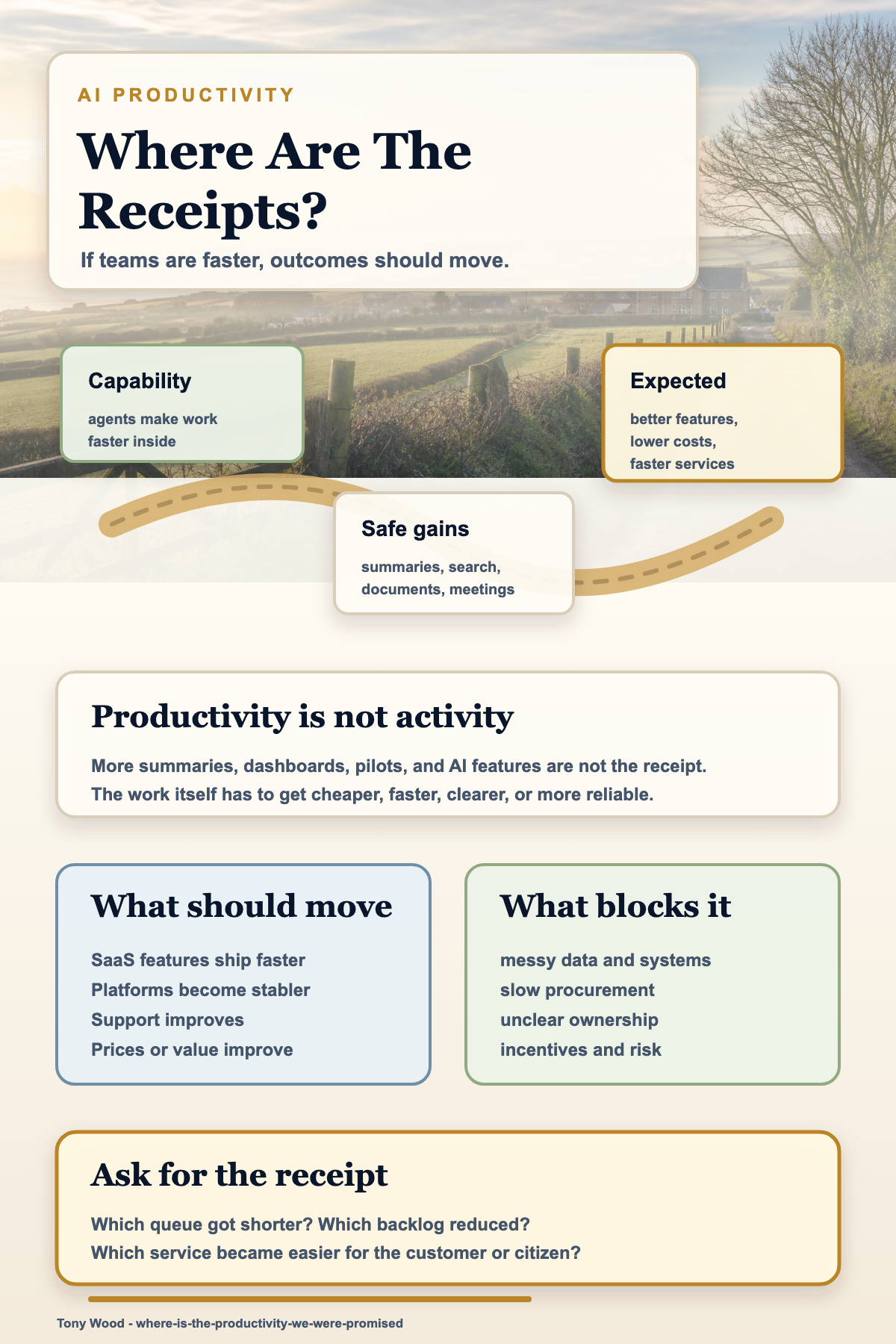
Companies start with the safe areas. Security. Compliance. Search. Summaries. Internal knowledge. Meeting notes. Proposal drafts. Document generation. The obvious places where AI can save half an hour here and half an hour there without immediately changing the whole organisation.
That is sensible.
Then teams get more confident. They learn how to write better prompts. They build internal tools. They connect AI to documents, tickets, logs, policies, code, customer history, and operational data.
At that point, the gain should stop being personal convenience and start becoming organisational capacity.
Not just, "I summarised my emails."
More like, "We shortened this process."
"We cleared this backlog."
"We reduced this queue."
"We made this service easier to use."
"We found the work that nobody had time to do, and now it is getting done."
Public services should feel it too
This is not only a SaaS question.
If the productivity story is true, we should start to feel it in services.
Councils should be able to speed up information work. Planning. Procurement. Housing repairs. Council house management. Reports. Case summaries. Resident communication. Finding the right policy. Understanding what is happening across a messy set of systems.
Healthcare should feel some of it too. Not by pretending AI is a clinician. By removing administrative sludge, getting information to the right person faster, drafting routine communications, checking forms, reducing duplicated effort, and helping teams see the state of the work.
Government services should become easier to navigate. Information should be more personalised. Forms should be less stupid. Updates should be clearer. Internal handoffs should be less painful.
That is the promise, isn't it?
Not a demo.
A service that feels less stuck.
Productivity is not activity
One problem is that we confuse activity with productivity.
More documents is not productivity.
More summaries is not productivity.
More meetings with better notes is not productivity.
More internal pilots is not productivity.
Those things may help. They may be steps on the way. But they are not the outcome.
Productivity means something changed in the work.
The queue got shorter. The error rate fell. The release got more reliable. The customer got an answer faster. The resident did not have to chase three times. The team could handle more without burning out. The price could move because the cost structure genuinely changed.
That is the level where this becomes real.
The blocker may not be the model
So where is the blockage?
I do not think the answer is simply, "The models are not good enough."
Sometimes they are not. Fine.
But often the model is already good enough to help. The problem is around the model.
The process is not owned clearly.
The data is messy.
The system integration is awkward.
The procurement route is slow.
The incentives reward announcing transformation more than changing the work.
The risk framework says no to everything until someone senior decides what a sensible yes looks like.
The management layer has not redesigned the job. It has just given people new tools and hoped productivity would appear.
A faster developer does not automatically make a faster organisation.
A faster document does not automatically make a faster council.
A faster report does not repair a house, approve a plan, or answer a patient unless the operating system around it changes.
Where is the benefit going?
There is another uncomfortable possibility.
The benefit may be going somewhere. Just not to the customer, citizen, resident, patient, or user.
It may be absorbed into margin.
It may be spent on more features rather than fewer problems.
It may be consumed by compliance, security, governance, sales, implementation, support, and coordination costs.
It may be used to do more work internally without changing the external experience.
It may be swallowed by complexity.
That does not mean AI is useless. It means productivity is political and operational, not just technical.
Ask for the receipts
I think we need to become more demanding about this.
Not cynical. Demanding.
If a SaaS company says AI has made its teams more productive, ask:
- Which customer-facing feature shipped faster?
- Which reliability problem got fixed?
- Which support burden came down?
- Which price changed?
- Which part of the product became simpler?
If a public body says AI is improving productivity, ask:
- Which queue got shorter?
- Which process got easier for the citizen?
- Which backlog reduced?
- Which handoff disappeared?
- Which decision got clearer without becoming less accountable?
Those are the questions that matter.
We should be seeing more by now
We are several years into this AI wave.
By now, many organisations have moved through the obvious stages. Summarise emails. Draft documents. Search internal knowledge. Write proposals. Capture actions. Prepare meeting notes. Help with code.
That work matters.
But it should not be the destination.
The next phase has to be visible productivity.
Better software.
Faster services.
Lower avoidable cost.
Less chasing.
Fewer queues.
More capacity where the public and the customer can actually feel it.
That is what I am looking for.
Not another AI announcement.
The receipt.