I am sitting here with an army of agents doing a whole bunch of things I need to get done.
That sounds like the start of a story about doing less.
It is not.
What has actually happened is more interesting.
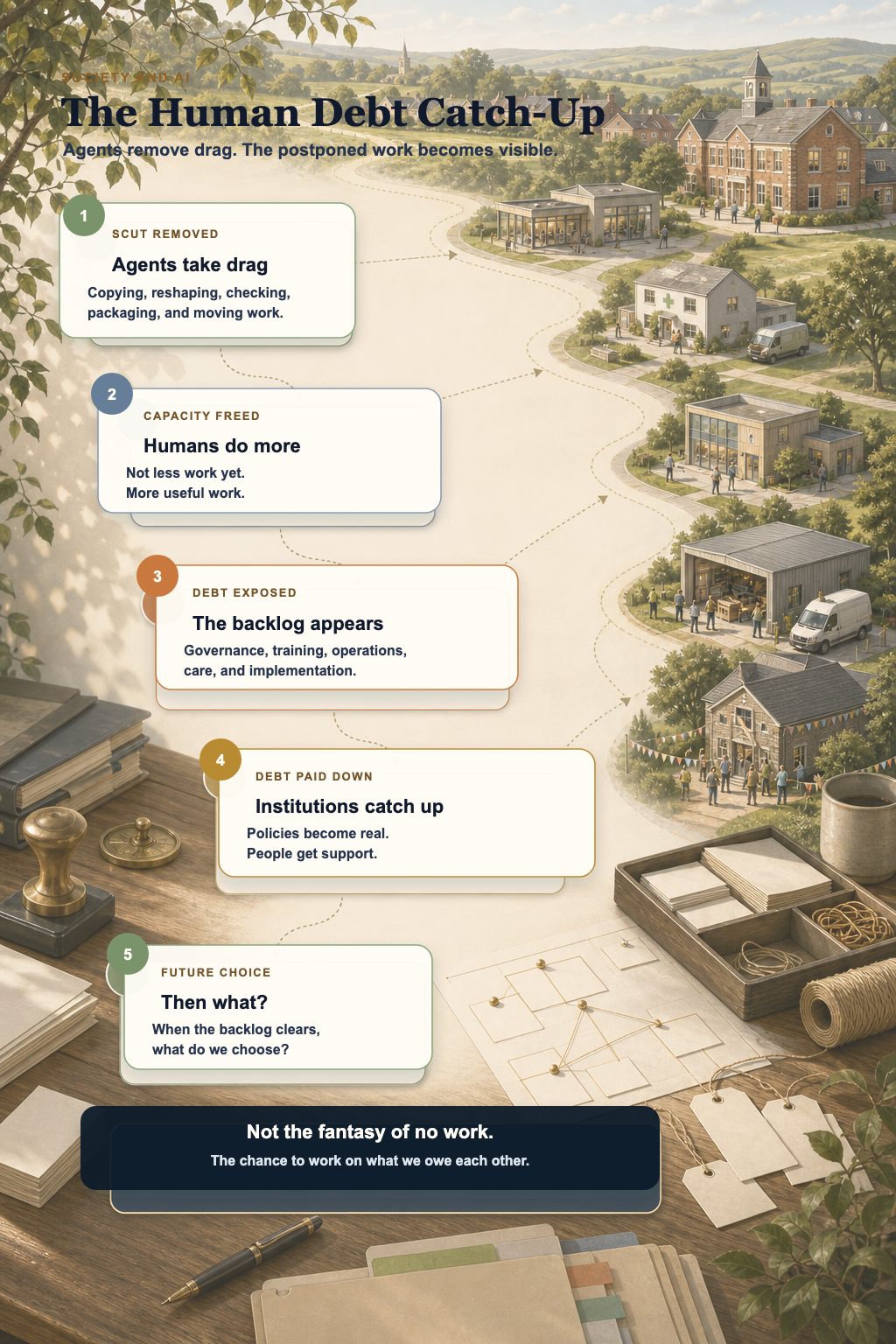
The agents have taken away a lot of the drag between pieces of work. The copying, reshaping, checking, packaging, rebuilding, searching, formatting, and moving things from one place to another. The scut work. The work between the work.
And once that goes, I am not sitting on the beach doing nothing.
I am doing more.
That surprised me.
I think it tells us something important about the period we are entering.
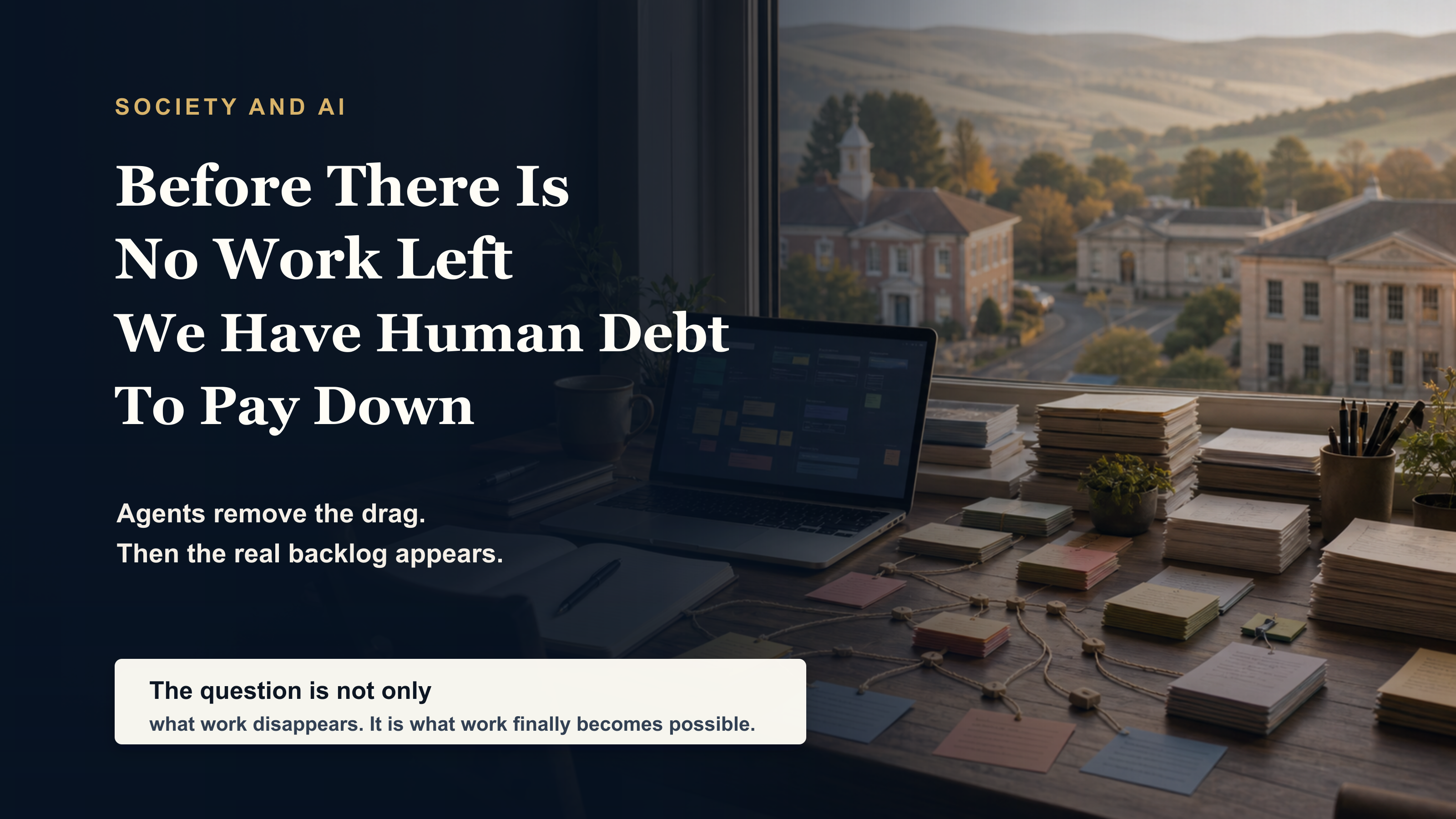
Before we run out of work, we may have a lot of human debt to pay down.
The work does not disappear first
There is a simple story about AI.
AI does the task. The worker is no longer needed. The job goes away.
Some of that will happen.
There are tasks that do not need a human anymore, or will not need one very soon. There are roles that are mostly made of moving information around, tidying it up, producing routine outputs, or sitting between systems that should have been connected years ago.
Those roles are exposed.
But that is not the whole story.
In practice, when intelligence starts doing the repetitive drag, it does not always reduce the amount of useful work. Sometimes it exposes how much useful work was not being done.
The reason is simple.
We were already overloaded.
Most organisations were not sitting around with empty capacity, waiting for something to do.
They had backlogs everywhere.
Human debt
Technical debt is the work you owe the system because you took shortcuts, delayed maintenance, or left messy foundations in place.
Human debt is the work we owe people because there was never enough time, attention, care, operational capacity, or institutional energy to do it properly.
It is the policy nobody has implemented.
The regulation nobody has operationalised.
The training nobody has delivered.
The process nobody has updated.
The governance nobody has properly read.
The person nobody has had time to support.
The patient, student, tenant, customer, citizen, founder, employee, or board member who needed a better answer than the system had time to give.
We talk a lot about whether AI will remove work.
I am looking around and seeing something else first.
I am seeing work that has been waiting for years.
Governance is full of it
Governance is a good example.
I see a huge amount of work not being done.
Not because people are bad.
Because they do not have enough time.
I do not have enough time to read this policy properly.
I do not have enough time to check whether this policy is actually being followed.
I do not have enough time to implement this regulation.
I do not have enough time to train this person.
I do not have enough time to understand what is really happening.
That phrase appears everywhere.
Especially in operations.
So if agentic systems remove some of the drag, that does not immediately mean everyone has nothing to do. It may mean people finally have the chance to do the work that should have been done all along.
More capacity does not mean less ambition
This is what I am feeling in my own work.
The agents take tasks off me.
Then I notice the next thing.
And the next.
And the next.
The boundary of what is possible moves.
That is the strange part.
When the cost of doing useful work falls, you do not only reduce the current workload. You discover new work. You raise your standards. You revisit things you had parked. You take on problems that previously looked too expensive, too slow, or too fiddly to touch.
That may happen at the level of a person.
It may happen at the level of a company.
It may happen at the level of a council, a university, a hospital, a charity, a regulator, or a country.
If it does, the next few years may not be a sudden emptying out of work.
They may be a catch-up period.
A period where we finally start paying down human debt.
The question after the backlog
I used to worry more about the timeline.
How long until high intelligence?
How long until AGI?
How long until huge categories of work change?
I still think those questions matter.
But I am increasingly interested in the question after them.
What happens when the backlog starts to clear?
What happens when a society has enough intelligence, enough automation, enough operational capacity, and enough tools to do the things it has been postponing?
What do we choose to do then?
Right now, we are all caught in the race.
Get the thing done.
Answer the email.
Fix the process.
Write the policy.
Train the person.
Catch up.
But if we get through enough of that human debt, the question changes.
It becomes less about what work must be done.
It becomes more about what kind of society we want.
That is the exciting bit
I do not think the immediate future is everyone doing nothing.
I think the immediate future is a lot of people discovering that they can finally do more of the work that matters.
Better governance.
Better services.
Better training.
Better care.
Better operations.
Better use of the knowledge we already have.
Eventually, perhaps, we reach a different place.
A place where the backlog is smaller.
A place where the work that was always urgent is no longer consuming everything.
Then we get to ask a much bigger question.
What do we choose to do as humans?
What do we choose to build?
What do we choose to care about?
What do we choose to become as a civilisation?
That is what I am excited about.
Not the fantasy of no work.
The possibility that, for the first time in a long time, we might have enough intelligence around us to work on the debt we owe each other.