If I were leading a large company today, I would be watching Codex and Claude just as closely as I watched Microsoft, Apple and Google.
Not because they are better chatbots.
Because I think they are becoming operating systems.
Or, to be more precise, they are becoming the operating layer for work.
The distinction matters. Codex and Claude are not replacing the kernel, the drivers, the network stack or all the careful machinery that makes a computer work. They still need macOS, Windows, Linux, browsers, cloud services and hardware underneath them.
But increasingly, I do not start with the operating system.
I start with the agent.
I tell it what I am trying to achieve. It works with files, code, terminals, browsers, tools and other agents. It remembers the project. It comes back when it needs authority or judgement. The old operating system is still there, but it is becoming the floor rather than the room I spend my time in.
My prediction is simple:
Within a year, OpenAI or Anthropic will offer something that functions as the operating system for a meaningful class of work, even if they never call it one.
It will not arrive with a dramatic launch
I do not think somebody will walk onto a stage and say, "Here is our new operating system."
It will happen gradually.
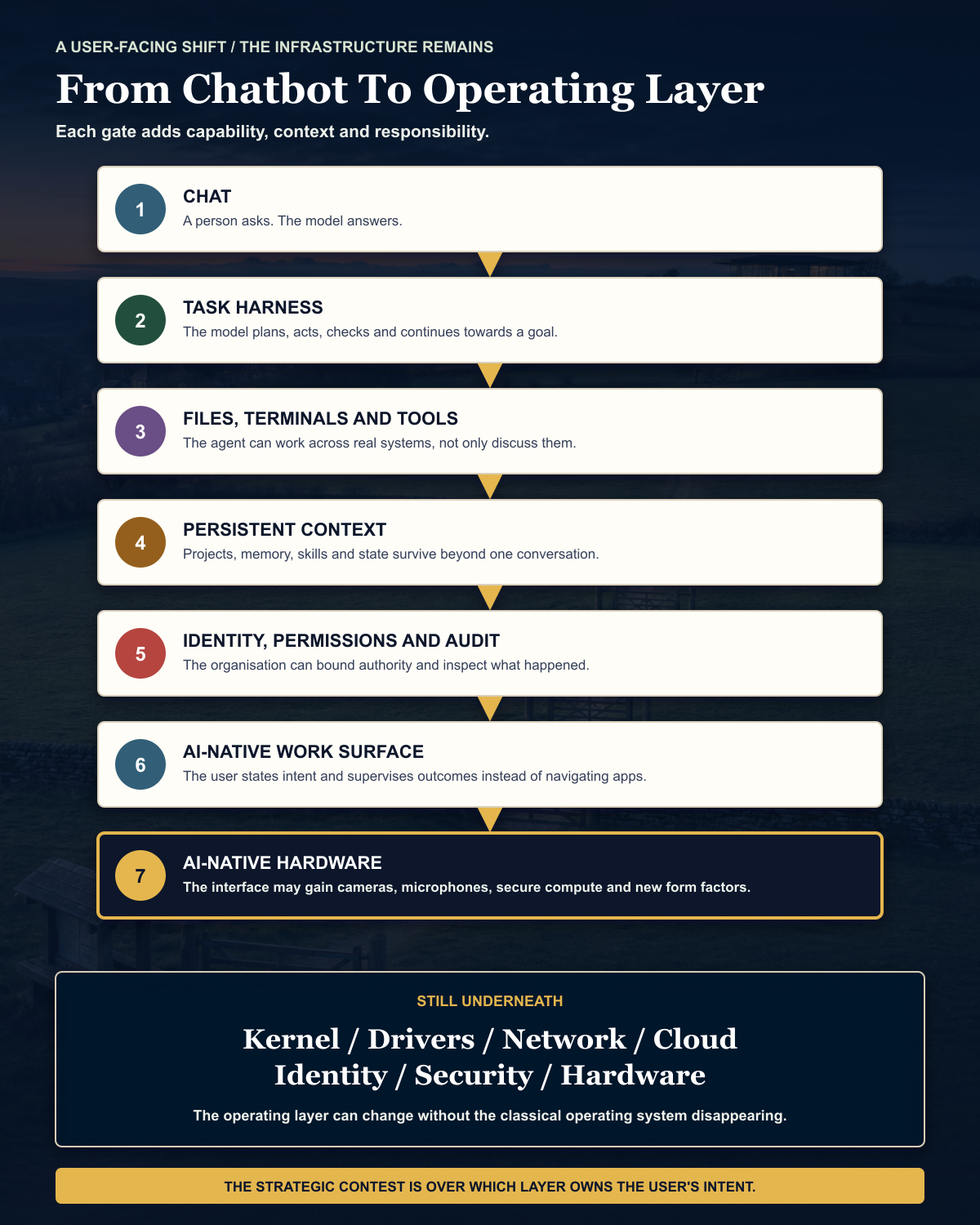
First there was chat. Then there were tools. Then files. Then terminals. Then coding agents that could work across whole repositories. Then longer-running tasks, multiple agents, skills, automations, memory and computer use.
OpenAI now describes the Codex app as a command centre for multiple agents. It can coordinate work that runs for hours, days or weeks, use reusable skills and automate tasks. OpenAI also says Codex is becoming useful for knowledge work beyond writing code.
Anthropic says people are using Claude for increasingly complex work across repositories, research, tools and teams. Its investment in computer use is explicitly about helping Claude act inside live applications, not merely talk about them. Its business controls are adding roles, administration, observability and audit.
Those are not isolated chatbot features.
They are the components of an operating environment.
What I mean by an operating system
A traditional operating system manages hardware, memory, processes, files, identities and applications. That definition remains important, and I am not pretending an agent harness already does all of it.
But people also experience an operating system as the place where they begin work, find things, grant access, move between tasks and understand what is happening.
That surface is changing.
In the old model, I decide which application to open. I navigate its menus. I locate the right file. I translate my intention into the sequence of clicks the software expects.
In the emerging model, I state the outcome. The agent decides which tools and information it needs, asks for the appropriate permissions, performs the work and shows me the evidence and decisions that require my attention.
The applications do not necessarily disappear. But I may stop visiting many of them directly.
That is the strategic change.
The interface becomes intent
Most software gives everybody a version of the same screen.
There are buttons, menus, fields, dashboards and forms designed to cover many possible users and situations. Much of what is on the screen is irrelevant to the task I am doing right now.
An agentic interface can be different.
It can begin with my goal, retrieve only the relevant context, call the right systems and then display what I need to oversee: what is happening, what has changed, what is uncertain, what requires approval and whether the outcome matches my intention.
That is a far more natural interface for work.
It also explains why computer use matters in the short term. The digital world was built for people who point, click and type. Agents currently have to imitate us because many systems still lack good APIs or MCP connections. Browser use is the bridge while the underlying services become more agent-readable.
This should worry the incumbents, but it does not make them irrelevant
If people spend more of their day inside an AI work surface, the owner of that surface gains an extraordinary position.
It can become the place where intention begins, context accumulates, work is delegated and results return. The underlying apps and operating systems risk becoming infrastructure that the user notices less.
But I would not write off Apple, Microsoft or Google. That would be far too easy.
They own enormous advantages: hardware, identity, security, distribution, cloud infrastructure, developer ecosystems and deeply embedded enterprise relationships.
More importantly, they can see the same change.
Microsoft says it is building isolated agent workspaces and agent accounts into Windows. Google says Android is moving from an operating system towards an intelligence system. Apple says it is integrating foundation models and personal intelligence deep into its platforms.
So this is not OpenAI and Anthropic moving while everybody else stands still.
It is a contest over which layer becomes the primary relationship with the user.
Enterprise permissions are the real test
A clever agent demo is not an enterprise operating system.
To cross that line, these platforms need to handle the boring, difficult parts that real organisations depend on:
- Who is this person or agent?
- Which company, role and team do they represent?
- What files, systems and people may they access?
- What may they read, change, approve, send, spend or publish?
- Where may the data travel?
- What evidence and audit trail must be retained?
- How can a human pause, reverse or recover the work?
- How can the organisation move its context if the provider changes?
Email looks simple until you try to operate it for a company. Then you meet identity, groups, retention, legal hold, malware, permissions, data boundaries, recovery and audit.
An agentic operating layer inherits all of that complexity, then adds delegated action.
The winner will not simply have the cleverest model.
It will have the most trustworthy way to turn a person's intent into bounded organisational action.
Hardware is part of the move
There is another reason I take this seriously.
OpenAI has brought the io hardware team into the company and says it is working across hardware and software with Jony Ive and LoveFrom. Its own announcement says that, despite computers now seeing, thinking and understanding, our experience is still shaped by traditional products and interfaces.
Meta is making the same argument from another direction. Its latest AI glasses combine cameras, microphones and audio; Meta says the assistant can understand what the wearer is seeing.
Once the agent becomes the primary interface, the ideal hardware may change. We may need a screen less often, but better microphones, cameras, battery life, local secure compute and clear ways to see when the system is listening or acting.
The device becomes a body for the operating layer.
Open source remains the escape route
There is a danger in all of this.
If one AI surface holds our instructions, memory, workflows, permissions and organisational context, leaving that provider becomes very difficult.
So I would use the best harness available, but I would not give it the only copy of my company.
I would keep important context in portable formats. I would separate business rules from provider-specific prompts. I would retain tested API and open-model routes for critical work. I would make sure identity, evidence and permissions can survive a change of model.
The open-source ecosystem does not need to reproduce every polished feature immediately. It needs to keep a credible route out.
What I would do as a corporate leader
I would not wait for somebody to announce an AI operating system.
I would start preparing for the behaviour now.
- Measure where work begins. Are people opening applications first, or asking an agent first?
- Map the agentic workflows. Which files, tools, decisions and approvals are already moving through AI harnesses?
- Separate company context from the supplier. Keep policies, procedures, evidence and reusable skills portable.
- Demand enterprise controls. Identity, permissions, audit, data boundaries, recovery and stop-lines are not optional extras.
- Test an escape route. Know what happens if the preferred harness becomes unavailable, unaffordable or unsuitable.
- Watch the hardware layer. The next work device may not look like a smaller laptop.
I could be early on the timing. Predictions about platforms are easy to make and hard to date.
But the direction now feels quite clear to me.
The operating system is not necessarily disappearing.
It is becoming the layer underneath the thing we actually use.