
I have spent a lot of time recently talking about what agents can do. Today I found myself thinking about what I need to do.
There are messages to send, introductions to make and people I have promised to get back to. An agent can help me keep track of all that. But if it has every conversation for me, how much of a relationship have I actually built?
That seems like a rather useful distinction at a time when everybody is telling us to brush up on our AI skills.
Yes, learn the tools. But brush up on your people skills too.
The small things are the work
Picture a conversation over coffee. The next time you meet, you remember how the other person takes theirs. It is a small thing, but it says you paid attention.
You remember the project they were worried about, ask what happened, and offer to introduce them to somebody who could help. Then you actually make the introduction. A good follow-up is more valuable than a polished promise.
None of this requires being the loudest person in the room. Some of the people I trust most ask a careful question and then leave enough space for the answer.
People skills are often described as if they were a fixed part of your personality. I do not think that is quite right. Listening, asking, remembering, following through and handling disagreement are things you can practise.
A review combining the results of randomised empathy-training trials found that, overall, the training helped. The studies used different settings and ways of measuring empathy, so that does not mean one workshop will transform your business relationships. But it gives us a reason to practise, rather than assume we either have people skills or we do not.
AI can give you back time. What will you do with it?
An agent can prepare a meeting brief, remind me what I promised, find a relevant document, suggest questions or help draft a follow-up. That preparation can help me give more of my attention to the person in front of me.
But there is a temptation to automate the visible part of a relationship too. Send a perfectly worded note. Add a personal detail from a database. Schedule a cheerful check-in every month. Eventually the other person is talking to a workflow that sounds like me.
That may be fine for a routine acknowledgement. It is a poor substitute for turning up when someone needs you. And I would be uncomfortable pretending to remember a detail that I had only just read in a database.
Use a reminder if it helps. Keep only information the other person would reasonably expect you to keep, and handle it with care. Then decide what you want to say.
What the research does and does not say
The World Economic Forum's 2025 employer survey lists leadership and social influence, empathy and active listening, and customer service among the skills employers regard as important. It is a survey of employer expectations, not proof that every people-facing job will be protected from automation.
The OECD's AI and skills review describes a mixed picture. Communication, teamwork and empathy remain important in many jobs. But there are also early signs that demand for some social skills may fall in workplaces adopting AI. We cannot assume every job will change in the same way.
I think there is still a strong personal lesson here. When the preparation becomes easier, the quality of the human interaction becomes easier to notice. A brilliant briefing does not rescue a meeting in which nobody listens. An automated follow-up does not fix a promise you did not keep.
Five habits worth practising
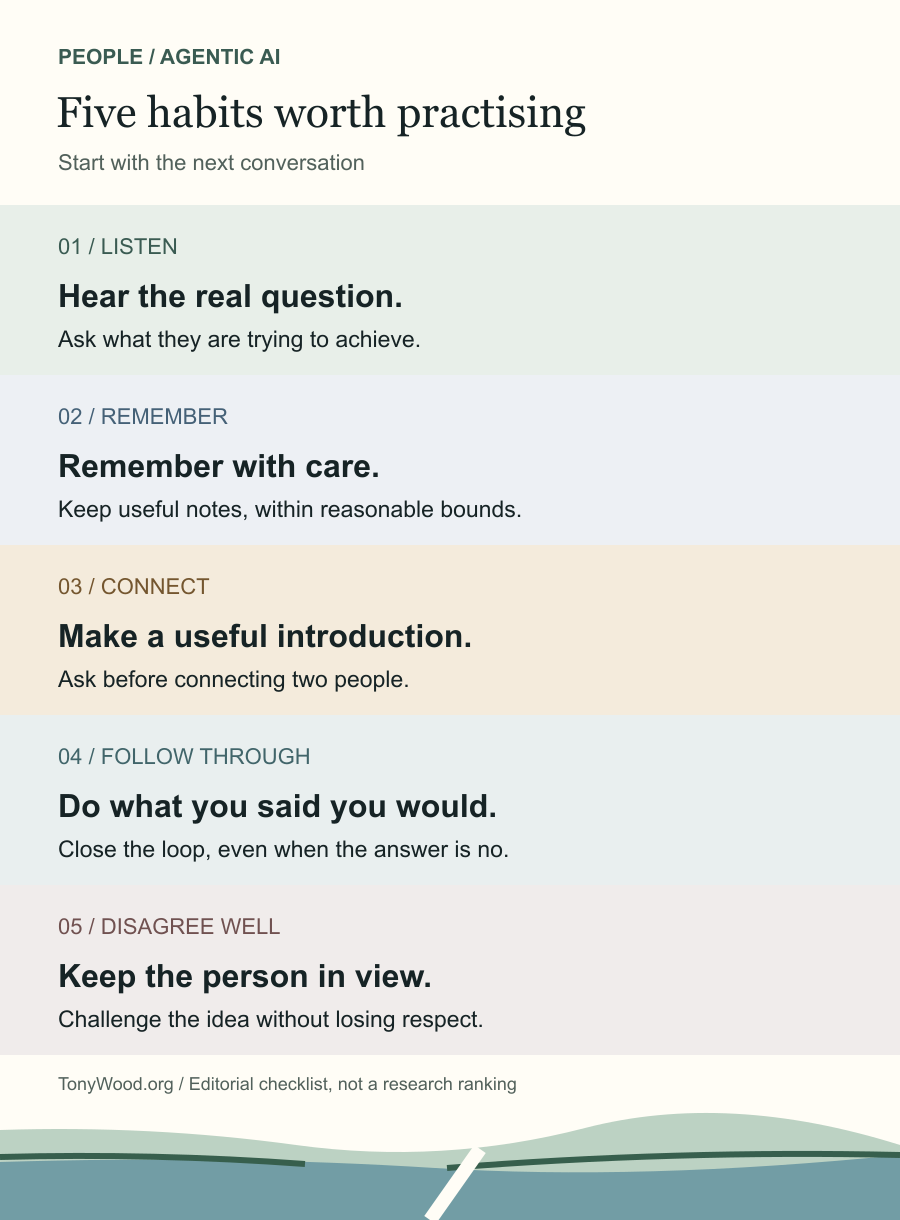
- Listen for the real question. Before offering your clever solution, ask what the person is trying to achieve, what is worrying them and what they have already tried.
- Remember with care. A brief note can help you keep a promise or remember a preference someone has shared. Keep it relevant and respect their privacy.
- Make one useful connection. Think of a person, resource or opportunity that could help with what they need. Ask before introducing people to each other.
- Close the loop. If you said you would send a document, make an introduction or check something, do it. If you cannot, say so. Reliability is wonderfully unglamorous.
- Disagree without damaging the relationship. Ask what matters to them and explain what matters to you. If you disagree about the facts, ask what evidence would change their mind and say what would change yours. You can be polite and still make clear when someone's behaviour is unacceptable.
Somebody should not have to be useful to you before you pay attention to them. These habits matter in ordinary conversations as much as they do in business.
Start with one conversation
If you feel your people skills are rusty, do not start by trying to become a different sort of person. Start small.
In your next meeting, put your phone down for ten minutes. Ask one question you want to hear the answer to. Let the answer change what you say next. If you make a promise, write it down afterwards and keep it.
You can use AI to organise the work around that conversation. Ask it to prepare you, to help you see what you missed, or to remind you to follow up. The relationship grows through what you do with that help.
We are going to need people who can work well with agents. We are also going to need people who can still work well with people.
So, yes, brush up on your AI skills. And perhaps buy someone a coffee. Then listen.
Sources and limits
This is my practical interpretation, informed by the WEF employer survey, the OECD's review of AI and skills and a meta-analysis of empathy training. They examine different populations and questions. None tests the five habits above as a package or proves that human connection is immune to technological change.
Related: Not Everybody in Your Community Is Going to Be Your Cup of Tea and When Every Agent Can Write the Proposal, Trust Wins.