I have been thinking about what happens to the proposal in an agentic age.
Give four agencies the same brief, the same public information and access to similarly capable models. Ask each of them for a clear, evidence-led proposal.
The answers will not be identical. People will still make different choices. But the competent middle is going to become very good and very crowded.
That is excellent for the buyer. It is slightly awkward for any business whose main advantage was producing a polished document faster than everybody else.
When every agent can write the proposal, the differentiator is no longer the proposal. It is why anybody should trust you.
The competent middle gets crowded
Generative AI can raise the quality of work. It can also pull people towards similar answers.
A 2024 experiment published in Science Advances found that access to AI ideas improved the judged quality of short stories, especially for less creative writers, while the AI-assisted stories became more similar to one another.
That is not proof that consultancy proposals will all become the same. It was a tightly defined creative-writing experiment using GPT-4, and the researchers were careful about its limits.
There is also evidence pointing the other way. In a different experiment involving 844 participants across 48 countries, high exposure to AI-generated ideas increased collective idea diversity, although it did not make individual ideas more creative.
So sameness is a design risk, not a law of nature.
But the commercial pressure is real. If organisations use the same public material, ask similar questions and optimise for the same acceptable answer, AI makes a strong median output cheaper and faster. Better prompting and better models can generate options. They cannot manufacture private context that was never supplied.
What remains scarce?
I think four things become more valuable as competent output becomes abundant.
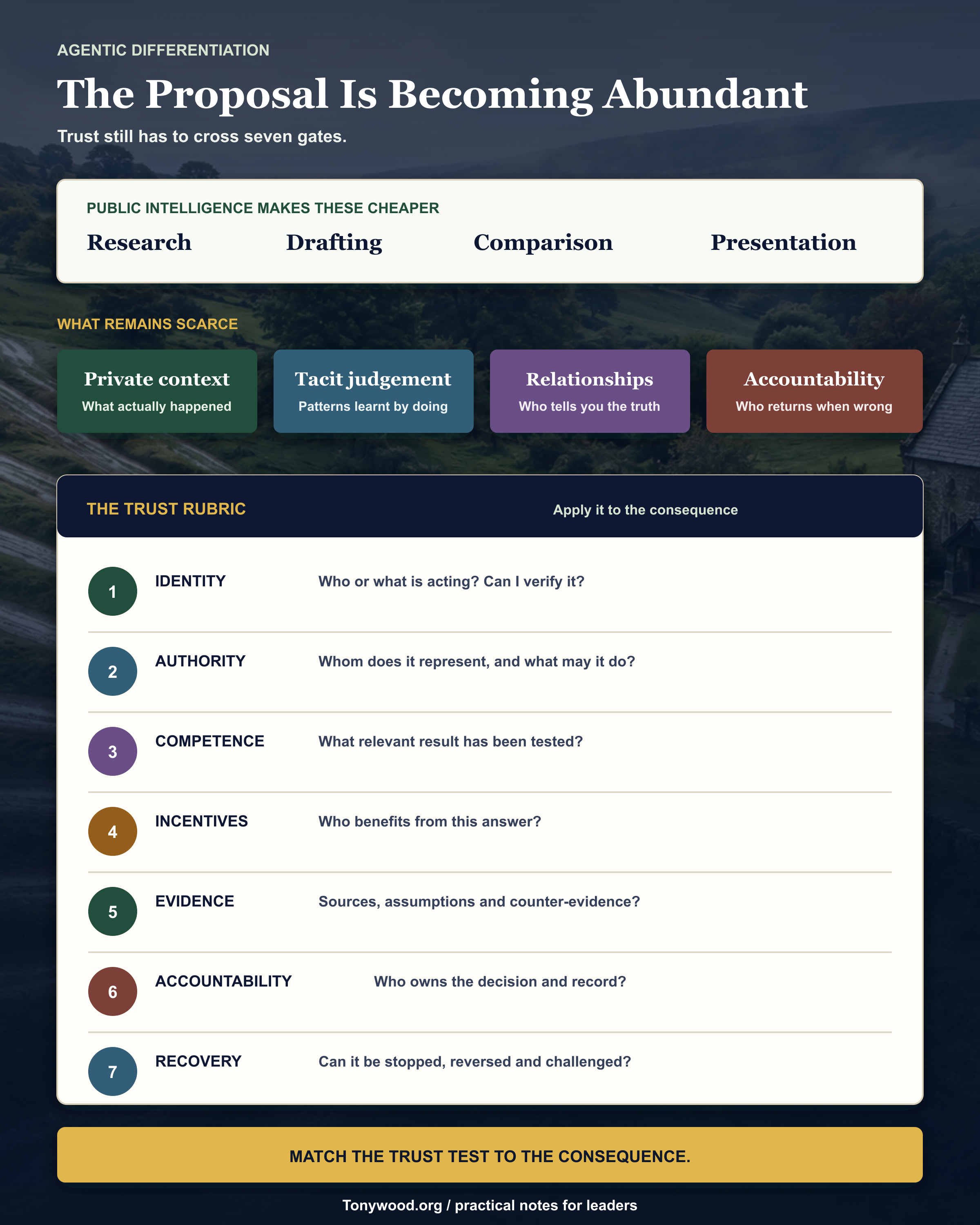
Private context. What has actually happened inside this company? Which attempt failed? Which customer promise matters? What does the formal process say, and what really happens on a wet Tuesday afternoon?
Tacit judgement. The pattern recognition built through doing the work, seeing consequences and learning which apparently sensible answer falls apart in practice.
Trusted relationships. The people who will tell you what happened after the press release, the implementation partner left and the invoice arrived.
Accountability. Somebody with a name, a reputation and a reason to come back when the advice is wrong.
This is why I do not think the future belongs simply to whoever has the biggest model. Public intelligence will become widely available. Context, judgement, relationships and earned trust remain much harder to copy.
Do not give away your professional self
There is a tempting response to this: put every experienced person's knowledge into the company system.
I would be careful.
Ikujiro Nonaka's work on organisational knowledge describes knowledge creation as a continuing dialogue between tacit and explicit knowledge. Turning some experience into checklists, examples, decision rules and training material is how a company becomes more capable.
But that does not mean uploading every confidence, client story, instinct, relationship and half-formed judgement into an unrestricted model.
I would use four drawers.
- Public knowledge: use it, organise it and let agents work hard with it.
- Company operating knowledge: encode it in approved internal systems with clear access, retention and ownership.
- Client or commercially confidential knowledge: use it only with permission, purpose limits and the minimum necessary access.
- Personal tacit judgement and relationships: augment them carefully, but keep the consequential judgement and responsibility attached to the professional.
The answer is not hoarding. A company that never converts experience into reusable knowledge keeps paying to rediscover the same lesson. The answer is classification: know what should be shared, with whom, for what purpose and with what consequence if it escapes.
Your agent may speak to their agent
I also think the sales conversation is about to change.
Why would I begin by spending an hour being sold to when my agent can examine the public offer, compare alternatives, test the numbers and prepare the questions? I may still want to speak to a person, but I will want that conversation later, when the issue is ambiguity, risk, judgement or commitment.
That future is not complete, but parts of it already exist. OpenAI's Agentic Commerce Protocol and Instant Checkout let ChatGPT act as the user's agent between buyer and merchant. The design keeps the merchant responsible for the order and requires explicit confirmation and purpose-bound payment details.
In June 2026, Visa and OpenAI described work on agent identification, authorisation, tokenisation and spending guardrails. Visa's Trusted Agent Protocol similarly focuses on helping a merchant verify that an agent is legitimate and its request has not been altered.
That does not prove that autonomous agents will run every complex B2B tender. It does show the plumbing being built for agents to discover, compare and transact on somebody else's behalf.
The Agent2Agent protocol already defines an Agent Card that can describe an agent's identity, capabilities, endpoint and authentication requirements. Useful, yes. But a card is a claim about capability. It is not evidence that the agent is competent, honest or authorised for this particular decision.
We are going to need more than agents that can talk. We need agents that can establish why they should be trusted.
This makes peer communities more valuable
If more commercial information arrives through optimised agents, I think trusted peer communities become more important.
At their best, communities such as CEO CF give leaders somewhere to ask a question without the other person needing to win the contract. A peer can tell you what worked, what did not and what they would do differently. They can give you the context that never appears in the case study.
This is not because peers are automatically right.
Research on CEOs' advice networks provides a useful warning. Michael McDonald and James Westphal found that leaders responding to poor performance could turn towards friends and similar executives, reinforcing existing judgements and inhibiting strategic change.
A trusted network can become a very comfortable echo chamber.
So the valuable peer group is not merely friendly. It has enough psychological safety for people to ask for help and discuss errors, which Amy Edmondson's research connected with team learning behaviour. It also has enough diversity and challenge to stop agreement becoming the price of belonging.
I would want no-pitch norms, declared conflicts, confidentiality, evidence where evidence exists and permission to say, "I think you are wrong."
Brand is a shortcut, not proof
Brands will matter because they compress a lot of information. We may trust a known company because it has a record, controls, insurance and something to lose.
But brand cannot be the whole rubric.
A classic model from Roger Mayer, James Davis and F. David Schoorman describes perceived trustworthiness through ability, benevolence and integrity. That maps neatly onto human relationships. It maps less neatly onto an agent, which does not have human goodwill in the ordinary sense.
For an agent, I would translate benevolence into incentives and alignment: whose interests is it designed to serve, who pays for it and what happens when those interests conflict?
The NIST AI Risk Management Framework adds useful operational qualities: validity and reliability, safety, security and resilience, accountability and transparency, explainability, privacy and fairness. It also makes the important point that trustworthiness depends on context and trade-offs.
I would not trust an agent because it calls itself trustworthy. I would ask for evidence.
My trust rubric for an agentic world
Before I rely on a person, organisation, community or agent for consequential work, I want seven questions answered.
- Identity: Who or what is acting? Can I verify it?
- Authority: Who does it represent, and what is it allowed to do with my data, money and systems?
- Competence: What relevant work has it done, and how was the result tested?
- Incentives: Who benefits from this answer? Is somebody selling, ranking or steering without saying so?
- Evidence: What sources, assumptions, provenance, confidence and disconfirming information sit behind the recommendation?
- Accountability: Who owns the decision, keeps the record and answers when it goes wrong?
- Recovery: Can I stop it, reverse it, appeal it, repair the harm and learn from the failure?
Trust is not a permanent score out of 100. I might trust an agent to compare train times and not to sign a five-year property lease. The rubric has to be applied to the consequence.
What I would do now
If I were leading a professional firm, I would begin with six practical changes.
- Classify the knowledge that differentiates us before connecting it to agents.
- Build a governed private-context layer rather than one enormous unlabelled knowledge dump.
- Make proposals show their assumptions, evidence, uncertainties and conflicts.
- Use a separate agent or reviewer to challenge the comfortable answer.
- Invest in peer relationships where candour is more valuable than selling.
- Require identity, bounded authority, audit trails and recovery routes for agents that act.
I would review that every month. Models, protocols and commercial behaviour are changing too quickly for a trust policy to be written once and forgotten.
The scarce resource is trust
AI will make it easier to start a business on your own. It will make research, drafting, analysis and the mechanics of delivery much cheaper.
But it may make it harder to differentiate on your own.
The difference will come from what you know that is relevant, who trusts you enough to tell you the truth, whether you can show your working, whether your incentives are visible and what you do when you are wrong.
An agent can write the proposal.
The real question is: who trusts it enough to act, and why?
Related reading
- Physical Communities Matter More In An Agentic World
- Not Everybody In Your Community Is Going To Be Your Cup Of Tea
- People Aren't Always Being Rude. They're Being Polite In Their Own Way.
- The Future Is Either ERP Or AI
- Will We Be Getting Skill Patents?
Sources and notes
This is a researched argument about a plausible commercial direction, not a prediction that all proposals, sales conversations or buying decisions will become agent-to-agent. Evidence about generative AI and collective diversity is mixed and task-dependent, so the article treats convergence as a risk rather than a settled universal effect.
- Science Advances: Generative AI enhances individual creativity but reduces the collective diversity of novel content
- Ashkinaze et al.: How AI ideas affect the creativity, diversity and evolution of human ideas
- Nonaka: A Dynamic Theory of Organizational Knowledge Creation
- Mayer, Davis and Schoorman: An Integrative Model of Organizational Trust
- OpenAI: Buy it in ChatGPT and the Agentic Commerce Protocol
- Visa and OpenAI: Building the future of AI commerce
- Visa: Trusted Agent Protocol documentation
- Agent2Agent protocol specification
- NIST: Artificial Intelligence Risk Management Framework 1.0
- Edmondson: Psychological Safety and Learning Behavior in Work Teams
- McDonald and Westphal: CEOs' advice networks and strategic responses