How do you work with demanding leaders?
I think the first thing to understand is that people at the top of organisations are paid to have opinions.
They are paid to make decisions, often quickly and sometimes without anything close to perfect information. If a chief executive responds to every difficult question with, "I have absolutely no idea", they are unlikely to remain chief executive for very long.
So demanding leaders tend to have a view. They may state it with enormous confidence. They may test everything you say. They may find one imperfection and immediately wonder whether the rest of the work is wrong.
And when those leaders come from different countries, organisations and professional cultures, the same sentence can mean completely different things.
A British leader may soften a criticism so thoroughly that the other person does not realise there was a criticism. Another European leader may believe the respectful thing is to tell you exactly what is wrong, immediately and without wrapping it in a small blanket.
I am British. I need a little sugar in my tea. If you are very direct with me, I may become extremely polite. At that point we can spend twenty minutes sounding delightful while achieving almost nothing.
People are not always being rude. Sometimes they are being polite in their own way.
But sometimes they really are being rude. The useful skill is learning how to tell the difference.
Confidence is part of the uniform
Leadership creates an awkward incentive.
People want leaders to be decisive. Research on executive confidence finds that confidence can affect how leadership capability is perceived. But confidence is not the same as competence, and decisiveness is not the same as decision quality.
A multidisciplinary review of executive confidence found that the research itself often mixes different things together: confidence in capability, overestimating outcomes, overprecision and confidence relative to others. A leader can be confident in one domain and badly calibrated in another.
There is also a reputational problem with uncertainty. Experiments reported in When Leaders Disclose Uncertainty found that leaders were judged more competent when uncertainty was framed externally - "the situation is uncertain" - rather than internally - "I am uncertain".
That does not mean leaders should pretend. It means the job rewards a particular performance of certainty.
When you work with a demanding leader, it helps to hear the opinion without automatically treating the confidence around it as additional evidence.
Demanding is not one personality type
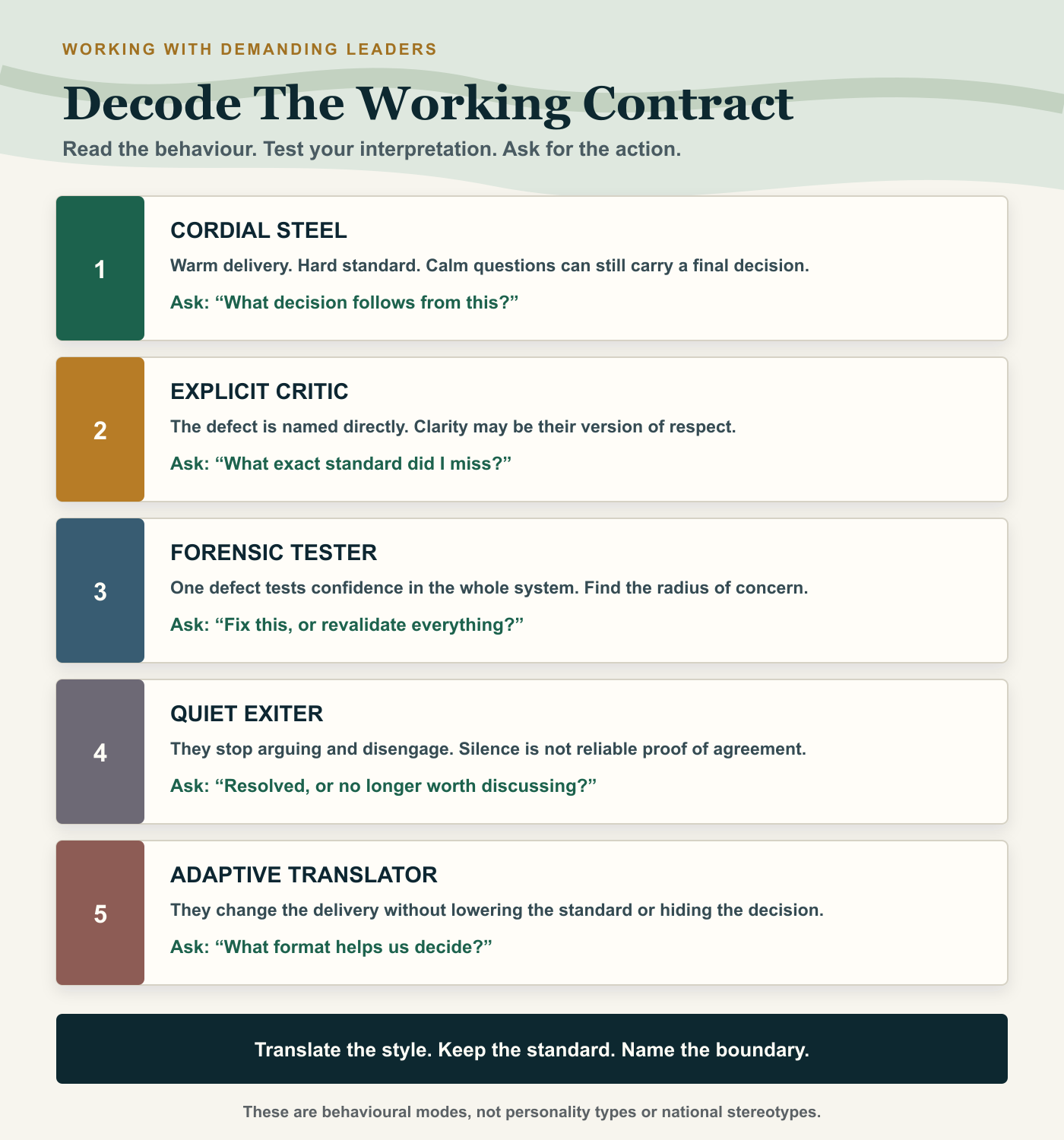
I have noticed several working modes. They are behaviours, not diagnoses. The same person may switch between them depending on pressure, subject and audience.
The cordial steel. Friendly, polite and often extremely smart. They ask calm questions, remember the answer and make ruthless business decisions without needing to raise their voice. Do not confuse warmth with a lack of standards.
The explicit critic. They tell you what is wrong as soon as they see it. They may believe that clarity is respectful because it saves time and gives you a fair chance to fix the issue. To an indirect communicator, it can sound like a personal attack.
The forensic tester. One defect changes their view of the whole system. Sometimes this is sensible. In security, finance or safety-critical work, a small failure can reveal a weak control. Sometimes it is an overreaction. The answer is to ask whether they want the single issue corrected or the whole evidence base revalidated.
The quiet exiter. They do not argue. They do not complain. They simply stop engaging, change supplier, leave the community or move the work somewhere else. Silence is not always satisfaction.
The adaptive translator. The best leaders I know change their delivery without changing the standard. They can be direct with somebody who values directness, slower with somebody who needs context and clear with everybody about the decision.
There are more modes than these. The point is not to put leaders into boxes. The point is to stop interpreting every difficult interaction through your own preferred style.
Silence is a decision too
The quiet exiter is particularly easy to miss.
A major review of employee voice and silence makes an important distinction: silence can come from fear, resignation, calculation or a belief that speaking will make no difference. It is not a single behaviour with a single motive.
A systematic review covering 92 studies similarly found that organisational silence has many antecedents and forms. More recent research found that dialogic communication from leaders was associated with less defensive and acquiescent silence, with psychological safety and empowerment helping explain the relationship.
So if a demanding leader suddenly goes quiet, do not celebrate too early.
Ask: "Have we resolved this, or have you decided it is no longer worth discussing?"
There is no European communication style
This is where we need to be careful.
Europe is not one culture. The GLOBE research programme measured cultural practices and leadership expectations across countries and clusters. Its European work found meaningful differences and concluded that it was hardly possible to speak of one European culture or one European management style.
The later GLOBE CEO study, involving more than 1,000 CEOs and 5,000 senior executives across 24 countries, found that cultural expectations influence which leadership behaviours people see as effective. Importantly, values did not mechanically predict each leader's behaviour.
That last sentence matters. A country is context, not a personality test.
Company culture, profession, generation, language confidence, hierarchy, personal history and the pressure of the moment may matter as much as nationality.
Still, broad patterns can help us form a starting question, provided we are willing to discard the pattern as soon as the person in front of us gives better evidence.
A rough European decoder
This is deliberately a rough map. It is not permission to say, "You are Dutch, therefore you will behave like this." It is a set of hypotheses to test.
| Starting context | What respect may sound like | Common misreading | Useful question |
|---|---|---|---|
| UK and some Anglo settings | Hedging, understatement, diplomacy and leaving the other person room. | A softened no is heard as a maybe. Politeness is read as weakness or politics. | "Is that a concern, a request or a decision?" |
| Germanic and Dutch settings | Precision, explicit disagreement, clear ownership and separating the task from the person. | Clarity is heard as hostility; British cushioning is heard as vagueness. | "What exact standard have I missed?" |
| Nordic settings | Concise language, informality, consultation and relatively low status display. | Quiet consideration is treated as agreement; informality is mistaken for an absent decision. | "Who decides after consultation, and when?" |
| Latin European settings | Relationship, intellectual debate, expressive involvement or greater formality, depending on context. | Energy is heard as aggression, or relational work is dismissed as avoiding the task. | "Are we debating options, or has a decision been made?" |
| Central and Eastern European settings | Practical clarity, formality around status, or more direct requests in some languages and organisations. | Direct form is treated as bad intent; indirect English is treated as evasive. | "What would a clear and respectful answer sound like to you?" |
The linguistic evidence is more nuanced than the stereotypes. A study comparing English, German, Polish and Russian requests found both cross-cultural differences and substantial agreement around conventional indirectness in the tested scenario. Politeness is negotiated in particular settings; it is not a national switch marked direct or indirect.
Use the table to open a conversation. Never use it to close one.
Build a translation contract
The best way to work with demanding leaders is not to become an amateur anthropologist during every meeting. Agree the working contract before the pressure arrives.
I would ask six questions.
- How do you want bad news delivered? Headline first, evidence first or options first?
- When do you want a recommendation? Do you want me to decide, propose or simply present the facts?
- What does good enough mean here? Which defects are irritating and which invalidate the work?
- How should I challenge you? In the room, privately afterwards or with written evidence?
- How will I know a decision is final? Discussion can sound like instruction and instruction can sound like discussion.
- What does silence mean? Continue, stop, wait or assume the answer is no?
Then leave a short receipt: the decision, the owner, the standard, the date and what remains uncertain.
That may feel very procedural for a human relationship. It is much less procedural than repairing three weeks of work built from a British "that is quite interesting" which everybody else mistook for approval.
How to respond in the moment
When a demanding leader challenges the work, I try to do five things.
Give the outcome first. "The release is late by one day. The cause is known. No customer data is at risk." Let them orient before you provide the history.
Separate fact, interpretation and decision. "The test failed" is a fact. "The system is unreliable" is an interpretation. "Rebuild the entire service" is a decision.
Ask about the radius. "Do you want this defect fixed, or do you want the whole system revalidated?" Do not make either assumption silently.
Play the instruction back. "I have heard that you want X by Friday, with Y left untouched. Is that correct?" Direct leaders normally appreciate precise confirmation.
Name the communication problem without diagnosing the person. "I can work with direct feedback. I cannot work out which action you want from what you have just said." That is more useful than "you are rude".
Culture explains style. It does not excuse harm.
This article is not an excuse for shouting, humiliation, threats or discrimination.
The research on abusive supervision is messy in places because people's judgements and leaders' behaviours can be conflated. A critical systematic review in The Leadership Quarterly warns against careless labels. That is another reason to name observable conduct rather than diagnosing a difficult leader from a distance.
Say what happened.
"You interrupted me six times." "You raised your voice." "You changed the acceptance standard after delivery." "You criticised me personally rather than describing the defect."
Then state the condition for continuing.
"I will stay in this conversation if we discuss the work rather than my character."
Directness can be respectful. Diplomacy can be manipulative. Silence can be thoughtful. Silence can also be exit.
Do not judge the style alone. Look at whether the person makes the work clearer, keeps the standard stable, allows challenge, protects dignity and repairs the relationship when they get it wrong.
Put a little sugar in the tea
I do not want demanding leaders to stop being demanding.
I want the cordial leader to make the decision visible. I want the explicit critic to make the required action clear. I want the quiet exiter to tell me before they disappear. And I want the British among us, including me, to stop hiding an important no inside six layers of lovely language.
Working across cultures requires translation in both directions.
If somebody's directness is useful, I can learn to hear it. If my diplomacy is hiding the decision, I can learn to make it clearer. We do not have to become the same. We do have to make the work understandable.
People are not always being rude. They may be being polite in their own way.
But even when the tea is strong, we can all learn to put in just enough sugar for the other person to drink it.
Sources and notes
This article uses broad cultural patterns as prompts for clarification, not predictions about individuals. Europe contains substantial variation within countries, organisations, professions and people. The five leadership modes and translation contract are Tonywood.org editorial models, not validated personality assessments.
- GLOBE Project: 2004 and 2007 studies
- GLOBE Project: 2014 CEO study
- National culture and leadership profiles in Europe
- Politeness and indirectness across English, German, Polish and Russian requests
- Executive confidence: multidisciplinary review
- When leaders disclose uncertainty
- Employee voice and silence: taking stock a decade later
- Employee silence in an organisational context
- Breaking employee silence through dialogic communication
- Abusive supervision: systematic review and rethink
- Acas: Challenging conversations and how to manage them