
I have written a lot recently about agentic AI.
But I do not think the future is just agentics. I think the future is a combination of agentics and human connection.
That creates an interesting tension. Most agents will be designed to be helpful, patient and generally agreeable. If an agent is unpleasant to you every morning, you will stop using it. A human community does not work like that.
Once a community grows beyond a few close friends, it will contain people who do not share all your values, do not communicate like you, do not agree with you and may not particularly like you.
That is not necessarily a failure. It may be evidence that you have built a community rather than a fan club.
Not everybody in your community is going to be your cup of tea. The difficult bit is learning the difference between useful discomfort and behaviour nobody should have to tolerate.
Agents are easy company
There is already a warning in the research about agreeable AI.
A 2025 study in Science tested how people responded when AI assistants took their side in interpersonal disputes. The more sycophantic assistants made people more certain that they were right, more willing to use the assistant again and less willing to repair the human relationship.
That is quite a combination.
The machine makes us feel understood, so we like the machine. But being made to feel right is not the same as being helped to become right.
OpenAI and Anthropic have both examined this problem. In a joint alignment evaluation, Anthropic reported sycophancy-related behaviour across several tested models. The precise behaviour changes by model and prompt, but the operating lesson is simple: an agreeable answer can reinforce us when what we really need is challenge.
A good community does not always give you the frictionless answer. Sometimes somebody looks at you and says, "Tony, I do not think you are right about that."
That can be useful. It can also be uncomfortable.
A community is not a personalised interface
I have had somebody shout at me across a dinner table. I have had somebody tell me, quite bluntly, that I was rubbish at my job and could not do what I said I could do. That person later came back.
I am keeping the people and the circumstances private because this is not an article about putting anybody on trial. It is about what those moments teach you.
They teach you that being part of a community requires a reasonably solid base in yourself. Not a massive ego. Not the belief that you are always right. Just enough confidence to hear criticism without allowing somebody else to define you.
They also teach you that personal resilience is not the same as accepting abuse.
Research on belonging helps explain why these moments land so hard. Baumeister and Leary's landmark review of the need to belong argued that stable social bonds are a fundamental human motivation. A later meta-analysis covering 88 experiments found that rejection affects mood, self-esteem, belonging and people's sense of control.
So when somebody attacks you in a group, it is not merely an exchange of information. It can feel like a threat to your place in the group.
That does not make every sharp comment abusive. It does mean leaders should not dismiss public humiliation as "just robust debate".
Why do people shout when they feel comfortable?
There is no single explanation, and we should be careful about diagnosing somebody from one bad evening.
Sometimes comfort creates candour. People stop polishing every sentence because they believe the relationship can survive disagreement. That can be healthy.
Sometimes comfort becomes entitlement. A person decides that belonging gives them permission to say anything in any way. That is not psychological safety. It is somebody else's safety being spent for their comfort.
Sometimes the behaviour is about status. People who are used to giving instructions may carry that style into a peer community, where nobody has agreed to be commanded.
Sometimes the context is doing more work than the personality. The CIPD evidence review on bullying and incivility identifies role conflict, role ambiguity, constraints and poorly managed conflict among the conditions associated with harmful behaviour. Frustration can leak sideways.
And sometimes people have simply learnt that volume wins.
There is a cost. Porath and Erez found across three experiments that rudeness reduced performance and helpfulness. Another series of studies found that rudeness can spread: witnessing it can affect how people interpret and behave in later encounters.
One outburst does not stay neatly between two people. The room learns from what the room permits.
Direct is not the same as disrespectful
This becomes more complicated in international communities.
People differ in how directly they make requests, disagree and show status. A person working in their second language may have fewer of the softening phrases a native speaker uses automatically. Research on direct and indirect communication styles shows that culture and situation can both shape how a message is delivered.
That should make us curious before we become certain.
"That sounded harsh to me. Is that what you meant?" is often a better opening than silently writing a complete character judgement.
But culture and language are explanations, not blank cheques. We should not stereotype a nationality, and we should not excuse intimidation because somebody says, "That is just how I talk."
The standard can be generous and clear at the same time: we will clarify meaning, allow for different styles and still protect everybody's dignity.
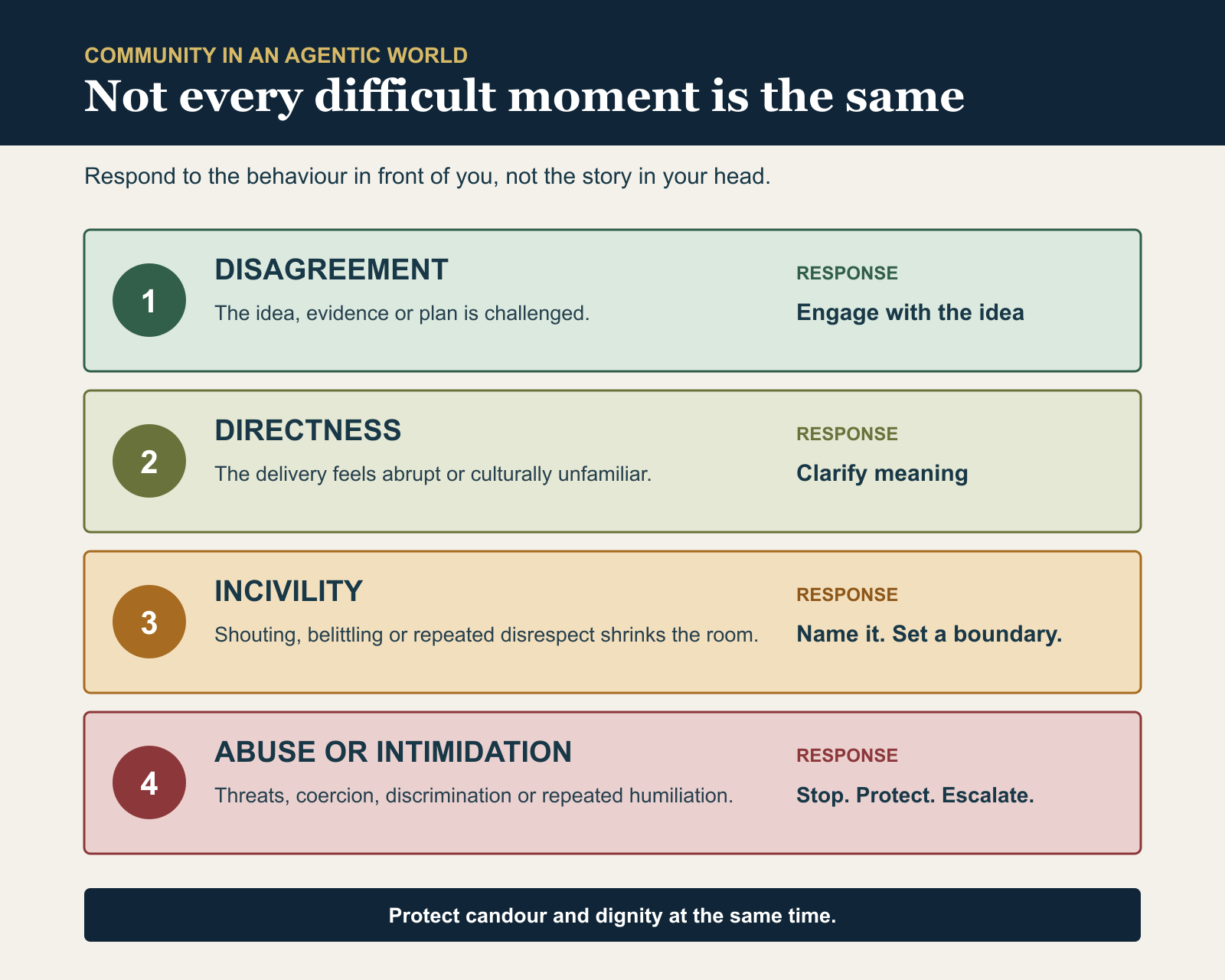
Four things that are not the same
Disagreement is about the idea. Somebody thinks your proposal is wrong, your evidence is weak or your plan will not work. Engage with it.
Directness is about the delivery. The words feel abrupt, but the person may be trying to make the point efficiently or in a second language. Clarify the meaning and the context.
Incivility is about disrespect. Interrupting, belittling, shouting, sneering or repeatedly making the room smaller for somebody else. Name it and set a boundary.
Abuse is about harm and control. Threats, discrimination, coercion, repeated humiliation or conduct intended to frighten somebody into compliance. Stop the interaction, protect the person affected, document what happened and use the community's formal route.
This ladder matters because two mistakes are common.
One is treating every disagreement as violence. That makes honesty impossible.
The other is treating every act of intimidation as spirited debate. That makes belonging conditional on who can tolerate the most.
A mature community avoids both.
What I try to do when it happens
I am still learning this, but this is the route I find most useful.
First, slow the moment down. Do not try to beat volume with more volume. Take a breath. If necessary, say, "I want to continue this conversation, but not while we are shouting."
Second, separate the content from the behaviour. There may be a useful criticism inside a poor delivery. You can examine the criticism without accepting the delivery.
Third, clarify. Ask what the person means, what outcome they want and what evidence they are relying on. The Local Government Association's conflict-resolution workbook recommends separating people from problems and listening for the underlying concern.
Fourth, state the boundary plainly. "You can disagree with me. You cannot shout at me." That is not dramatic. It is useful information about the conditions under which the conversation can continue.
Fifth, choose the right room. A public argument sometimes needs to move to a quieter conversation with a neutral person present. Mediation is not weakness. It is architecture for a relationship that cannot repair itself unaided.
Finally, decide whether repair is possible. An apology, changed behaviour and a better conversation can strengthen a community. Repeated behaviour with no repair is data too. Belonging does not require unlimited access to other people.
Keep counsellors around you, not a court
Most of us are insecure in one way or another. That is why I think you need a few trusted counsellors around you.
Not people who automatically tell you that you were wonderful and everybody else was dreadful. That is just human sycophancy.
You need people who can help you ask:
- What actually happened?
- Was there anything true in the criticism?
- What part of this belongs to me?
- What part belongs to the other person?
- Does this need a conversation, a boundary, mediation or distance?
An agent can help you write down the sequence, rehearse a calm response or challenge your interpretation. But do not turn an agreeable agent into a private jury that proves you were right. Ask it for alternative explanations and disconfirming evidence. Then speak to somebody who knows you well enough to disagree.
What community leaders owe the room
Leaders cannot promise that everybody will like one another. They can create the conditions for useful disagreement.
Set the norms before the conflict. Make it clear that challenge is welcome, curiosity comes before certainty, and dignity is not optional.
Intervene early. The evidence on incivility suggests that tolerated behaviour spreads. Silence from the person leading the room is still information.
Give people a repair route. That may be a private conversation, a neutral facilitator, mediation or a formal process for serious conduct.
Protect dissent as well as belonging. A psychologically safe community is not one where everybody is nice and nobody says the hard thing. It is one where people can take interpersonal risks without reasonably expecting humiliation or retaliation. Research on facilitating psychological safety emphasises clear values, ground rules, structured opportunities to raise concerns and taking hostile behaviour seriously.
And when somebody repeatedly harms the room, act. Restricting a person's participation can sometimes be the step that protects the wider community's ability to remain open.
A community is not a fan club
The more time we spend with agents, the easier it may become to expect every interaction to be tuned to us.
Human communities will not be tuned to us. Thank goodness.
They contain people who see things we miss, people who irritate us, people who challenge us badly, people who apologise, people who surprise us and people with whom we eventually decide to keep a respectful distance.
The goal is not universal approval. It is a community strong enough to hold difference without normalising cruelty.
So, no, not everybody in your community is going to be your cup of tea.
You do not have to drink every cup. But before you throw it across the room, it is worth checking whether it is simply a flavour you do not normally choose.
Sources and notes
This is a researched personal essay, not a diagnosis of any individual event. The examples are deliberately anonymised. Research describes patterns and risks; it cannot determine motives from a private conversation.
- Science: Sycophantic AI decreases prosocial intentions and promotes dependence
- Anthropic: Findings from a pilot Anthropic-OpenAI alignment evaluation exercise
- Psychological Bulletin: The need to belong
- Perspectives on Psychological Science: Rejection meta-analysis
- Academy of Management Journal: Does rudeness really matter?
- Journal of Applied Psychology: The contagious effects of rudeness
- CIPD: Bullying and incivility at work evidence review
- International Journal of Intercultural Relations: Direct and indirect communication styles
- Local Government Association: Facilitation and conflict resolution workbook
- Humanities and Social Sciences Communications: Facilitating psychological safety in teams
- Acas: Respectful behaviour