If agents make digital work easier, why would physical community matter more?
I think it matters more because the scarce thing is not going to be access to information. The scarce thing is going to be trust.
Agents can help us remember, research, summarise, match people, organise meetings, follow up, and keep the threads alive between conversations. That is wonderful. I want that. But there are some things that still need the room.
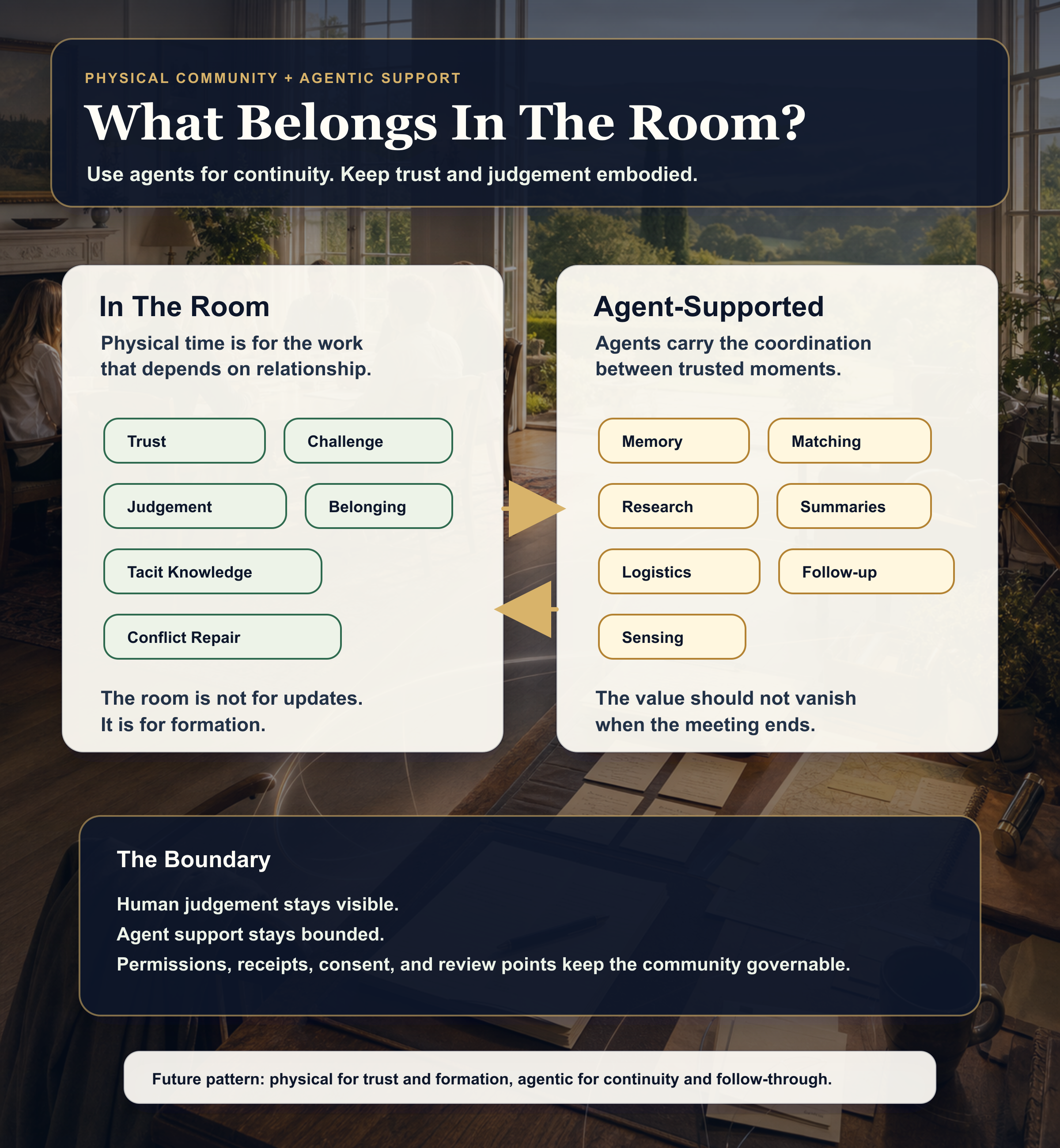
Trust needs the room. Challenge needs the room. Belonging needs the room. Tacit knowledge needs the room. Difficult judgement often needs the room.
So I do not think the future is physical versus digital. I think the future is knowing which work belongs in the room, and which work can be carried by agents around the room.
The obvious answer is wrong
The obvious answer is to say that if agents can do more digital work, we will need fewer physical communities.
I think that is wrong.
Remote tools extend reach. Hybrid formats make participation easier for people with distance, cost, disability, care responsibilities, or heavy diaries. Digital continuity matters. I am not arguing for some lazy return-to-office slogan dressed up as community.
But the evidence is fairly clear that physical presence still does something that video and asynchronous tools struggle to do.
Research in Nature found that virtual communication can narrow cognitive focus and reduce creative idea generation. A Nature Human Behaviour study of Microsoft employees found that remote work made collaboration networks more static and siloed. At the same time, a later Nature study on hybrid working found improved retention without damaging performance.
That is the interesting bit.
The answer is not "everyone in the office" or "everything remote". The answer is design. Use the right medium for the right work.
What belongs in the room
Some work is mostly information transfer. A document, a briefing, a reminder, a summary, a route through a problem. Agents can help enormously with that.
Some work is social formation. You need to read the room. You need to hear the hesitation in someone's voice. You need to notice who has gone quiet. You need to challenge an assumption and still be in relationship afterwards.
That work is different.
This is why physical communities matter. A good physical community gives people a place to be known, challenged, encouraged, corrected, and formed over time.
That matters even more when agents are accelerating everything around us. Speed without trust is dangerous. Speed without judgement is brittle. Speed without belonging can become lonely.
What agents should carry
Agents are brilliant at the work around community.
They can help people find the right material before a meeting. They can remember what was agreed last time. They can spot patterns across conversations. They can prepare summaries, chase actions, match members, suggest introductions, organise logistics, and keep knowledge from evaporating after everyone leaves the room.
That is not small. Most communities lose enormous value between meetings. Someone says something useful. A connection is made. A possible action appears. Then everyone goes back to normal life and half of it disappears.
Agentic tools can help with that. They can carry continuity.
But I would give them bounded jobs. Memory, matching, research, summaries, logistics, follow-through, sensing. I would not quietly hand them judgement over who belongs, who is trusted, whose voice matters, or what a community should become.
Those are human questions.
CEO CF and the lonely CEO
This is why the CEO CF example is so interesting to me.
Being a CEO can be lonely. You can have lots of people around you and still have very few places where you can say the thing you are actually worried about. You may not want to say it to the board yet. You may not want to say it to your team. You may not know whether it is strategy, fear, ego, exhaustion, or genuine risk.
A trusted peer group gives you somewhere to test that.
Here I mean CEO CF: the CEO peer community built around CEOs and senior leaders learning from one another in trusted rooms. Its public model includes summits, small Trust Groups, peer learning, challenge, calls, and ongoing digital channels.
That blend matters. The summit gives energy and relationship. The small group gives candour. The digital layer gives continuity.
That is the community pattern I am interested in. Not a broadcast audience. Not a networking list. A place where leaders can bring real questions, hear challenge from people who understand the weight of the role, and build enough trust for useful honesty.
In an agentic world, I think that pattern becomes even more valuable.
An agent can brief you before the Trust Group. It can remind you what you said three months ago. It can help you prepare your challenge clearly. It can track the actions afterwards. But the moment where someone looks at you and says, "I do not think you are being honest with yourself here", that belongs in the trusted room.
That is not inefficiency. That is the point.
Communities of practice still matter
Wenger-Trayner's work on communities of practice is helpful here. A real community of practice is not just a mailing list. It has a shared domain, a community of people who interact, and a practice that develops over time.
That is a good test.
If your community is only content distribution, agents will probably eat most of the value. People do not need to travel to be broadcast at. They can get a better summary from an agent.
But if your community is about practice, formation, judgement, identity, trust, and challenge, agents do not replace it. They support it.
They make it easier to prepare. They make it easier to remember. They make it easier to follow through. They may even help include people who could not otherwise attend.
But they do not become the community.
The leadership job changes
Leading a physical community in an agentic world is not just booking a room and sending a calendar invite.
It is designing the social operating system.
What is the purpose of the community? What belongs in the room? What can happen asynchronously? What can an agent support? What must stay human? What needs consent? What needs confidentiality? What should be remembered? What should be forgotten? What should be measured?
That is leadership.
And it is not soft. It is architecture.
The NIST AI Risk Management Framework is useful here because it reminds us that risk has to be governed, mapped, measured, and managed. In community work, that means agents should have boundaries, permissions, review points, receipts, and escalation routes.
You do not just add an agent to a community and hope the culture absorbs it.
A simple model
If I were leading a physical community in an agentic world, I would start with five rules.
Convene the humans. Use physical time for trust, challenge, belonging, conflict repair, and difficult judgement.
Give agents bounded jobs. Let them help with memory, matching, research, summaries, logistics, follow-through, and sensing.
Keep judgement visible. If something affects people, trust, membership, opportunity, money, reputation, or dignity, humans should know where the decision is being made.
Use digital tools for continuity. The value of a community should not vanish when the meeting ends.
Measure what matters. Not just attendance. Measure trust, belonging, participation, inclusion, action, resilience, and whether members are actually becoming more capable.
The future is not less human
I think this is the optimistic version of agentic work.
Agents should remove the friction around human connection, not replace the connection itself.
They should help us prepare better, remember better, follow through better, and include more people. They should make the human room more valuable because the room is no longer wasted on admin, status updates, and half-remembered actions.
The room can be used for what the room is good at.
Trust. Challenge. Judgement. Belonging. Formation.
That is why I think physical communities matter more in an agentic world.
Sources and notes
This article draws on research about virtual communication and creativity, remote work and collaboration networks, hybrid working, communities of practice, community leadership, and AI risk governance. It also uses public information from CEO CF.
- Nature: Virtual communication curbs creative idea generation
- Nature Human Behaviour: Remote work and collaboration among Microsoft employees
- Nature: Hybrid working improves retention without damaging performance
- Wenger-Trayner: Introduction to communities of practice
- CFLeads: Five competencies for community leadership
- NIST AI Risk Management Framework
- CEO CF about page, nextGen, and CEO CF Academy