I joined CEO CF in the autumn of 2010. Over roughly 16 years, I have attended almost every community meeting, worked at Powered by CEO CF events and spent ten years as a Group Chair. I have learned as a member, a facilitator and a chair. That is the experience behind what I am saying.
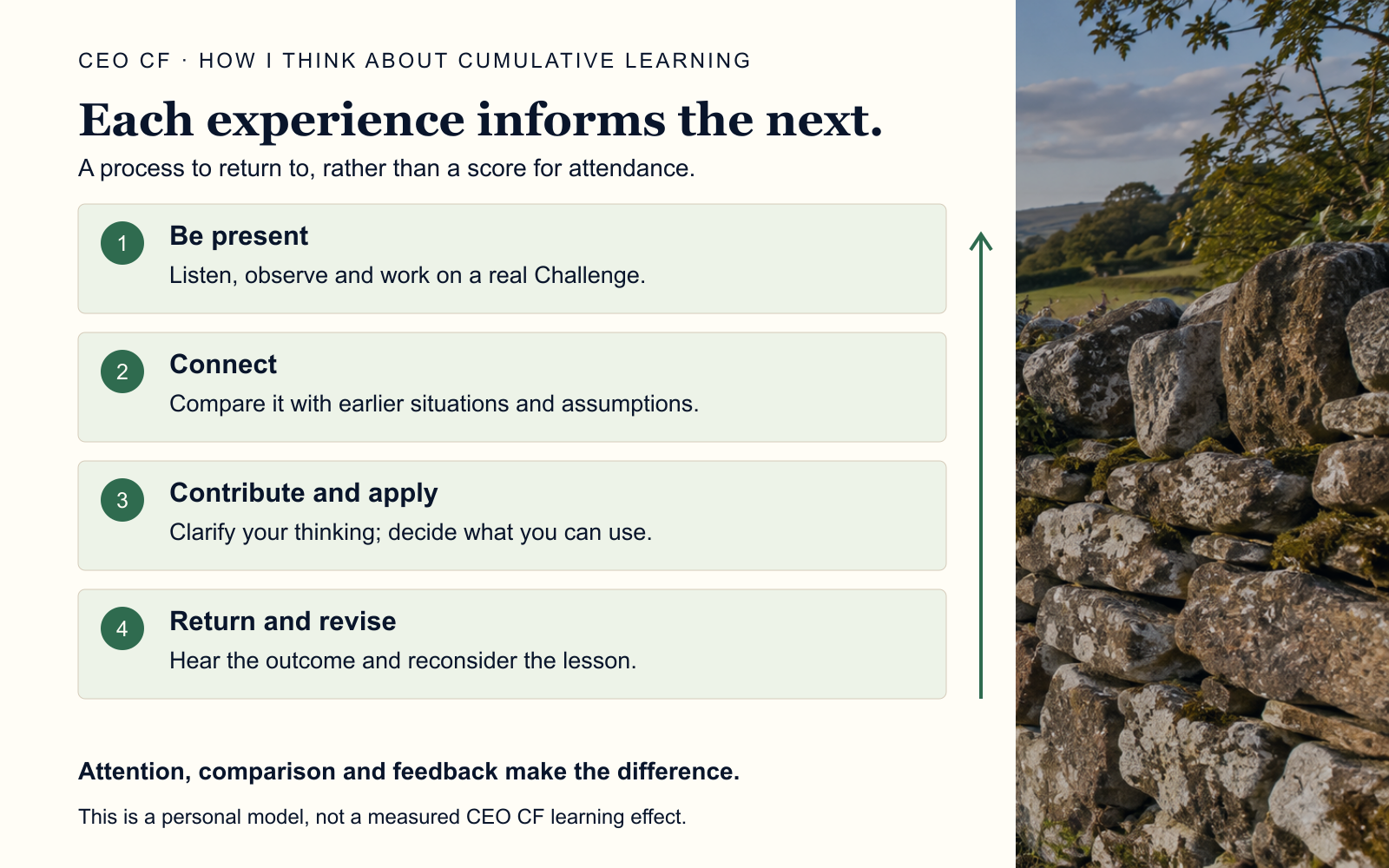
I have noticed something over those years: the learning is cumulative. Each Challenge adds to the experience I bring into the next one.
A question somebody asks today can bring back a conversation from years ago. A Challenge in one industry can help me understand something happening in another. A recommendation I have heard before can mean more because I now have an experience to connect it to.
That is what I mean when I say the learning is cumulative. I arrive at the next summit carrying something from the previous ones. The new experience adds to it, and sometimes changes how I understand what I already thought I knew.
For me, being there in person is an important part of that.
I was in the room
You can read a lot. You can ask a consultant. You can buy a service. But in my experience, it is very difficult to get completely honest feedback or an independent opinion from people you pay, or people who pay you. The financial relationship can shape what people feel able to say.
You can get that honesty from your peers. When you are in the room together, sharing the real situation and working on it through pure peer collaboration, that is when the magic happens.
Being in a CEO Challenge asks something different of me. There is a person in front of me trying to explain a situation they are living with. I hear their voice. I see their expression. I notice when a question makes them pause, or when they have to think again about the way they have described the problem.
The experience has a place around it. There is the room, the light, the sound of people moving, the conversation over coffee afterwards. Even the smell of the coffee belongs to that moment. I have travelled there, put time aside and taken part.
When I recall a Challenge, I can find myself remembering the person and the conversation as well as the point they made. The idea has somewhere to belong.
Research gives some support to this way of thinking, with limits. Smith and Vela’s review of context-dependent memory found that the environment can influence recall, although the effect depends on the task and the other cues available. Shams and Seitz’s review of multisensory learning discusses benefits from relevant combinations of sensory information in the tasks studied.
Neither paper establishes that a physical CEO meeting produces better learning than an online one. I would not claim that seeing, hearing and smelling something guarantees that I will remember it. What I recognise in my own experience is that a useful idea can be attached to a whole event, with several ways back into the memory.
Some of the learning comes from doing the thinking
There is work to do while another leader presents. I need to understand their question before deciding what I can contribute. What are they trying to achieve? What is making it difficult? Am I recognising something useful, or jumping too quickly to a familiar answer?
I listen to the questions from other people. They often notice something I have missed. Then I have to think about my own observation or recommendation, write it down and make it clear enough to be useful.
When I read it out and see it captured on the screen, I can check whether it says what I meant. Somebody else may build on the point, disagree with it or put it in a different context. I am working on an idea while other people are working on it too.
That is one reason these conversations stay with me. I have had to participate in making sense of the situation. The learning has involved attention, judgement and sometimes the discomfort of discovering that my first reaction was incomplete.
I have written separately about why I want to keep that thinking in the Challenge process. Here, I am interested in what happens when you repeat it over years.
How I worked it out
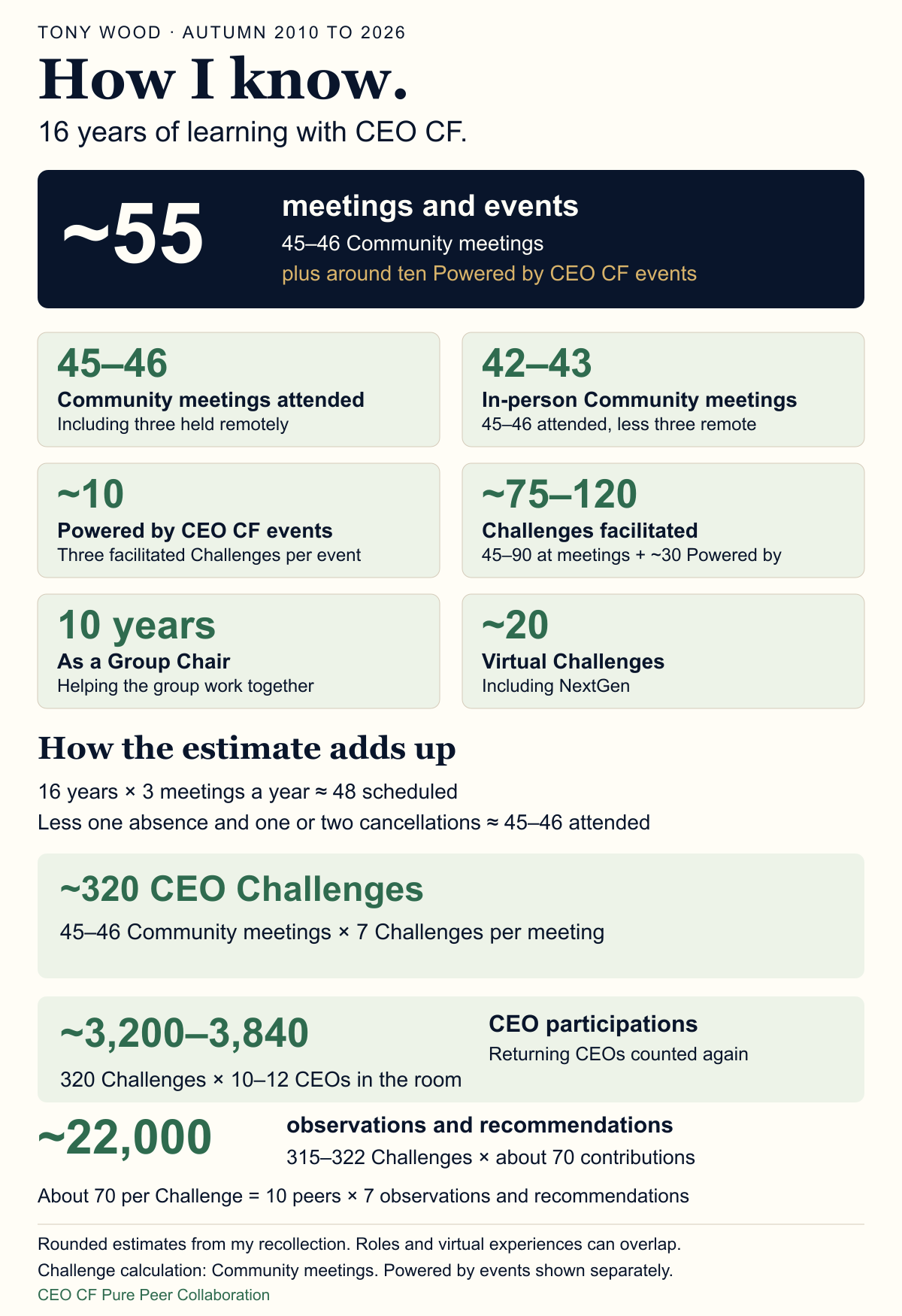
Three community meetings a year over roughly 16 years gives about 48 scheduled meetings. Allowing for the one I missed and one or two pandemic cancellations, I put my attendance at around 45–46, including three we held remotely.
Add the roughly ten Powered by CEO CF events I have worked at, and that is about 55 meetings and events. I also estimate that I have worked through around 20 virtual Challenges, including NextGen. Those virtual experiences can overlap with the remote community meetings.
At an average of seven Challenges per community meeting, that suggests around 320 CEO Challenges. With roughly ten CEOs and leaders contributing about seven observations and recommendations each, a single Challenge brings together around 70 contributions.
With 10–12 CEOs in the room for each of those Challenges, that is around 3,200–3,840 CEO participations: 320 Challenges × 10–12 CEOs. Many of the same people return, bringing their experience into another conversation. That is thousands of opportunities to hear how other leaders think and to work through a decision together.
The simple calculation is 45–46 community meetings × 7 Challenges × 70 observations and recommendations: around 22,000 contributions. That is the community-meeting estimate alone, with many of the same leaders returning.
What the estimate helps me see is the amount of time I have spent considering other leaders’ situations. Each contains a business context, a decision, several possible ways forward and a person who has to live with the consequences.
Across that many conversations, the opportunities to make connections begin to add up.
What that could add up to across the community
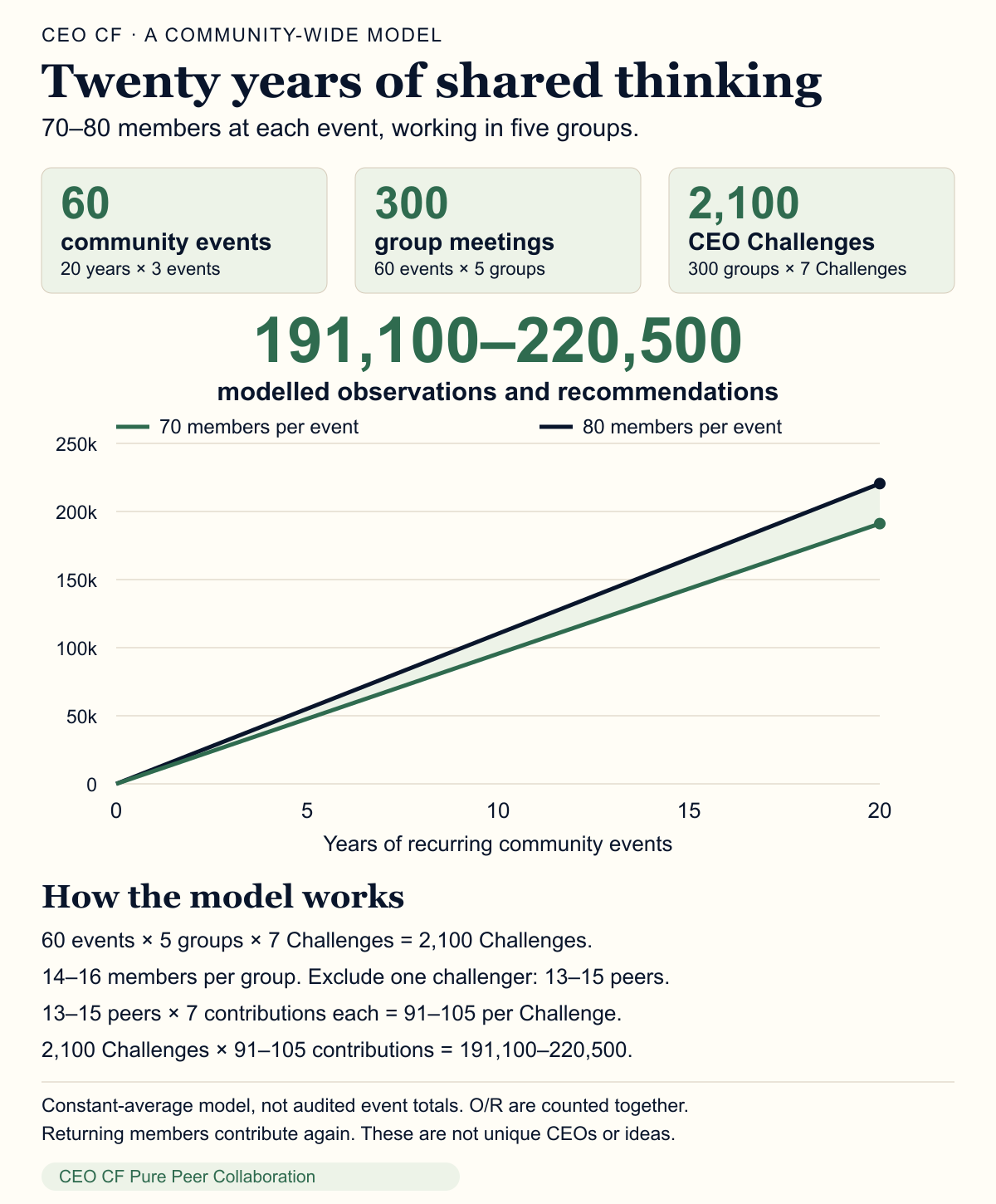
My experience is one part of a much wider exchange. Take 70–80 members at each event, working in five groups. At three events a year and seven Challenges per group, twenty years would bring together around 2,100 CEO Challenges.
With each contributing peer offering about seven observations and recommendations, that model suggests around 191,000–221,000 contributions. It gives me another way to think about the scale of the experience being shared: leaders returning, bringing new situations and building on what they have learned together.
The next experience changes the earlier one
Consider an illustrative example. At one meeting, a CEO talks about being unable to delegate. At another, a leader in a different industry describes a management team that keeps bringing decisions back to them. Later, somebody talks about a founder who wants the business to grow but struggles to let other people take responsibility.
Those could be quite different problems. But discussing them carefully might help me notice a recurring question: has responsibility actually been transferred, or does everybody still know who will make the final decision?
The third conversation can send me back to the first. I may see something I did not understand at the time. I may also realise that an analogy I was using does not fit as well as I thought.
That is the part I find valuable. I am building a wider set of situations against which to test my thinking. An earlier experience can become more useful when another one gives me a way to interpret it.
There is a related idea in Gick and Holyoak’s research on analogy. In their experiments, comparing examples helped people identify an underlying structure and apply it to another problem. These were laboratory tasks involving written stories. They support the value of comparison; they also remind me that useful learning can happen through reading.
My preference for the room comes from what I can do there: ask another question, hear competing interpretations and check whether the connection I am making holds up.
I need to hear what happened next
A compelling recommendation is still a recommendation. I need to be careful about treating the confidence with which it was given as evidence that it worked.
That is where a continuing community can add something important. When people return, there is an opportunity to hear what they did, what happened and what they would now do differently. A promising idea may have helped. It may have failed. It may have depended on a circumstance nobody understood in the first discussion.
Those later conversations can correct the lesson I was carrying. If I only remember the advice and never hear the outcome, I may be building confidence around an untested story.
Kahneman and Klein’s work on intuitive expertise makes a useful distinction here. Reliable intuition depends on the conditions in which someone learns, including whether the environment offers dependable patterns and whether they receive useful feedback. Feeling experienced is not enough. Business decisions can be especially difficult because outcomes are delayed and many things change at once.
A meta-analysis by Tannenbaum and Cerasoli also found benefits from structured debriefing across the settings studied. It does not tell us how much a CEO CF member improves. It gives me another reason to value the time spent examining an experience afterwards.
For me, returning matters because it gives the conversation a chance to be corrected.
Other leaders broaden the experience I can draw on
Running my own company gives me a particular set of experiences. Working with peers brings me into contact with circumstances I may never encounter directly: different industries, markets, ownership structures and ways of leading.
Being present for their Challenge does not mean I have lived their experience. I have not carried their decision, worked with their team or seen everything happening in their business. I need to remember that.
But I can learn from the part they are able to share. I can hear the alternatives people considered, see which questions helped and notice where someone else’s circumstances differ from mine.
Sometimes that broadens the answer I would give. Sometimes it broadens the question I would ask. I may leave less certain of my first response, which can be useful if that certainty was premature.
Facilitating adds another layer for me. At one or two Challenges per community meeting, I estimate that I have facilitated roughly 45–90 of those sessions. At the roughly ten Powered by CEO CF events, I facilitated three Challenges each: about 30 more. That puts my estimated facilitation total at around 75–120 Challenges. I have to follow the situation, keep the process moving and make room for different contributions. Ten years as a Group Chair have added further experience of helping other leaders think.
Why I believe staying longer makes you a better CEO
I believe that staying longer in CEO CF makes you a better CEO. I see it in the way my own thinking has developed: I have more experiences to draw on, a wider range of questions to ask and more perspectives against which to test a decision.
Each summit builds on that foundation. You listen to another leader’s situation, contribute your thinking and hear how other people approach it. When you return, you bring those experiences with you. You have more to offer the room, and more ways to understand what the room offers you.
The relationships deepen too. People understand more of your context, remember earlier conversations and can challenge you with that knowledge. Fresh perspectives keep broadening the picture. Together, those continuing relationships and new experiences give you more to draw on.
The value stays with me even when I cannot recall every sentence. Sometimes the lasting contribution is a question I now think to ask, a possibility I would previously have missed or a familiar situation I can see differently.
Over time, those changes become part of how I lead. That is why I believe the value grows the longer you stay: you keep adding to your experience, and that experience keeps improving the thinking you bring to the next decision.
Why I keep making the time
This is the best way I have found to broaden myself as a leader: spend time in person with peers, work seriously on the situations they bring, contribute what I can and come back to hear what followed.
I arrive with my own experience. I leave with more to think about. The next time I return, I bring some of that thinking with me, and it becomes part of what I can offer someone else.
That is why I find it difficult to judge the value of CEO CF from a single meeting. A useful conversation today may connect to something from years ago. Something I hear now may only become useful when I face a different situation later.
The learning keeps adding up because I keep bringing it back into the room.
Sources and notes
This article brings together my experience as a member of CEO CF since 2010 and research that helps me understand why that experience has been so valuable. The studies linked above explore memory, learning, analogy, expertise and reflection in a range of settings. They give me useful ways to think about what I recognise in the room: making connections, learning from outcomes and carrying that experience into the next decision.
The rounded estimates give a sense of the scale of those repeated conversations and contributions over the years. The delegation example illustrates how one discussion can help me see an earlier experience differently.