I would keep the writing, reading aloud and live checking in a CEO CF Challenge, even if AI could produce an excellent transcript and summary. The process asks us to decide what we mean, express it clearly and check that the words on the page still say what we intended.
I am usually the person asking whether AI could make something easier. As someone involved in CEO CF, I understand the question: why not simply record the Challenge and let AI produce the observations and recommendations? This is my personal view of what I would keep in the process.
A recording can preserve the spoken discussion. A summary can organise it. But if those replace the work of preparing and checking our own contributions, we have changed what participants actually do. We may have a perfectly serviceable document without having done the same thinking to create it.
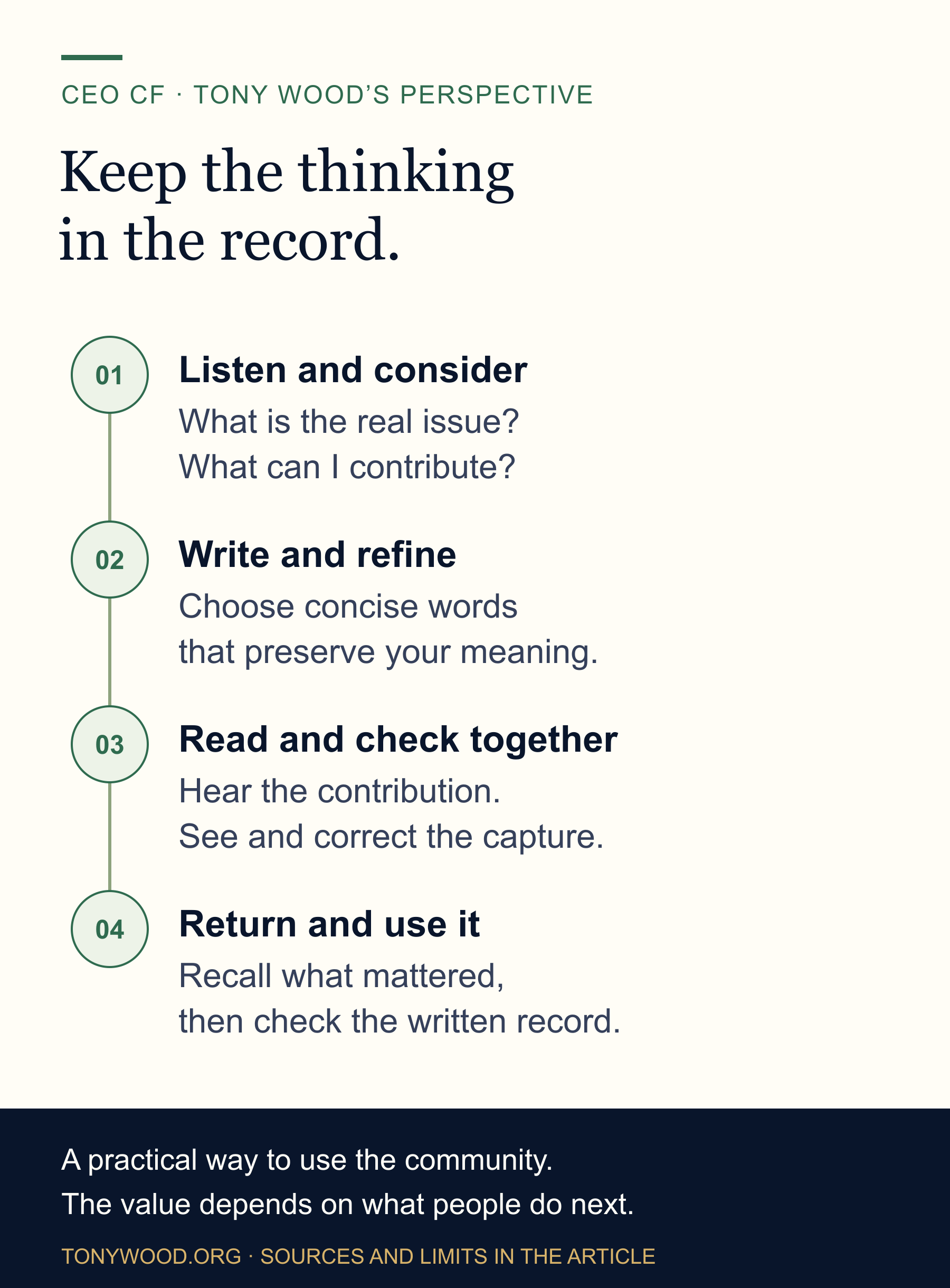
The sequence I want to protect is simple: listen, think, write, refine, read aloud, see the words being typed and check them together. Here is why I think those steps are worth keeping.
First, listen to the person with the problem
As an attendee, I start by listening to the Challenge. I make rough notes as the presenter explains the situation and the group asks questions. Something may remind me of a decision I made, a mistake I recognise, or a pattern I have seen before.
Then comes the useful question: what would actually help this person?
That requires a little discipline. My first reaction may be interesting to me without being useful to them. I need to consider what the questions have revealed, what I still do not know, and whether my experience really fits this situation.
An Observation describes something I notice or an interpretation I want the presenter to consider. A Recommendation proposes something they could do. Keeping those distinct helps me see whether I am describing the problem or jumping straight to a solution.
Writing a contribution makes me choose. I have to turn a collection of impressions into something another person can understand. Research on the generation effect finds that people generally remember material they generate better than material they simply read. Those experiments often involve much simpler tasks than advising a CEO. They give a plausible reason to preserve the effort of forming our own contribution; they do not establish the memory benefit of a CEO CF Challenge.
Make it short enough to use and complete enough to mean something
I want to write as briefly as I can while keeping the meaning intact. The test is whether the presenter could read the note later, without my explanation, and understand what I was trying to offer.
Take an invented example: “Your team lacks capability” and “Your team lacks capacity” are very different observations. One questions whether people can do the work. The other questions whether they have enough time or resources. Changing one word could send the presenter towards a different decision.
“The team may be overloaded” also says something different from “The team is overloaded”. The uncertainty belongs in the note. A smoother sentence is not necessarily a more faithful one.
Refining the wording forces me to decide what I mean and how strongly I mean it. If a summary merges several contributions into a broad theme, those distinctions can disappear. A human summariser can lose them too. Whoever prepares the record needs to preserve them.
This is not a claim that every act of summarising improves memory. Dunlosky and colleagues’ review of learning techniques found summarisation too dependent on the learner and task to recommend as a broadly reliable study method. My immediate reason for refining the note is practical: I owe the presenter a contribution they can use.
I do this in my notebook. There is some support for handwriting in education: a 2024 meta-analysis of college lecture notes found a small average achievement advantage. But a direct replication by Urry and colleagues did not reproduce a handwriting advantage on its brief-delay quiz. The activity I want to retain is choosing and organising the words ourselves, whether we use a pen or a keyboard.
Read it aloud, then connect it to the room
Reading the contribution aloud gives everyone a chance to hear the words I have chosen. It also lets me hear whether my carefully prepared sentence actually makes sense.
The production-effect literature finds memory benefits from saying material aloud in many experimental conditions. Much of that research uses word lists, so we should be careful about carrying it over to a complex discussion. Reading from a page is also different from retrieving something without looking. Still, it is another reason to take speaking our own contribution seriously.
Sometimes someone else has already made the point. I might say, “I support Jane’s second observation,” and explain the part that matters to me. Or I might add a condition: her recommendation makes sense if a particular assumption holds.
To do that properly, I need to consider what Jane said, compare it with my own thought and identify the connection. If it brings an earlier business experience to mind, I can ask whether the situations really are comparable. The reference should help the presenter follow that relationship later.
Keeping the original contribution and attaching the addition to it preserves that connection. One person may be agreeing, another extending the idea, and a third qualifying it. Summarising all three as “the group agreed” would lose useful information. I want the presenter to be able to follow the differences later.
Seeing it typed is another chance to think
In the process I am describing, the Facilitator Assistant, or FA, types the contribution onto the shared screen. As the words appear, I compare them with what I intended. Does it say “capacity”? Is the qualification still there? Have we linked the addition to the right numbered point?
I am also seeing the sentence as the presenter will see it on the page later. Does it still make sense without my spoken explanation? If I need to add another paragraph aloud to explain it, perhaps the written contribution needs more work.
Other people can inspect it too. They may spot a missing word, ask what a phrase means or notice that two apparently similar observations make different claims. We can clarify the wording while the contributor is there. A summary produced afterwards cannot, by itself, recreate that exchange.
Communication researchers Herbert Clark and Susan Brennan described grounding: the collaborative work of establishing that something has been understood sufficiently for the task. Their framework also considers the value of messages that persist and can be inspected again. I see the shared screen as a practical way to support that work. This is an application of a communication framework, rather than a trial of CEO CF.
Checking the wording does not mean endorsing the advice. We can agree that the note accurately records a recommendation while disagreeing with the recommendation itself. And it remains the presenter’s decision which actions to take.
Give people time to take in the contribution
I have been in the room when a completed block of text was dropped onto the screen. In my experience, I remembered less of it. I had missed the slower process of watching a contribution take shape, reading it and checking whether it said what was intended.
That is my experience, not a controlled experiment. But research gives us useful reasons to examine the pace.
In two school studies of spoken and written explanations, Singh and colleagues found that breaking material into segments particularly helped with spoken information. Speech passes; written information can remain available to look back at. These were immediate learning tests, not measurements of executives’ memory months later.
Spanjers and colleagues also found that pauses between parts of instructional animations improved students’ immediate test performance. That supports taking processing time seriously. It does not establish an ideal speed for typing meeting notes.
The practical point for me is to give the room a manageable contribution and enough time to inspect it before moving on. The useful time is spent reading, comparing, clarifying and connecting ideas. Typing does not need to be artificially slow. What I would resist is using faster capture as a reason to skip that shared attention.
Visible words can help people working in another language
In a European group, people may be discussing difficult business decisions in English when it is not their first language. The written contribution gives them something stable to inspect alongside what they have heard.
A meta-analysis of 18 studies by Montero Perez and colleagues found benefits from same-language captions for second-language listening comprehension and vocabulary learning. Its pooled results used immediate tests. Captioned learning videos are different from edited Challenge notes, so this is supporting evidence for visible language, rather than proof of better long-term recall in our room.
There is a useful caution about brevity too. In a study involving 226 university students watching French clips, full captions helped overall comprehension more than keyword captions or no captions. Keywords alone did not outperform no captions.
My implication for the Challenge is to keep the complete meaning. A short, clear sentence can be more useful than a string of abbreviations that requires the reader to reconstruct what was meant. That is a judgement about applying the research, not a tested rule for writing observations.
Noise adds another difficulty. In a laboratory study of speech in background babble, participants recalled fewer previously identified words under worse listening conditions. That was a short-term memory task, but it illustrates why hearing a word and having capacity to remember it are different demands.
With roughly a dozen people in a room, clear turns, readable text and permission to ask for a repetition are sensible supports. Putting a recorder on the table does not remove those needs. Nor is the person typing immune to noise or ambiguity: everyone benefits from having a chance to check.
A lasting record and a lasting memory need different things
I want the contribution to be useful after the meeting. That means both making a record worth returning to and giving people opportunities to learn from what happened.
A spoken conversation can create a lasting memory. Writing something down does not guarantee one. Nor can we count listening, writing, speaking and seeing as four identical doses of learning.
What the process offers is several different kinds of engagement: forming an idea, expressing it, comparing it with other contributions and checking its meaning. The resulting record can support the next stage, when the presenter returns to the Challenge and considers what they discovered and what happened after acting. For the peers who contributed, the question is also what they took from the discussion and can use elsewhere.
For longer-term learning, later recall matters. In Karpicke and Roediger’s vocabulary experiment, continuing to practise retrieval improved recall a week later more than continued study did. It was not a business meeting, but it suggests a useful habit: try to recall the important point first, then check it against the record. That gives the presenter and the contributing peers something more active to do than simply reopening the document.
What would “just record it” actually replace?
AI can already produce live captions. Microsoft’s current Teams guidance also describes using meeting context to help transcription, and advises clear speech, low background noise and avoiding simultaneous speakers. My concern is what happens to the participant’s work when we introduce that capability.
If we speak our first thoughts and leave AI to turn them into polished recommendations, we may skip the effort of deciding exactly what we mean. The eventual sentence could be clearer than the one we spoke, but we have not necessarily done the work of reaching that clarity ourselves.
If we write and refine our contributions first, read them aloud and ask AI to capture them, we have retained much more of the process. We still need to see and check the wording together. Sending everyone a summary afterwards would leave that part unfinished.
If AI helps with the typing while we continue to inspect, correct and connect the contributions, it could support the work I value. I would judge it by whether we still choose our own words, preserve qualifications, connect additions to the right point and give people time to understand. That is a different proposal from simply recording the meeting and collecting a summary.
The research reviewed here does not directly compare this complete Challenge process with AI recording and summarisation. It supports the value of several activities within it. My judgement is that those activities are worth preserving, even when a tool can produce the document faster.
That is why I would not replace writing, reading aloud and checking together with a recording and an AI summary. I want us to leave with a useful record and with ideas we have personally worked through. The time spent choosing a word, hearing it aloud and checking it on the screen can be part of the value of the Challenge.
Before we automate a step, I want us to ask what thinking happens during it. Then we can decide what to speed up and what deserves our attention.
Sources and notes
This is a researched personal essay. The Challenge sequence and examples of room practice come from my account and CEO CF’s method. The business wording examples are invented. The studies explain relevant mechanisms and limits; none directly compares this complete process with AI recording and summarisation.
- Bertsch et al. (2007), The generation effect: A meta-analytic review. Constrained memory experiments; application to forming advice is indirect.
- Dunlosky et al. (2013), Improving students’ learning with effective learning techniques. Summarisation varies with skill and task; retrieval and distributed practice have broader support.
- Flanigan et al. (2024), Typed versus handwritten lecture notes and college student achievement: A meta-analysis, and Urry et al. (2021), Don’t ditch the laptop just yet. College note-taking evidence, including a null direct replication.
- MacLeod and Bodner (2017), The production effect in memory. Experimental review; reading aloud is not automatically retrieval practice.
- Clark and Brennan (1991), Grounding in Communication. A theoretical framework for establishing understanding, rather than an FA outcome study.
- Singh, Marcus and Ayres (2012), The Transient Information Effect, and Spanjers et al. (2012), Explaining the segmentation effect in learning from animations (linked through the author’s thesis, Chapter 5). School studies with immediate assessments.
- Montero Perez, Van Den Noortgate and Desmet (2013), Captioned video for L2 listening and vocabulary learning: A meta-analysis. Immediate-test synthesis. Montero Perez, Peters and Desmet (2014; online 2013), Is less more?, full-versus-keyword caption study; original publisher abstract consulted.
- Pichora-Fuller, Schneider and Daneman (1995), How young and old adults listen to and remember speech in noise. Original abstract consulted; short-term laboratory recall.
- Karpicke and Roediger (2008), The critical importance of retrieval for learning. Vocabulary learning with a one-week delayed test.
- Microsoft Teams live-caption documentation, checked 3 September 2026. Operator description of current capabilities.