If I were running Amazon's shopping business, I would be asking a fairly uncomfortable question: what happens when buying somewhere else becomes just as easy?
Not because Amazon suddenly stops being useful. Its delivery service is a large part of why I use it. But a lot of the convenience comes from not having to visit another website, create another account, type in my address again and chase another order.
Those are precisely the jobs I would like an agent to do for me. And if it can do them reliably, my reason for choosing a shop starts to change.
I started with a bottle of vitamins
This thought came out of researching supplements. I came across reports of counterfeit products sold through Amazon, and it made me stop and think about what I was actually trusting.
If a chair arrives with a leg missing, I can see the problem. If a bottle of capsules contains less of the advertised ingredient, or something else entirely, I cannot tell by looking at it. A tidy label and a parcel arriving on Tuesday do not answer that question.
There are documented examples. In April 2023, supplement manufacturer NOW reported finding eleven counterfeit versions of its products sold by one seller on Amazon's US site. It said its analysis found rice flour in the capsules and traces of sildenafil in some samples. It also reported that Amazon had agreed to block the seller. This is the manufacturer's account of a specific incident, not a survey of everything on Amazon. NOW's original report.
Separately, the US FDA's December 2023 warning letter to Amazon described products bought on its website and marketed as supplements or food which laboratory testing found contained undeclared pharmaceutical ingredients. That is evidence of particular adulterated products, not proof that ordinary UK vitamin purchases are generally fake. Counterfeiting a brand and adulterating a product are different problems, although both make the contents harder to trust. FDA warning letter.
I have not had my own purchases laboratory-tested, and I am not claiming that I received a counterfeit. What bothers me is the gap between being able to buy something easily and being able to know what I have bought.
One website does not mean one seller
We often talk about Amazon as though it were one big shop. The more accurate description is that it is both a retailer and a marketplace. Sometimes Amazon is the seller. Sometimes another business is selling through Amazon. Delivery, the selling business and the manufacturer are not necessarily the same organisation.
That is why I want to know who the seller is, not just whose logo is at the top of the page. The CMA's investigation into Amazon's marketplace describes this dual role and the competition questions it raises. CMA investigation and commitments.
I also need to be fair here. It would be wrong to say Amazon does nothing to police its marketplace. In its report covering 2025, Amazon describes seller verification, automated monitoring and work with accredited safety laboratories. It says it identified, seized and disposed of more than fifteen million counterfeit products worldwide that year. Those are Amazon's own figures, not an independent estimate of the proportion of orders that are counterfeit. Amazon's trust and safety report.
So my question is not whether Amazon has people and systems working on this. It plainly does. My question is whether, at the moment I buy, I can see enough evidence to trust this seller and this product.
A refund is useful. Knowing beforehand is better.
My first reaction was to ask what a refund could possibly put right if you only discovered a problem after a long time. It might replace the money. It cannot give you back the certainty you thought you had.
But that is not the same as saying Amazon will never help or can never be liable. In May 2024, Amazon extended its UK A-to-z Guarantee to include a process for property-damage and personal-injury claims arising from defective products. UK consumer rights also apply to faulty and counterfeit goods. Responsibility and remedies depend on the facts and who supplied the product; they cannot be dismissed with “we are just a marketplace”. Amazon's UK guarantee explanation; GOV.UK consumer-rights guidance.
The point I want to keep is simpler: sorting out a problem afterwards is not the same as helping me avoid it. That matters particularly when the quality is hidden inside the product.
Nor does buying direct magically solve it. A manufacturer's own website is not an independent laboratory. UK guidance advises using reputable suppliers when buying supplements online. For me, a clearer supply chain, a verifiable authorised seller and credible testing evidence are more useful than a confident paragraph of marketing. UK food-supplement guidance.
My agent does not mind filling in another form
Here is where agentics become interesting.
I might not want to spend an evening comparing ten suppliers. I certainly do not want ten accounts, ten sets of emails and ten different places to remember when something fails to arrive.
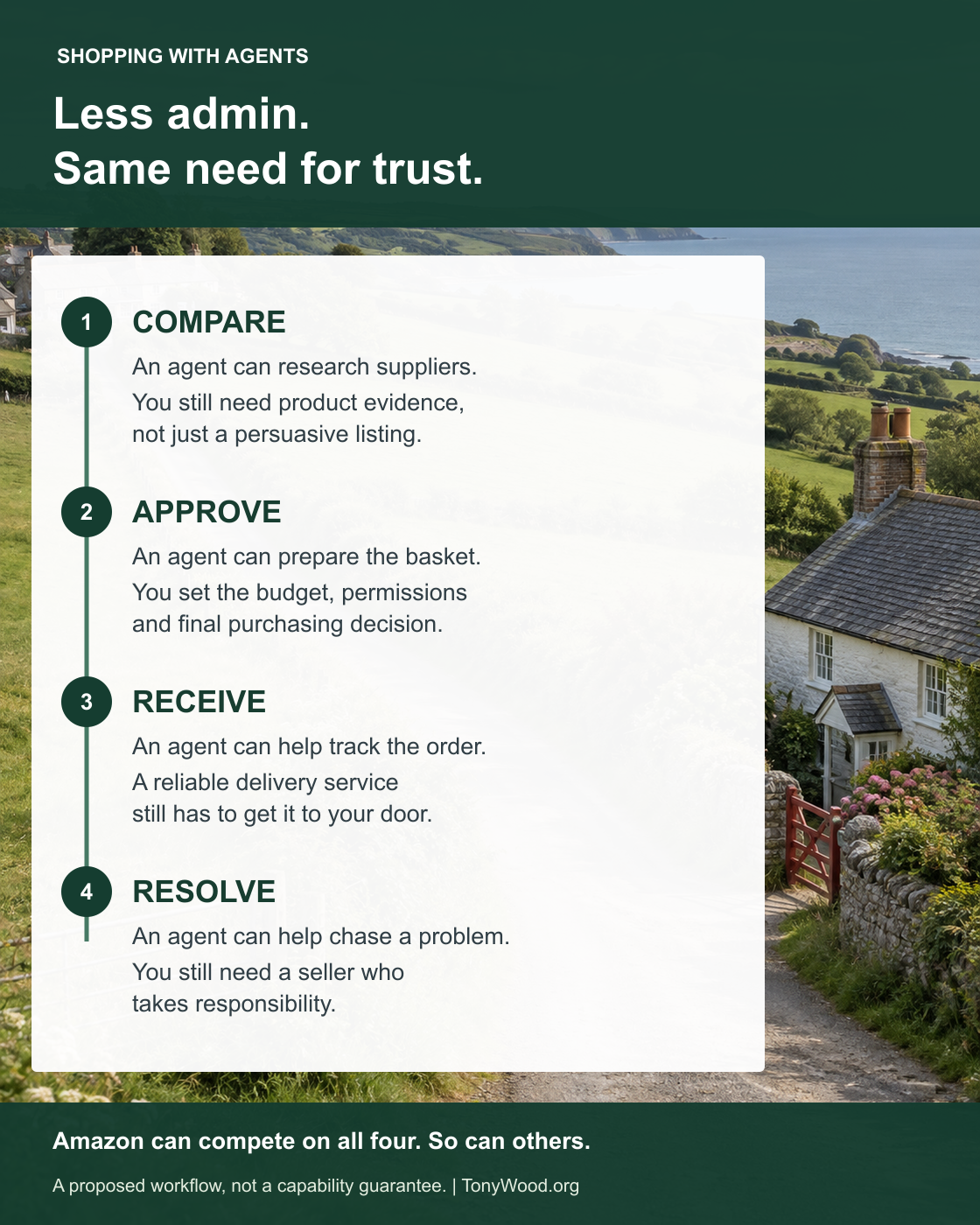
An agent could take on much of that administration: find suppliers, compare the exact specification, check the delivered price, prepare a basket, keep the order confirmation and remind me when a delivery is overdue. With appropriate access and permission, it could help chase the missing parcel too.
I am describing the workflow I want, not promising that today's agents can successfully buy anything from any website. Logins, payment checks, website restrictions and mistakes still get in the way. The agent also costs money to run. Spending a pound of compute to save twenty pence would be a rather special sort of bargain.
But the direction matters. I do not need to enjoy shopping across a thousand stores. I need a system that can find the few worth considering and show me why.
Then I can ask a different question: which supplier gives me the best combination of evidence, price, delivery and help if something goes wrong? Amazon might still win. It just has to win the comparison rather than receive the order because I could not be bothered to go elsewhere.
The awkward bit for my argument: Amazon has noticed
There is a rather important twist. Amazon is already working on this.
Its US Shop Direct service shows products from other merchants, and eligible items offer Buy for Me, which uses an agent to complete a purchase on the merchant's website after the customer confirms the order details. Amazon says the merchant handles delivery, returns and customer service. This is a US example, not a claim that the same service is available to every UK customer. Amazon's Shop Direct explanation.
That makes the contest more interesting. Amazon does not necessarily need to sell every item if it remains the place where I ask what to buy.
But I would still ask: is this agent working for me, or working to keep me shopping inside somebody else's commercial relationship?
That question applies to an independent agent as well. Who pays it? Does it earn commission? Does it distinguish an advert from a recommendation? Can it explain why it rejected a cheaper or more trustworthy supplier? A friendly voice does not make a recommendation impartial.
You cannot prompt a parcel onto my doorstep
Delivery is where I would be careful about writing Amazon off.
Finding a better supplier does not get the van down the lane, make someone knock properly or stop a parcel being left somewhere daft. Amazon's delivery has often worked well for me. That is a real service, not just a clever checkout page.
Ofcom's October 2025 research found that 68% of surveyed parcel recipients had experienced at least one delivery issue in the previous six months. That is a percentage of people, not a claim that 68% of parcels failed. In the same research, Amazon and FedEx jointly led satisfaction with handling contacts and complaints, at 57%. Ofcom's parcel-delivery research.
I would like much better shared delivery instructions, reliable proof of arrival and an easier way to resolve failures across carriers. We already have a regulator in Ofcom. My suggestion is not to invent regulation from nothing, but to make the practical experience work better across the whole journey. Whether that needs stronger common standards or another service is a question worth exploring separately.
A doorbell camera might help me check a delivery, but it is not infallible proof and I would not give a shopping agent unrestricted access to footage of everyone coming to the door. An order confirmation, tracking event or delivery photo may be enough.
Meanwhile, splitting an order across several suppliers can mean several delivery charges, more packaging and several returns processes. An agent should count those costs, not congratulate itself on finding the lowest sticker price.
Quality needs evidence that the buyer can inspect
If I were Amazon, this is where I would put serious effort: make trustworthy sellers and products easier to distinguish.
Show me who made the product, who is selling it and whether that seller is authorised. Where testing matters, let me inspect what was tested, by whom and when. Make it clear whether a report covers the batch being sold or merely some sample from the past. A certificate with a logo is not the end of the enquiry.
I would also want those details available to buying agents. Clear product information, stock, total costs, delivery commitments and returns terms should be easy to check. The better my agent can inspect a supplier, the less it has to guess from a persuasive product page.
There is a separate trust question when the marketplace also competes with its sellers. In 2023, the CMA accepted commitments addressing Amazon's use of non-public seller data and treatment of offers in the Buy Box. That supports a real discussion about conflicts of interest. It does not establish that every successful supplier gets copied into Amazon Basics and wiped out. I would not turn that concern into a universal claim. CMA commitments.
The brief I would give my buying agent
Find three credible suppliers for this exact product. Identify the actual seller, explain the evidence for authenticity and show the total delivered price, delivery date and returns terms. Separate independent evidence from the supplier's claims. Tell me what you could not verify. Do not create accounts, share personal details, substitute products, start subscriptions or spend money without my approval.
That is where I would start. Give it a narrow job, check the results and expand its authority only when the process deserves it. A buying agent that confidently chooses the wrong product is not an improvement on a human who clicks too quickly.
So yes, I would be worried
Not “Amazon disappears next Tuesday” worried. This is an argument about its shopping business, not a prediction that the whole company, including AWS, has run out of things to do.
I would be worried about losing the easy default. When my agent can deal with the forms, comparisons and follow-up, “we have everything in one place” becomes less persuasive. I can choose a specialist without taking on all the specialist-shopping paperwork.
Amazon can respond with its own agents, better product evidence and the delivery and service it already knows how to provide. It may do that extremely well.
But I think the question changes from “where is it easiest to click?” to “who can I trust to get the right thing to me, and put it right if they do not?”
If I were Amazon, I would want a very good answer.
Evidence checked on 24 September 2026. This is commercial commentary, not medical or legal advice. The future shopping workflow is my assessment, not a guarantee of current agent capabilities.
Related: When Every Agent Can Write the Proposal, Trust Wins and Don't Just Delegate to AI. Work Beside It.