"The research says..." has become a conversational trump card.
It is often offered as though the discussion has ended. There is a professor somewhere. There is a paper somewhere. Somebody says a percentage. Therefore we are done.
Come on.
Research is not a magic spell. It is a trail of questions, methods, measurements, assumptions, disagreements and limits. A citation tells us that somebody did some work. It does not, by itself, tell us whether the conclusion belongs in this decision.
I am not arguing that every opinion deserves equal weight, or that we should throw up our hands and say nothing can be known. Some bodies of evidence are strong, important and worth acting on. I am arguing for something more respectful of science than a soundbite: show the route.
My words
I keep hearing people say, "the research says this," as if that settles it. But which researchers? Which study? Paid for by whom? Looking at what population? Measuring what? Compared with what? And how much does it actually have to do with the claim in front of us?
People can disagree with a paper without being anti-science. The sample may be too narrow. The question may be wrong. The measurements may be contaminated. The data may not travel from one setting to another. Or a good study may be one piece of a larger and messier picture.
What I want is not a yes-or-no badge. I want an honest confidence route.
A paper is not a verdict
A paper can be excellent and still not answer the question you are asking. A large sample can be precise about the wrong population. A clean experiment can be indirect for the decision in front of you. Ten papers can repeat the same blind spot. One result can be real in one place, at one time, under one set of conditions, and fail to travel elsewhere.
This is not a defect unique to science. It is what happens when we try to understand a complicated world with limited instruments, limited time and imperfect language.
Evidence frameworks are more grown-up about this than most public debate. The GRADE Working Group, for example, assesses the certainty of a body of evidence against domains including risk of bias, imprecision, inconsistency, indirectness and publication bias. Crucially, it rates confidence for a particular outcome and decision context, not whether an entire subject is simply "true" or "false". The Cochrane Handbook makes a related point: evidence can be indirect when it does not directly address the review question.
That is the discipline I think we need to borrow. Do not ask, "Is there research?" Ask, "What can this evidence honestly support?"
The glove story is a useful correction
I had heard a striking version of the microplastics story: perhaps apparent polyethylene was being found because residues associated with disposable laboratory gloves were being misidentified. It is a good example of why we need to slow down and read the actual work.
A 2020 study tested leachates from ten types of disposable laboratory glove, along with a reagent commonly used in sample preparation. Using several common analytical methods, the substances could initially appear to be polyethylene. The authors found that long-chain compounds such as stearates or fatty acids could be falsely identified as polyethylene; stearates and sodium dodecyl sulfate could cause substantial overestimation of polyethylene.
A 2026 study found a related issue: dry contact between common laboratory gloves and equipment could lead to false-positive microplastic results when traditional library matching was used. It also set out ways to reduce or distinguish that contamination.
That is not evidence that all microplastic research is false, nor a reason to dismiss every environmental or health claim made about plastics. It is evidence that contamination controls, blank samples, method validation and the limits of an analytical library matter enormously. The useful conclusion is not "science failed." It is "measurement needs a receipt too."
Ask the questions before you borrow the conclusion
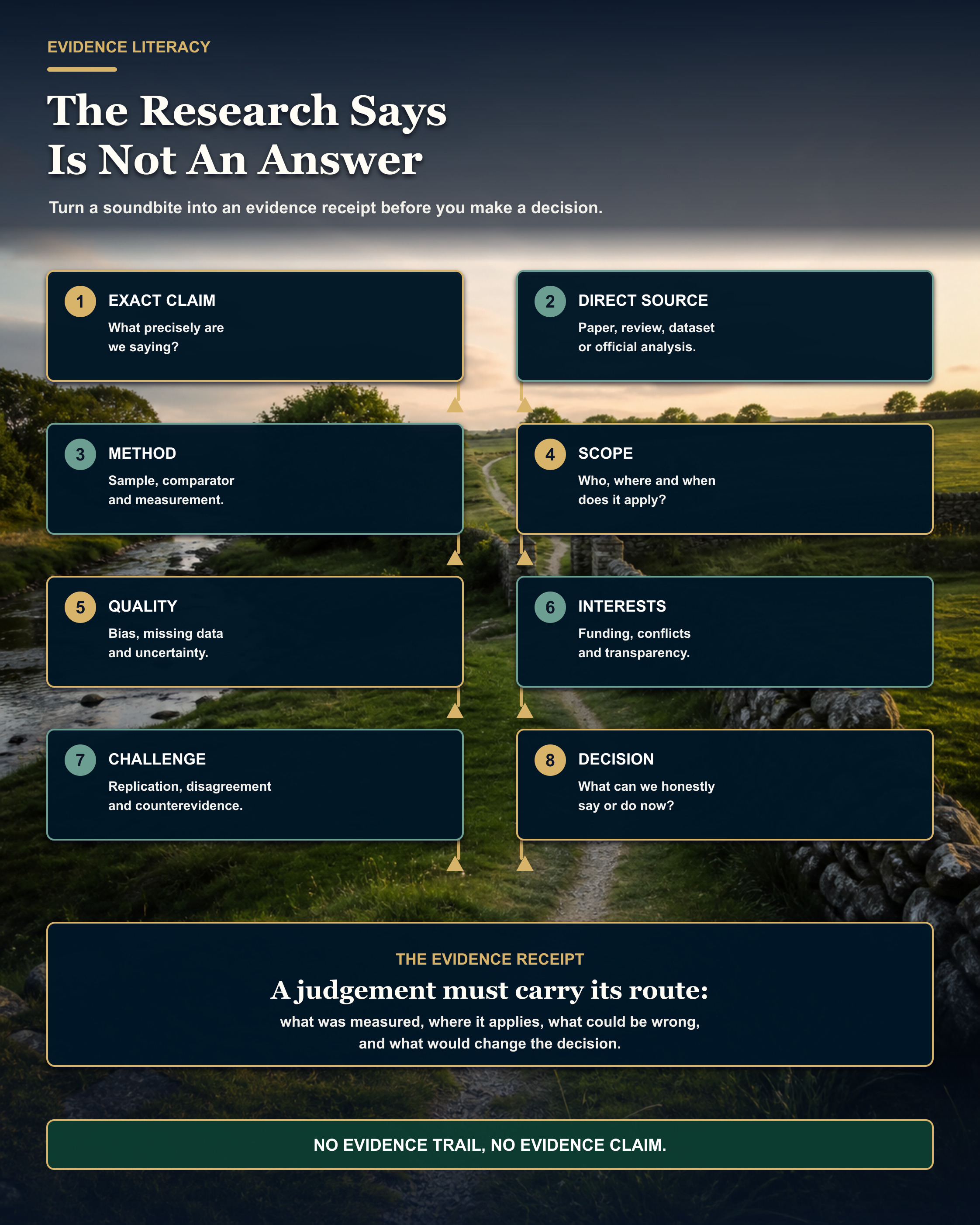
When somebody says "the research says," I think we should be able to ask these questions without sounding like we are starting a fight:
- What is the exact claim? Not the topic. The precise sentence we are relying on.
- Which source supports it? A direct paper, dataset, systematic review or official analysis - not a headline linking to a headline.
- What was studied? The population, place, time period, exposure, comparison and outcome.
- How was it measured? The design, instruments, data and assumptions that created the number.
- How large and how uncertain was the result? A percentage without a denominator, baseline, range or time window is usually a partial sentence.
- What could distort it? Bias, missing data, selection, confounding, contamination, selective reporting or a mismatch between the study and the decision.
- Who funded it and what was declared? Funding is relevant evidence, not an automatic conviction.
- What disagrees, and why? Are there replications, better studies, different contexts or an honest unresolved question?
Funding deserves its place in that list, but it should not become another lazy shortcut. A Cochrane review found that industry-sponsored drug and device studies more often reported efficacy results and conclusions favourable to the sponsor than studies with other funding sources. That was a specific body of research, not proof that every industry-funded paper is wrong. It is a reason to show funding, conflicts and design choices openly, then inspect the work rather than merely sneer at it.
Confidence is not a fake percentage
I do not want us to replace one piece of theatre with another. It is tempting to attach a neat percentage to a claim and call that confidence. But if we cannot explain what the percentage represents, it is just a more expensive-looking opinion.
Better language is often simpler: high confidence, moderate confidence, low confidence, or unresolved - followed by why. High confidence might mean multiple good studies agree in the relevant setting and the result has survived serious attempts to challenge it. Lower confidence might mean the evidence is indirect, inconsistent, underpowered, unreplicated or limited to a different population.
The National Academies makes another useful distinction: reproducing results with the same data and code is different from replicating a result with new data. A successful replication does not prove a finding for ever; a single failed replication does not, on its own, settle the opposite. That is frustrating for people who want one clean answer. It is also how honest learning works.
Agents should return evidence receipts
This is one place where agentic systems can be genuinely useful. An agent can find sources, extract methods, compare scopes, flag missing denominators and surface disagreement much faster than a person with twelve browser tabs open.
But it should not be allowed to turn that speed into false authority. The NIST Generative AI Profile calls confidently presented false or misleading output "confabulation" and explicitly recommends reviewing and verifying sources and citations. An agent that produces an elegant paragraph with broken references has not done research. It has produced a very convincing problem.
The evidence receipt I want from an agent
- the exact claim it is evaluating;
- direct links to the strongest available sources;
- the research type and what was actually measured;
- population, setting, time period and comparison;
- the result, denominator, effect size and uncertainty where available;
- funding, declared conflicts and material limitations;
- credible disagreement or evidence that does not travel to this case;
- a plain-English confidence judgement and what would change it;
- and a clear statement of whether a qualified human needs to review the decision.
A prompt I would use: "Create an evidence receipt for this claim. Do not give me a yes-or-no answer first. Find the strongest direct sources, state what each source actually studied, show its scope and limitations, identify disagreement and conflicts, and finish with a confidence judgement, the decision boundary and what would change the answer. Mark anything you cannot verify."
For medical, legal, financial, safety or other consequential decisions, that receipt should help a competent person review the evidence. It should not pretend to be a replacement for them.
Why this matters to me now
I have just been doing this kind of work in my COVID evidence audit. The only way I could make it useful was to make each proposition specific, attach the source, state its boundary and distinguish what was supported from what was overstated or unresolved.
That is slower than repeating a slogan. It is also much harder to manipulate.
We are entering a time when everyone can generate an apparently researched answer in seconds. That makes provenance, context and disagreement more valuable, not less. The question is no longer simply whether a person can find a paper. The question is whether they, or their agent, can show the path from a paper to a decision without quietly losing all the important bits on the way.
"The research says" is not the end of the conversation.
It is the moment to ask: which research, about what, and how far does it take us?
Related reading
- COVID: What Actually Held Up?
- You Cannot Vibe What You Do Not Know
- The AI Screwed Up. Then What?
- Let's Have Competence In The Loop, Not Just Humans
Sources and notes
- Witzig et al. (2020): False positive microplastic detection caused by disposable gloves (PubMed record)
- Clough et al. (2026): Avoiding and reducing microplastic false positives from dry glove contact
- GRADE Working Group: assessing certainty of evidence
- Cochrane Handbook: considering bias and conflicts of interest
- Cochrane: industry sponsorship and research outcome
- National Academies: Reproducibility and Replicability in Science
- NIST: Artificial Intelligence Risk Management Framework, Generative AI Profile
This article is about evidence literacy, not medical, legal, financial or personal professional advice. The right burden of proof depends on the decision and the consequences of getting it wrong.