I think OpenAI has just changed the business equation. Not because it has given us another model that can write a slightly better email. Because it is starting to put the work, the people and the intelligence in the same place.
I'm talking about ChatGPT Space, alongside Sites, connected tools and Sign in with ChatGPT. Together, these make me ask a fairly uncomfortable question about the software a company pays for.
If my people and their agents can work together here, what exactly do I still need all those other subscriptions for?
That does not mean cancel everything this afternoon. Please don't. But I think the question has become much more serious.
Product information checked on 30 September 2026. This is my interpretation of the business implications, not evidence that companies have already achieved these savings.
My words
You can bring your intelligence to other people's data. Suddenly, token usage starts to become personal. That's a massive shift.
Documents are shared information. Spreadsheets let people look at data. Presentations let people explain it. If we can work with that information, share it and get our agents to help keep it updated, what does that mean for the software we're buying?
Those are my thoughts, cleaned up from a voice note. The important distinction is between that direction of travel and what the products can actually do today.
This is becoming a workplace, not just a chat window
A chat window is useful. You ask a question, get something back, copy it into another application and carry on.
But that leaves a lot of the actual work elsewhere. The plan is in a document. The figures are in a spreadsheet. The discussion is in another tool. Somebody has to keep them lined up.
Space changes the starting point. It provides shared Pages and files for people and AI to work around. It is available on Pro, Business and Enterprise. Creating and editing Pages works on web and desktop; mobile reading and sharing is available, with mobile creation and editing still to come. OpenAI's Space product page.
Pages can combine ordinary text and tables with supporting files, references and interactive visualisations. You can ask ChatGPT to revise the work rather than repeatedly moving it between a conversation and a document. Pages documentation.
That is the part I find interesting. The AI is no longer just helping you prepare something to take back to work. It is becoming part of the place where you do the work.
What is actually here?
OpenAI's 29 September DevDay recap puts several related announcements together. They are not all the same product, and they do not all have the same availability.
| Capability | Status at this check | Why it matters to a business |
|---|---|---|
| Space and Pages | Available on Pro, Business and Enterprise, subject to account and workspace controls. | A shared working reference, rather than another answer somebody has to copy elsewhere. |
| Sites | Public beta on eligible plans. The new supported-plugin hosting is announced for Business, Enterprise, Healthcare and Edu. | A way to build a tailored dashboard or working tool without treating every need as a separate software purchase. |
| Teams and Team Tasks | Business and Enterprise. Tasks use configured accounts and workspace credits. | Recurring work can belong to a team, with shared instructions and reviewable results. |
| Sign in with ChatGPT | Sign-in and plan usage are separate. Eligible Plus and Pro users can opt into plan usage in participating tools. | You may bring an existing AI allowance to a tool instead of buying every AI capability separately. |
| Collaborative slides and spreadsheets | Coming soon, not fully available at launch. The recap says collaborative slides are due in the coming weeks. | Potentially less copying between tools, but not something to base today's migration on. |
That last row matters. A demonstration of the destination is not the same as having the whole destination available in your account.
Small businesses could stop buying quite so much scaffolding
Imagine a small company with six people. It needs to organise customer work, keep track of commitments, understand its money and let everybody know what is happening.
It does not necessarily need six different places to do that.
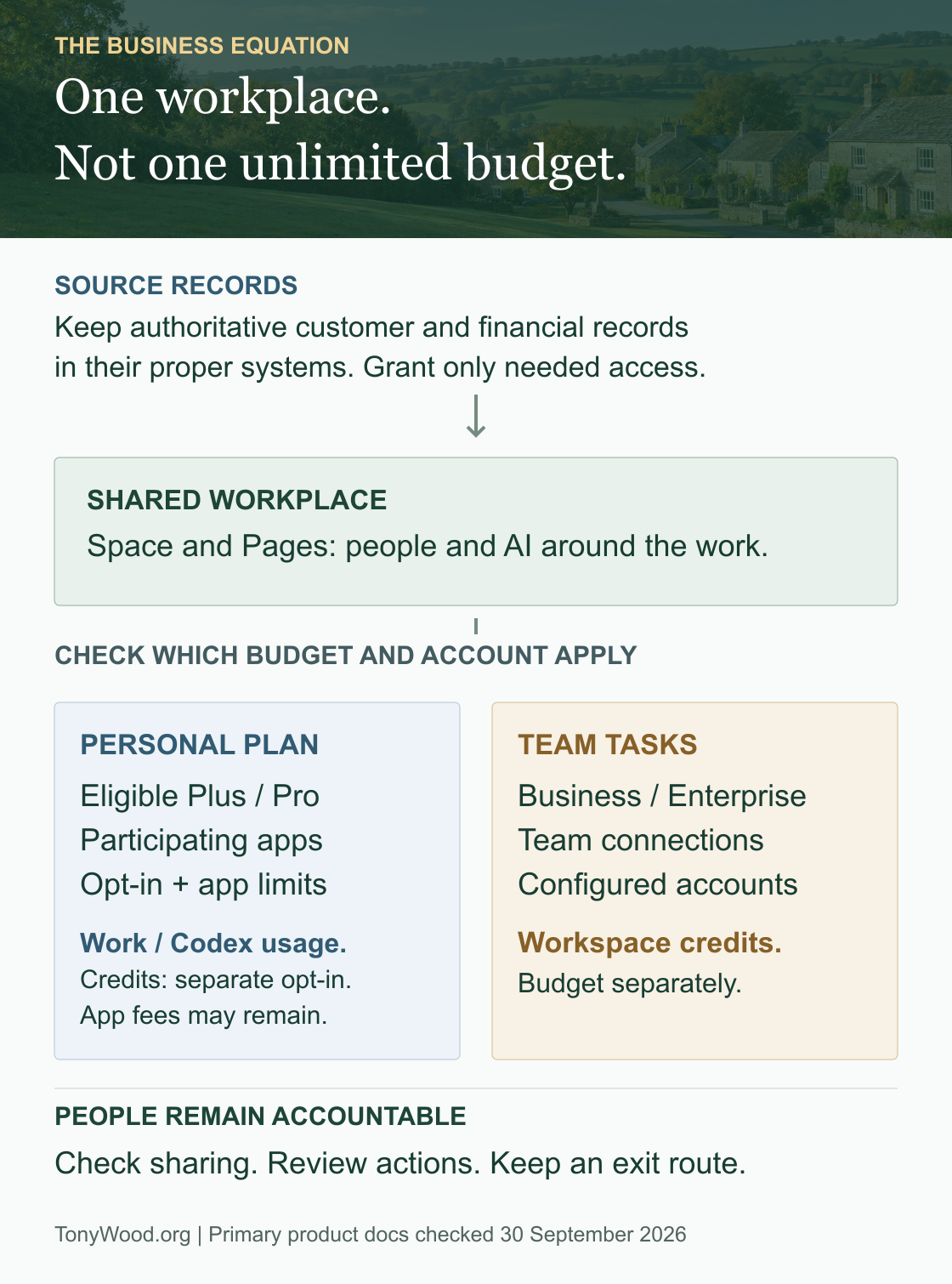
A useful pilot might be one shared project Page: the agreed scope, who owns each action, what has changed and which decisions still need a person. The agent prepares the update. The people check it. The original customer and financial records stay in their proper systems.
You could then test a simple Site for displaying the information people need. Sites supports building and sharing websites and apps; its documented connected-tool access is read-only, uses the visitor's permissions and is limited to eligible workspaces. That is not permission to change the underlying CRM or accounts. Sites documentation.
This is an example of how I would test the opportunity, not a promise that one prompt gives you a finished operating system for your company.
But the possibility is clear. Some tools may still earn their place because they do a difficult job brilliantly. Others may have been bought mainly because they gave us somewhere to put a list and circulate an update.
The second group is where I would start asking questions.
Bring your own intelligence is a different commercial model
There is another part of this that I think deserves far more attention.
Sign in with ChatGPT is not just another login button. Eligible Plus and Pro users can opt into qualifying AI requests using their plan's included ChatGPT Work and Codex usage. Per-app weekly caps do not create a new allowance. Apps can still charge their own fees. OpenAI's explanation of plan usage.
The partner list distinguishes tools offering plan usage, such as Devin, Notion and Vercel, from sign-in-only apps, such as HubSpot and Canva. OpenClaw is listed as an open-source integration. A ChatGPT login does not automatically mean every tool can use your subscription. Current partner categories.
My interpretation is that this could change what a software company has to provide. Perhaps it supplies an excellent specialist service, while the customer brings an AI allowance to help use it.
That is a different proposition from every product selling you its own little AI assistant. I do not necessarily want another assistant that only knows one corner of my business. I want the intelligence I already work with to help me use the right tools.
Plan usage does not itself reveal private chats or memories. After included usage runs out, available credits can be used only with separate permission. This is neither universal model access nor free compute. Plan permissions and limits.
And do not confuse that personal option with company automation. Team Tasks run using the team's service account and configured connections, and consume workspace credits. Budget for those separately. Team Task accounts and billing.
Your people bring expertise, not just a subscription
There is a human side to this too. Bringing an AI allowance is one thing. Bringing the knowledge and judgement you have built up over a working lifetime is another.
I have forty years of business experience. I want to apply that experience to a company's problems. I do not necessarily want to upload my entire working library so it can build a reusable "Tony bot".
The opportunity I see is to keep my wider knowledge separate, use the context I am authorised to use, and deliver an agreed result into the company's work. Sharing a Page does not share private chats or saved memory, but anything written onto that Page is shared with its readers. And using a personal plan in another app does not automatically bring that private context with it. These are useful boundaries, not a ready-made guarantee of intellectual-property protection. Space's source and sharing rules; plan usage and private context.
That deserves its own argument. In Consulting Just Got a New Lease of Life, I look at how a consultant could deliver more useful outcomes without handing over everything they know. The broader point here is that a business may buy access to someone's expertise, rather than demanding a copy of their entire knowledge base.
The file is no longer necessarily the centre of the job
Why do we make a presentation? Usually because we want somebody to understand something and make a decision.
Sometimes a slide deck is exactly right. Sometimes a live Page, an interactive calculator or a small dashboard would do the job better. If the figures change, I would rather inspect the updated position than commission another twenty slides about the old one.
The same question applies to spreadsheets. They are excellent for exploring assumptions, modelling and inspecting calculations. But when a spreadsheet is mainly being used as a fragile little database with three people copying rows into it, perhaps the data should live somewhere more suitable.
I am not saying documents, presentations or spreadsheets disappear. Humans still need to inspect things. We need records we can retain, export and challenge.
I am saying the format becomes a choice made for the job, rather than the job being organised around whichever application we bought first.
That connects with my previous argument about the rules becoming more important than the code. Know what the business needs to do. Keep its data and responsibilities clear. Then choose the implementation.
So should Google and Microsoft worry?
I think they should take this seriously. I also think it would be silly to pretend they have been sitting there waiting for somebody to invent AI.
Google already offers Gemini within Workspace, with capabilities varying by edition, alongside its email, storage and collaboration tools. Microsoft offers Copilot across its business applications and sells wider identity, security and management capabilities. Google's plan comparison; Microsoft's business comparison.
For some companies, those capabilities are the reason to buy the suite. Not a regrettable extra attached to the email account.
But for a smaller business, the bundle deserves another look. If the team increasingly works in an AI environment, do we need all the old collaboration tools as well? Or do we need a reliable mailbox, a few proper systems of record and a much better way of joining them together?
Email-only services can be much cheaper than a full suite. For example, Hostinger's UK page currently advertises a Starter mailbox at £0.39 a month on a 48-month prepaid term, renewing at £1.59 a month on that term. That is a term-dependent offer, not a normal month-to-month price. Check tax and the final checkout total. Hostinger's published terms.
It is also not a like-for-like replacement for Workspace. Add the cost of the AI plan, storage, backups, administration and whatever else you still need before declaring a saving. I would rather have a real saving than a lovely spreadsheet that has forgotten half the bill.
I've found connecting Google access to OpenClaw awkward. That is my experience, not proof that Google's security model is worse. The useful test is whether your own team can get the right access, understand it and revoke it when required.
And using AI with email is not the same as OpenAI becoming your email provider. Nothing in these announcements establishes that hosted business mailboxes have been replaced. Agents may eventually handle more routine communication between systems. That is a possibility, not the end of email.
The wider market: who owns the working relationship?
The competitive question goes beyond the office suite.
If a person starts their day in ChatGPT, asks it what needs doing and works with their team there, the specialist applications may become services used from that environment rather than destinations the person visits themselves.
That is my forecast. It has not already happened to every business. But plugin extensions now let developers put native interfaces in the ChatGPT sidebar and beside conversations. There is a documented route for a specialist product to meet users there. Plugin extension documentation.
If I ran a software company, I would be asking: why should somebody still come to us? Do we have better data, better controls, a genuinely better service or expertise they cannot get elsewhere? Can their agent use those capabilities properly?
Being the place somebody has to click through five screens is not much of a defence when the agent can do the clicking.
There is a counterweight here too. Moving everything into OpenAI can create another dependency. Prices can change. Access can fail. Moving the work out again may be harder than moving it in.
A small business should not escape one expensive bundle simply to become trapped in another. Keep an exit route, not just an entrance.
A shared workspace is also a shared responsibility
Before anybody gets carried away with the convenience, check what you are sharing.
As the consulting example shows, separate source access does not make a shared output confidential. Review what the Page actually reveals, not just the permissions on the files behind it.
Access can also be inherited from a parent Page or shared Space. Removing a direct invitation is not enough if the person still has inherited access. Space permission guidance.
For Team Tasks, check the external account being used, not just the person who created the task. A configured shared account may have different access from an individual member. Team connection guidance.
My practical rule is simple: somebody owns the work, somebody knows where the authoritative data lives, and somebody approves the actions that matter. Convenient access is not unlimited permission.
What I would do next
I would pick one irritating, repeated business job. Not the whole company. One job.
- Choose an outcome. For example, a weekly view of customer commitments and outstanding decisions.
- Name the sources and owner. Leave financial and customer records in their authoritative systems. Give the pilot only the access it needs.
- Build a shared working Page. Ask the agent to prepare updates. Have a person review them before relying on them.
- Measure the whole cost. Include subscription fees, credits, setup, mistakes and review time. Check the usage limit before adding recurring work.
- Test the exit. Can you retain the important records and continue working if this service is unavailable?
- Remove duplication only after it works. A tool has earned retirement when the replacement has proved useful, not when the launch video looks convincing.
This is why I think the business equation has changed. Not because every old product is suddenly useless. Because we can start asking whether the intelligence should sit inside each application, or whether our applications should work with the intelligence we have chosen.
For small businesses, that could mean doing more without accumulating another pile of subscriptions. For the wider market, it could change who owns the everyday relationship with the customer.
And for all of us, it is a chance to organise the software around the work. Which, honestly, would be a rather pleasant change.
Sources and notes
The product sources linked throughout are supplier documentation, checked on 30 September 2026. They establish announced features, availability and limits; they do not independently establish savings, reliability or market displacement. The business forecasts and practical recommendations are mine.
The official product name is ChatGPT Space. This article concerns shared work and agent-enabled business tools, not a separate announcement about OpenAI Search. Google and Microsoft comparisons acknowledge their existing AI capabilities. Email-only pricing is an example, not a purchasing recommendation or a like-for-like cost comparison.