I think consulting has just been given a new lease of life. Not because we can produce a report more quickly. Because we may be able to bring our experience into a company's work without handing over our entire knowledge library.
I have forty years of business experience. I am quite happy to use it to help somebody. That is the point of being a consultant.
But if I pour everything I know into their systems, and they use it to create a "Tony bot", where is my protection?
There is a fairly important difference between hiring me to help you and asking me to build my own replacement as part of the induction process. I would rather notice that before I upload the files.
You are buying the outcome of my experience, not a copy of me.
That is the opportunity I want to explore. It is not a claim that a new login button has solved confidentiality or made consultants impossible to replace.
My words
As a consultant, I can bring my knowledge to a company without giving away everything and making myself redundant. I have forty years' worth of business experience. If I gave all of that to a company and they produced a "Tony bot", where is my protection?
But if I can bring my intelligence into the software the company has, I can deliver outcomes rather than having them replicate me.
That is my argument, in my own words. The commercial possibility is mine; the product capabilities and limits below come from OpenAI's documentation, checked on 30 September 2026.
Three different things we keep calling intelligence
In the companion article, OpenAI Just Changed the Business Equation, I look at shared work, connected applications and the possibility of bringing an existing AI allowance to another tool.
Here, I want to separate three things that can easily get muddled together.
The model's capability. This is the general-purpose AI we are using. Paying for it does not mean it contains forty years of my experience.
My working context. This is the knowledge I have chosen to record, the questions I tend to ask, my methods and the lessons I am entitled to reuse. Some of my judgement is still in my head. A pile of files is not a complete consultant.
The client's context. Their priorities, people, decisions, records and constraints. Those belong in the engagement under the access and confidentiality arrangements we have agreed.
Useful consulting happens when those things meet around a real problem. They do not have to become one enormous shared repository.
What OpenAI actually enables, and what it doesn't
Space gives people a place to share and work on Pages. Linked files keep their source permissions; copied or summarised information is visible to the people who can access the Page. Sharing it does not itself share your private chats or saved memory. Space's source and sharing rules.
Separately, eligible Plus and Pro users can authorise participating apps to use their included ChatGPT Work and Codex allowance. Using that allowance does not give the app access to conversations or memories. Other requested permissions need their own review. Sign in with ChatGPT.
So "bring your own intelligence" needs a little care. Bringing your plan is not automatically bringing your personal knowledge. Nor does joining a company's workspace establish that all your personal context is available there.
If I want an agent to use particular notes or methods, I still need an approved way to provide that context where the work happens. The client must approve the handling of their information too. I cannot assume I am allowed to copy it into my personal account because that would be convenient.
There is a specific trap here too: personal Space files are removed from a project's sources when the project is shared. Direct project uploads remain accessible to its members. Do not assume a private-library link will continue working unchanged. Shared-project source limits.
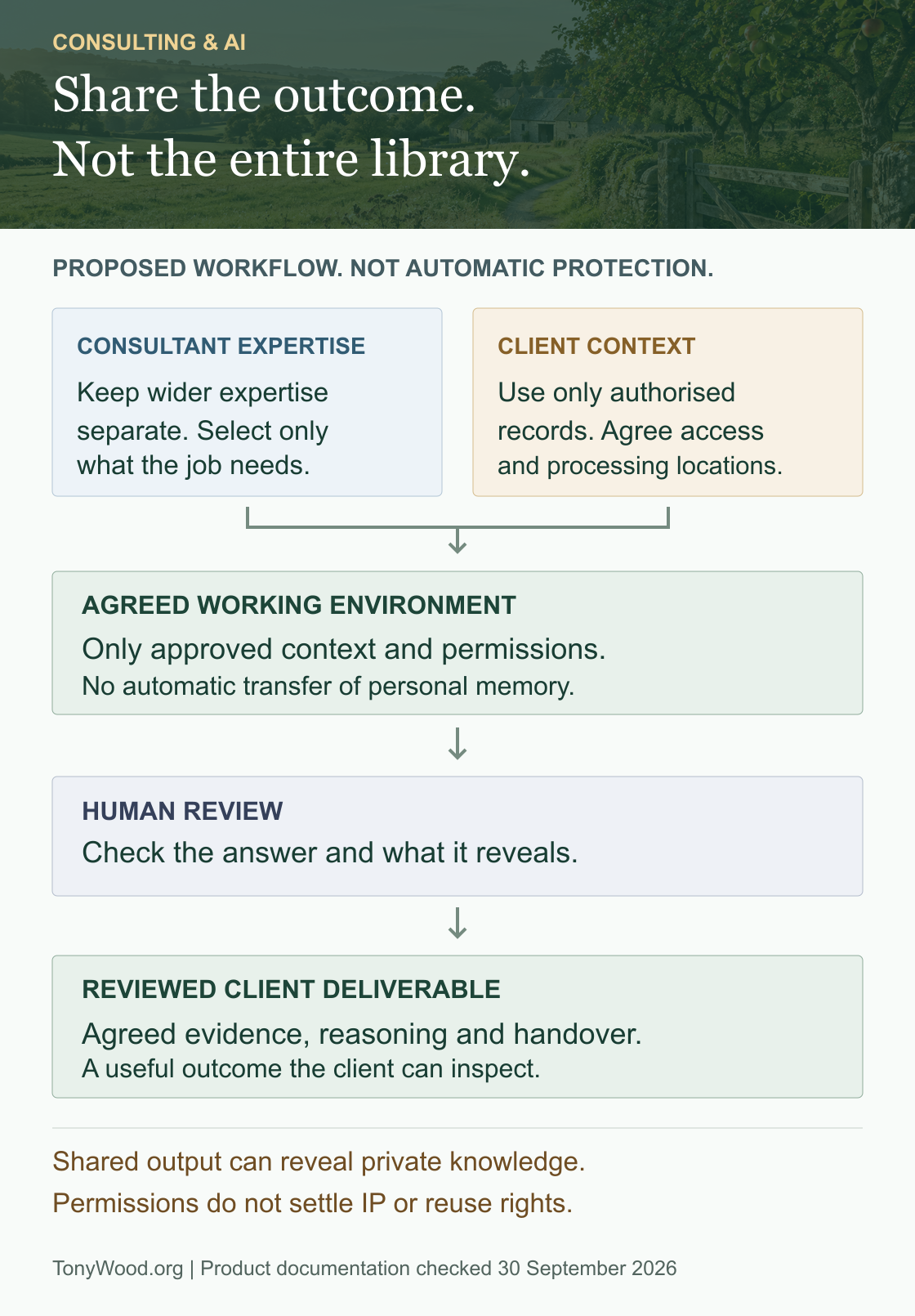
What interests me is the design possibility: use my own expertise in an agreed working environment, and contribute the reviewed result to the company's software or shared work. That is a proposed way of working, not an announced universal "private consultant brain" feature.
Bring the experience. Deliver the outcome.
Imagine a company asks me to help with a difficult supplier decision.
The company supplies the approved facts: what it needs, what the suppliers have offered, the costs, the risks and who makes the decision.
I bring my experience. Which questions are missing? Where might the proposal be optimistic? What looks like a saving but creates an expensive dependency? What would I want clarified before anybody signs?
An agent can help me organise that work. But I am still responsible for reading it, challenging it and deciding what I am prepared to stand behind.
The client receives a useful comparison, a recommendation, the assumptions behind it and a record of the decision. If it belongs in their shared Page or procurement system, we put the agreed output there using approved access.
They do not need my complete notebook, every reusable method or the history of every other engagement to use that recommendation.
And I must not use somebody else's confidential material to make it. General experience I can reuse is not the same as another client's private information.
The client must not buy a black box
This works both ways. Protecting my wider expertise is not a reason to give a client a mysterious answer and say, "Trust me, I've been doing this for years."
If they are paying for advice, they should be able to understand the recommendation, challenge its assumptions and keep the records they need to act on it.
And if I build a process they will operate themselves, they need the agreed documentation and handover. I cannot sell them a working capability and quietly make it unusable the moment I leave.
The distinction is between a useful, inspectable deliverable and a wholesale transfer of everything I know. We should agree which is being bought.
Where is the protection?
Not in the word "private" on its own.
If a private method is reproduced in the output, it has been disclosed to whoever can read that output. If I upload my library into the client's workspace, I have not kept it separate by adding a polite instruction saying, "Please don't copy Tony."
Permissions, storage choices, human review and the engagement agreement need to support the same boundary. None of them is a promise that useful ideas cannot be learned from a delivered result.
Space access can be inherited from a parent Page or shared Space. Check the actual readers, not just the person you directly invited. Inherited access guidance.
Also check the wider environment. OpenAI's Enterprise guidance warns that read-only tool queries can disclose information to external services, and that disconnecting an app stops future access through that connection but does not automatically delete saved content. A company workspace may retain files under its own retention policy. Enterprise sharing and data controls.
The same common-sense warning applies to my own setup: work being local does not mean every tool or model it uses is local. Know what is sent where.
I would get the commercial boundary written down before the work starts. Which existing methods stay mine? What deliverables and usage rights does the client receive? Does the engagement include building an internal agent, or not? Can either party reuse the materials, and for what purpose?
Those are matters to agree and have reviewed where needed, not legal rights created by choosing a particular AI product. This article is an operating and commercial argument, not legal advice.
A practical starting point
| Part of the engagement | What I would agree | What I would not assume |
|---|---|---|
| My existing expertise | Keep the wider reusable library separate. Identify the specific context needed for this job. | A private label prevents disclosure through an output. |
| The client's information | Approved sources, access, processing locations and confidentiality arrangements. | Permission to advise means permission to send records to any AI service. |
| The deliverable | Useful results, supporting evidence, assumptions and the handover the client needs. | Outcome-based work means the client cannot inspect or question it. |
| An internal bot or reusable method | Make this an explicit part of the scope if the client wants it, with its own commercial terms. | A normal consulting engagement automatically includes a permanent replica. |
| The end of the engagement | Review access and retention. Leave agreed records and remove access that is no longer needed. | Revoking access makes previously delivered material disappear. |
Start with one real outcome. Check where the work and its context will live. Give the agent only the approved material. Inspect the result before sharing it. Then ask both sides whether the arrangement was useful.
That is not quite as exciting as "upload your brain and transform consulting overnight". It is rather more likely to survive the second meeting.
Why I think this is a new lease of life
AI will put pressure on some consulting work. If the product is a generic report assembled from public information, we should not be surprised when a client asks whether they can produce it themselves.
But that is not the whole job. Understanding a company, asking the awkward question, recognising what matters and accepting responsibility for a recommendation are part of the value too.
My bet is that experienced people can use agents to spend less time assembling the work and more time applying their judgement. A small company might get a more useful piece of help without having to buy somebody's entire working life or employ them full-time.
That is an opportunity, not a guaranteed saving or a guarantee of demand. We still have to deliver something worth paying for.
Some consultants will sell their methods. Some will help clients build internal agents. There is nothing wrong with either, if that is the deal they have chosen. Others will provide an ongoing service, bringing their knowledge to the job and delivering the agreed results.
I would like that to be a deliberate choice, not an accidental consequence of uploading everything because the new tool asked for more context.
So yes, I think consulting just got a new lease of life. Not because the client can no longer learn from us. Because we may be able to do more useful work together while being much clearer about what they are buying.
Bring your experience. Deliver the outcome. Agree what is being handed over.
Sources and notes
The linked sources are OpenAI's own documentation, checked on 30 September 2026. They support the product permissions and data-handling distinctions described here, not an independent guarantee of confidentiality, legal protection or commercial success.
My forty-years-of-experience example and concern about a "Tony bot" are personal reflections. The supplier scenario is illustrative, not a disclosed client engagement. The proposed separate-knowledge workflow must be tested against the actual accounts, workspace rules, tools and agreement. No automatic transfer of personal memories into company software is claimed.