
If parts of America's AI data-centre build-out slow down, Britain could benefit. Not because America becoming less productive would somehow make us richer. Because investment that still needs a home may look for somewhere else that can deliver.
That is an opportunity I would like us to take seriously. But there is a fairly important condition: we have to be able to build the thing, power it and put it to useful work.
We will not win it simply by being pleased that somebody else has a planning problem.
First, is America actually retreating?
The mid-2026 market evidence does not show a general collapse. CBRE's industry survey reported 7,481 MW under construction and vacancy of 1.4% across its eight primary North American wholesale markets in the first half of 2026. It also identified power availability, delivery timetables and local opposition as constraints. These are defined-market figures, not an AI-only series or a census of every American facility. CBRE's report.
Nor do historical closure counts establish an AI retreat. GAO recorded 6,250 closures reported by 24 federal agencies by August 2018, in a consolidation programme using its own tiered and non-tiered definitions. That is not a count of modern AI campuses closing in 2026. GAO testimony, page 23.
An old facility closing, a workload moving to the cloud, a new project losing a connection date and an investor deciding demand is weaker are different stories. We need to know which one we are looking at.
So the argument here is conditional: what should Britain do if capacity cannot be delivered in parts of America, while demand for the computing remains?
The reason for a slowdown changes everything
These are three possible scenarios, not predictions or probability estimates.
| What slows the US project? | What might that mean for Britain? |
|---|---|
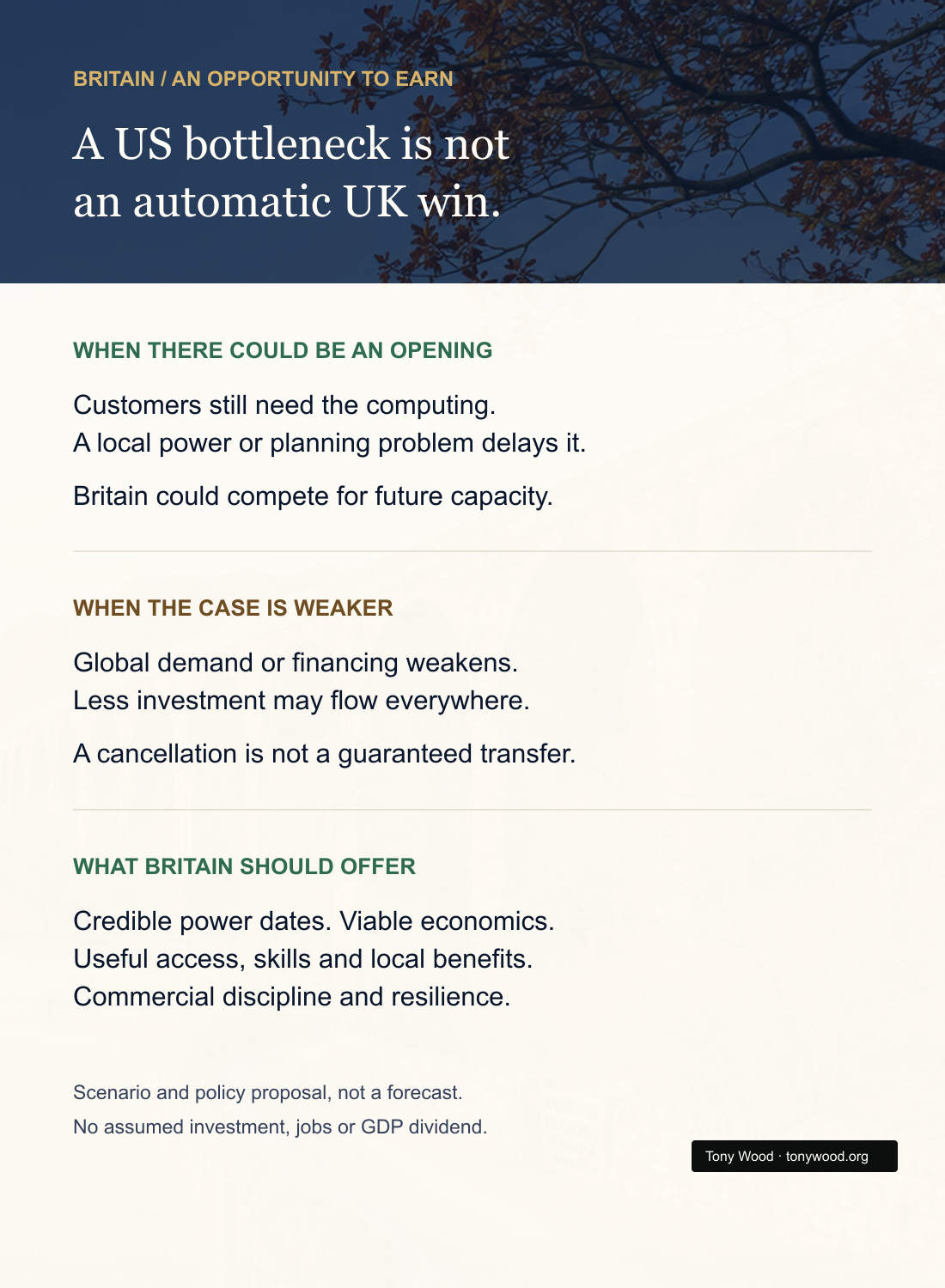
| Local power, planning or construction constraints, with customers still waiting. | Some future investment or workloads might move, if a UK site offers a better delivery date and viable economics. |
| Weaker demand, disappointing returns or a financing squeeze. | Less money may be available everywhere. A cancelled American project does not become a British one. |
| A policy change that also restricts overseas deployment. | The opportunity could shrink rather than grow. The actual policy would need checking. |
That first scenario is the interesting one. A company that still needs computing power has a delivery problem. Britain could offer an answer. A company that no longer believes it needs the capacity has a different problem altogether.
And Britain is not the only possible answer. Another American state or another country could win the work instead. We would have to earn that investment, not assume it was ours to collect.
Win the next investment, not the old building
I am not suggesting we persuade somebody to dismantle a working American campus and ship it to Yorkshire. The more useful question is where the next investment goes.
There is already a British investment proposition. In September 2025 Microsoft announced $30 billion for UK AI infrastructure and ongoing operations over 2025-28, including $15 billion in capital expenditure for cloud and AI infrastructure. That is an announced programme, not $30 billion of completed data centres. Microsoft's announcement.
Different workloads also need different locations. The UK Compute Roadmap says training is generally less location-dependent, while inference may benefit from being near data or users. Inference is the running of a trained model: the work behind an agent answering, analysing or helping carry out a task. UK Compute Roadmap.
Our offer should therefore be specific. Which customers will this serve? What response times do they need? What data and skills are nearby? Why does this workload belong here?
We do not need to win every computing job in the world to build a useful British industry.
We cannot offer a different queue for the same problem
The warning is already on our doorstep. Reuters reported on 19 October 2026 that Microsoft had ended its agreement to anchor Nscale's Loughton data centre after the expected power supply slipped into the 2030s. Microsoft described it as a single-site decision and said it remained committed to the wider partnership. Nscale said it remained committed to Loughton and was exploring alternatives. This was not the cancellation of every UK project. Reuters report.
That is the thing. If the American problem is getting electricity to the site, our answer cannot be, “Come here. We also cannot connect you.”
Price matters too. Here is simple illustrative arithmetic, not a tariff comparison: a facility drawing 100 MW continuously for 8,760 hours uses 876,000 MWh. A difference of £10 per MWh therefore changes its annual electricity bill by £8.76 million. Actual utilisation, contracts and other charges will differ.
A slightly cheaper plot of land will not rescue every power-cost disadvantage. Equally, a credible earlier delivery date may be worth paying for. We should test the complete business case rather than assume one British advantage settles it.
I have explored the physical distinction in More Power Is No Use Without a Grid Connection. A national ambition is not a functioning substation.
We have missed technological opportunities before
History does not give us a neat equation saying a country that delays AI loses a particular percentage of GDP. It does give us examples of people having access to an invention in principle, but not to its practical benefits.
France had telephones. Too few people could use them.
Scott Wallsten's historical study reports 0.8 telephones per hundred people in France in 1914, compared with 4.1 in Sweden. It describes French arrangements that protected telegraph revenues and constrained telephone investment. Across the countries studied, its statistical analysis associated state monopolies with lower telephone penetration and higher long-distance prices, controlling for income and, where possible, country and year effects. World Bank working paper 2690, especially pages 7-8 and 18.
That is evidence about network development, not a calculation of lost French GDP. Nor is it proof that every public operator failed: the paper distinguishes different government approaches. The lesson I take is narrower. An institution can know a technology exists and still organise investment in a way that holds its spread back.
For Britain, the question is whether our systems help useful capacity reach customers, or mainly help us explain why it cannot.
American farms needed connections, not another demonstration of electricity
The US Rural Electrification Administration, established in 1935, provided loans for distribution lines and connections. In their study of 1935-40, Carl Kitchens and Price Fishback report that the number of electrified rural farm homes doubled within five years. Their county-level analysis found contributions to crop output and productivity, with much smaller effects outside agriculture. This was a particular financing and connection programme, not evidence that every infrastructure subsidy pays for itself. Flip the Switch.
The useful point is that the technology was not enough. People needed a financially workable way to connect to it.
A farmer without a usable connection could not obtain the same benefits as a connected neighbour simply by being enthusiastic about electricity. That is the comparison I find useful for AI: access is part of productive capability, not an afterthought.
Neither case means America is now repeating that history, or that Britain is destined to win. They explain why delivery and diffusion deserve as much attention as invention.
The prize is productive capability, not just more buildings
The UK roadmap forecasts a requirement for at least 6 GW of AI-capable data-centre capacity by 2030. That is a forecast requirement, not six gigawatts already operating. It also distinguishes AI-optimised infrastructure from much of the existing general-purpose estate. The roadmap's infrastructure section.
As I argued in Britain Needs Data Centres and AI Factories, ordinary data centres already do computing, not merely storage. The additional opportunity is infrastructure designed for training models and running the inference that agents and businesses use.
But owning more buildings would not automatically make the rest of our economy more productive. British firms can also use overseas compute. My case for domestic capacity is about improving our choices, access and resilience, not pretending every useful AI task must happen on British soil.
The World Bank's 2025 AI foundations report identifies four complementary foundations: connectivity, compute, context and competency. That means energy and digital connections, computing resources, relevant data and skills. The report particularly examines developing economies; using that framework for Britain is my policy interpretation, not a UK growth estimate. Strengthening AI Foundations.
Think about what success could look like: an engineering business producing reliable designs faster, a small company reducing administrative work, or a researcher testing something previously out of reach. Those are potential outcomes to test and measure, not benefits we should book in advance.
What I would put in Britain's offer
I would make the offer practical, and I would expect something useful back.
- Show the power and the date. Publish a credible connection timetable, the work still required, who is responsible and what happens if a milestone slips. A queued application is not energised capacity.
- Match the site to the workload. Assess power, fibre, cooling, water and customer requirements together. Do not choose a location first and invent the engineering case afterwards.
- Make the local bargain clear. Set out construction roles separately from permanent posts, training routes, infrastructure costs and measurable community benefits. Do not promise everyone a job in a server hall.
- Help British organisations use the capacity. Consider research access, smaller-business adoption and specialist skills alongside the campus. A surrounding economy matters more than a ceremonial opening.
- Check control as well as postcode. Ask who owns the equipment, who can operate it, what access contracts guarantee and how essential workloads continue during disruption. UK-located, UK-accessible and UK-controlled are different questions.
- Keep the commercial discipline. Test demand and customer commitments. Stage commitments against delivery. Do not turn a possible American overinvestment problem into a British public liability.
The Data Centre Covenant, published on 28 October 2026, moves in a relevant direction: it links support for strategic projects with security, community benefits, efficient resource use, jobs and supply chains, and outlines faster connection and planning measures. These are policy commitments and expectations, not evidence that the promised infrastructure has been delivered. The Covenant.
There is still detail to settle. In a parliamentary answer on 3 November 2026, the minister said the framework for assessing strategically important projects was being developed and further detail would follow. We should judge delivery, not award ourselves the result because a policy has been published. Parliamentary answer.
Do not wait for America to lose
My position is that Britain should prepare for this opportunity whether or not a wider American slowdown arrives. We already have reasons to improve power connections, skills, research access and the way businesses adopt AI.
If a company has real demand and cannot deliver capacity in its preferred American location, I would like Britain to be able to make a credible offer. Not another announcement. An offer it can build a business around.
The historical warning is not that every cautious society collapses. It is that productive opportunities can remain out of reach for years when the institutions, finance and connections around a technology do not work.
Somebody else's bottleneck could give us an opening. Whether we benefit will depend on what we do with it.
Sources and notes
Evidence checked on 7 November 2026. This is a conditional opportunity argument, not a report of a nationwide US AI retreat. Market surveys, company announcements, government intentions and historical research retain their different scopes. Scenarios and UK policy proposals are interpretation, not forecasts or measured GDP effects.
- North America Data Center Trends H1 2026.
- GAO-19-275T: Implementation of Recommendations Is Needed to Strengthen Acquisitions, Operations, and Cybersecurity.
- Microsoft invests $30 billion in UK to power AI future.
- Microsoft pulls out of UK Nscale data centre deal over power delay.
- UK Compute Roadmap.
- Ringing in the 20th Century: The Effects of State Monopolies, Private Ownership, and Operating Licenses on Telecommunications in Europe, 1892-1914.
- Flip the Switch: The Spatial Impact of the Rural Electrification Administration 1935-1940.
- The Data Centre Covenant.
- Parliamentary answer on the definition of strategic data centres.
- Digital Progress and Trends Report 2025: Strengthening AI Foundations.