
I think we need a new folder in our inboxes.
AI;DR.
AI; Didn't Read.
And in this case, I mean the person who sent it.
They took your question, put it into an AI, copied the answer and fired it back. Somewhere in that process, the person you actually wanted to hear from disappeared.
A conversation at the weekend brought this into focus. The complaint was about someone's words being put through AI and sent straight back to them. What was missing was the sender's own understanding.
That is the bit I find interesting. We are not just learning to use a new tool. We are starting to negotiate the manners around it.
And I think the mobile phone gives us a useful comparison.
A good name for an irritating habit
I cannot claim the acronym. Rick Manelius wrote about AI;DR on 17 August 2026, crediting an earlier post by @seclilc. His version is the recipient's response to unreviewed AI output: if the sender has not bothered to review it, why should the recipient bother to read it?
That is a traceable example, not a claim that we have located the first person ever to use those letters.
My inbox version turns the label back towards the sender: AI produced this, but where is your judgement?
It connects with the meat proxy idea I wrote about recently. The person has become a forwarding mechanism for the machine. The machine does the writing; the recipient inherits the checking.
You have saved yourself some work. You may simply have sent that work to me.
We have been here before with phones
I grew up with certain expectations about shared spaces. If people were concentrating in a library, you tried not to interrupt them. When mobile phones arrived, a call did not magically remove that obligation.
The phone was new. Other people needing a bit of peace was not.
That principle is still visible in the British Library's Reading Room guidance, which asks people to keep phones and laptops on silent and headphone volume low. It is a rule for that setting, rather than a universal rule for every conversation everywhere.
On a bus or a train, I would rather not be given a compulsory seat in somebody else's speakerphone meeting. You may be having a perfectly ordinary conversation. The rest of us have not necessarily agreed to join it.
But my expectations are not the world's default settings.
Scott Campbell's 2007 study of mobile-phone etiquette found both shared patterns and differences between groups in what they considered acceptable. Setting mattered: talking in a theatre was judged differently from talking on a pavement. It was a convenience sample of 271 participants at a university in Hawaii, not a representative survey of entire countries.
That is a useful warning against turning an irritating journey into a theory about a whole nationality.
Different expectations, not people without manners
The useful question is not which country has manners. It is what people in a particular setting expect of one another.
Different expectations are not the same thing as no expectations.
For another perspective, Pew's 2015 report on a 2014 US survey found that 75% of American adults thought cellphone use on public transport was generally acceptable. Younger and older respondents differed considerably.
That question concerned phone use generally, not a licence to have a loudspeaker conversation. Reading a message is rather different from broadcasting a video. Nor is an American survey from 2014 a measurement of British manners today.
The useful point is that expectations can differ by place, generation and situation, as well as between people living in the same country.
One person thinks they are being efficient. Another thinks they are being ignored. Both may believe their interpretation is obvious.
Sound familiar?
What we do and what we approve of
Social psychologists make a helpful distinction between what people believe others commonly do and what they believe others approve of. Cialdini, Kallgren and Reno call these descriptive and injunctive norms.
In ordinary language: everybody does it and we think it is acceptable are different claims.
Their research programme concerned behaviour such as littering, not AI email. I am borrowing the distinction, not claiming they tested this inbox folder.
For a team, I think the practical implication is straightforward. If we reward whoever produces the biggest document fastest, we should not be surprised when people produce bigger documents faster.
If what we value is a checked recommendation, we need to say that, show what one looks like and make it reasonable to ask for one.
A quiet sigh at your screen is understandable. It is not a particularly clear team policy.
The problem is not that AI helped
I am very much in favour of using AI. I use it to help research and shape my writing. That makes reviewing what goes out under my name more important, not less.
And we should not confuse effort with quality. A useful, checked answer does not become worse because somebody produced it quickly.
There is an interesting counterpoint in Hohenstein and colleagues' experiments with AI-suggested replies. Using those suggestions could improve communication and interpersonal evaluations, while believing a partner used them was associated with more negative judgements. This accessible 2021 preprint concerns short replies in controlled messaging experiments, not today's long, AI-written workplace reports.
So disliking something because it feels AI-written is not the same as establishing that it is bad.
The standard I want is whether the sender understands it, has checked the important parts and can stand behind it.
You do not need to replace three adjectives to prove that a human touched the keyboard.
You do need to know what you are asking me to believe or do.
A 2025 study involving Carnegie Mellon and Microsoft researchers surveyed 319 knowledge workers. Higher confidence in generative AI was associated with less self-reported critical thinking. Participants also described checking information and fitting AI responses to the job.
That is self-reported, observational evidence, not proof that AI makes people less intelligent. It does help explain why reviewing the result is work, rather than an optional finishing touch.
What would go in the AI;DR folder?
I would use AI;DR as a private triage label for needs the sender's judgement, not as a machine-generated verdict about who wrote the words.
The signs I care about are practical. My question has not been answered. A recommendation has no connection to our circumstances. Important figures have no source. The sender cannot explain the proposal when asked.
None of those proves that AI was involved. A human can produce a remarkably unhelpful document all on their own.
And a polished sentence, a long email or slightly formal English is not evidence that somebody failed to read their work. Liang and colleagues' 2023 research found that the detectors they tested frequently misclassified non-native English writing. That historical study is not a benchmark of every detector available today; it is a good reason to avoid treating a detector score as an accusation.
For my purposes, there is an even simpler problem. Detecting possible AI authorship would not tell me whether the sender read and understood the result.
So this is not a proposal to automatically bin AI-assisted email. Check the actual request and any urgent obligation first. A missing human explanation is a reason to ask for one, not an excuse to miss a deadline or ignore somebody who needs help.
The same courtesy should apply to people using AI for translation, accessibility or help expressing an idea. The question is whether the message is useful and owned, not whether somebody finds writing easy.
A small piece of AI etiquette
Here is the team rule I would suggest:
Use AI as much as it helps. Before you send the result as your work, read it, understand it and make the useful part clear.
For something consequential, check the facts, sources and assumptions as well. Reading a convincing error does not make it correct. Routine automated notifications need an agreed, tested process; nobody needs to pretend a human reads every receipt before it leaves a system.
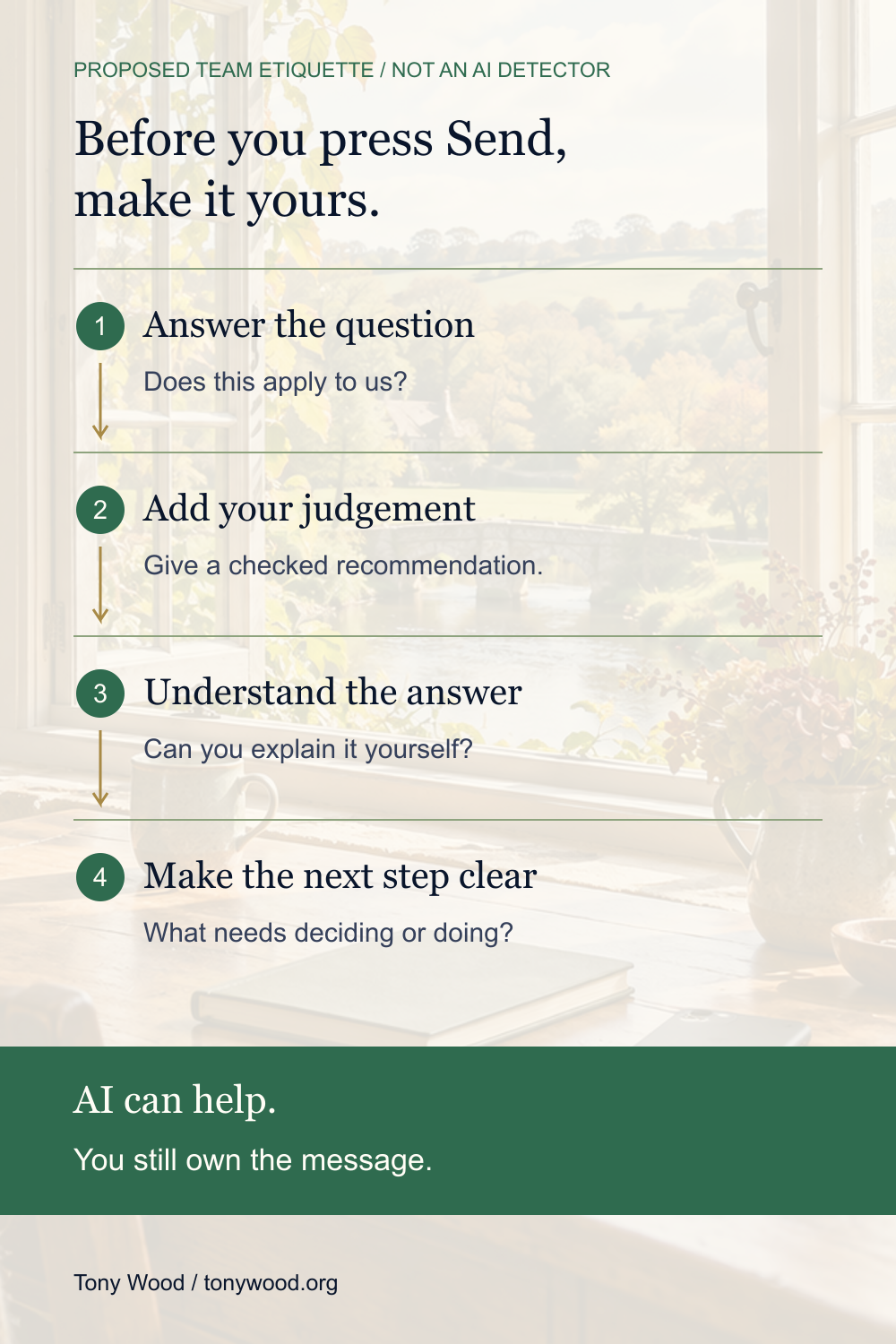
Before sending an email or recommendation, I would ask:
- Does this answer their question? Not a broadly similar question the AI preferred.
- What am I adding? My circumstances, checks, recommendation or explanation of what remains uncertain.
- Can I explain it? Without sending the next question straight back to the chatbot.
- Have I made the next step clear? What does the recipient actually need to decide or do?
And if you are sending an unverified AI draft because you want help reviewing it, say that. Agree who is doing the checking. That is a perfectly reasonable collaboration, not a finished recommendation in disguise.
A reply could be as simple as:
Could you give me your recommendation in a few lines, explain how it applies to us, and tell me which parts you have checked?
No public shaming. No argument about whether somebody sounds like a chatbot. Just a request for the contribution you needed.
The inbox is a shared space too
I think this is where the phone comparison becomes useful.
You can have the conversation. You still need to consider the people around you.
You can use the AI. You still need to consider the person receiving the result.
In my earlier piece about email becoming a source of useful context, I argued that agents could help us make more of the information arriving in our inboxes. I still think that. It does not mean the sender gets to stop caring whether the information is any good.
Perhaps AI;DR will become a useful little label. Perhaps the joke will wear thin. I cannot tell you it is an established inbox convention already.
But the etiquette behind it seems worth keeping.
Your AI can help write the email. It cannot take responsibility for what you meant to send.
Sources and notes
Sources checked on 19 October 2026. The weekend conversation is my personal account, paraphrased without identifying anyone. The inbox label and team rules are my proposals, not measured interventions or a claim about how most workplaces behave.
- Rick Manelius, AI;DR, 17 August 2026: an author's etiquette argument, crediting @seclilc, rather than evidence of widespread inbox-folder adoption.
- British Library Reading Rooms: current, setting-specific quiet-use guidance.
- Scott W. Campbell, 2007, and Pew Research Center, 2015 report (2014 fieldwork): different studies and populations, not a country-by-country ranking of manners.
- Cialdini, Kallgren and Reno, 1991: the distinction between descriptive and injunctive norms; application to AI is my interpretation.
- Hohenstein and colleagues, 2021 preprint: controlled smart-reply experiments. The later publisher page was inaccessible during this review, so this article identifies the version actually read.
- Lee and colleagues, CHI 2025: a vendor-affiliated, English-language survey of regular AI users, not a causal intelligence test.
- Liang and colleagues, 2023 research version: historical detector-bias evidence with limited samples, not a test of every present-day detection system.