A meat proxy is someone who forwards AI-generated documents without reading them.
Ask the AI. Copy the answer. Add your name. Press Send.
I heard the phrase recently and loved it. It is a slightly ridiculous name for a habit that deserves a very serious look.
Because there is a difference between using an AI to help you work and becoming its forwarding address.
First, what is a proxy?
A forward proxy is an intermediary. Your computer sends it a request, it makes the request on your behalf, and the response comes back through it. Proxies can do useful things along the way, such as controlling traffic, caching content or protecting identities. MDN explains the technical distinction.
The meat version is you sitting between the AI and another person. Except, in this particular version, the filtering appears to have been switched off.
The document arrives with your name, your job title and your reassuring little email signature. The recipient might reasonably think your judgement came with it.
Did it?
Who came up with it?
Niklas Gruhn published Don't be a meat proxy on 3 August 2026. He describes people passing on huge chatbot answers and moving code-review feedback back and forth through an AI without doing the thinking themselves. His instruction is wonderfully straightforward: Read it, understand it, validate it
.
Simon Willison highlighted the post that day, calling it an excellent new term.
But there is an earlier-dated page whose current text also uses the phrase. Frank Allenby's site carries meat-based llm proxies, dated 31 March 2026. The page also links to Gruhn's August post, so its current wording cannot prove what was there in March. I would credit Gruhn with helping popularise it, not confidently declare that he invented it. Those are the dates on the pages available now, not proof of who first said it anywhere.
Which is rather the point of this article. Even a lovely phrase deserves a checked attribution before we send it round the office.
You have not finished the work. You have moved it.
Imagine I ask for a recommendation between two suppliers. You send me a beautifully formatted document with eight headings, three tables and a conclusion that manages to recommend both.
I ask which one you would choose.
You ask the AI.
Come on. I could have done that bit myself.
What I needed was your understanding of our budget, the awkward integration, the deadline and the supplier who has already let us down. I needed a recommendation I could question, not another document I now have to investigate.
There is some research behind this concern. In a September 2025 online survey of 1,150 full-time US desk workers, BetterUp and Stanford's Social Media Lab found that 40% reported receiving AI-generated workslop in the previous month. Respondents estimated an average of around two hours to resolve an incident. That is a vendor-linked, self-reported survey, not an audited measure of everyone's productivity or a finding that all AI work is poor.
Still, it gives a name to the cost the recipient can inherit. You saved time producing the document. Have you saved anyone time using it?
This is not a request to stop using AI
Absolutely not. I want us to use these systems. Ask them to draft, research, explain, challenge and help you see what you have missed.
But do not mistake a fluent answer for a checked answer. And do not mistake reading for understanding.
A 2025 study by Carnegie Mellon and Microsoft researchers, based on 319 knowledge workers' self-reports, associated greater confidence in generative AI with less critical thinking. It did not establish that AI causes people to become lazy. It also described work shifting towards verification, fitting answers into context and overseeing the task.
That sounds like a useful job for us.
Nor do you need to rewrite a perfectly good sentence just to leave fingerprints on it. Jordan Foreman's response to Gruhn makes that useful distinction: selecting, shaping and routing information can add real value. Unexamined forwarding is the problem, not the mere fact that AI helped.
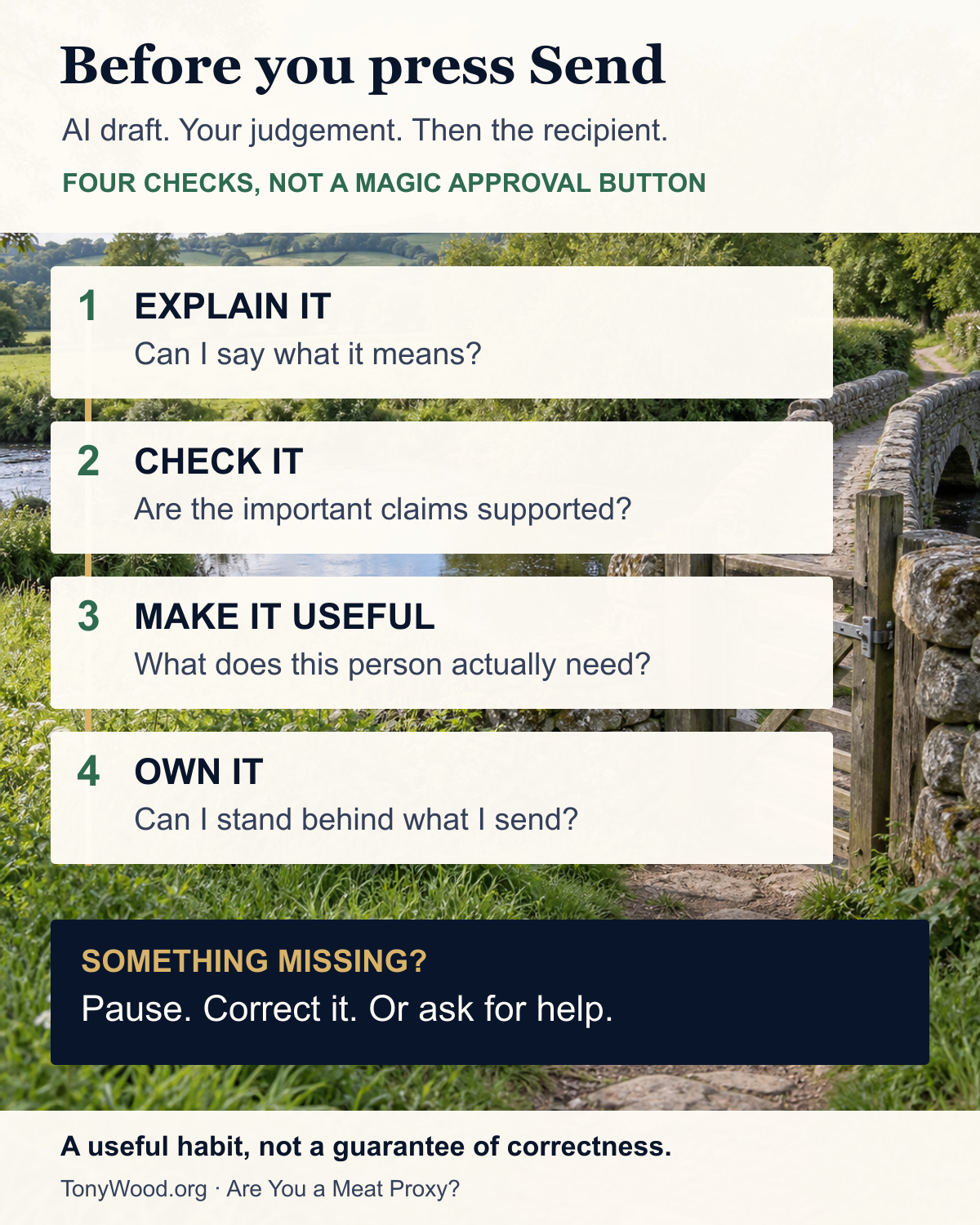
Before you press Send
Here is the test I would use. It is a practical habit, not a scientific score.
- Can I explain it? Put the document down. What is the argument, and what is the recipient being asked to do?
- Have I checked what matters? Open the important sources. Check the figures, dates and assumptions. If you cannot judge the technical claim, get somebody who can.
- Have I made it useful? Remove what the recipient does not need. Add the context only you know. Make the decision, uncertainty or request clear.
- Will I own it? If somebody challenges it tomorrow, can I discuss the evidence and correct the mistake without hiding behind the model?
And if you are deliberately sharing an unverified draft so a colleague can help check it, say so. Agree that job with them. That is collaboration, not pretending the checking has already happened.
A human in the loop, not just a finger on the button
I have written before about competence in the loop. Merely putting a human at the end of a process does not give that person the knowledge, time or authority to challenge it.
Managers have a part here too. If you demand more output while allowing no time to check it, do not act surprised when you receive more output and less judgement.
In a large agentic workflow, somebody reading every token is not a complete assurance system. You may need tests, monitoring, source checks and independent review, matched to the consequences. NIST's generative-AI risk profile, for example, recommends checking sources and citations during evaluation and ongoing monitoring. No magic approval click replaces that work.
But for the report, email or recommendation you send under your name, reading and understanding it is a fairly reasonable starting point.
Use the phrase with a smile, preferably on yourself first. This is a habit any of us could slip into, not a label to stick on a colleague.
Use the AI. Read the work. Bring your judgement.
Otherwise, you are not the human in the loop. You are the forwarding address.
Sources and notes
Checked on 10 September 2026. The origin discussion compares currently available, dated posts; it does not establish absolute coinage or prove what a page contained when first published. The workplace figures and critical-thinking findings are self-reported research with the limits noted above. The supplier example is illustrative, and the four-question test is my recommendation.
- Frank Allenby, meat-based llm proxies, page dated 31 March 2026; identity on the site's About page.
- Niklas Gruhn, Don't be a meat proxy, 3 August 2026; Simon Willison's same-day link post.
- MDN, Proxy servers and tunneling, updated 9 November 2025.
- BetterUp Labs and Stanford Social Media Lab, workslop survey, September 2025.
- Hao-Ping Lee and colleagues, The Impact of Generative AI on Critical Thinking, CHI 2025.
- Jordan Foreman, Be a (Good) Meat Proxy, 12 August 2026.
- NIST AI 600-1, Generative Artificial Intelligence Profile, July 2024, action MS-2.5-003.