
If I were backing a CEO, I would want them to have a room where they could say the thing they were not yet ready to put in a board paper.
It might be a doubt about the strategy. A concern about a member of the leadership team. A decision that looks sensible on paper but still feels wrong. Or the uncomfortable possibility that the CEO is part of the problem.
I would want them to examine it properly. I would also accept that the most useful room for that conversation might be one I did not control.
That is the case I want to make for CEO CF from a venture capital perspective. I am involved in CEO CF, so this is my personal view. It is not a promise of better returns and it is not an argument for keeping material information from a board. It is an argument for giving a leader an independent place to think before they bring a clearer decision back to the people responsible for governing and funding the business.
The investor relationship changes the conversation
A good investor can be an excellent adviser. They may have seen several companies make the same hiring mistake, enter the same market or run into the same financing problem. A thoughtful board member can ask a question that changes a company.
They are also an owner, monitor and governor. Their advice arrives inside a relationship involving capital, performance and accountability. That does not make the advice less valuable. It does mean the CEO may think carefully about how an unfinished concern will be heard.
Imagine a CEO who is no longer convinced by the plan they presented six weeks ago. The honest first sentence may be, “I think I have been defending this because it was my idea.” That is useful thinking. It is not necessarily the easiest opening line in an investor update.
A confidential peer room gives the CEO somewhere to work on the thought while it is still rough. They can test whether the doubt is a passing reaction, a gap in the evidence or a sign that the plan needs to change. The purpose is to improve the conversation with the board, not avoid it.
Support can include giving up access
Venture capitalists already say that the management team matters enormously. In a survey of 885 institutional venture capitalists at 681 firms, Paul Gompers and colleagues found that 95 per cent regarded the management team as important when selecting an investment. Respondents also described substantial work after investment, including strategic and operational guidance and introductions to customers and other investors.
That is a survey of what investors said they valued and did. It does not test CEO CF or prove that a peer group changes investment performance. It does establish that many investors see supporting the people running a company as part of the job.
My addition is that one form of support can be valuable precisely because it is independent of the investor relationship.
There is already a practical precedent for this idea. Octopus Ventures describes coaching for founders as confidential and independent. It says that, beyond connecting founders and coaches, the firm has no insight into the sessions. Coaching is different from CEO CF, but the boundary is instructive. An investor can pay attention to a leader's development without asking to sit inside every developmental conversation.
The board is a decision room. A peer group can be a thinking room
A board needs to govern. It needs enough information to make decisions, challenge management and discharge its duties. Nobody should use a peer group to conceal something the board needs to know.
But good governance does not require every early thought to begin in the boardroom. Leaders need places where they can admit uncertainty, explore alternatives and discover that they have been asking the wrong question.
That is the distinction I would make. The board is a decision room. A continuing peer group can be a thinking room.
The thinking room should make the eventual board conversation better. The CEO may return with a more precise diagnosis, a proposal that has survived challenge or a clear statement of what they still do not know. Independence earns its place when it improves responsibility rather than diluting it.
What actually happens in the room
CEO CF describes carefully matched groups of 8 to 14 leaders from non-competing businesses. The groups meet in person three times a year, maintain contact between meetings and work under a confidentiality commitment. An approved guest can attend a group meeting before deciding whether membership is right for them.
The useful unit is not “networking”. It is one consequential, unfinished decision.
The CEO prepares the issue, presents it and first receives questions. That order matters. The group tries to understand the situation before moving into Observations and Recommendations. The CEO then identifies what they have discovered or rediscovered and chooses what they will do next.
Questions before recommendations make it harder to rush towards the familiar answer. A CEO may arrive asking how to replace a sales director and discover that the more important issue is a pricing model nobody believes in. They may still need a new sales director. They now have a better problem to solve first.
I have written separately about why I think the CEO CF Challenge format helps leaders think through difficult decisions. For an investor, the relevant point is that the CEO retains the decision. Peers contribute questions, experience and recommendations. They do not become a shadow board.
Confidentiality is part of the method
Confidentiality can sound like an administrative rule. In a room like this, it changes what people are willing to examine.
If every sentence could later be reported to an investor, employer or colleague, the CEO would quite reasonably manage the impression they created. The conversation would start later, after the uncertainty had been cleaned up. That is precisely the part of the thinking the room is there to help with.
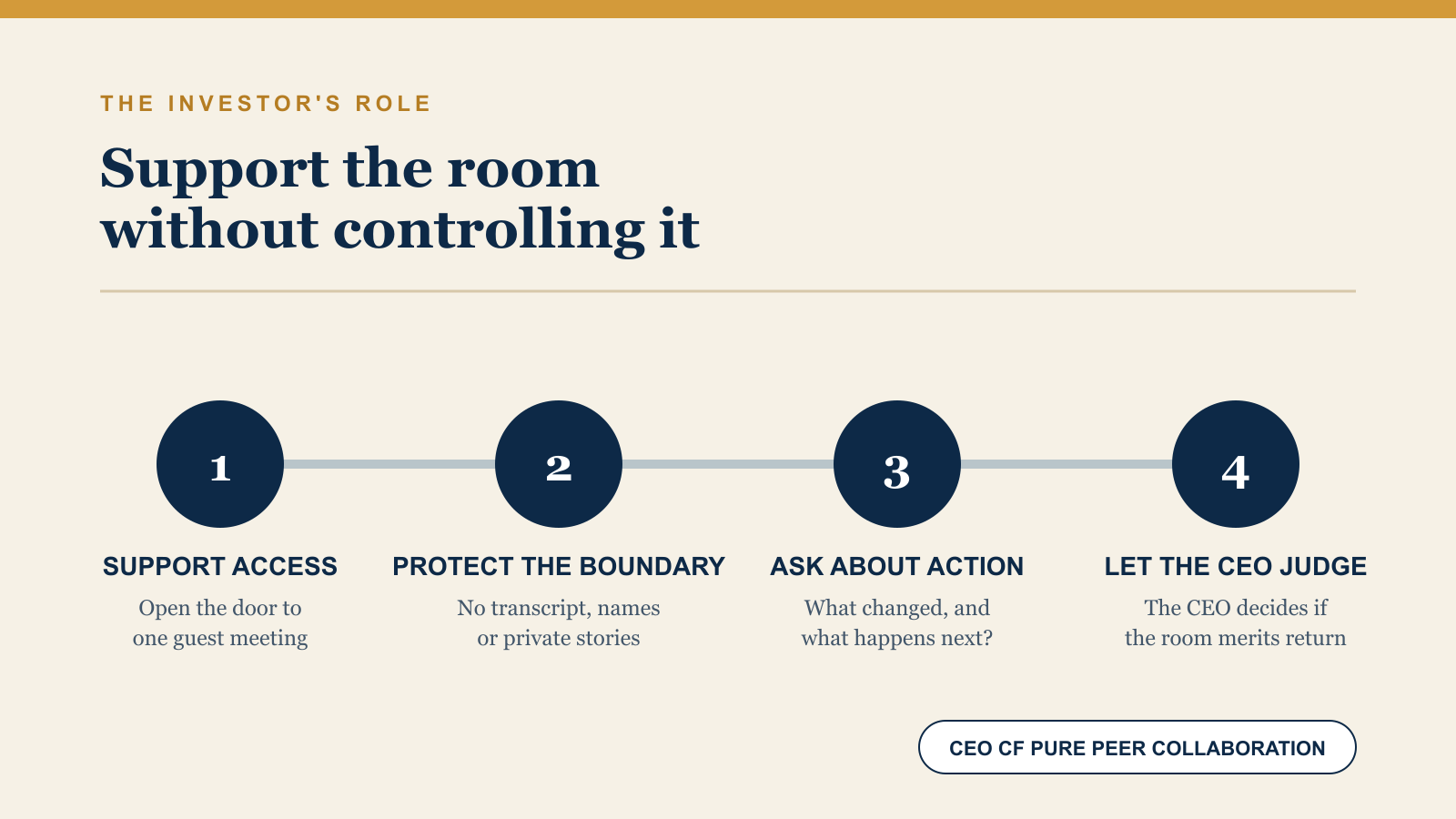
The investor does not need the transcript, the names of contributors or the private stories used to help the CEO. They can ask questions at the level that matters to the company:
- Did the way you understand the decision change?
- What action have you chosen?
- What evidence will tell us whether it is working?
- When should we return to it?
That keeps accountability where it belongs while protecting the conditions that made candid thinking possible.
Why the same people should meet again
A useful adviser can ask a good question. A continuing group can also remember the answer you gave last time.
That continuity matters because business decisions unfold. The acquisition that looked exciting becomes an integration problem. The reorganisation reveals a capability gap. The conversation a CEO promised to have did not happen.
When the same peers return, the context does not disappear at the end of the meeting. They can ask what happened, what changed and what the CEO learned. A new room may provide fresh ideas. A continuing room can notice a repeating pattern.
This is one reason I see CEO CF as leadership infrastructure rather than an event. The value is not simply the quality of one conversation. It is the expectation that the conversation has a next chapter.
That continuity is also the subject of my companion article, You Do Not Need Another Network. You Need a Room That Remembers.
What I would ask a portfolio CEO
I would not ask for a report on the other people in the room. I would ask the CEO to judge the experience against three practical tests:
- Did you speak more plainly than you normally can?
- Did a question change the way you understood the problem?
- Did you choose an action worth returning to?
I would also look for fit. The CEO must be willing to bring a real issue, listen without defending every decision and make the same effort for other members. A peer room is reciprocal. It will not work as a service where a busy leader arrives, collects advice and leaves.
CEO CF should complement the board, the investor and specialist advice. It cannot replace legal, financial, sector or operational expertise. Nor should a CEO join because the name looks useful on a biography. The case rests on the quality of the work done in the room and what the leader does afterwards.
One meeting is a sensible first test
If I were sponsoring a portfolio CEO, I would start with one approved guest meeting.
I would ask them to take a real question, not a polished presentation designed to impress the room. I would protect the confidentiality boundary and let them experience the process. Afterwards, I would ask about the clarity and action it produced, not for an account of everybody else's contributions.
Then I would let the CEO decide whether the room merits continuing.
The strongest support an investor can give is not always another opinion. Sometimes it is access to a room where the CEO can hear their own thinking properly, test it with experienced peers and return ready for a better decision.
Your CEO may need that room. Its value may depend on it being one you do not control.
Sources and notes
This is Tony Wood's personal case for an independent CEO peer room. Sources were checked on 4 September 2026. I am involved in CEO CF. No public controlled evaluation was found that establishes CEO CF-specific effects on company performance or investment returns.
The Gompers study reports a survey conducted in 2015 and 2016. It supports the claim that the surveyed VCs placed high importance on management teams and described substantial post-investment support. It does not evaluate peer groups.
Octopus Ventures' account is an investor's description of its own founder-coaching provision. Its confidentiality boundary is a useful practice example, not an endorsement of CEO CF, and coaching is not the same intervention.
Group size, meeting frequency, non-competition, confidentiality and guest attendance come from the CEO CF FAQs. The questions-first Challenge sequence draws on local CEO CF method material and the linked TonyWood.org explanation of the format. The sales-director situation is invented. No private member story or investor endorsement is presented as evidence.