There is a point in the life of a difficult decision when it is too early for a board paper and too important to keep turning over inside your own head.
You know something needs to change. You may not yet know whether the problem is the strategy, the team, the timing or you. You can explain the polished version. What you need is somewhere to say the unfinished version.
At that point, I do not think you need another network. You need a room that remembers.
I am involved in CEO CF, and this is my personal view of what its continuing peer groups can offer. It is not access to a list of useful contacts. It is a group of people who hear the difficult question, help you examine it, and are still there when it is time to ask what happened next.
For the investor looking at the same relationship from outside the room, I have written the companion piece, Your CEO Needs a Room You Do Not Control.
The decision before the decision
Chief executives are expected to make decisions. The harder part is often working out what the decision really is.
A growth problem may be a positioning problem. A performance problem may be an unclear set of expectations. A proposed acquisition may be a way of avoiding the slower work needed in the existing business.
The first account a leader gives themselves is not always wrong. It is simply incomplete. The challenge is finding somewhere they can test it before the organisation starts moving around it.
An INSEAD study based on interviews with 111 CEOs found that more than 65 per cent described balancing competing stakeholder interests as a challenge in high-stakes decisions, while more than 60 per cent raised unpredictable conditions or a lack of reliable data. This is descriptive research rather than a test of a solution. It does capture something familiar: consequential decisions often arrive before certainty does.
A CEO needs good governance, capable executives and the right specialist advice. They may also need a room where the issue can remain unfinished for long enough to be understood.
A network gives you contacts. A room gives you a conversation
There is nothing wrong with a useful network. Introductions matter. A contact in a new country can save weeks. Someone who has hired the role you need may point you in the right direction.
But access is not the same as candour.
At a networking event, most of us tell the story we already understand. We explain what the company does, where it is going and why it is interesting. A decision room has a different purpose. It should help us find the part of the story that does not yet make sense.
That requires enough time to listen, enough structure to stop the loudest answer winning and enough trust to say, “I may have handled this badly.” The value is not the number of people you meet. It is the quality of the thinking you can do with them.
Bring one real, unfinished decision
CEO CF describes groups of 8 to 14 carefully matched leaders from non-competing businesses. They meet in person three times a year, stay in contact between meetings and work within a confidentiality commitment.
The practical invitation is simple: bring one consequential, unfinished decision.
Not a case study whose ending you already know. Not a speech about the company. A question where another perspective could still change what you do.
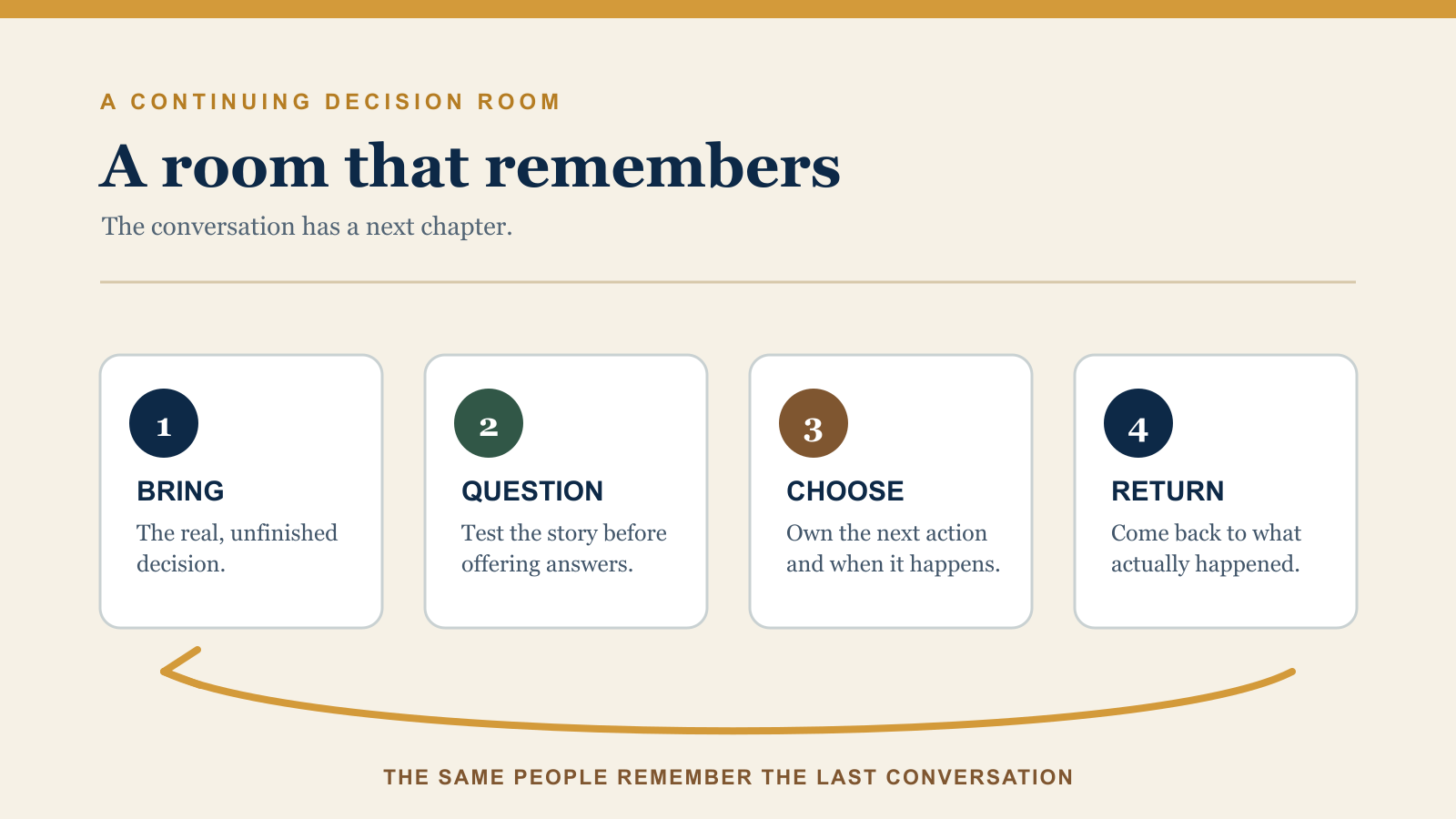
The CEO CF Challenge begins with preparation. The CEO presents the situation, then the group asks questions before moving to Observations and Recommendations. That sequence gives the story a chance to change before people start trying to solve it.
The difference can be substantial. A CEO may ask how to persuade a senior leader to stay. The questions reveal that they have spent six months avoiding a direct conversation about performance. Retention may still matter. The immediate decision is now about honesty.
The room has not made the decision. It has helped the CEO see it.
Why the same people matter
A good one-off conversation can be extremely useful. It can also end just as the interesting part begins.
The next part of a decision happens in the company. The conversation goes well or badly. The customer says no. The person you were sure would leave decides to stay. New information changes the economics. You discover that the obstacle you worried about was not the real obstacle.
When the same group meets again, you do not have to start from the beginning. People remember the reasoning, the commitment and perhaps the hesitation in your voice when you made it. They can ask what happened. More usefully, they can notice when a different problem contains the same pattern.
That is what I mean by a room that remembers. It remembers the business context, but it also begins to remember you.
The continuity changes the standard of the conversation. “I will deal with it next week” is a different sentence when everyone knows there will be a next time.
There is research behind the design, with limits
The best external evidence does not prove that CEO CF produces a particular business result. It does give us reasons to take recurring peer relationships seriously.
In a randomised study of 2,820 young Chinese firms, Jing Cai and Adam Szeidl assigned some owners to groups of ten that met monthly for a year. The researchers reported improvements in business performance and evidence that peers shared information and business relationships.
That was a different country, a different population and a different programme. The reported revenue effect should not be transferred to CEO CF. What travels more cautiously is the design idea: recurring contact among peers can create information exchange and relationships that a single event cannot.
A UK evaluation of the Peer Networks programme found that more than 90 per cent of surveyed participants felt able to build trust and share real issues, and 63 per cent reported maintaining trusting relationships six months later. The evaluation also warns about self-selection, other support received by participants and delivery during the pandemic, much of it virtual. These are participant reports with important limits, not proof of a CEO CF effect.
Together, the studies support an idea rather than a sales claim. If you want peers to exchange useful information and develop trust, repeated contact is a sensible part of the design.
You are not buying access to a room
A continuing peer group only works if everybody helps create it.
You cannot arrive only when you have a problem, collect ten recommendations and disappear. Other members need you to listen to their unfinished thinking with the same care you want for yours. Your experience becomes useful when it helps somebody else ask a better question.
That reciprocity is part of the attraction. A CEO spends much of the day being asked for an answer. In a peer room, they can contribute without having to be the final authority. They can recognise a problem from their own past, offer what they learned and still leave the decision with the person who has to live with it.
You are not buying access to a room. You are agreeing to help build the room.
Confidentiality lets the unfinished version exist
Some decisions cannot be discussed casually. They involve people, money, investors, customers or changes that have not been announced. More often, the sensitive part is the leader's uncertainty.
Confidentiality does not remove a CEO's duties to their board or company. It creates a boundary within which they can work on how to meet those duties well.
That boundary allows the CEO to try a sentence, hear how it sounds and correct it. Other members can share relevant experiences without wondering where their names or stories will travel. The room can challenge the account without turning the conversation into a public verdict.
This is also why continuity and confidentiality belong together. Trust is not a line in the meeting notes. It is a judgement people keep making about one another over time.
It is not for everybody
If you want leads, prestige or an audience for a polished story, this is probably the wrong test.
The fit is more demanding. You need a real issue. You need to be willing to hear questions before defending your answer. You need to respect the confidentiality of other people and make time for their Challenges as well as your own.
You also need to attend. A room cannot remember you if you are rarely in it.
The group will not always be right. Experience from another company is evidence to consider, not an instruction to copy. Legal, financial and specialist questions still need the right professional advice. The CEO remains responsible for deciding what applies.
Attend once with a question that matters
CEO CF allows an approved guest to attend a group meeting. That makes the first step practical and reversible.
Take a decision that is still capable of changing. Give the room the honest version. Then judge the experience against three questions:
- Did I speak more plainly than I usually can?
- Did a question change the way I saw the problem?
- Did I choose an action worth revisiting?
Do not judge it by how many business cards you collect. Judge it by whether the room helped you think and whether you would value returning to the same people after reality has had its say.
You probably do not need another network.
You may need a room that remembers.
Sources and notes
This is Tony Wood's personal account of the value he sees in a continuing CEO peer group. Sources were checked on 4 September 2026. I am involved in CEO CF. No public controlled evaluation was found that establishes CEO CF-specific effects on company performance, decision quality or leadership outcomes.
The INSEAD CEO study is descriptive. The Cai and Szeidl study and UK Peer Networks evaluation concern different participants and programme designs. They provide evidence about components and analogous settings, not the outcome of joining CEO CF.
Group size, non-competition, meeting frequency, contact between meetings, confidentiality and the guest route come from the CEO CF FAQs. The Challenge description draws on local method material and my article on why the CEO CF Challenge format works. The senior-leader example is invented. No private member story is presented as evidence.