
A difficult business decision deserves more than a quick round of opinions. It deserves a clear question, people willing to examine it properly, and enough discipline to turn a useful conversation into something you can act on.
That is what I value about the CEO CF Challenge format. A leader brings a real issue to a continuing group of peers. A coach helps them prepare. The group works through a deliberate sequence. The presenter then decides what they have discovered and what they will do.
I am part of CEO CF, so this is a personal view of a community I care about. I wanted to look more closely at why the format makes sense, including what research can tell us about its ingredients.
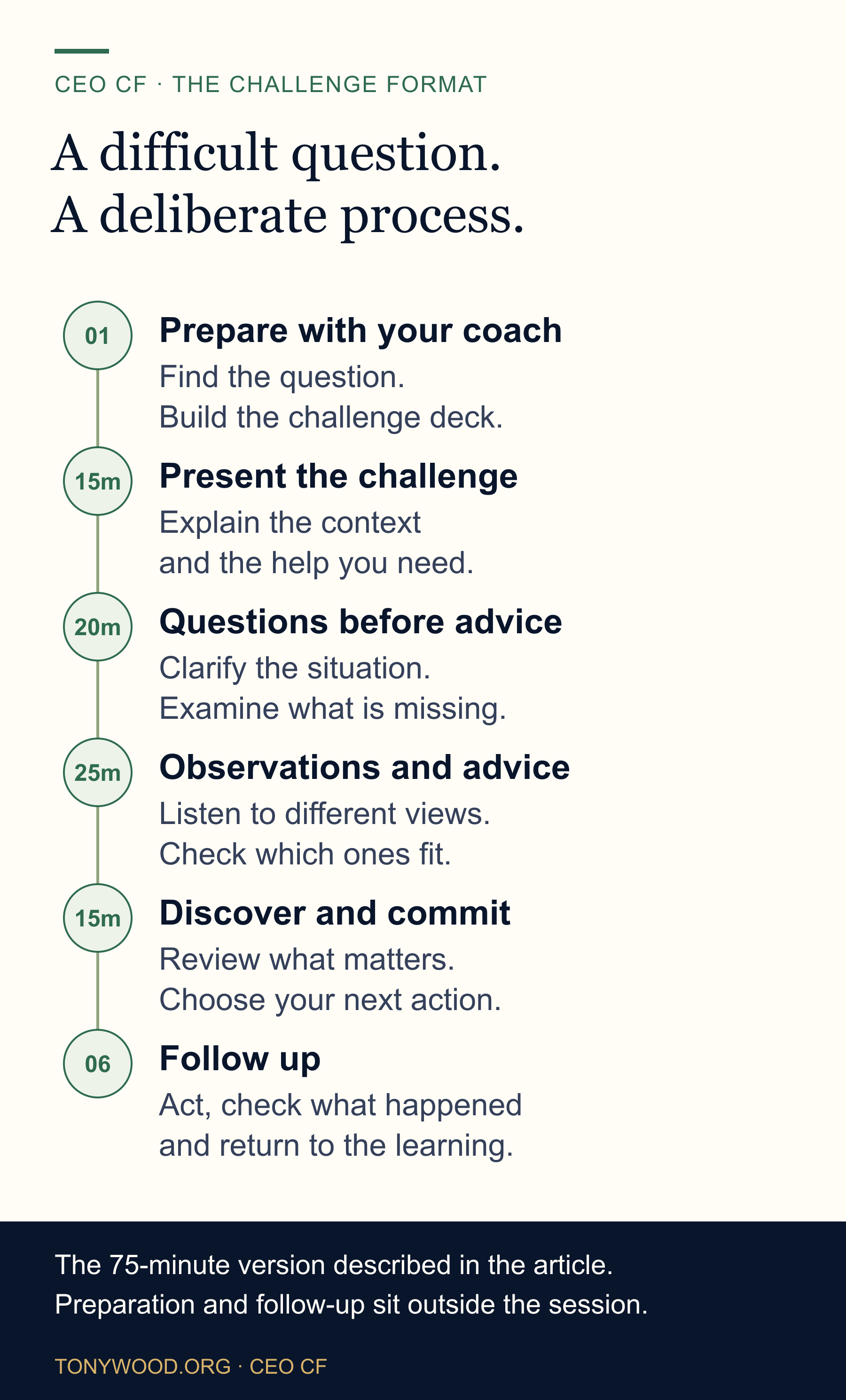
What makes sense to me is how the stages connect: prepare and frame the issue; write and present it; answer questions; hear observations and recommendations; identify discoveries and rediscoveries; then commit to action. Preparation gives the questions something specific to test. The feedback gives the presenter something to weigh. Follow-up gives everyone a chance to learn what happened.
The work starts before the meeting
The first useful intervention is often the preparation conversation. Before building a deck, the leader and coach have to work out which question deserves the room's attention.
Consider an invented example. A founder arrives saying, “We need a better sales director.” After some discussion, the challenge becomes: “Why do our customers buy the pilot but hesitate to roll it out?”
Those questions lead to quite different conversations. The first already contains a proposed answer. The second leaves room to examine the product, the buying process, implementation and the evidence.
The coach helps narrow the issue, organise the relevant context and prepare a presentation that other people can work with. That requires some resistance to a beautifully polished account of the wrong problem.
There is a useful research foundation here. A 2023 meta-analysis by Erik de Haan and Viktor Nilsson analysed 39 randomised coaching samples involving 2,528 participants and found positive average effects on the personal and leadership outcomes studied. It also found signs of publication bias and larger effects for self-reported than observed outcomes. Those findings support coaching as a serious intervention; they do not establish the effect of one CEO CF preparation call.
Another relevant finding comes from Rozenblit and Keil's research on the illusion of explanatory depth. People can feel that they understand a mechanism until they have to explain how it actually works. Their experiments concerned explanatory knowledge, including everyday devices. The business application is my inference: putting a diagnosis into words gives us a chance to notice what we have assumed.
A preparation question I would keep close is: “What would make this the wrong question to bring?”
Seventy-five minutes, with a job for each stage
The 75-minute version I am describing has four blocks, with preparation before it and follow-up afterwards. Other versions use different timings:
- 15 minutes to present. Explain the challenge, the context and what help would be useful.
- 20 minutes for questions. Peers clarify the situation before offering recommendations.
- 25 minutes for observations and recommendations. The presenter listens while peers contribute their perspectives.
- 15 minutes for discoveries, rediscoveries and commitments. Review the captured feedback, identify what matters and choose the next actions.
The timing gives each activity space. No study I found establishes these exact minutes as optimal, or tests the complete CEO CF sequence. The research helps explain the design choices. It does not provide a scientific seal for the whole programme.
The deck helps you work out what you mean
A useful challenge deck gives peers enough information to understand the decision. What is happening? What have you tried? What do you know? Where are you uncertain? What decision are you facing?
Choosing that material is work. A page of options can expose a missing option. A timeline can reveal that the explanation does not fit the order of events. A number on a slide can prompt the awkward but necessary question: “Where did that come from?”
A meta-analysis of self-explanation research by Bisra and colleagues, drawing on 64 research reports, found learning benefits from prompting people to explain material. These were instructional settings, rather than executive decisions. They provide a good reason to make the presenter do the explaining rather than simply approve someone else's slides.
The fifteen-minute presentation brings that explanation into the room. It also imposes a useful editorial constraint: decide what your peers need to know. The company history can usually survive being shortened.
Questions deserve their own twenty minutes
For me, this is one of the strongest features of the format. It makes room for understanding before advice.
“Which customers are hesitating?” is a question. “How many pilots have converted?” is a question. “Have you thought about hiring my former sales director?” is already a recommendation, however politely it is dressed.
In our invented example, the questions might uncover a difference between customers who cannot justify the cost and customers who cannot implement the product. The same disappointing conversion figure could conceal two different problems.
Questions also let the presenter correct the group's understanding. The object is to get a more useful account of the situation onto the table. A rapid answer to a misunderstood question is not much of a service.
Research on “hidden profile” group tasks offers a relevant warning. Across 65 studies, groups tended to discuss common information more than information held by only one participant. Business challenges are more open-ended than those experiments, but the implication for a Chair is useful: actively make room for information the conversation has not yet surfaced.
Different experience becomes useful when people explain it
CEO CF describes its groups as bringing together non-competing leaders across industries and countries. That creates the possibility of seeing the same issue through different experience. A manufacturing leader might ask about delivery capacity. A software founder might ask about adoption. Another member might recognise a problem with incentives.
Those are hypothetical perspectives, not fixed characteristics of people in those industries. Their value lies in opening up alternatives the presenter can examine.
The distinction between an observation and a recommendation helps. “You have described three different buyers” is something a peer has noticed. “I would test the proposition separately with each buyer” is a proposed action. Keeping those apart makes it easier for the presenter to accept the observation while questioning the advice.
The written contribution matters too. I would protect a short opportunity for each peer to formulate their own view before the discussion gathers momentum.
In Lorenz and colleagues' experiment with 144 participants, seeing other people's estimates narrowed the range of answers without improving collective accuracy in the tasks studied. It is a warning against treating convergence as proof. My practical conclusion is to preserve independent thought and invite disagreement before everyone settles comfortably around the first confident answer.
The Chair protects the conversation
The Group Chair and facilitator keep the session moving, protect the distinction between questions and recommendations, and help the group contribute constructively. The Facilitator Assistant captures the feedback so the presenter can review it.
I would judge the quality of chairing partly by what it makes possible: a quieter member gets heard; a recommendation is examined; the presenter can admit uncertainty; a sharp challenge remains respectful.
Amy Edmondson's study of 51 work teams found that psychological safety was associated with learning behaviour. It was a study in a manufacturing company, not a trial of CEO peer groups. Its relevance here is the importance of being able to take an interpersonal risk: ask for help, report a mistake or question an assumption.
For me, a good Challenge should allow someone to say, “I think you are solving the wrong problem,” and give the presenter room to consider it. That takes care, especially when the subject is personal or the stakes are high.
Peers still have incomplete information. Their experience can suggest a useful avenue, but the presenter has to check whether it fits. Some decisions also need specialist advice and further investigation after the meeting.
The final fifteen minutes belong to the presenter
This is where a collection of contributions becomes the presenter's own judgement. What have I discovered? What have I rediscovered? Which observation changes my understanding? What will I do now?
The group can offer plenty. The presenter does not have to adopt every recommendation, and the session is not a vote on how to run their business.
CEO CF uses SMART commitments: specific, measurable, achievable, relevant and time-bound actions. I find the useful test is whether the commitment describes something that will actually happen.
Returning to our invented example: “Improve customer adoption” leaves a great deal open. “By Friday, arrange three conversations with customers whose pilots stalled, and separate purchasing objections from implementation problems” gives the leader a first action and a way to learn.
Gollwitzer and Sheeran's research on implementation intentions supports connecting a particular situation to a planned response. A useful addition might be: “If a customer names an implementation obstacle, I will ask them to show me the step where progress stops.” That is an application of the research, not a prescribed CEO CF script.
The follow-up matters because a good intention can still disappear into a busy diary. Harkin and colleagues' meta-analysis of 138 experiments found that interventions encouraging progress monitoring improved goal attainment on average. Effects were larger when progress was recorded or reported. In this setting, reporting can mean a confidential conversation with the coach or peers.
And when action has happened, review it. Research on structured debriefs supports learning from completed activity. That is particularly relevant to the later review of what the leader tried, rather than treating the original advice session as an after-action review.
More than twenty years of a continuing community
CEO CF began in 2005. The local membership register reviewed for this article contains 339 current and alumni records, covering 338 distinct names after basic deduplication. That is a count from the records available, not a complete census of everyone who has ever attended.
My own attendance records mark 31 summits between 2016 and 2026. They cover only part of my involvement, and summit attendance does not tell us how many individual Challenges I joined. I would rather use the figure for what it shows: a continuing relationship with the community over many meetings.
What interests me about that continuity is the opportunity to return. What happened after the last decision? Which assumption held up? What did we miss? Familiar peers have a chance to hear more than the initial story.
That is why I rate the format so highly. It gives a difficult issue time, structure and several thoughtful perspectives. It asks the leader to explain, listen, reconsider and choose. Then it creates a reason to come back to the decision after real life has had its say.
A leader may arrive wanting an answer and leave with a better question. I count that as progress when it leads to a more useful next step, with people you can return to as you learn.
Sources and notes
The format is described from CEO CF's local methodology guides and the 75-minute version specified for this article. Other timing variants exist. The guides describe preparation, live written capture and follow-up; they are process evidence, not outcome evaluations. CEO CF's FAQs explain the continuing peer groups, and its FA Academy page describes documentation and facilitation training.
The research links above concern coaching, learning, group judgement and action planning. None of the studies cited evaluates the complete CEO CF Challenge. The coaching paper was checked in an accessible copy of the original paper; some other references were available as published abstracts, with claims restricted accordingly. The membership count was checked on 2 September 2026; the attendance calculation uses an August 2026 local snapshot. No member cases or other members' contributions are reproduced.
For the wider community context, see CEO CF: Bringing European Leaders Together Since 2005. For the learning and memory side, see Why a CEO CF Challenge Can Stay With You Long After the Meeting.