
A useful test of a CEO CF Challenge comes later, when you are back at work. Can you bring the useful lesson to mind, check the detail and do something with it?
That is the part I want to understand here. Preparation and the conversation give you material to work with. Returning to the record, recalling what changed your thinking and finding out what happened after you acted give you further opportunities to learn.
For me, the learning starts before the meeting and can continue well beyond it, for the presenter and for the peers who take part.
I am part of CEO CF. This is my interpretation of the format through the learning research, rather than a claim that anyone has measured its effect on members' memory.
Writing the challenge requires you to choose
A concern can remain rather vague while it lives entirely in your head. “The team is not aligned.” “The board does not understand.” “Our growth has stalled.”
Preparing a challenge forces choices. Which evidence belongs in the account? What happened first? Which explanation are you using? What is the actual question?
That matters because generating material and recognising familiar material are different tasks. Bertsch and colleagues' meta-analysis of 86 studies found a memory advantage for generated information over material people simply read. Many of the tasks involved words and similarly constrained material. It would be quite a leap to turn that into a percentage improvement for a CEO's strategy deck.
For me, the useful application is to keep the leader actively involved in constructing the explanation. The coach can help organise it. The leader still needs to work out what they mean.
Research on self-explanation adds another reason to value that work. Explaining relationships and causes can support learning. A clear-looking slide is not, on its own, evidence that its author understands those relationships.
Preparing to explain is part of the benefit
You know that other leaders will ask questions. That gives preparation a purpose beyond making the slides presentable.
A 2024 meta-analysis by Keiichi Kobayashi found an important condition in learning by teaching: explaining material benefited learning when people had studied with the expectation of teaching it. The average benefit was not statistically distinguishable from zero when they had studied without that expectation.
Those were educational studies, and explaining a business challenge is a different activity. Still, the finding strengthens the case for treating preparation and explanation as connected parts of the design. Simply asking somebody to speak at the end of a meeting is not the same intervention.
During a Challenge, the presenter also has to make the account understandable in real time. An explanation that seemed perfectly adequate at the kitchen table may need work when another person asks what one of its key words means.
Saying something can help you remember it
Memory researchers call one relevant finding the “production effect”. Producing material, including speaking it aloud, can improve later memory compared with silently reading it.
MacLeod and Bodner's review describes both the effect and its boundaries. Much of the evidence comes from word-list experiments, and the way produced items stand out from other items matters. The research does not show that reading an entire deck aloud makes every idea more memorable.
My practical preference is to explain the challenge in your own words. Use the deck to keep the context available. If you hear yourself making an assertion that you cannot properly explain, that is useful information to take into the question period.
The screen should give the explanation some shape
It is tempting to think that seeing the words, hearing them and saying them must automatically make the memory stronger.
The evidence is more conditional. In Kalyuga, Chandler and Sweller's multimedia experiments, adding written text that duplicated spoken text could interfere with learning. The studies used technical instructional material. They are a reason to pay attention to cognitive load, not a rule that visible words are always unhelpful.
A short question, a timeline, a diagram or a few relevant figures can give the group something to inspect while listening. A wall of prose gives them another reading task.
In a pan-European group, clear terminology and readable labels also make practical sense. Leave time to inspect an important number or clarify a phrase. The aim is shared understanding.
Questions make you retrieve, explain and sometimes revise
When a peer asks, “What happened the last time you tried that?”, you have to retrieve an experience. When they ask, “What evidence supports that explanation?”, you have to find and evaluate the basis of your claim. When they ask about an alternative, you may have to reason about something new.
Those activities should not all be called memory retrieval. But the occasions when you genuinely recall relevant material are interesting.
Karpicke and Roediger's experiment asked students to learn foreign-language vocabulary. Continuing to retrieve successfully learned words improved delayed recall; continuing to study those words did not produce the same benefit in that experiment.
The practical inference is modest: answering a question from memory may be a learning opportunity as well as a way to inform the group. It does not follow that every difficult question improves memory or that a confidently recalled answer is correct.
The Chair can give the presenter time to think, and the record can distinguish an answer from something that needs checking. “I don't know; I will find out” is a perfectly useful contribution.
The people listening have work to do as well
A Challenge belongs to one presenter, but there is an opportunity for everyone to learn.
As a peer, you can ask yourself: what resembles a decision I have faced? What is different here? Why would my suggested response work in this situation? What would make it fail?
That last pair matters. Experience from another business is most useful when its assumptions travel with it.
Gick and Holyoak's experiments on analogy found that comparing two examples could help people extract a common problem structure and transfer it to another task. These were laboratory problems with designed solutions. They support deliberately comparing cases; they do not show that an anecdote from one company will solve another company's problem.
I would encourage each peer to leave with a short note of their own: “The principle I might use is this. The condition I must check is that.” It makes participation more demanding, and more useful, than waiting for your turn to give advice.
The written record gives you something to check
CEO CF's Facilitator Assistant captures feedback for review. Observations, recommendations and the presenter's discoveries serve different purposes, and it helps to keep them recognisable in the record.
This matters because a memorable conversation can still be misremembered. In Roediger, Meade and Bergman's social-memory experiment, participants could later recall objects that another person had suggested, even though those objects had not appeared in the scenes they saw.
That is a laboratory demonstration, not evidence of a problem at CEO CF. It gives us a reason to preserve the difference between what the presenter originally reported, what a peer proposed and what the presenter subsequently concluded.
A written record cannot guarantee accuracy either. It does make correction possible. During Observations and Recommendations, the contributor can check that the capture preserves their meaning while the presenter listens. The presenter can return to the record when it is their turn to reflect.
The record also means we can use the conversation without remembering every sentence. The aim is to retain the useful understanding and know where to find the detail.
Discovery is a moment; returning to it is a practice
At the end of the Challenge, the presenter reviews discoveries, rediscoveries and commitments. A rediscovery may be something they already knew but had stopped applying.
There is a further opportunity after the meeting: try to recall the useful ideas before reopening the notes.
Cepeda and colleagues' review of distributed practice covered 317 experiments on verbal recall. It showed that the spacing between learning episodes and the delay before the final test jointly mattered. There is no single interval that makes all learning stick, and the research does not establish three annual summits as an optimal memory schedule.
Combining that work with retrieval research suggests a practical routine I would use:
- After the Challenge: put the main discovery and intended action into your own words.
- At a later review: before opening the record, write down what you remember of the question, the discovery and the commitment.
- Then check: compare your recollection with the notes and correct what you missed or changed.
- After taking action: record what happened and what that changes about your understanding.
This is a suggested learning routine, not an additional CEO CF requirement or a tested prescription for its members. The distinction matters: the same-session word “rediscovery” does not itself establish that spaced retrieval has taken place.
Experience becomes more useful when we learn what happened
Repeated Challenges can give us more cases to compare. What I want to preserve alongside them is the outcome: what did the leader actually try, and what happened next?
In their 2009 analysis of intuitive expertise, Daniel Kahneman and Gary Klein argued that dependable intuition needs an environment with learnable regularities and opportunities to learn them through practice and clear, timely feedback. They also warned that confidence is an unreliable guide to accuracy.
That is a condition to examine, not a promise that attending more Challenges creates expertise. A business decision may unfold slowly, and several things may change before its outcome becomes clear. Recording the result alone does not tell us which recommendation helped.
At a later review, I would put the original account next to what happened: What did we expect? Which action was actually taken? What else changed? Which assumption should we keep, revise or drop? If the outcome is still unclear, record that too.
This is where the Challenge record can earn its keep again. It lets us revisit an earlier judgement without relying entirely on the version we remember after learning the result.
What matters when you are back at work
The useful outcome is being able to bring the right lesson to mind when you need it, find the detail, and take an appropriate next step.
A commitment needs a place in the diary and something you can review. Experimental research on progress monitoring supports checking what actually happened rather than relying only on an intention. The later conversation can then become a review of evidence.
For example, did the customer interviews change your diagnosis? Did the board discussion uncover a different constraint? Did the action fail because the idea was wrong, or because it was never carried out?
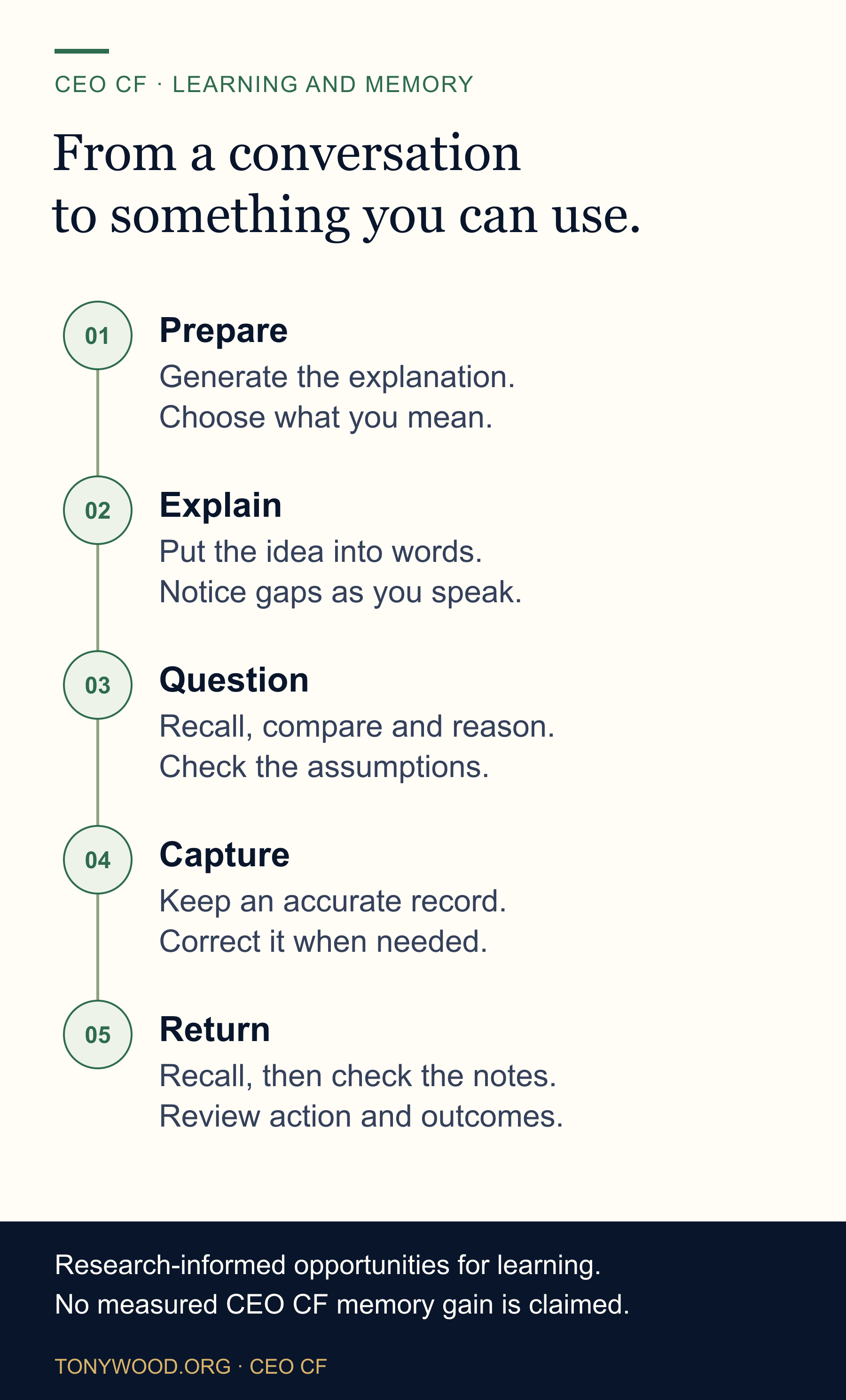
My reason for valuing this format is the opportunity it creates to work on a problem repeatedly and purposefully: prepare an explanation, test it in conversation, choose what you have learned, then return to it after taking action.
The meeting gives that work a beginning. What you do with the record, the commitment and the next conversation gives it a chance to last.
Sources and notes
The research linked here distinguishes generation, self-explanation, production, retrieval, spacing, analogy, social influences on memory and the conditions for learning dependable judgement. These mechanisms overlap; their effects cannot be added together to calculate a CEO CF benefit. Some papers were available only as published abstracts, so their use is limited to the findings those abstracts report.
The CEO CF process description comes from local method guides and the requested 75-minute version. It describes intended practice, not measured memory outcomes. The suggested recall-and-review routine is an editorial application of the research. It preserves the role of a checked written record rather than treating unaided recall as the final authority.
For the complete process, see The CEO CF Challenge: A Better Way to Think Through a Difficult Decision. For the broader community, see CEO CF: Bringing European Leaders Together Since 2005.